
Optiese Deurlopende Vlaksensor
HojellyTek ondersteun optiese vloeistofvlak-sensingprojekte vir kopers wat duideliker terugvoer benodig, kompakte installasie, en aanpassing bo en behalwe standaard aan/af-opsporing.
Deurlopende optiese vlak sensing vermoëns
Die meeste optiese vloeistofvlaksensors gebruik 'n foto-elektriese beginsel: 'n infrarooi LED stuur lig na 'n prismapunt, en 'n fototransistor of ontvanger detecteer die weerkaatste lig. In die lug, Die prisma weerkaats lig anders as wanneer dit deur vloeistof natgemaak word. Die sensorkring omskep dan hierdie droë/nat optiese verandering in 'n bruikbare sein.
Vir 'n eenvoudige tenkalarm, Hierdie sein kan 'n aan/af-uitset wees. Vir deurlopende of byna-deurlopende vlakmonitering, Die ontwerp kan 'n langer sensorstruktuur gebruik, Meervoudige optiese punte, of 'n seinomskakelingsontwerp wat vlakveranderings aan 'n beheerder rapporteer.
Ons optiese vlaksensorondersteuning kan insluit:
- Pasgemaakte optiese puntskakelaars vir hoë, laag, Leë, Oorloop, en lekopsporing
- Multi-punt optiese vlakskikkings vir getrapte vlak-aanwysing
- Deurlopende-vlak projekte waar die sein prosesbeheer of doseringsterugvoer moet ondersteun
- Uitsetkonfigurasie vir beheerborde, PLC's, Pompe, Alarms, of IoT-toestelle
- Materiaalkeuse vir water, Olie, Brandstof, Chemiese, en skoonmaakvloeistoftoepassings
- OEM/ODM-sensorliggaam, gare, Kabel, Konnektor, en behuisingsaanpassing
Vir kopers wat algemene oplossings vergelyk, sien ons optiese vlaksensor Gids.
Puntoptiese skakelaar vs Deurlopende Optiese Vlakmeting
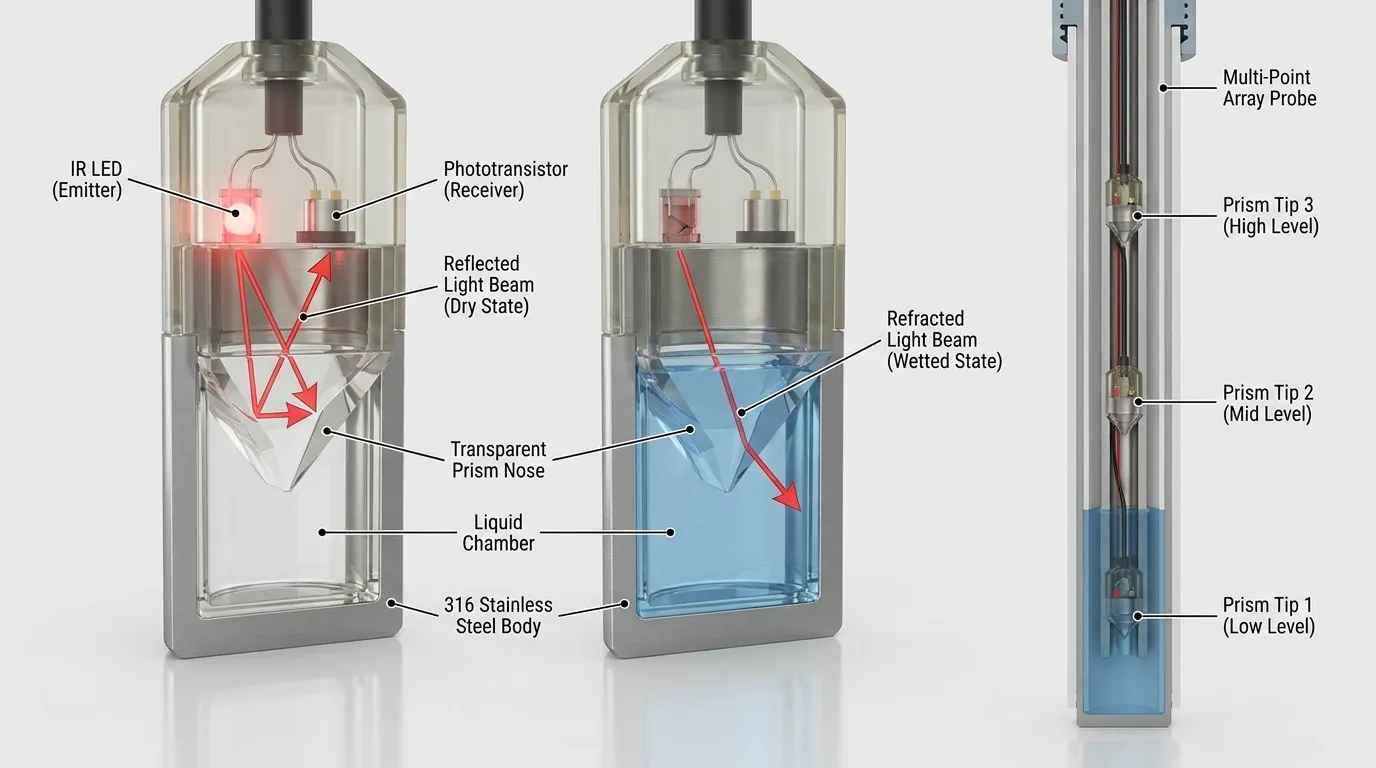
'n Foto-elektriese puntvlakskakelaar beantwoord een vraag: "Is vloeistof teenwoordig op hierdie posisie?"Dit is ideaal wanneer die stelsel net 'n duidelike droë/nat status nodig het. Byvoorbeeld, 'n Koffiemasjien mag dalk 'n lae-water waarskuwing benodig, 'n Mediese toestel mag 'n reagens-teenwoordige sein benodig, Of 'n klein tenk mag oorloopbeskerming benodig.
Deurlopende meting beantwoord 'n ander vraag: "Hoeveel vloeistof is daar nou in die tenk?" Dit maak saak wanneer 'n beheerder vlakverandering tydens vul moet opspoor, Dreinering, Dosering, Groepering, of prosesoperasie.
In baie projekte, Kopers vra eers vir 'n optiese deurlopende vlaksensor, Maar na hersiening, Die korrekte ontwerp kan een van drie opsies wees:
- Enkele optiese puntskakelaar vir hoë/lae alarm
- Multi-punt optiese skikking vir verskeie vaste vlakstappe
- Deurlopende uitsetontwerp waar die beheerder 'n veranderlike analoog- of digitale sein ontvang
As jou vereiste net "tenk vol" of "tenk leeg" is," 'n Punttoestel is gewoonlik eenvoudiger. As jy vlak tendens nodig het, Hervultyd, Doseringshoeveelheid, of verwerk terugvoer, Deurlopende of meerpuntwaarneming is meer geskik.
Vir vastepuntopsporingsprojekte, Vergelyk ons Elektro-optiese puntvlaksensor.
Meting reeks, Resolusie, en Seinontwerp
Vir deurlopende optiese vlakprojekte, Die meetreeks word nie soos 'n generiese katalogusskakelaar gekies nie. Dit moet ooreenstem met die tenkdiepte, Waarnemingsone, Installasieposisie, Vloeibare gedrag, en vereiste beheerakkuraatheid.
'n Kort reservoir benodig dalk net verskeie optiese opsporingspunte. 'n Hoër tenk mag 'n langer sonde of 'n pasgemaakte sensorstruktuur benodig. 'n Doseringskamer mag 'n hoër resolusie oor 'n nou gedeelte benodig eerder as 'n lang voltenk-reeks.
Resolusie hang af van die sensormetode. Met 'n multi-punt skikking, Resolusie is gebaseer op die afstand tussen elke optiese punt. Nader spasiëring gee meer vlakstappe, Maar dit beïnvloed ook die ontwerp van die sonde, Bedrading, koste bereken, en kontroleerderinvoervereistes. Met analoog of digitale deurlopende uitset, Die bruikbare resolusie hang af van die optiese sensorontwerp, Seinverwerking, Vloeistofstabiliteit, en kalibrasiemetode.
Kopers moet definieer:
- Totale tenkdiepte of teikenwaarnemingshoogte
- Minimum en maksimum vloeistofvlakke om te monitor
- Vereiste vlakstap- of beheerakkuraatheid
- Of die stelsel nou gladde uitset of vaste vlak-sones benodig
- Vloeistoftipe, Duidelikheid, viskositeit, Skuim, Borrels, en bedekkingsrisiko
- Beheerder-invoertipe: NPN, PNP, Spanning, 4–20 mA, Pols, RS485, of pasgemaakte digitale sein
Uitsetopsies: NPN, PNP, 4–20 mA, en Digitale Seine
Uitsetkeuse is een van die grootste koopbesluite. 'n Puntskakelaar gebruik normaalweg 'n diskrete uitset soos NPN, PNP, Stoot-trek, of relais-styl logika, afhangende van die beheerkring. Dit is geskik vir alarms, Pomp begin/stop, Hervul-snellers, en interlock-seine.
Vir deurlopende of prosesvlak terugvoer, Kopers vra dikwels vir analooguitset. 'n 4–20 mA-sein is algemeen in industriële beheer omdat dit 'n veranderende vlak oor 'n gedefinieerde reeks kan voorstel, en meer geskik is vir langer kabelroetes as eenvoudige spanningsseine. Digitale uitset kan gebruik word wanneer die sensor met 'n mikrobeheerder moet kommunikeer, Slimtoestel, of industriële poort.
HojellyTek kan die beheerdervereiste tydens RFQ hersien en help om die uitsetlogika aan jou stelsel te koppel. Toevoerspanning, Bedradingmodus, Kabellengte, Konnektor, en seingedrag bevestig word voor monsterproduksie.
Multi-punt optiese skikkings as 'n deurlopende alternatief
Nie elke deurlopende toepassing benodig 'n ware deurlopende sender nie. In baie kompakte OEM-stelsels, 'n Multi-punt optiese skikking is 'n praktiese alternatief.
'n Multi-punt ontwerp plaas verskeie optiese sensorposisies langs een sonde of samestelling. Elke punt detecteer of vloeistof daardie hoogte bereik het. Die beheerder interpreteer dan die resultaat as leeg, laag, Medium, Hoë, of vol. Vir baie toestelle, Dit is genoeg om die hervulling te beheer, Voorkom droogloop, stop oorloop, of skat die oorblywende vloeistof.
Hierdie benadering is nuttig wanneer:
- Die tenk is klein of onreëlmatig
- Presiese millimetervlakmeting is nie nodig nie
- Die beheerder het verskeie digitale insette
- Die koper wil optiese betroubaarheid hê sonder 'n bewegende dryfmiddel
- Die toepassing benodig eenvoudige vlaksones vir dosering of prosesbeheer
Multipunt-reekse word dikwels in reagenstenks gebruik, Waterreservoirs, Skoonmaakvloeistofpatrone, Olietenks, Brandstofmoniteringsmodules, Slim Toestelle, Laboratoriumtoerusting, en kompakte industriële toestelle.
Vir olie-water of vloeistof-koppelvlak projekte, sien ons Optiese koppelvlakvlaksensor.
Punt vs Deurlopende Optiese Vlak Sensor Vergelyking
| Vereiste | Foto-elektriese puntskakelaar | Multi-punt optiese skikking | Deurlopende Optiese Sensing |
|---|---|---|---|
| Hoofdoel | Detecteer vloeistof by een vaste posisie | Detecteer verskeie vaste vlak sones | Baanverandering van vlak oor 'n gedefinieerde reeks |
| Tipiese uitset | NPN, PNP, digitale aan/af | Meervoudige digitale seine of gekodeerde uitset | 4–20 mA, Spanning, Digitaal, of pasgemaakte sein |
| Beste pasvorm | Vol, Leë, Oorloop, Lek, Hoë/Lae alarm | Lae/medium/hoë aanduiding, Getrapte hervulbeheer | Dosering, Prosesterugvoer, Tenktendensmonitering |
| Resolusie | Een opsporingspunt | Gebaseer op puntspasiëring | Gebaseer op sensorontwerp en seinverwerking |
| Ontwerpkompleksiteit | Laagste | Medium | Hoogste |
| Koper moet dit kies wanneer | Slegs droë/nat status is nodig | Verskeie vlakke stappe is genoeg | Die beheerder benodig veranderlike vlak terugvoer |
Toepassingsgebruike vir deurlopende of multi-punt optiese vlakdeteksie
Deurlopende en multi-punt optiese sensing is nuttig wanneer meganiese vlotters te groot is, kan vassteek, of nie by die produkontwerp pas nie. Omdat die sensorpunt geen bewegende dryfarm het nie, Dit is geskik vir kompakte toerusting waar ruimte beperk is.
Algemene gebruike sluit in:
- Doseringstenks wat hervultydsberekening of volume-terugvoer benodig
- Prosestoerusting waar vloeistofvlak pomp- of klepbeheer beïnvloed
- Slim toestelle wat water monitor, skoonmaakmiddel, of skoonmaakvloeistof
- Mediese en laboratoriumtoerusting met reagens- of afvaltenks
- Olie, Koelmiddel, of brandstofreservoirs wat lae tot hoë aanduiding benodig
- OEM-stelsels gekoppel aan 'n beheerbord, Wys, of IoT-module
Vir slim produkontwerpe, Tuya/Smart Life-integrasie kan bespreek word waar die sensor deel is van 'n groter gekoppelde moniteringstelsel.
Seleksiekontrolelys voor bestelling
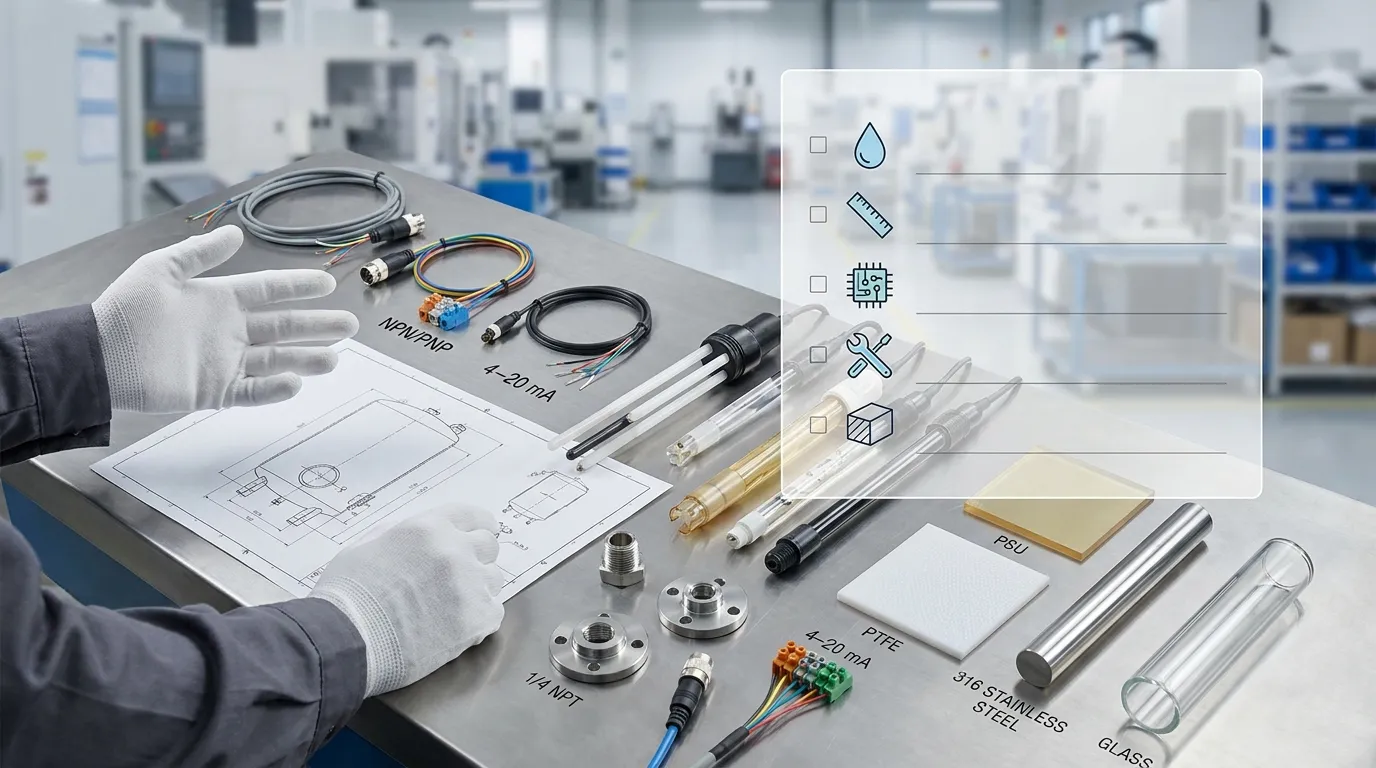
Voordat jy 'n kwotasie versoek, Berei die volgende besonderhede voor:
- Vlakfunksie: Puntalarm, Multi-punt aanduiding, of deurlopende uitset
- Tenktekening: Hoogte, Wanddikte, Hoekinstallasie, en beskikbare monteerruimte
- Meetsone: Volle omvang of slegs die aktiewe beheerafdeling
- Vloeistofbesonderhede: water, Olie, Brandstof, Chemiese, Skuimrisiko, Borrels, viskositeit, Bedekking, en deursigtigheid
- Nat materiaal: PSU, PTFE, 316 Vlekvrye staal, Glas, of ander materiaal gebaseer op chemiese kontak
- Monteringsstyl: Geskroefde liggaam, Paneelmontering, Symontering, Boonste montering, 1/4 NPT, Flens, of pasgemaakte behuising
- Uitsetvereiste: NPN, PNP, 4–20 mA, Spanning, Pols, RS485, of pasgemaakte digitale uitset
- Elektriese besonderhede: Toevoerspanning, Kabellengte, Konnektor, draadkleure, en beheerderinvoer
- Bedryfsomgewing: Skoonmaakmetode, Vibrasie, kondensasie, gespat, en temperatuurtoestande
- Projekfase: Prototipe, Vervanging, nuwe OEM-ontwerp, of produksieverkryging
5-Stap pasgemaakte diensproses
- Navraag-oorsig
Deeltekeninge, Vloeistofbesonderhede, Teikenvlak-reeks, Uitsetbehoeftes, en installasiemetode. - Spesifikasie en aanpassing
Ons ingenieurspan bevestig die sensorstruktuur, natgemaakte materiaal, Montering, Kabel, Konnektor, en seintipe. - Monstervoorbereiding
'n Monster kan voorberei word vir passing, Bedrading, en vloeistoftoetsing voor massaproduksie. - Produksie en kwaliteitsbeheer
Die fabriek kontroleer optiese reaksie, Bedrading, Samestellingsgehalte, en konsekwentheid gebaseer op die goedgekeurde monster. - Versendingsondersteuning
Ons ondersteun uitvoerkopers in die VSA, ONS, Indië, en ander markte met verpakkings- en versendingskoördinering.
Hoekom HojellyTek kies
HojellyTek is 'n vervaardiger van optiese en vloeistofvlak-sensors in Shenzhen met 'n interne R&D, Foto-elektriese sensasie-ervaring, en OEM/ODM-aanpassingsondersteuning. In plaas daarvan om elke koper tot 'n standaard puntwisselaar te dwing, Ons help om te hersien of jou produk 'n puntsensor benodig, Multi-punt skikking, of deurlopende vlak seinontwerp.
Kopers kan ook ons besoek Optiese vlaksensorproduk bladsy voor die stuur van tekeninge of aansoekbesonderhede.
Vrae
Is 'n optiese deurlopende vlaksensor dieselfde as 'n optiese puntskakelaar?
Nee. 'n Optiese puntskakelaar detecteer vloeistof op een vaste posisie. 'n Optiese deurlopende vlaksensor of multi-punt ontwerp gee vlakterugvoer oor 'n reeks of verskeie hoogtesones.
Kan optiese vlakwaarneming 4–20 mA uitset verskaf?
Ja, 4–20 mA kan gespesifiseer word vir projekte wat veranderlike vlak terugvoer benodig. Die waarnemingsreeks, Seinskaal, Bedrading, en beheerderinvoer moet tydens RFQ bevestig word.
Wanneer moet ek 'n multi-punt optiese skikking gebruik?
Gebruik 'n multi-punt skikking wanneer jy verskeie vaste vlakvlakke nodig het, soos laag, Medium, en hoog, maar het nie 'n heeltemal gladde, deurlopende sendersein nodig nie.
Watter natgemaakte materiaal moet ek kies?
PSU is algemeen vir baie watergebaseerde gebruike. PTFE, 316 Vlekvrye staal, of glas kan oorweeg word vir chemikalieë, Olies, Brandstowwe, Hoë netheidsvereistes, of meer veeleisende vloeistofkontak.
Wat kan optiese vlaksensorprobleme veroorsaak?
Algemene risiko's sluit vuil prismapunte in, Bedekte vloeistof, Skuim, Borrels, kondensasie, Slegte monteerposisie, onversoenbare materiaal, verkeerde bedrading, of om 'n puntskakelaar te kies wanneer die proses deurlopende terugvoer benodig.
Hoe vra ek vir 'n pasgemaakte optiese vlaksensorkwotasie?
Stuur jou tenktekening, Vloeibare tipe, Meting reeks, Uitsetsein, Monteringsmetode, Spanning, Kabelvereiste, en verwagte toepassing. Jy kan 'n kwotasie per WhatsApp of per e-pos versoek.
Versoek 'n Kwotasie
Het deurlopende vlak terugvoer nodig in plaas van 'n eenvoudige aan/af sein? Stuur jou tekening, Vloeistofbesonderhede, Vereiste uitset, en installasieplan aan HojellyTek. Ons span kan jou help om te kies tussen 'n puntoptiese skakelaar, Multi-punt optiese skikking, of 'n deurlopende optiese vlaksensoroplossing vir jou OEM- of industriële projek.
