
Optiese (Infrarooi) Watervlaksensor Bedradingdiagram
Die Optiese vlaksensor bedradingdiagram vir 'n tipiese 3-draad optiese/IR watervlaksensor is eenvoudig: Koppel VCC na 'n 5V-toevoer, GND na die gemeenskaplike grond, en UIT na die digitale inset, Relêmodule-inset, of beheerskakelaar seinterminaal. Vir 'n NPN oopversamelaar-uitset, die UIT-draad genereer nie altyd self 'n spanning nie; Dit benodig gewoonlik 'n Pull-up sodat die beheerder 'n duidelike HOOG/LAE sein kan lees.
In praktiese terme: Krag aan die sensor, Deel die grond, trek die sein op, laat dan die UIT-draad die beheerderinset of relaiskoppelvlak oorskakel. Moet nie begin deur draadkleure te raai nie—bevestig die penuitsetting uit die datablad of verskafferdokumentasie voordat jy krag toepas.
Vinnige Bedradingdiagram in Woorde
Vir 'n algemene 3-draad optiese watervlaksensor:
VCC → 5V GS
Koppel die sensor se positiewe toevoerdraad aan die beheerder se 5V-uitset of 'n gereguleerde 5V-kragtoevoer.
GND → 0V / Grond
Koppel die sensoraarde aan die kragtoevoer-aarde en die beheerder-aarde. Arduino, Raspberry Pi-koppelvlakborde, PLC-insette, Relêmodules, en sensorkrag moet 'n verwysingsaarde deel.
OUT → Digitale inset of relaisbeheer-inset
Koppel UIT aan die insetpen wat vloeistofteenwoordigheid moet opspoor. As die sensor is NPN oopversamelaar, OUT werk soos 'n sinkskakelaar. Dit trek die sein af wanneer dit aktief is., dus het die inset normaalweg 'n pull-up tot 5V nodig.
Pull-up → UIT na VCC
Die pull-up maak die sein leesbaar wanneer die NPN-transistor dit nie laag trek nie. Sommige mikrobeheerders kan 'n interne pull-up gebruik; Industriële beheerders of relaismodules mag die korrekte insetbedrading benodig volgens hul stroombaanontwerp.
Relais of beheerskakelaar → 'n koppelvlak gebruik
As jy 'n pomp ruil, Klep, Alarm, of relais, Gebruik 'n relaismodule of transistor/drywerkring. Moet nie aanvaar dat die sensor OUT-draad 'n relaisspoel direk kan aandryf nie.
Vir dieper voorbeelde op bordvlak, sien die Arduino-gids en Raspberry Pi-gids.
3-Draadoptiese Draad / IR-watervlaksensor Pinout-tabel
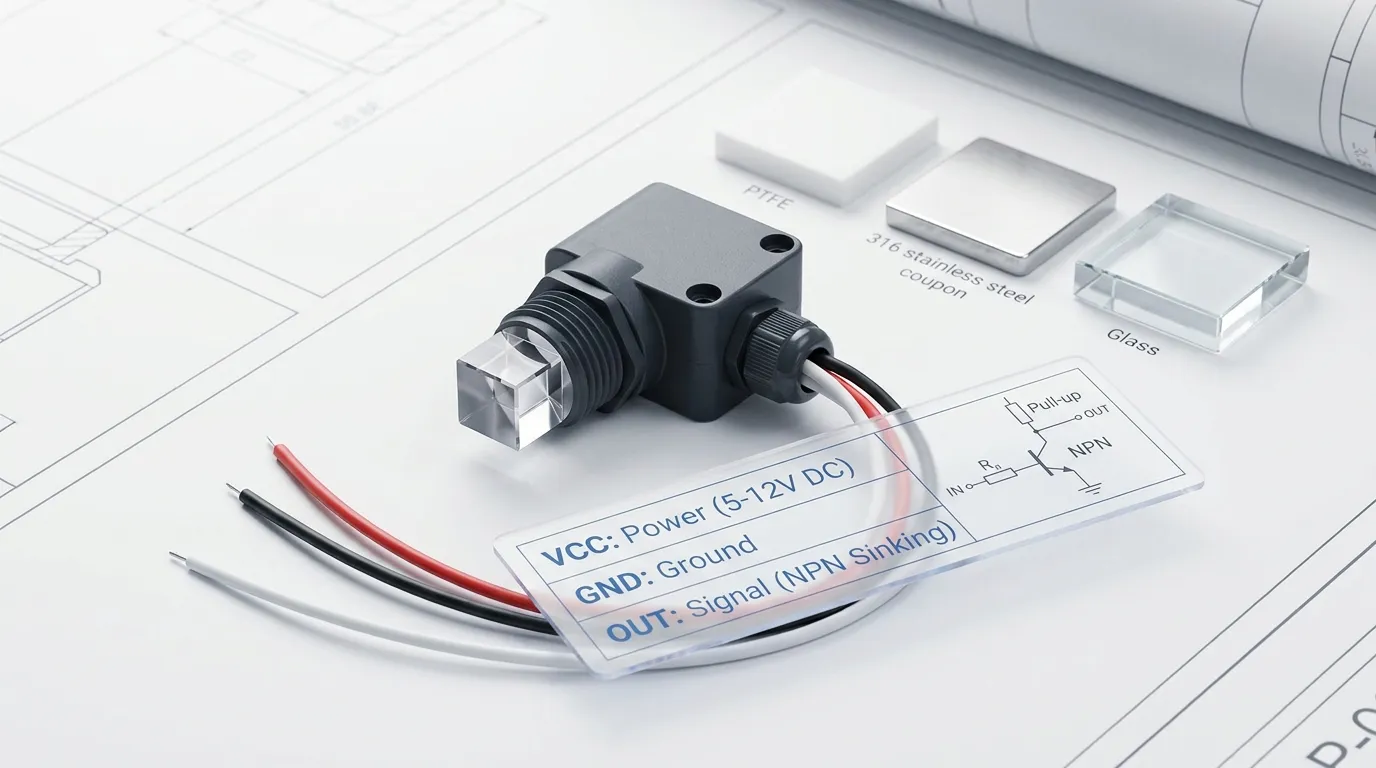
Draadkleure is slegs algemene voorbeelde. Bevestig altyd die werklike penuitsetting voordat jy bedrading maak, veral vir OEM/ODM-sensors, Paneelmonteerweergawes, en pasgemaakte kabelsamestellings.
| Sensorpen / Draad | Tipiese Funksie | Skakel Aan | Bedradingnotas |
|---|---|---|---|
| VCC / +V | Sensorkraginset | 5V GS-toevoer in 'n tipiese toetsopstelling | Gebruik die spanning wat vir jou sensormodel gespesifiseer is. Vir hierdie gids, die basiese bedradingvoorbeeld gebruik 5V. |
| GND / 0V | Kragterugvoer | Beheerder-aarde en kragtoevoer negatief | Die aarde moet gedeel word tussen die sensor en die toestel wat die sein lees. |
| UIT / Sein | Skakeluitset | Digitale inset, Relêmodule-inset, Beheerskakelaar-inset, PLC-insetkoppelvlak | Vir NPN oopversamelaar-uitset, gebruik 'n pull-up sodat die inset HOOG kan lees wanneer die uitset nie sink nie. |
| Optrekverbinding | Seinverwysing | UIT na VCC | Dit is nodig wanneer die inset nie reeds 'n pull-up verskaf nie. |
| Relais/beheer-koppelvlak | Lasbeheer | Aflos module, Transistordrywer, of beheerderinvoer | Gebruik 'n koppelvlakstadium vir pompe, kleedke, Alarms, of hoër-stroom laste. |
Hoe die NPN Open-Collector-uitset werk
Baie 3-draad optiese/IR-watervlaksensors gebruik 'n NPN oopversamelaar Uitset. Dit beteken die sensoruitset gedra hom soos 'n skakelaar na aarde, nie soos 'n kragspanningsuitset nie.
Wanneer die sensoruitset onaktief is, die UIT-draad mag dryf tensy 'n pull-up teenwoordig is. Met 'n pull-up, die inset lees HOOG. Wanneer die sensoruitset aktief word, die interne transistor trek UIT na aarde toe, so die inset lees LAAG.
Dit is hoekom baie gebruikers dink die sensor gee "nie spanning nie." In werklikheid, Die uitset mag korrek werk, Maar die stroombaan kort 'n pull-up of die beheerder-invoer is nie korrek gekonfigureer nie.
Vir 'n mikrobeheerder, OUT koppel gewoonlik aan 'n digitale inset. Vir 'n industriële beheerder, OUT kan aan 'n versoenbare digitale insetkanaal koppel. Vir 'n relaismodule, OUT moet slegs aan die seininset koppel wanneer die module-insettipe versoenbaar is met 'n sinkende NPN-sein.
Nat vs Droë Logika: NO en NC Gedrag
Optiese watervlaksensors detecteer of die sensorpunt in die lug is of deur vloeistof bedek is. Binne-in die sensor, 'n IR-LED stuur lig in 'n prismapunt, en 'n fototransistor detecteer die teruggekose lig. Wanneer die punt droog is, Lig weerkaats anders binne die prisma. Wanneer vloeistof die punt bedek, Die brekingstoestand verander, So die ontvanger sien 'n ander sein.
Die uitsetlogika hang af van die sensorontwerp:
- GEEN logika nie kan slegs aanskakel wanneer vloeistof die sensorpunt bereik.
- NC-logika kan afskakel wanneer vloeistof die sensorpunt bereik.
- Sommige produkte is beskikbaar in verskillende uitvoerweergawes.
- Sommige beheerstelsels keer die logika in sagteware om in plaas daarvan om hardeware te verander.
Omdat nat/droë gedrag per model kan verskil, Moet nie net op die etiket "optiese watervlaksensor" staatmaak nie. Bevestig of jou vereiste veilige toestand is nat = aktief, droog = aktief, nat = LAAG, of droog = LAAG.
Vir pomp-droogloopbeskerming, Baie ingenieurs verkies 'n logiese opstelling waar 'n gebreekte draad of verlore sein as 'n fout behandel kan word. Vir oorloopalarms, Die prioriteit is dikwels vinnige opsporing wanneer die vloeistof die hoëvlakpunt bereik.
Koppeling aan 'n relais of beheerskakelaar
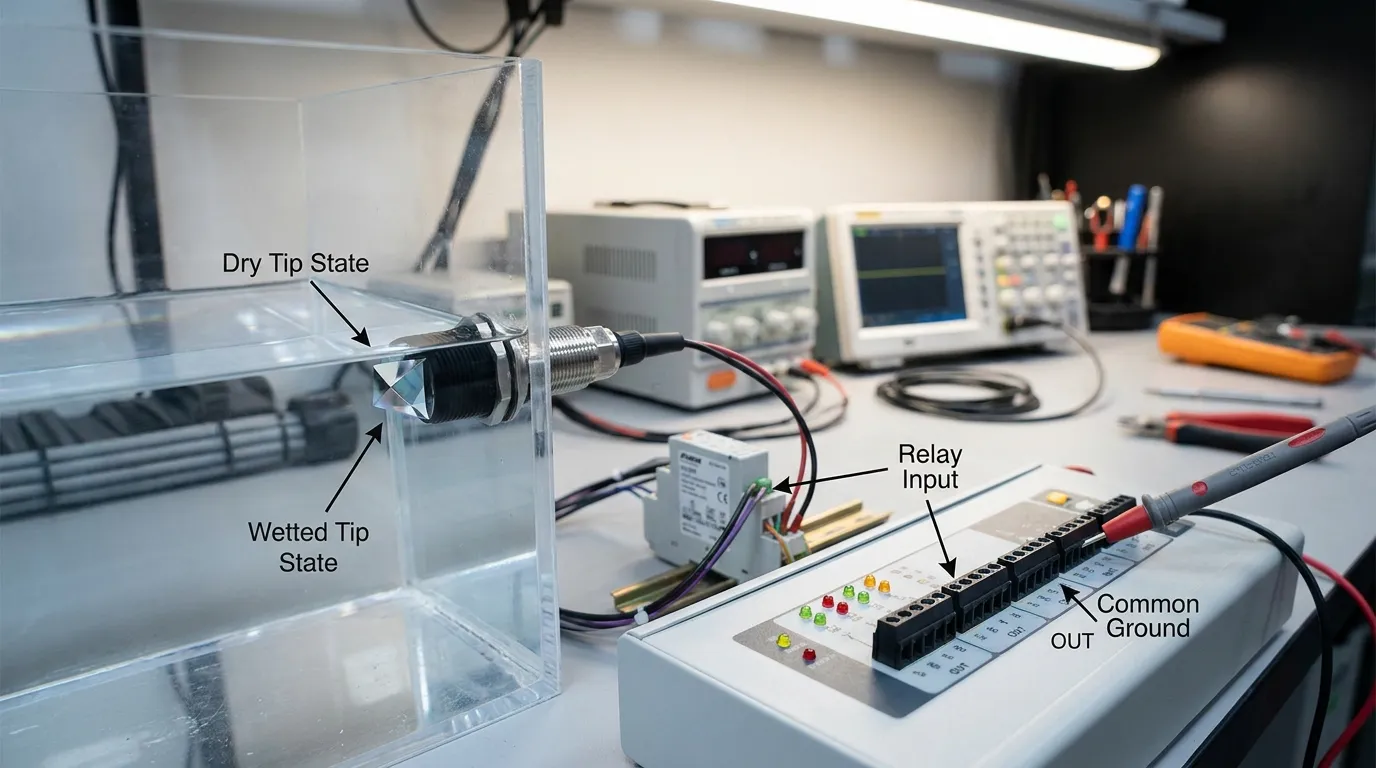
As die optiese sensor as 'n beheerskakelaar gebruik word, die UIT-sein moet normaalweg 'n beheerinset dryf, nie direk die las nie.
'n Veilige bedradingkonsep is:
Sensor VCC → 5V
Sensor GND → gemeenskaplike grond
Sensor OUT → relaismodule-inset of beheerder-inset
Relaiskontakte → pomp, Klep, Buzzer, Alarm, of beheerkring
Die relaiskontakte doen die lasskakeling. Die sensor verskaf slegs die vlaksein.
Vir 'n kaal relaisspoel, Gebruik 'n behoorlike drywerfase. Die sensoruitset is nie bedoel om 'n relaisdrywer te vervang tensy die stroomgradering en stroombaanontwerp bevestig is nie. Induktiewe laste benodig ook beskerming soos onderdrukking oor die spoel- of laskring. In OEM-toerusting, dit word gewoonlik op die beheer-PCB of relaismodule hanteer.
As jy 'n eenvoudige prototipe bou, 'n Relêmodule met 'n seininset is makliker as 'n los relaisspoel. As jy 'n produk ontwerp, Bevestig die insettipe, Snellerpolariteit, Lasstroom, Isolasiebehoeftes, en foutgedrag voordat die bedrading gefinaliseer word.
Toets van die sensor voor installasie
Toets die bedrading op die bank voordat jy die sensor in 'n tenk installeer.
Eerste, koppel VCC en GND aan die korrekte 5V-toevoer en verifieer polariteit. Koppel dan OUT aan 'n digitale inset of metertoetspunt met die korrekte trek-up. Hou die sensorpunt droog en hou die uitsettoestand waar. Volgende, Bedek die prismapunt met water en kyk of OUT verander.
As die sein verander wanneer die punt natgemaak word, Die sensor skakel. As die sein nie verander nie, Kontroleer die krag, Grond, Pull-up, en logika-modus voordat die sensor blameer word.
'n Multimeter kan help, Maar onthou dat 'n oop-kollektoruitset dalk nie 'n skoon spanning wys nie, tensy die trek-op en gemeenskaplike aarde korrek is. Vir mikrobeheerdertoetsing, druk die insettoestand in sagteware uit. Vir relaistoetsing, Kyk na die relaismodule-aanwyser en luister net vir die relaisaksie nadat bevestig is dat die module korrek bedraad is.
Vir meer tegniese produknotas, sien die IR-sensor dokumentasie.
Algemene Bedradingfoute en Oplossings
Geen gedeelde grond nie
Die sensor het krag, maar die beheerder kan nie UIT korrek lees nie. Verbind sensor GND en beheerder GND saam.
Geen pull-up op NPN OUT nie
Die uitset dryf en gee onstabiele lesings. Voeg 'n pull-up by of aktiveer dit volgens die kontroleerder-invoerontwerp.
Verkeerde draadkleur-aanname
Nie elke verskaffer gebruik dieselfde kabelkleure nie. Bevestig VCC, GND, en UIT voordat krag toegepas word.
Omgekeerde nat/droë logika
Die sensor werk, Maar die sagteware- of relaisaksie is die teenoorgestelde. Bevestig NO/NC-logika en keer die inset in sagteware om of kies die korrekte uitsetweergawe.
Probeer om 'n relaisspoel direk aan te dryf
Die uitset kan faal of die relais mag dalk nie skakel nie. Gebruik 'n relaismodule, Transistordrywer, of beheerder-insetstadium.
Vuil prismapunt
Oliefilm, Skaal, Skuimresidu, of kleefmiddelbesoedeling kan betroubare optiese skakeling voorkom. Maak die prisma skoon en kontroleer chemiese verenigbaarheid.
Reflektiewe of stywe monteerarea
Tenkwandrefleksies, Borrels, of swak posisionering kan onstabiele opsporing veroorsaak. Monteer die sensor sodat die prismapunt die teikenvloeistof skoon kontak.
Verkeerde sensormateriaal
Water, Olie, Chemikalieë, Voedselgraad vloeistowwe, Brandstowwe, en korrosiewe vloeistowwe vereis verskillende natgemaakte materiale. Bevestig versoenbaarheid voordat jy bestel.
Materiaal, Montering, en Uitsetopsies wat kopers moet nagaan
'n Bedradingdiagram los die elektriese verbinding op, Maar die regte sensorkeuse hang af van die vloeistof, Tenkontwerp, en beheerder.
Vir optiese/foto-elektriese puntvlakdeteksie, Die sensorpunt is dikwels gemaak van 'n deursigtige prismamateriaal. Afhangend van die toepassing, kopers mag dalk 'n kragtoevoer benodig, PTFE, 316 Vlekvrye staal behuising, of glaskontakontwerpe. Watertenks en toestelle kan kompakte plastiek-liggaamsensors gebruik. Chemiese tenks mag PTFE- of vlekvrye staal konstruksie benodig. Olie- en brandstoftoepassings benodig sorgvuldige materiaalhersiening as gevolg van swelling, Vlekke, of residu kan langtermynbetroubaarheid beïnvloed.
Montering maak ook saak. Sommige sensors word deur 'n geskroefde poort geïnstalleer, terwyl ander paneelmontering gebruik, Pasgemaakte flense, kompakte sondevorms, of kabelgemonteerde samestellings. Die prismapunt moet op die werklike skakelhoogte sit, Nie bo 'n dooie sone of binne 'n sak waar vloeistof nie skoon inkom nie.
Uitsettipe is 'n ander aankoopbesluit. NPN is algemeen vir die sink van digitale insette. PNP kan deur sommige industriële beheerstelsels verkies word. Vir deurlopende vlakmeting, kopers kan analoog-uitset soos 4–20 mA oorweeg in plaas van 'n eenvoudige puntskakelaar. Hierdie artikel fokus op die 3-draad puntvlakbedrading omdat dit die mees algemene behoefte agter die bedradingdiagram-soektog is.
HojellyTek vervaardig foto-elektriese optiese sensorprodukte in Shenzhen met interne R&D, OEM/ODM-ondersteuning, en uitvoerervaring vir die VSA, ONS, en Indië. Vir die breër sensorkategorie, besoek die optiese vlaksensor Bladsy.
Wat om te bevestig voordat jy bestel
Voordat jy 'n 3-draad optiese/IR-watervlaksensor koop, Bevestig:
- Voorsieningsspanning wat deur jou beheerbord benodig word
- Uitsettipe: NPN, PNP, analoog, of pasgemaakte sein
- Nat/droë logika: NO of NC gedrag
- Pull-up of insetkringvereiste
- Vloeistoftipe en natmateriaal-verenigbaarheid
- Monteringsdraad, Paneelgat, Flens, of pasgemaakte installasiemetode
- Kabellengte, Konnektor, en draadkleurdefinisie
- Of die sensor 'n beheerder-inset sal dryf, Relaismodule, Pompbeheer, Alarm, of IoT-bord
- Vereiste behuisingsmateriaal vir water, Olie, Brandstof, Chemiese, of gebruik van toestelle
- Of dit OEM-etikettering is, Kabelaanpassing, of module-integrasie is nodig
Vir slimhuis- of gekoppelde toerusting, Tuya/Smart Life-integrasie kan relevant wees op stelselvlak, Maar die sensorbedrading self begin steeds met dieselfde basiese reël: Krag, Grond, Sein, en korrekte invoerlogika.
Vrae
Wat is die basiese optiese vlak sensor bedrading diagram?
Die basiese bedrading is VCC na 5V, GND na gemeenskaplike grond, en UIT na die insetpen of relaismodule seininset. Vir 'n NPN oopversamelaar-uitset, voeg 'n pull-up by of aktiveer dit sodat die sein skoon tussen HOOG en LAAG kan wissel.
Het 'n 3-draad optiese watervlaksensor 'n pull-up weerstand nodig??
As die uitset NPN oop-versamelaar is, Ja, Die sein benodig gewoonlik 'n pull-up. Sonder dit, OUT kan dryf en die beheerder kan onstabiele of verkeerde toestande lees. Sommige borde bied interne pull-ups, maar dit moet in die insetkring bevestig word.
Kan ek die sensor direk aan 'n relais koppel??
Koppel die sensor aan 'n relaismodule-inset of drywerstroombaan, Nie direk na 'n hoëstroom-relaisspoel nie, tensy die sensorgradering en stroombaanontwerp bevestig dat dit veilig is. Vir pompe, kleedke, en alarms, Gebruik die relaiskontakte om die las te skakel.
Hoekom bly die uitset altyd HOOG of LAAG??
Algemene oorsake sluit in die ontbreking van gemeenskaplike grond, Geen pull-up nie, Omgekeerde toevoerpolariteit, verkeerde insetlogika, verkeerde NO/NC-aanname, Vuil prisma-punt, of om die verkeerde uitsettipe vir die beheerder te gebruik. Toets die sensor droog en nat voordat jy dit installeer.
Is natdeteksie normaalweg oop of normaalweg gesluit??
Dit hang van die model af. Sommige sensors aktiveer wanneer vloeistof die punt bedek; ander deaktiveer. Bevestig nat/droë logika voordat jy bestel, veral vir oorloopbeskerming, Droogloopbeskerming, en alarmkringe waar foutveilige gedrag saak maak.
Kan ek dieselfde sensor met Arduino en Raspberry Pi gebruik??
Ja, Maar die bedradingbesonderhede verskil omdat die insetspanning en optrek-opstelling per bord kan verskil. Gebruik die toegewyde Arduino- en Raspberry Pi-bedradinggidse voordat jy die sensor aan 'n ontwikkelingsbord koppel.
Het hulp nodig om die bedrading by jou beheerbord te pas?
Deel jou toevoerspanning, Beheerdertipe, Uitsetvereiste, Vloeibare, Monteringsmetode, en nat/droë logika-voorkeur met HojellyTek. Ons span kan jou help om die korrekte 3-draad optiese/IR-watervlaksensorbedrading te bevestig, NPN- of PNP-uitsetkeuse, Materiaalopsie, en OEM/ODM-konfigurasie. Versoek 'n kwotasie via WhatsApp of e-pos vir voorbeelde, Datablaaie, of pasgemaakte sensorondersteuning.


