
Optiese Vlaksensor vir Apex (Cerebra) Akwariumbeheerders
As jy op soek is na 'n Cerebra optiese vlaksensor met apex, Die werklike vraag is nie net "gaan die sensor pas nie?" maar "watter optiese sensor, Spanning, Poorttipe, en bedradinglogika sal veilig werk met 'n Apex- of Cerebra-klas akwariumbeheerder?" Vir ATO-hervulbeheer, Sump hoëvlakbeskerming, Reservoir-lae waarskuwings, en lekwaarskuwings, Versoenbaarheid hang af van die kontroleerder-inset, Sensoruitset, Konnektorstyl, en foutveilige konfigurasie.
Hierdie gids verduidelik hoe optiese vloeistofvlaksensors werk in reef-akwariumoutomatisering, wat om na te gaan voordat een aan Apex/Cerebra-styl stelsels gekoppel word, en hoe om veiliger dual-sensor logika te bou sonder om amptelike goedkeuring van enige kontroleerderhandelsmerk te eis.
Hoe 'n optiese akwariumvlaksensor werk
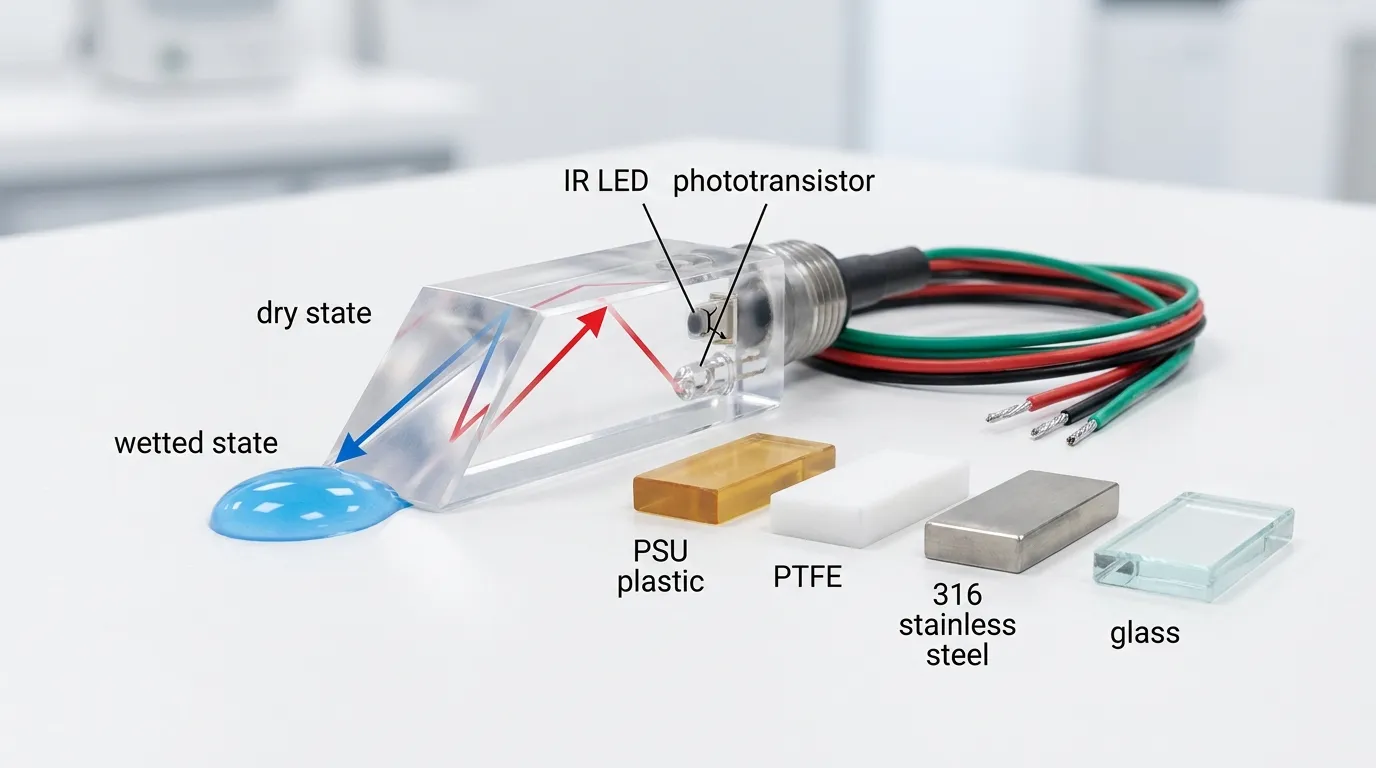
'n Optiese vlaksensor is 'n foto-elektriese puntvlaktoestel. Binne-in die sensorliggaam, 'n infrarooi LED stuur lig na 'n deursigtige prismapunt, en 'n fototransistor of ontvanger detecteer hoe daardie lig terugkeer.
Wanneer die prismapunt droog is, Lig weerkaats intern deur die prisma. Wanneer die punt deur water natgemaak word, Die brekingstoestand verander, So die ontvanger sien 'n ander sein. Die beheerder lees dan daardie verandering as 'n nat/droë toestand.
Vir akwariumgebruik, Dit is nuttig omdat daar geen blootgestelde dryfarms is nie, Geen skarnierbeweging nie, En geen magnetiese rietskakelaar wat van soutkruip kan vassteek nie. 'n Kompak optiese vlaksensor kan in 'n sump gemonteer word, ATO-reservoir, Skimmerbeker, of waterverversingshouer as 'n skoon digitale vlaksein.
Nietemin, "Opties" beteken nie outomaties "plug-and-play" nie. Die sensor moet ooreenstem met die kontroleerder se insetgedrag.
Apex- en Serebra-integrasie: Wat Moet Eers Pas
Vir Apex/Cerebra-klas akwariumbeheerders, Versoenbaarheid word gewoonlik deur vier dinge bepaal:
- Poorttipe — of die beheerder optiese sensorinsette direk aanvaar, deur 'n bykomstige module, of deur 'n/digitale inset.
- Toevoerspanning — die sensor moet die korrekte GS-krag vir sy ontwerp ontvang en mag nie die beheerpoort oorlaai nie.
- Seinuitset — die beheerderinvoer moet die sensoruitset verstaan, soos NPN, PNP, Open Collector, of relais-styl koppelvlak.
- Nat/droë logika — die beheerder moet so gekonfigureer wees dat "nat"," "droog," "Maak oop," of "gesluit" beteken die korrekte aksie.
Apex-stelsels gebruik gewoonlik toegewyde sensor-/bykomstigheidmodules of -poorte vir vloeistofvlakdeteksie. Cerebra-klas beheerders kan sensorinsette gebruik, Mini DIN-styl verbindings, of derdeparty-koppelvlakbedrading, afhangende van die weergawe en installasie. Omdat beheerdersgenerasies verskil, Die veiligste benadering is om die presiese poortpenuitsetting en insetvereiste te bevestig voordat 'n sensor bestel word.
Dit is hoekom 'n "versoenbare" sensor deur elektriese gedrag gespesifiseer moet word, Konnektor, Kabel, Monteringsstyl, en beoogde beheerlogika—nie net volgens handelsnaam nie.
Beheerder-verenigbaarheidstabel
| Beheerder / Stelsel | Tipiese Aansluitpunt | Geskikte Sensorstyl | Algemene gebruik | Sleutelversoenbaarheidskontrole |
|---|---|---|---|---|
| Apex met sensormodule of bykomstigheidspoort | Optiese sensor / Vloeistofvlak-invoer | Digitale optiese puntvlaksensor | ATO laevlak-sneller, Hoëvlak-alarm, Reservoir Lae Waarskuwing | Bevestig konnektor, Hawe-toewysing, Nat/droë toestand, en of die poort die sensor van krag voorsien |
| Apex-styl DIY-integrasie | Breekboks, Relaiskoppelvlak, of digitale inset | NPN/PNP of relais-gekoppelde optiese sensor | Pasgemaakte pompafskakeling of alarmlogika | Pas-invoertipe, Grondverwysing, en seinpolariteit |
| Cerebra / Cerebra-klas beheerder | Sensorinset of Mini DIN-styl poort, afhangende van die beheerder | Optiese sensor met ooreenstemmende spanning en sein | BEDRYF, Sump-waarskuwing, Watervlakmonitering | Bevestig penuitsetting, Toevoerspanning, en of die inset kontaksluiting of aktiewe uitset verwag |
| Afsonderlike akwarium ATO-beheerder | Toegewyde sensorpoort | Ooreenstemmende akwarium-optiese sensor | Outomatiese top-off beheer | Die beste is wanneer sensor en beheerder saam gevalideer word |
| Slim akwarium / IoT-beheerder | Digitale inset, Relaisbord, of app-gekoppelde module | Optiese sensor plus koppelvlakbord indien nodig | Waarskuwings, outomatisering, Afstandmonitering | Bevestig of die stelsel droë kontak benodig, NPN, PNP, of analoogsein |
HojellyTek kan die ontwikkeling van versoenbare akwariumsensors ondersteun, maar die sensor moet teen die beheerder se elektriese koppelvlak gekies word. Dit moet nie as amptelik deur Apex goedgekeur beskryf word nie, Cerebra, Neptunus, of enige ander beheerderhandelsmerk tensy daardie handelsmerk formele goedkeuring gegee het.
Die keuse van die regte sensor vir ATO- en lekwaarskuwings
ATO en lekdeteksie lyk soortgelyk, Maar dit is nie altyd dieselfde toepassing nie.
Vir ATO-beheer, Die sensor is gewoonlik in die terugvoerkamer van die put gemonteer waar verdamping die watervlak verander. Wanneer die water onder die stelpunt daal, Die beheerder skakel die top-off pomp aan. Wanneer die optiese punt weer nat word, Die pomp stop.
Vir Hoëvlakveiligheid, 'n Tweede optiese sensor is bo die normale waterlyn gemonteer. As dit nat word, Die beheerder skakel die opvulpomp af en stuur 'n alarm.
Vir Reservoir-lae beskerming, Nog 'n sensor kan in die varswaterhouer geïnstalleer word. As die reservoir leeg is, Die stelsel blokkeer die pomp om droogloop te voorkom.
Vir lekwaarskuwings, 'n Plat lekprobe of doelgeboude leksensor kan beter wees as 'n standaard sygemonteerde optiese vlaksensor. 'n Optiese sensor kan vloeistof op 'n punt opspoor, Maar vloerlekdeteksie hang af van die sensor se plasing, Pooling-gedrag, en die vorm van die sensoroppervlak.
'n Kompak Akwarium optiese sensor is gewoonlik die beste wanneer die doel die opsporing van skoon watervlakke binne 'n sump is, Tenk, reservoir, of kamer.
Hawe, Spanning, en bedradingkontroles voor bestelling
Voordat jy 'n monster koop of versoek, Bevestig hierdie besonderhede:
Kragtoevoer vanaf die beheerder
Sommige kontroleerderpoorte kan 'n sensor direk van krag voorsien; ander lees slegs 'n skakelsein en benodig 'n aparte kragbron. Moet nie aanneem die poort lewer die korrekte spanning nie.
Uitsettipe
Optiese sensors kan as NPN voorsien word, PNP, Open Collector, Stoot-trek, Relaisuitset, of analooguitset soos 4–20 mA vir industriële stelsels. Akwariumbeheerders benodig gewoonlik 'n digitale nat/droë sein, maar die presiese invoerstyl moet bevestig word.
Normaalweg nat of normaalweg droë logika
'n Sump-sensor kan nat wees tydens normale werking, terwyl 'n lek of hoëvlaksensor droog kan wees tydens normale werking. Jou program moet hierdie state anders hanteer.
Konnektor en kabel
Apex/Cerebra-styl stelsels kan spesifieke verbindings gebruik, Breakout-bykomstighede, of pasgemaakte kabels. Die konnektorvorm alleen bewys nie versoenbaarheid nie; Pentoewysing is belangrik.
Montering van draad of beugel
Akwariuminstallasies gebruik dikwels magnetiese monteerplekke, Brackets, Skottoebehore, Geskroefde liggame, of symuurmontering. Industriële bouwerke kan draad- of flensmontering gebruik. Die sensorpunt moet presies op die vlak sit wat jy wil opspoor.
Vir meer kontroleerder-spesifieke vervangingsdenke, sien ons Neptune-sensoralternatief Gids.
Dubbelsensor-veiligheidslogika vir ATO
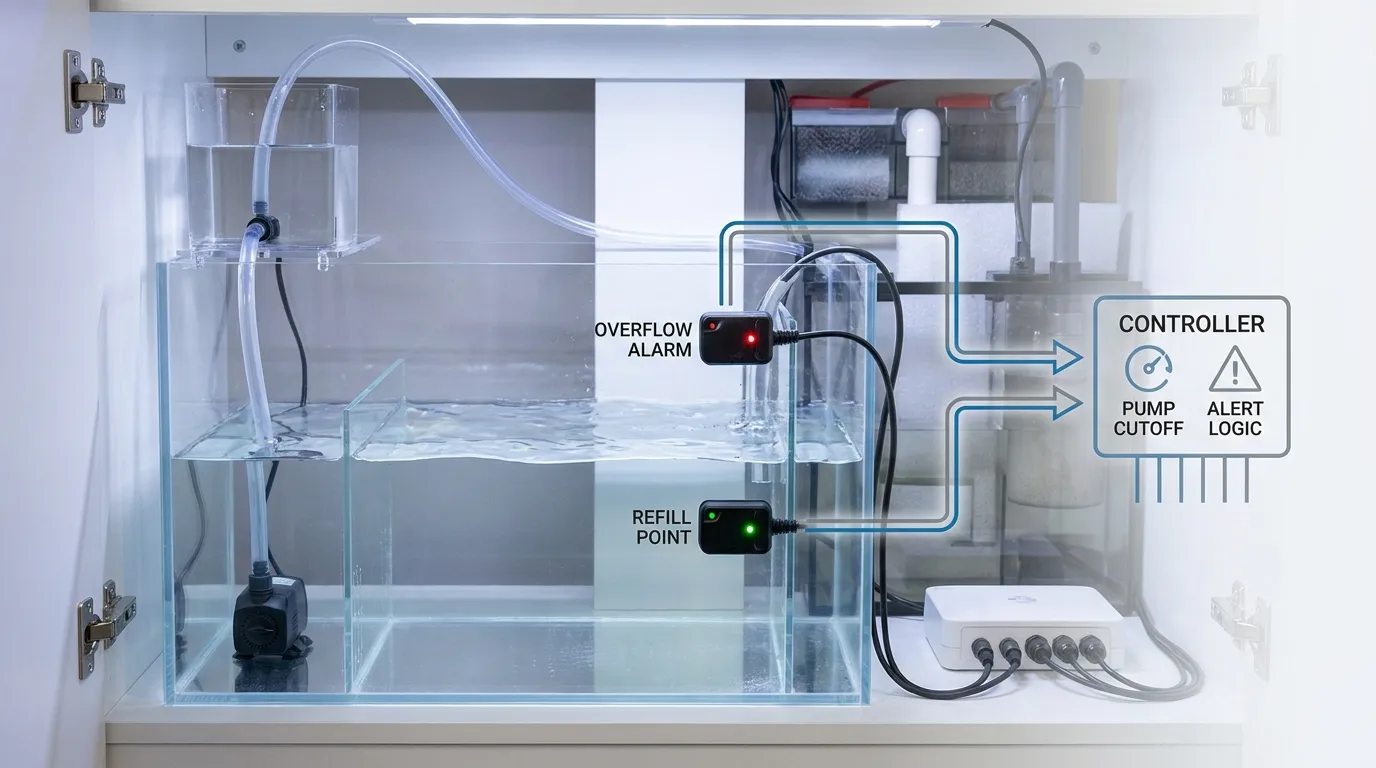
'n Enkelvlak-sensor kan 'n ATO laat loop, maar 'n veiliger stelsel gebruik ten minste twee onafhanklike seine.
Die eerste sensor is die Laevlakbeheersensor. Dit vertel die beheerder wanneer die sumpwatervlak gedaal het en die aanvulling behoort te begin.
Die tweede sensor is die Hoëvlak-veiligheidssensor. Dit lê bo die normale waterlyn. As dit nat word, die beheerder moet onmiddellik die ATO-pomp stop en 'n waarskuwing stuur.
'n Sterker logikaplan sluit in:
- Beperk hoe lank die ATO-pomp in een siklus kan loop.
- Voeg 'n vertraging by om vinnige aan/af skakeling van golwe of borrels te vermy.
- Gebruik 'n reservoir-lae sensor om die pomp te blokkeer wanneer varswater leeg is.
- Programmeer 'n hoëvlak-alarm wat die normale hervulopdrag oorskryf.
- Toets albei sensors handmatig voordat jy die stelsel onbewaak los.
Dit maak saak omdat die duurste mislukking gewoonlik nie die sensor self is nie. Dit is die varswaterpomp wat te lank loop, Verlaging van soutgehalte, wat die sump oorloop, of toerusting beskadig.
Werklike Mislukkingsmodusse in Riftenks
Optiese sensors is betroubaar wanneer dit gespesifiseer en korrek geïnstalleer word, Maar riftenks skep moeilike toestande.
Soutkruip kan 'n kors rondom die prisma vorm en die nat/droë lesing verander. Skoonmaaktoegang moet beplan word.
Mikroborrels kan rondom die punt versamel en onstabiele lesings veroorsaak. Vermy om die sensor direk langs die skimmer-ontlading of turbulente terugvloei te monteer..
Slakke, Alge, en puin kan die optiese vlak blokkeer. 'n Sensorbeskerming of beter ligging mag nodig wees.
Kondensasie kan swak verseëlde kabeluitgange of elektronika beïnvloed. Kies 'n akwarium-geskikte liggaam en kabelseël.
Verkeerde bedrading kan die sensor of beheerder beskadig. Bevestig altyd krag, Sein, en aarde voor aansluiting.
Verkeerde logika kan die aksie omkeer. As die beheerder "nat" as "af" sien wanneer jy dit as "aan" geprogrammeer het,"Die ATO kan gevaarlik optree.
Materiaal en Monteringsopsies
Vir akwarium- en industriële watervlakwaarneming, algemene natgemaakte materiale sluit PSU-plastiek in, PTFE, 316 Vlekvrye staal, en glas. Die regte keuse hang af van die vloeistof, Skoonmaakmetode, Druk, Installasiestyl, en of die sensor in varswater gebruik word, Soutwater, Chemiese dosering, of OEM-toerusting.
Vir rif ATO-toepassings, Kompakte plastiek- of verseëlde optiese ontwerpe is algemeen. Vir meer veeleisende OEM-tenks, PTFE, Vlekvrye vlekvrye, of glasopsies kan oorweeg word. Die montering kan sywaarts gemonteer word, Beugel gemonteer, Draad, of geïntegreer in 'n pasgemaakte behuising.
HojellyTek is 'n vervaardiger en uitvoerder in Shenzhen met 'n interne R&D vir foto-elektriese optiese sensing, OEM/ODM-sensoraanpassing, en uitvoere na die VSA, ONS, en Indië. Vir slim akwariumprodukte, Tuya/Smart Life-integrasie kan ook relevant wees wanneer die sensor deel is van 'n gekoppelde ATO- of moniteringstoestel.
Konfigurasiewenke vir Apex/Cerebra-klas beheerders
Na bedrading, Toets die sensor voordat jy dit aan 'n pompopdrag koppel.
Eerste, plaas die optiese punt in die lug en kontroleer die beheerdertoestand. Maak dan die punt nat en kyk weer. Merk die staat duidelik as "normale waterlyn"," "Lae water," "hoë water," of "lek opgespoor,"nie net oop/toe nie.
Vir ATO-programmering, Vermy onmiddellike pompaktivering as die wateroppervlak beweeg. Gebruik 'n klein vertraging- of debounce-instelling as die beheerder dit ondersteun. Voeg 'n maksimum looptyd-afsnypunt by sodat die pomp nie oneindig aan kan bly nie. Vir waarskuwings, stel die hoëvlaksensor in om die normale ATO-opdrag te oorskryf.
Ook toetsfoutgevalle.: Ontkoppel die sensor, Bedek die punt, Verwyder water uit die sumpkamer, en die hoëvlaksensor aktiveer. 'n Goeie konfigurasie behoort veilig te faal, Nie stil nie.
As jy 'n gereed-akwarium-hervuloplossing nodig het in plaas van net 'n sensor, Hersien ons Akwarium outomatiese aanvulling Produk bladsy.
Vrae
Kan ek 'n cerebra optiese vlaksensor met Apex gebruik??
Ja, Dit mag versoenbaar wees as die sensorspanning, Konnektor, Seinuitset, en nat/droë logika pas by die Apex-invoer of bykomstigheidsmodule. Moet nie net op die naam staatmaak nie. Bevestig die tipe en bedrading van die kontroleerderpoort voordat jy aansluit.
Is 'n optiese sensor beter as 'n vlotskakelaar vir akwarium ATO?
Vir baie riftenks, Optiese sensors is skoner omdat hulle geen bewegende vlotterarm het nie. Hulle word steeds deur soutkruip beïnvloed, Borrels, Alge, en bedradingfoute, Dus is veilige plasing en dubbelsensorlogika steeds belangrik.
Het ek twee optiese sensors nodig vir ATO??
Een sensor kan basiese hervulling beheer, Maar twee sensors is veiliger. Gebruik een by die normale laewaterpunt en 'n tweede hoëvlaksensor om die pomp te stop en 'n alarm te aktiveer as water te ver opstyg.
Kan dieselfde sensor gebruik word vir lekopsporing??
Soms, Maar 'n standaard optiese vlaksensor is nie altyd ideaal vir vloerlekkasies nie. Lekdeteksie hang af van waar water ophoop. 'n Plat leksonde of doelgeboude leksensor kan beter buite die sump werk.
Watter uitsettipe moet ek kies: NPN, PNP, of 4–20 mA?
Vir akwariumbeheerder-insette, Die vereiste sein hang af van die poort of koppelvlakbord. NPN/PNP is algemene digitale uitsette, terwyl 4–20 mA meer algemeen is vir industriële analoogmonitering. Bevestig die kontroleerderinvoer voordat jy bestel.
Is hierdie sensor amptelik deur Apex of Cerebra goedgekeur??
Nee. HojellyTek bied versoenbare optiese sensoropsies en OEM/ODM-ondersteuning, maar verenigbaarheid moet bevestig word deur die elektriese koppelvlak, Konnektor, en konfigurasie. Ons eis nie amptelike goedkeuring van Apex nie, Cerebra, Neptunus, of ander beheerdersmerke.
Sagte CTA: Versoek 'n Versoenbare akwariumsensor
As jy 'n ATO bou, Sump-alarm, Reservoir-lae waarskuwing, of beheerder-kompatibele akwariummoniteringstoestel, Ons span kan help om die sensorliggaam te hersien, Kabel, Konnektor, Spanning, Uitsettipe, en monteermetode voor produksie.
Stuur jou kontroleerdermodel, Poortfoto of penuitleg, Teikenfunksie, normale nat/droë toestand, en installasietekening per WhatsApp of e-pos. HojellyTek kan 'n versoenbare optiese akwariumsensor aanbeveel of 'n OEM/ODM-weergawe ondersteun vir jou akwariumbeheerprojek.


