
Best Water Leakage Sensors for Homeowners Looking to Prevent Damage
You probably know that smart-home technology can make life easier, but did you know it can also save you thousands in repairs? Water leak sensor systems like the Flo by Moen Smart Water Shutoff give you real-time alerts and even automatic shutoff for top-notch protection. Only 16% of homeowners use a water leakage sensor, even though almost 80% know about them. That’s surprising, especially when water damage happens about 14,000 times a day in the U.S. and can cost a fortune to fix.
| Statistic Description | Data |
|---|---|
| Annual frequency of water damage claims | About 1.6% of insured homes (1 in 60 homes) |
| Daily water damage incidents in the U.S. | Approximately 14,000 incidents per day |
| Average insurance payout per water damage claim | $13,954 |
| Percentage of home insurance claims due to water damage and freezing (2022) | 27.6% |
| Percentage of basements experiencing water damage | 98% |
| Flood damage financial impact (2024) | $627 million paid in claims nationwide |

If you want smart protection, you have options. The YoLink Water Leak Sensor 4 is perfect for smart-home fans, Kangaroo Water + Climate Sensor works for budget buyers, and Govee Wi-Fi Water Sensors help with multi-room smart-home coverage. Picking the right water leak sensor gives your home the smart protection it needs.
Why a Water Leakage Sensor Matters for Home Protection
The Cost of Water Damage
Water damage can sneak up on you fast. One small leak can turn into a huge problem before you even notice. Did you know that water damage claims made up nearly 24% of all homeowners insurance claims in 2021? That means almost one out of every four claims comes from water issues. In 2025, the average cost for water damage repair is about $3,814, but it can go much higher. Some repairs reach up to $16,000, especially if you have to fix hardwood floors or deal with mold.
| Cost Aspect | Cost Range / Average Cost (2025) |
|---|---|
| National Average Cost | Around $3,814 |
| Typical Cost Range | $1,361 to $6,270 |
| Low-End Cost | $450 |
| High-End Cost | Up to $16,000 |
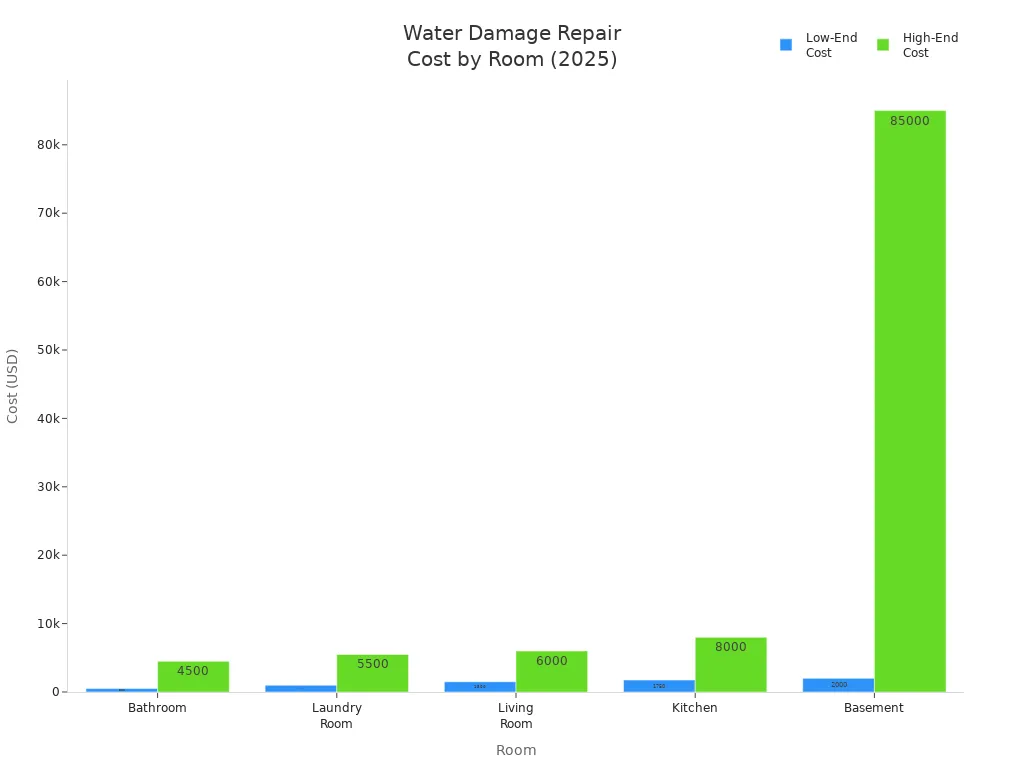
If you think water damage only happens in basements, think again. Bathrooms, kitchens, and laundry rooms are all at risk. Without proper protection, you could face expensive repairs, lost belongings, and even health problems from mold. That’s why home security isn’t just about alarms—it’s about comprehensive protection from every threat, including water.
How a Water Leak Detector Prevents Home Disasters
A water leak detector gives you the power to stop problems before they start. These smart devices use real-time detection to catch leaks early. When a leak happens, you get an alert right away. You can act fast, even if you’re not home. This quick response means you avoid major damage and keep your home security strong.
Let’s look at how these sensors work for real families:
- Sarah and James in California placed a water leak detector near their hot water tank. The sensor caught a hidden leak early. They fixed it before it ruined their floors and walls, saving about $9,400.
- Rachel in Sherman Oaks got an alert from her water leak detector while she was on vacation. She called a neighbor, who shut off the water. Her kitchen and living room stayed dry, and she avoided $12,000 in repairs.
Water leakage sensors do more than just send alerts. Some models shut off your water automatically, giving you comprehensive protection. With leak detection, you lower your risk of costly repairs and may even get a discount on your insurance. Smart sensors help you protect your home, your wallet, and your peace of mind.
Tip: Installing a water leakage sensor is one of the easiest ways to boost your home security and get comprehensive protection from water damage.
Top 10 Water Leakage Sensors for Home Protection in 2025
Best Overall Water Leak Sensor: Flo by Moen Smart Water Shutoff
If you want the best water leak sensor for your home, the Flo by Moen Smart Water Shutoff stands out in 2025. This device gives you whole-home protection by monitoring your water flow, pressure, and temperature in real time. It uses AI to learn your water habits and can spot leaks as small as a single drop per minute. You get instant alerts on your phone, by email, or even a call if something goes wrong. The system can shut off your water automatically within seconds, stopping damage before it starts.
You can control everything from the Moen Smart Water app, even when you’re not home. The Flo by Moen works with Amazon Alexa, Ring, and other smart-home platforms, so you can add it to your existing setup. It even helps you save water and lower your bills by finding waste you might not notice. If you own more than one property, you can manage them all from the same app.
Here’s a quick look at what makes the Flo by Moen Smart Water Shutoff a top pick:
| Feature / Metric | Description / Performance Detail |
|---|---|
| Build Quality | Rugged, with solid brass fittings and a motorized valve |
| Installation | Needs to be installed on your main water line; pro installation recommended |
| Leak Detection Sensitivity | Finds leaks as small as a drop per minute |
| Automatic Shutoff | Shuts off water within seconds of detecting a leak |
| App-Based Control | Full remote control and instant alerts via the Moen Smart Water app |
| Smart Home Compatibility | Works with Alexa, Ring, Alarm.com, and NICE |
| Water Conservation | Can cut household water waste by up to 90% |
| Multi-Property Management | Manage several homes or rentals from one app |
| Power and Connectivity | Needs Wi-Fi and a nearby power outlet |
Tip: The Flo by Moen Smart Water Shutoff can still protect your home even if your internet goes down, thanks to its backup features. That means you get reliable protection no matter what.
The Flo by Moen gives you peace of mind and helps you avoid expensive repairs. It’s a smart investment for anyone who wants the highest level of water leak protection.
Best Smart Water Leak Detector: YoLink Water Leak Sensor 4
If you love smart-home gadgets, the YoLink Water Leak Sensor 4 is a great choice. This water leak detector uses LoRa technology, which means it has a super long wireless range. You can place sensors all over your house—even in the basement or garage—and they’ll still connect to the YoLink Hub. The YoLink system sends you instant alerts through the app, and you can set up automations with Alexa or IFTTT. That way, you can get notified right away if there’s a leak, no matter where you are.
You don’t need to worry about complicated wiring. The YoLink Water Leak Sensor 4 runs on batteries that last for years. It’s easy to install and works well in smart-home setups. While it doesn’t connect directly to SmartThings, you can use Alexa or IFTTT to make it work with other devices. This flexibility makes it a favorite for tech-savvy homeowners.
Here’s why the YoLink Water Leak Sensor 4 is a top smart water sensor:
- Long-range wireless connection (LoRa) covers large homes and tricky spots.
- Works with Alexa and IFTTT for smart automations.
- Sends instant app alerts for leaks.
- Easy to install and move as needed.
- Battery-powered for up to five years of use.
Note: The YoLink Water Leak Sensor 4 works best with the YoLink Hub and app. If you want to connect it to other smart-home systems, you can use Alexa or IFTTT for more options.
This smart leak detector gives you strong protection and fits right into your smart-home lifestyle.
Best Budget Water Leak Sensor: Kangaroo Water + Climate Sensor
You don’t have to spend a lot to get good protection. The Kangaroo Water + Climate Sensor is perfect if you want a water leak sensor that’s affordable but still gets the job done. For just $29.99, you get a sensor that checks for leaks, humidity, and temperature changes. That’s more than most budget models, which usually only detect water.
The Kangaroo sensor sends alerts to your phone through its app. It’s easy to set up and doesn’t need any special wiring. While it doesn’t have an audible alarm or a sensor cable, it covers the basics well. The battery lasts about a year, so you won’t have to change it often. If you want smart-home integration, you’ll need a subscription, but the basic leak detection works right out of the box.
Here’s a quick comparison of Kangaroo and other budget options:
| Feature/Aspect | Kangaroo Water + Climate Sensor | Similar Budget Options (e.g., D-Link, LeakSmart, Moen) |
|---|---|---|
| Price | $29.99 | Usually higher |
| Sensors Included | Water, humidity, temperature | Water only |
| Audible Alarm | No | Yes in some models |
| Battery Life | About 1 year | Up to 3 years |
| Smart Home Integration | With subscription | Some offer it for free |
| Notifications | Mobile app only | App and audible alarms |
For budget-conscious buyers, the most important things are simple: you want a water leak sensor that detects leaks quickly, doesn’t cost much, and sends you alerts. Smart features are nice, but not always necessary if you just want basic protection.
Callout: If you want to save money but still protect your home, the Kangaroo Water + Climate Sensor is a smart pick. It gives you the essentials without breaking the bank.
Best Water Leak Detector for Large Homes: Govee Wi-Fi Water Sensors
If you live in a big house, you know how hard it can be to keep track of every spot where a leak might start. The Govee Wi-Fi Water Sensors make this job much easier. You can cover your whole home, even if you have a lot of rooms or tricky spaces like garages and basements. These sensors use smart technology to give you peace of mind.
Here’s why Govee stands out for large homes:
- The GoveeLife Wi-Fi Smart Gateway supports up to 100 water sensors. You can put a water leak detector in every room, closet, or crawl space.
- The sensors use LoRa technology. This gives you a super long range—up to 1,300 feet. You can place a sensor far from the gateway, even in a detached garage, and it will still work.
- The signal goes through walls and floors. You don’t have to worry about losing connection in hard-to-reach places.
- In a real test, a sensor stayed connected even when it was a block away from the gateway. That means you get reliable coverage for your whole property.
You get instant alerts on your phone if a leak happens. The Govee app is easy to use and lets you check the status of every smart water sensor in your home. You can also set up notifications for multiple users, so everyone in your family stays informed.
Tip: Place water sensors near water heaters, under sinks, behind toilets, and in the basement. This way, you catch leaks before they cause big problems.
Govee Wi-Fi Water Sensors give you strong, smart protection for every corner of your home. You don’t have to worry about missing a leak, even in the largest houses.
Best Water Leakage Sensor with Automatic Shutoff: Phyn Smart Water Monitor and Shutoff
Sometimes, you need more than just an alert. You want a system that takes action for you. The Phyn Smart Water Monitor and Shutoff does exactly that. This smart water monitor watches your pipes 24/7. If it finds a leak, it can shut off your water right away. You don’t have to be home or even awake to stop a disaster.
The Phyn system uses advanced sensors and AI to learn your water use patterns. It can spot tiny leaks, frozen pipes, or even a running toilet. When something goes wrong, you get a notification on your phone. If you don’t respond, Phyn can turn off the water automatically. This feature saves you from huge repair bills and water waste.
Here’s what makes the Phyn smart water monitor special:
- Automatic shutoff stops leaks fast, even if you’re not there.
- The system learns your habits and gets smarter over time.
- You get detailed reports on your water use, so you can save money.
- The app is easy to use and gives you full control from anywhere.
- Phyn works with Alexa and Google Assistant, so you can use voice commands.
Callout: If you travel often or own a second home, a smart water monitor with automatic shutoff is a must-have. You get real protection, not just alerts.
Phyn gives you the power to stop leaks before they turn into disasters. You can relax, knowing your home is safe.
Best Water Leak Sensor for Easy Installation: D-Link DCH-S1621KT Water Leak Detector
You might want a water leak detector that’s simple to set up. The D-Link DCH-S1621KT Water Leak Detector makes installation quick and easy. You don’t need special tools or a lot of time. You just plug in the Master Unit and place the Sensor Pods where you need them.
Here’s how you set up the D-Link system:
- Plug the Master Unit into a wall socket.
- Place the Sensor Pods near water heaters, washers, or under sinks.
- Connect the Master Unit to your home Wi-Fi network.
- The Sensor Pods use batteries and talk to the Master Unit using sub-gigahertz channels. This means they work even in places where Wi-Fi can’t reach.
You get alerts in three ways: a flashing LED, a loud 100dB alarm, and a notification on your phone. The system also works with Google Home and IFTTT. You can set up smart automations, like turning on a light when a leak is detected.
Compared to other models, the D-Link system needs a hub (the Master Unit). This adds a small step to installation, but it gives you better range and more reliable alerts. Some other water leak detectors, like Govee, use Wi-Fi only and skip the hub, making them even simpler. YoLink uses LoRa technology for long range and offline alerts, but the setup is a bit different.
Note: The D-Link DCH-S1621KT is a great choice if you want a smart water sensor that’s easy to install and gives you strong, multi-room protection.
You can protect your home from leaks in just a few minutes. The D-Link system makes it simple for anyone to get started.
Best Water Leak Detector for Multi-Room Coverage: Govee Wi-Fi Water Sensors
Do you want to protect every room in your house from leaks? The Govee Wi-Fi Water Sensors make it easy to cover your whole home. You can place a water leak sensor in the kitchen, bathroom, laundry room, and even the basement. Each water sensor connects to the smart gateway, so you get reliable notifications no matter where you put them.
Govee’s system supports up to 100 water sensors. That means you can protect every spot where leaks might start. The sensors use smart technology to send alerts to your mobile app. If water touches any sensor, you get an alert right away. You can also set up alerts for multiple family members, so everyone stays informed.
Here’s what makes Govee a top pick for multi-room coverage:
- Easy setup with the smart gateway and mobile app.
- Long-range signal reaches every corner of your home.
- Instant alerts help you act fast and prevent damage.
- Reliable notifications keep you updated, even if you’re not home.
Tip: Place a water leak sensor near your water heater, under sinks, and behind appliances. This way, you catch leaks before they become big problems.
Govee Wi-Fi Water Sensors give you peace of mind. You can relax, knowing your home has smart protection in every room.
Best Water Leakage Sensor for Battery Life: YoLink Water Leak Sensor 4
If you want a water leak sensor that lasts for years, check out the YoLink Water Leak Sensor 4. This smart device uses two AAA batteries. Under normal use, the batteries can last up to five years. You won’t have to worry about changing batteries every few months. That means you get long-term protection with less hassle.
YoLink uses LoRa technology, which gives you a strong signal even in hard-to-reach places. You can put a water sensor in the basement, garage, or attic. The smart system sends alerts to your mobile app as soon as it detects water. You also get reliable notifications, so you never miss a leak.
Why choose YoLink for battery life?
- Up to five years of battery life means fewer battery changes.
- Smart technology keeps you connected, even in large homes.
- Instant alerts go straight to your mobile app.
- Reliable notifications help you act quickly and avoid damage.
Callout: If you want a water leak detector that works for years without maintenance, YoLink is a smart choice.
You can trust YoLink to keep your home safe from leaks, year after year.
Best Water Leak Detector for App Alerts: First Alert L1 Wi-Fi Water Leak and Freeze Detector
Do you want to get alerts the moment a leak starts? The First Alert L1 Wi-Fi Water Leak and Freeze Detector gives you fast and reliable notifications. This smart water leak detector monitors for leaks, freezing, and humidity changes. When it finds a problem, it sends alerts to your mobile app and your email. You get notified at home or when you’re away.
Testing shows that the L1 detector sends instant push and email alerts through the Resideo app. You can see all your devices in one place and manage them easily. The app alerts help you act fast, even if you’re not near the sensor. While the device has an audible alarm, the mobile app alerts are key for remote protection. Reliable Wi-Fi keeps the alerts coming, so you always know what’s happening.
Here’s why the First Alert L1 stands out for app alerts:
- Sends alerts to your mobile app and email for leaks and freezing.
- Lets you monitor and control devices from anywhere.
- Gives you reliable notifications, so you never miss a leak.
- Works with other smart home systems for easy management.
Note: If your Wi-Fi signal is weak, you might need a Wi-Fi extender to keep the alerts reliable.
With the First Alert L1, you get peace of mind. You’ll always know when there’s a problem, no matter where you are.
Best Smart Water Leak Detector for Voice Assistant Integration: Moen Smart Water Detector
If you want a smart water leak detector that fits right into your smart-home setup, you might look at the Moen Smart Water Detector. At first glance, you might expect it to work with voice assistants like Alexa, Google Assistant, or Siri. Many homeowners want to control their smart devices with simple voice commands. You might picture yourself saying, “Alexa, check for leaks,” or “Hey Google, is there water in the basement?” That sounds convenient, right?
Here’s the thing: the Moen Smart Water Detector does not connect to any voice assistant. You won’t find support for Alexa, Google Assistant, or Apple’s Siri. Instead, Moen designed this device to work through its own dedicated app. The app is easy to use and gives you real-time alerts if it detects water where it shouldn’t be. You get all the important data and notifications right on your phone, so you can act fast if there’s a problem.
You might wonder if this lack of voice control is a dealbreaker. For some, it could be. If you want full smart home integration with voice commands and home automation routines, you’ll need to look at other smart leak detectors. But if you care most about reliable alerts and a simple setup, the Moen Smart Water Detector still delivers strong protection.
Let’s break down what you get with the Moen Smart Water Detector:
- Easy App Control: You manage everything from the Moen app. It’s simple to set up and use, even if you’re new to smart-home tech.
- Real-Time Alerts: The detector sends instant notifications to your phone if it senses water. You can respond quickly, even if you’re not home.
- Data Insights: The app shows you useful information about temperature and humidity, helping you spot problems before they get worse.
- Flexible Placement: You can put the detector under sinks, near water heaters, or in the basement. The compact design fits almost anywhere.
- Expandable System: If you already use the Flo by Moen Smart Water Shutoff, you can add these detectors for extra coverage.
Note: While you can’t use voice commands or connect the Moen Smart Water Detector to your home automation routines, you still get a reliable smart device that keeps your home safe from leaks.
If you want a smart-home that runs on voice commands and deep smart home integration, you might feel disappointed by the Moen Smart Water Detector’s limits. But if you value a straightforward, app-based experience, this detector gives you peace of mind. You get strong, smart protection without the hassle of complicated setups.
Here’s a quick comparison to help you decide:
| Feature | Moen Smart Water Detector | Other Smart Leak Detectors with Voice Assistant |
|---|---|---|
| Voice Assistant Support | No | Yes (varies by brand) |
| App-Based Control | Yes | Yes |
| Real-Time Alerts | Yes | Yes |
| Smart Home Integration | Limited (Moen ecosystem) | Often broader |
| Home Automation | No | Yes (if supported) |
| Data Insights | Yes | Yes |
If you want to keep things simple and still enjoy the benefits of a smart water leak detector, the Moen Smart Water Detector is a solid choice. You get reliable alerts, easy setup, and strong protection for your home. Just remember, you’ll manage everything through the app, not your voice.
Tip: Place your Moen Smart Water Detector in areas where leaks are most likely—under sinks, behind toilets, or near your washing machine. This way, you’ll catch problems early and avoid costly repairs.
Comparison Table: Top Water Leak Sensors for Home Protection
Choosing the right water leak sensor can feel overwhelming. You want something that gives you comprehensive protection, fits your budget, and works well with your smart home setup. To help you compare, here’s a handy table that breaks down the top options. You’ll see how each sensor stacks up in terms of price, installation, smart features, and more.
| Product Name | Price Range | Automatic Shutoff | Installation Complexity | Smart Home Compatibility | Key Features and Notes |
|---|---|---|---|---|---|
| Phyn Plus smart water assistant + shutoff (2nd Gen) | $540 - $579 | Yes | Professional recommended | Amazon Alexa, Google Assistant, IFTTT | Prevents major water damage, detailed analytics, daily inspections, fast response |
| Flo by Moen Smart Water Shutoff | ~$433 - $532 | Yes | Professional recommended | Amazon Alexa, Google Assistant | Monitors water pressure, anomaly detection, needs two apps, quick response time, Wi-Fi can be tricky |
| Flume 2 Smart Home Water Monitor | $230 - $249 | No | DIY | Wide compatibility | Monitors usage, detects leaks, no shutoff, helps lower water bills |
| Eve Water Guard (2nd Gen) | ~$100 | No | DIY | Apple HomeKit, Thread, Matter | Great for HomeKit users, supports new smart home standards |
| Fansitc Water Leak Detectors (5 pack) | $49.99 | No | DIY | None | Basic alarms, easy setup, no smart features, some setup issues reported |
| METAK Smart Water Leak Detector | N/A | No | DIY | None | Sensitive probes, loud alarm, long battery life, no smart home integration |
| YoLink Smart Home Water Leak Sensor | ~$90 | No | DIY | Alexa, IFTTT, LoRa | Freeze warnings, multiple alerts, rugged, long range, high reliability |
| Govee WiFi Water Leak Detector | N/A | No | DIY | Google Home, Alexa | Smart home support, but some users report notification and reliability issues |
You can see that some sensors, like the Phyn Plus and Flo by Moen, offer automatic shutoff for comprehensive protection. These models give you peace of mind, especially if you travel often or want to boost your home security. Others, like YoLink and Govee, focus on easy DIY setup and smart notifications. If you want a budget-friendly option, Fansitc and METAK keep things simple with loud alarms and basic leak detection.
Here’s a quick look at the price ranges for these top water leak sensors:
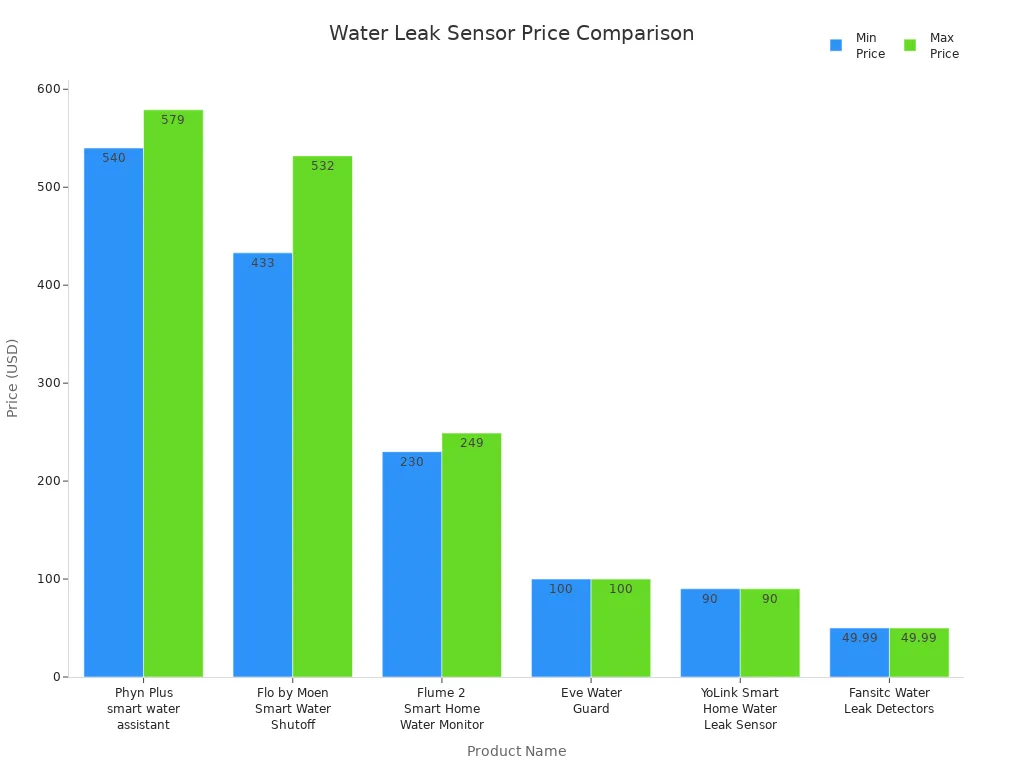
When you compare these sensors, think about what matters most to you. Do you want automatic shutoff for the fastest response? Are you looking for smart home compatibility or just a loud alarm? Some sensors shine with their quick response time, while others stand out for their reliability and ease of use.
- If you want the best response and comprehensive protection, go for a model with automatic shutoff.
- For simple home security, a basic alarm might be enough.
- If you care about reliability, check user reviews and battery life.
Tip: The best water leak sensor is the one that matches your needs and gives you confidence in your home’s protection.
Water Leakage Sensor Buying Guide
Detection Methods for Water Leak Sensors
When you look at water leakage sensors, you’ll see many detection methods. Some use simple moisture probes that sense water on the floor. Others use advanced technology to find leaks before you even notice a problem. Here are some of the most accurate detection methods:
- Acoustic sensors listen for tiny leak sounds in your pipes. They can pinpoint the exact spot where water escapes.
- Vibration sensors pick up small changes in your pipes. These sensors give you real-time monitoring and early warning. Recent studies show they work well for water leak detection, even when leaks are hard to see.
- Tracer gas sniffers help when sound-based detection gets tricky.
- Thermal imaging cameras spot temperature changes caused by leaks. You can use them to find hidden moisture in walls or ceilings.
- Ground-penetrating radar (GPR) scans below the surface to find leaks underground.
- Moisture meters check for water behind surfaces, which helps with interior leak detection.
Many smart-home systems combine these methods for better accuracy. When you use more than one detection type, you get faster response and fewer false alarms. AI and IoT features in modern leak detection systems also help you catch leaks early and avoid big repairs.
Connectivity Options for Smart Water Leak Detectors
Smart-home water leak detectors connect in different ways. Most use Wi-Fi to send alerts straight to your phone. This means you get real-time updates, even if you’re not home. Some detectors use Z-Wave or Bluetooth, which work well with smart home hubs. Cellular connections keep your leak detection system working during power outages or network problems.
Here’s what you get with strong connectivity:
- Fast alerts and quick response, no matter where you are.
- Easy setup with your smart-home devices.
- Reliable notifications through push alerts, emails, or texts.
If you want the best performance, make sure your water leakage sensor matches your smart-home setup. Good connectivity means you never miss an alert and always have time to respond.
Alert Types for Water Leak Sensors
You want to know right away if there’s a leak. Smart-home water leak sensors offer different alert types:
- Push notifications on your phone
- Text messages or emails
- Loud alarms or flashing lights
Some systems let you set up alerts for more than one person. That way, your whole family can respond fast. The best smart-home leak detection systems send alerts instantly, so you can act before damage spreads. Quick alerts mean you can shut off the water, call for help, or fix the problem yourself.
Tip: Set up your alerts to reach you wherever you are. Fast response is the key to stopping water damage before it gets worse.
Power Source and Battery Life in Water Leak Detectors
When you pick a water leak detector, you want to know how long it will last before you need to change the battery. Some detectors use regular AAA batteries, while others use special batteries like CR123A. Battery life can make a big difference in how often you need to check your devices.
Here’s a quick look at how battery life compares for popular models:
| Brand/Model | Battery Type | Battery Life Expectancy |
|---|---|---|
| Moen Smart Leak Detector | 1 × CR123A | Over 2 years |
| X-Sense SWS51 | 2 × AAA | About 3 years |
| SmartThings Leak Sensor | Coin cell | About 1 year |
| Aeotec Sensor | AAA | 45-60 days (unless plugged in) |
Some smart-home sensors, like the YoLink Water Leak Sensor 4, can last up to five years on a single set of batteries. Others, like Aeotec, need battery changes every couple of months unless you use mains power. If you want less hassle, look for a detector with a long battery life. You can also find models that plug into the wall, so you never have to worry about batteries at all.
Tip: Always check the battery status in your smart home app. Many smart-home leak detectors will send you an alert when the battery runs low, so you never miss a beat.
Smart Home Integration with Water Leakage Sensors
Smart home integration makes your water leak detectors even more powerful. You can connect your sensors to platforms like Home Assistant, SmartThings, or Alexa. This lets you set up automations, like turning on a light or sending a push alert if a leak happens.
Many smart-home sensors use ZigBee, Z-Wave, WiFi, or RF protocols. For example, you can use Ecolink Z-Wave leak sensors, Xiaomi Aqara sensors with a ZigBee stick, or Shelly Flood sensors that run on WiFi. Home Assistant is a favorite for many users because it supports a wide range of sensors and lets you avoid cloud services. You can set up notifications for your phone, email, or even a smart speaker.
Here are some popular smart home platforms and compatible sensors:
- Home Assistant (works with ZigBee, Z-Wave, WiFi, RF)
- SmartThings (supports many smart-home sensors)
- Alexa and Google Home (for voice alerts and automations)
- Sonoff RF Bridge (for RF-based sensors)
Smart home integration gives you more control and peace of mind. You can get alerts anywhere, set up routines, and even check your sensors from your phone.
Note: Smart home features let you build a system that fits your needs. You can add more sensors, connect to other devices, and keep your home safe with just a few taps.
Automatic Shutoff Features in Water Leak Sensors
Automatic shutoff is one of the best smart-home features you can get. When your water leak detector finds a leak, it can close the main water valve right away. This stops water from flooding your home, even if you are not there.
Here’s why automatic shutoff matters:
- The system closes the water valve as soon as it detects a leak, so you avoid big messes.
- You get real-time alerts on your phone, by text, or by email.
- AI technology checks your water use and finds leaks early, sometimes as small as a drop per minute.
- Daily microleak tests help catch problems before they grow.
- You can control your water system from your smartphone, which makes it easy to respond fast.
Automatic shutoff is perfect for vacation homes or places you do not visit often. It keeps your home safe, saves you money, and can even help with insurance. Some systems, like Flo by Moen or Water Hero, also have battery backup, so you stay protected during power outages.
Callout: With automatic shutoff, you do not have to worry about leaks when you are away or asleep. Your smart-home system takes care of it for you.
Price vs. Value in Water Leak Detector Selection
When you shop for a water leak detector, you might notice prices all over the place. Some sensors cost less than $30, while others go over $500. You may wonder, “Do I really need the most expensive one?” The answer depends on what you want and what your home needs.
Let’s break down what you get for your money:
| Price Range | What You Usually Get | Who It’s Best For |
|---|---|---|
| Under $50 | Basic leak alerts, simple setup, no smart features | Renters, small apartments |
| $50 – $150 | App alerts, better battery life, some smart options | Most homeowners, smart home fans |
| $150 – $500+ | Automatic shutoff, advanced sensors, full app suite | Large homes, frequent travelers |
You might think the cheapest sensor will do the job. Sometimes, it will. If you just want a loud alarm when water hits the floor, a budget model works. But if you want instant phone alerts, smart home integration, or automatic shutoff, you’ll need to spend more.
Tip: Think about where you live and how much water damage could cost you. Spending a little more now can save you thousands later.
Here are a few questions to help you decide:
- Do you travel often or own a second home?
- Do you want to control your sensor from your phone?
- Would you like your system to shut off water automatically?
If you answered “yes” to any of these, a higher-priced sensor may offer better value. You get more features, stronger protection, and peace of mind.
Remember, value isn’t just about price. It’s about what you get for your money. The right water leak detector protects your home, saves you stress, and can even lower your insurance bill. Choose the one that fits your life best.
Installation and Maintenance Tips for Water Leak Sensors

Where to Place Water Leakage Sensors
You want your water leak sensor to catch leaks fast. The best spots are places where water problems often start. Put sensors under sinks, behind toilets, and near your washing machine. Place one by your water heater and in the basement, too. If you have a dishwasher or fridge with a water line, tuck a sensor behind those as well. Don’t forget crawl spaces or garages if you live in a flood-prone area.
Tip: The closer you put your sensor to the source of a possible leak, the quicker the detection. This helps you stop damage before it spreads.
Installation Steps for Water Leak Detectors
Setting up a water leak sensor is simple. You don’t need special tools. Just follow these steps:
- Unbox your sensor and read the instructions.
- Put in the batteries or plug it in.
- Connect the sensor to your Wi-Fi or smart home hub.
- Place the sensor flat on the floor in your chosen spot.
- Test the sensor by dripping a little water near it. Make sure you get an alert.
Most sensors use an app for setup. The app will guide you through each step. If you have more than one sensor, repeat the process for each one.
Maintenance and Testing of Water Leak Sensors
You want your sensors to work when you need them. Check the batteries every few months. Most apps show battery life, so you can see when it’s time to change them. Clean the sensors with a dry cloth to keep them free from dust. Test your sensors by placing a damp cloth under them. Watch for alerts on your phone. This keeps your detection system ready and improves reliability.
Note: Regular testing helps you trust your water leak sensor. You know it will work when it matters most.
| Maintenance Task | How Often | Why It Matters |
|---|---|---|
| Check batteries | Every 3 months | Keeps detection active |
| Clean sensors | Every 6 months | Improves reliability |
| Test with water | Every 6 months | Confirms detection |
You can protect your home and wallet by using water leakage sensors. These smart devices help you catch leaks early and stop damage before it gets out of hand. Many homeowners find that the cost of a quality leak detector is much less than paying for repairs. Insurance companies often give discounts for smart sensors, and some people even see their system pay for itself in just a few years. When you choose the right detector, you get peace of mind and strong protection for your home.
FAQ
How do water leak sensors work?
Water leak sensors detect moisture where it should not be. When water touches the sensor, it sends an alert to your phone or sounds an alarm. You can act fast and stop damage before it spreads.
Where should I place my water leak sensors?
You should put sensors near places where leaks often start. Good spots include under sinks, behind toilets, next to water heaters, and near washing machines. You can also place them in basements or by dishwashers.
Do water leak sensors need Wi-Fi to work?
Most smart sensors use Wi-Fi for alerts. Some models use other wireless signals or work offline with alarms. If you want phone notifications, you need a Wi-Fi connection.
How often should I test my water leak sensors?
You should test your sensors every few months. Use a damp cloth or a small amount of water to check if you get an alert. Regular testing keeps your system ready.
Can water leak sensors help lower my insurance costs?
Yes! Many insurance companies offer discounts if you install water leak sensors. You can save money and protect your home at the same time.


