
Case Study | How the ULS-03GW Safeguards Oil Tank Level Safety in an Extreme Cold Region at -20°C
At an oilfield in Inner Mongolia, winter temperatures can drop as low as -20°C, with persistent winds of Force 6 or above. In the past, crude oil tank level monitoring at this oilfield relied primarily on manual patrols every four hours—an approach that was not only inefficient but also carried significant safety risks. After the introduction of the ULS-03GW wide‑temperature ultrasonic level sensor, the oilfield achieved round‑the‑clock automated level monitoring, providing reliable safety protection in the bitter cold of minus twenty degrees.
Project Background: Safety Challenges in Extreme Cold
Located in Xilingol League, Inner Mongolia, the oilfield experiences winters lasting up to six months, with extreme low temperatures reaching -20°C. The facility comprises 24 crude oil storage tanks and 8 wastewater treatment tanks. The previous level monitoring solution presented three major risks:
- High risk of manual inspections: Nighttime winter patrols required staff to walk up to 3 kilometers through snow, with incidents of frostbite and slips occurring from time to time.
- Failure of conventional sensors: Attempts had been made to use standard ultrasonic sensors, but all failed after the onset of winter due to ice formation on the transducer.
- Lack of early warning mechanisms: The inability to monitor level changes in real time left the facility exposed to the persistent risk of tank overflows.
- ULS-03GW Solution: From Failure to Stability
1. Extreme Cold Startup and Continuous Operation Validation
In January 2024, the first eight ULS-03GW units were installed on two crude oil tanks and one wastewater tank, where they endured the extreme cold of -20°C. Without activating the heating film, the sensors operated stably in temperatures above -20°C. When the temperature dropped below -20°C, the probe heating function automatically activated, ensuring that no ice layer formed on the surface and that measurements continued uninterrupted around the clock.
2. Sandstorm Resistance and Anti‑Icing Structural Design
The oilfield site is characterized by heavy sandstorms and drastic day‑night temperature swings. The PTFE‑coated transducer of the ULS-03GW effectively prevented sand and dust from adhering, while its hydrophobic properties prevented melted snow from accumulating and freezing on the probe surface. After three months of continuous operation, the cleanliness of the probe surface remained above 90% of its initial state.
3. Wireless Networking Enables Remote Monitoring
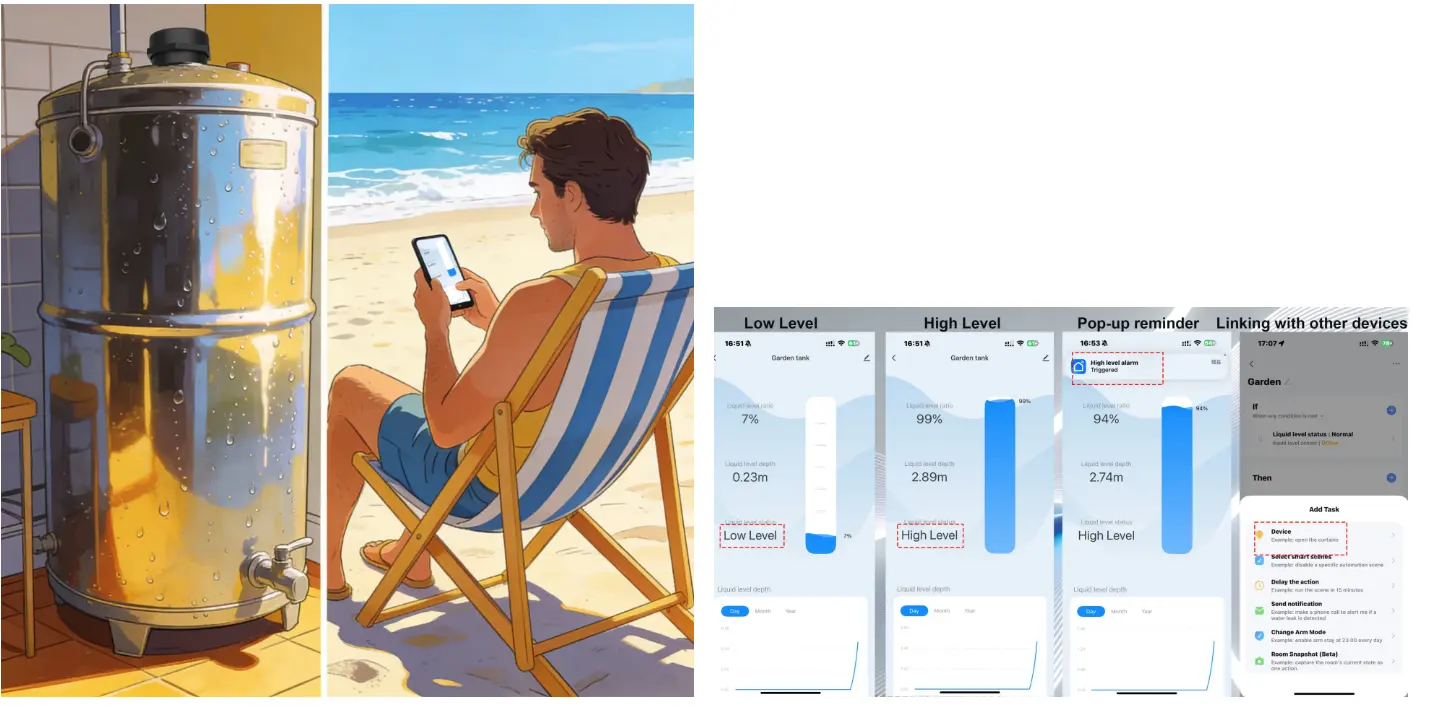
Each sensor is connected to an RTU (Remote Terminal Unit) via the Smart Life / Tuya Smart interface, with data transmitted in real time over a Wi‑Fi (2.4 GHz) network to the SCADA system in the oilfield control center. When the liquid level reaches the high limit, the system automatically issues an alarm and closes the inlet valve; at low level, it automatically stops the transfer pump—achieving fully automated operation.
4. Intelligent Diagnostics Reduce Maintenance Costs
The ULS-03GW performs regular self‑diagnostics and reports status parameters such as signal strength, probe temperature, and operating voltage. The control center can remotely assess sensor health, shifting from scheduled inspections to condition‑based maintenance. Throughout the winter of 2024, the eight sensors required only one onsite maintenance visit—due to a power module failure—representing a 90% reduction in winter field trips compared to previous practices.
Project Outcomes
1、Safety incidents: Zero level‑related safety incidents occurred during the winter.
2、Labor costs: Two nighttime patrol positions were eliminated, saving approximately RMB 250,000 annually in labor costs.
3、Operational efficiency: Continuous level data enabled a roughly 8% increase in tank utilization.
4、Return on investment: The investment in the eight sensors and supporting systems was recouped within the first winter through labor savings and avoidance of overflow‑related losses.
The oilfield’s equipment management head commented: “The ULS-03GW is the first ultrasonic level meter we have found that truly ‘survives’ the Inner Mongolia winter. It allows our staff to stop climbing tanks in snowstorms. This is not just a technological upgrade—it is a matter of respect for life.”
Expanded Applications
Building on the success at this oilfield, the ULS-03GW has since been deployed in petroleum, water conservancy, and environmental protection projects across other high‑altitude cold regions, including Northeast China, Xinjiang, and Qinghai. In addition, the model has demonstrated excellent adaptability in applications such as ammonia level monitoring in cold storage facilities and high‑altitude hydrological stations.


