
Ein vollständiger Leitfaden zur Entsorgung von scharfen Gegenständen für Krankenhäuser
Hospitals are high-volume, high-acuity environments. They generate a constant and significant stream of sharps waste. This waste includes everything from needles and scalpels to guide wires and broken glass. Each of these items represents a serious risk of injury and infection. Aus diesem Grund, a specialized sharps disposal service is not a luxury for a hospital; it is a critical component of its safety, risk management, and regulatory compliance infrastructure. The primary risk of improper sharps management is the threat of needlestick injuries to healthcare professionals.
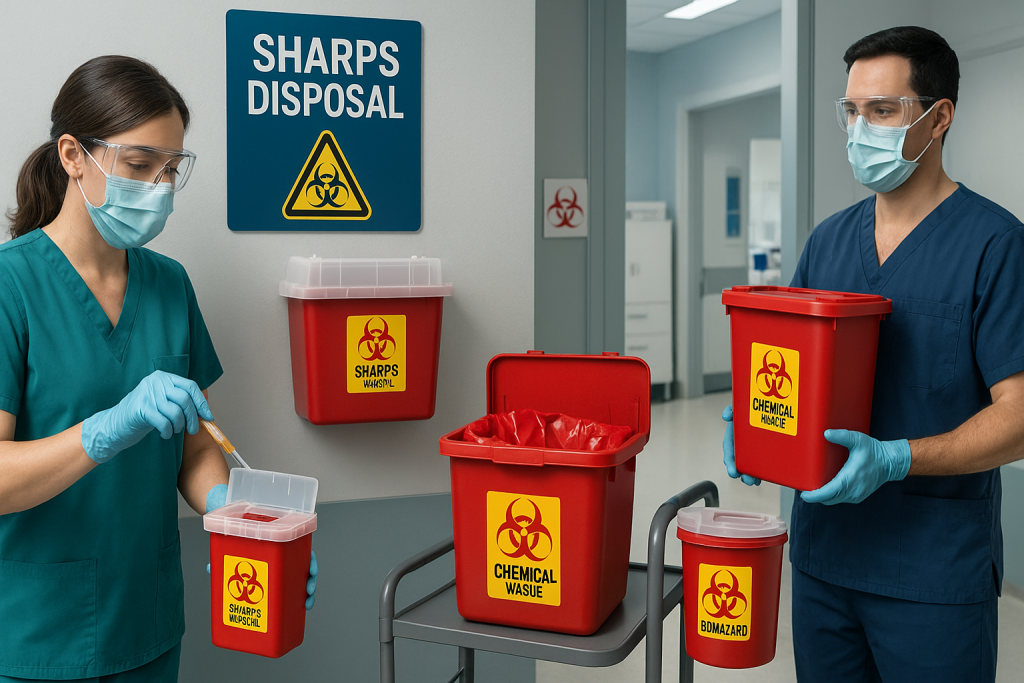
A sharps disposal service for hospitals is a comprehensive program for the supply, strategic placement, Sammlung, and compliant disposal of sharps containers. It is designed to maximize safety and efficiency in a high-volume, complex healthcare environment. A premier service goes beyond simple waste pickup. It acts as a partnership to reduce occupational health risks and ensure unwavering compliance. As a specialized provider of these critical safety services, CESH Startseite offers this guide. We aim to help hospitals design and implement a best-in-class sharps management program.
The Unique Challenge: Sharps Waste in a Hospital Environment
Managing sharps waste in a small clinic is a challenge. Managing it in a large hospital is a monumental task of a different scale and complexity. A specialized service is necessary because hospitals face a unique set of circumstances.
Why Do Hospitals Require a Specialized Sharps Service?
- Immense Volume and Velocity: A single large hospital can generate tens of thousands of used sharps every single day. The sheer volume and relentless pace of generation require a highly efficient and reliable system for containment and removal. A backlog of full containers is not just an inconvenience; it is a serious safety hazard.
- Diversity of Sharps Waste: Hospital sharps are not limited to simple syringes. Operating rooms generate used scalpels, trocars, and surgical staples. Catheterization labs produce long, sharp guide wires. Laboratories produce contaminated slides and broken glass pipettes. Each of these items has a unique shape and size, requiring a range of specialized containers to ensure safe containment.
- The High Risk of Needlestick Injuries: Needlestick injuries are a major occupational health and safety issue in the healthcare industry. They can expose doctors, nurses, and support staff to dozens of dangerous bloodborne pathogens. An effective sharps management program is the single most important engineering control for preventing these life-altering injuries.
- Intense Regulatory Scrutiny: Due to the high risks involved, sharps management is one of the most closely inspected areas of healthcare compliance. Regulators will scrutinize every aspect of a hospital's program. This includes container type, placement, staff training records, and final disposal documentation. Non-compliance can lead to severe penalties.
Core Components of a Hospital Sharps Disposal Service
A truly comprehensive sharps disposal service is a multi-faceted program. It integrates seamlessly into the hospital's daily operations. It should be a complete, end-to-end solution that addresses every aspect of the sharps waste lifecycle.
What Does a Comprehensive Sharps Service Include?
- A Full Range of Compliant Containers: The service should supply a wide variety of certified, Durchstichsichere Behälter für scharfe Gegenstände. This includes different sizes to match the needs of different departments, from small one-quart containers for patient rooms to large, hands-free containers for busy operating rooms and emergency departments.
- Strategic Container Placement and Installation: A key value-add is a professional site assessment. The service partner should work with the hospital's safety and infection control teams. They will map out all points of sharps generation and recommend the optimal type and placement of containers to maximize safety and convenience. This often includes installing secure wall mounts and brackets.
- Regular and Reliable Container Exchange: The core of the service is the reliable exchange of full containers for clean, empty ones. Trained technicians perform this task efficiently and safely. This relieves the hospital's environmental services staff of this high-risk duty.
- Sicher, Compliant Transportation: Full containers are transported from the hospital in specialized vehicles operated by trained drivers. The entire process is managed under a strict chain of custody, with all shipments tracked via a manifest document.
- Certified Treatment and Disposal: After collection, the sharps waste is transported to a permitted treatment facility. There, it is rendered safe and non-infectious, typically through high-temperature steam sterilization (Autoklavieren), before the remaining material is shredded and sent to a sanitary landfill.
- Comprehensive Staff Training and Support: A premier service partner does not just manage the waste; they help manage the program. This includes providing ongoing training for clinical staff on the proper use of containers. This training reduces the risk of overfilling and ensures safe handling practices.
The Key Decision: Reusable vs. Single-Use Sharps Containers
When implementing a hospital-wide program, the most significant decision is the choice of container system. There are two primary models: traditional single-use (disposable) containers and modern reusable container systems. Each has a different operational and environmental impact.
What Are the Options for Sharps Container Systems?
A deep, unbiased comparison is necessary to determine the best fit for a hospital's goals.
The Single-Use (Disposable) Container Model
This is the traditional model. The hospital purchases and owns the empty sharps containers. Clinical staff fill them, and when full, the lid is permanently locked. The entire container and its contents are then placed in a larger medical waste bin for transport and are destroyed along with the waste inside, typically through incineration or autoclaving followed by shredding.
- Profis:
- Simplicity and Familiarity: The process is straightforward and widely understood by clinical staff.
- Lower Upfront Cost: The initial purchase price per container is relatively low.
- Nachteile:
- High Environmental Impact: This model generates a massive amount of plastic waste, all of which ends up in a landfill.
- Ongoing Purchase Costs: The hospital must constantly purchase new containers, creating a perpetual operational expense.
- Inventory Management: The hospital needs significant storage space to inventory empty containers and store full ones awaiting pickup.
- Staff Risk: Hospital staff are responsible for handling and moving the full, heavy containers to the central storage area.
The Reusable Container Model
This is a modern, service-based model focused on safety and sustainability. The service provider owns a fleet of durable, reusable sharps containers. They supply the hospital with clean, empty containers. When a container is full, the service provider's technician collects it and leaves a fresh one in its place. The full containers are taken to a specialized processing facility where the contents are emptied robotically. The empty container is then sent through a multi-stage robotic washing and sanitizing process before being returned to service.
- Profis:
- Ökologische Nachhaltigkeit: This model is vastly better for the environment. It can reduce the amount of plastic sent to landfills by 80% or more compared to the disposable model.
- Enhanced Staff Safety: Hospital staff are no longer responsible for handling or transporting full containers. The robotic emptying process minimizes occupational exposure risks at the processing facility.
- Reduced Inventory Needs: The service provider manages the container inventory, freeing up valuable storage space within the hospital.
- Often Lower Long-Term Cost: While the service fee may seem higher, it eliminates the need to constantly purchase new containers. Langfristig, it is often the more cost-effective option.
- Nachteile:
- Requires a Dedicated Service Provider: This model is only possible through a partnership with a company that has invested in the required robotic processing technology.
- Veränderungsmanagement: It requires the hospital to transition from an ownership model to a service-based model.
Vergleichstabelle: Reusable vs. Single-Use Sharps Systems
| Besonderheit | Reusable Sharps System | Single-Use (Disposable) System |
| Auswirkungen auf die Umwelt | Very Low (High reduction in plastic waste) | Sehr hoch (All containers are landfilled) |
| Staff Safety | Höchst (Minimal handling by hospital staff) | Hoch (Staff responsible for transport) |
| Cost Structure | Service-based fee per container exchange | Ongoing cost of purchasing containers |
| Storage Needs | Minimal (Service provider manages inventory) | Significant (Requires storage for new & full units) |
| Am besten geeignet für | Environmentally conscious hospitals focused on long-term cost and safety optimization. | Facilities with existing inventory or those in very remote areas without a reusable service provider. |
Implementing the Service: Best Practices for Hospitals
Regardless of the container model chosen, a successful sharps management program relies on a well-planned implementation strategy. This is a collaborative effort between the hospital and its service partner.
How Should a Hospital Implement a Sharps Management Program?
- Conduct a Thorough Site Assessment: The first step is to walk through every department of the hospital. You must map out every single point where sharps waste is generated. This includes patient rooms, operating theaters, emergency bays, Labs, and pharmacies.
- Optimize Container Placement: The golden rule is that a sharps container must always be within arm's reach of the point of use. This prevents staff from having to walk with an exposed sharp. The service partner can help recommend the best placement, whether it's on a countertop, mounted to a wall, or attached to a mobile medical cart.
- Establish a Clear Collection Workflow: A clear, documented process must be created for moving full containers. This plan details how a full container is safely closed, removed from its bracket, and transported to the facility's main, secure soiled utility room or central accumulation area to await pickup by the service provider.
- Prioritize Staff Training: This is the most critical element. All clinical staff must be trained on the specifics of the sharps program. This training must cover:
- The danger of needlestick injuries.
- The importance of never overfilling a container beyond its fill line.
- The proper technique for closing and locking the container lid.
- The procedure for handling and transporting a full container.
Sharps are a critical subset of a hospital's overall gefährlicher Abfall stream. They must be managed with the highest level of care and attention to detail.
Beachtung, Tracking, and Reporting
A compliant sharps disposal service is built on a foundation of meticulous documentation. This provides a legal record of proper management and is essential for passing regulatory inspections.
How is Compliance Documented and Verified?
Das "Von der Wiege bis zur Bahre" principle means the hospital is responsible for its waste until it is destroyed. Documentation is the only way to prove this responsibility was met. A professional service manages this process. They provide a multi-part manifest document for every pickup. This document tracks the waste from the hospital to the treatment facility. Once the waste is treated and destroyed, the service provider returns a signed copy of the manifest and a Certificate of Destruction to the hospital. These documents must be kept on file for several years as legal proof of compliance. Zusätzlich, the hospital must maintain its own internal records, such as staff training logs and a log of any needlestick injuries.
Abschluss
A specialized sharps disposal service is a critical safety, Beachtung, and environmental partnership for any hospital. It moves beyond a simple vendor relationship. It becomes an integrated part of the hospital's mission to protect its staff and patients. The choice between a modern, sustainable reusable container system and a traditional disposable model depends on a hospital's specific goals. Jedoch, the choice to partner with an expert, certified provider is universal and non-negotiable.
This partnership is the most effective way to reduce the risk of needlestick injuries, ensure unwavering regulatory compliance, and create a safer environment for everyone. CESH Home provides the expertise, Technologie, and service excellence to be that trusted partner.
Häufig gestellte Fragen
Frage 1: What is the most common mistake made in hospital sharps management?
The most common and dangerous mistake is overfilling sharps containers. When a container is filled beyond its designated fill line, it becomes extremely difficult to close the lid safely, dramatically increasing the risk of a needlestick injury.
Frage 2: How often should sharps containers be exchanged in a busy hospital unit?
The exchange frequency depends entirely on the volume of waste generated. In a very busy area like an emergency department, containers may need to be exchanged multiple times per day. A professional service will work with the hospital to create a service schedule that prevents containers from ever becoming full.
Frage 3: Are reusable sharps containers as safe as single-use ones?
Ja, and many studies show they are even safer. They are made from a more durable, puncture-proof plastic. Because they are handled less by hospital staff and emptied robotically, they can significantly reduce the overall risk of occupational exposure.
Frage 4: Does a disposal service help a hospital reduce needlestick injuries?
Absolut. A premier service partner acts as a safety consultant. By providing the best containers, optimizing their placement, and delivering regular staff training, a good service can be a key part of a hospital's program to reduce its needlestick injury rate.


