
Five Major Pain Points in Household Liquid Level Monitoring: Why Your Water Tank Remains a “Blind Spot”
From manual dipsticks to failed sensors – why liquid level management has become the invisible trouble in home water and oil use
For many households, liquid level management of rooftop water tanks, oil containers, water purifier tanks, etc., has always been a “can’t see, can’t manage” blind spot. Running dry damages equipment, overflow wastes resources, and finding an empty oil container only when you need to cook – these seemingly minor daily frustrations reveal deep‑seated flaws in traditional level monitoring methods.
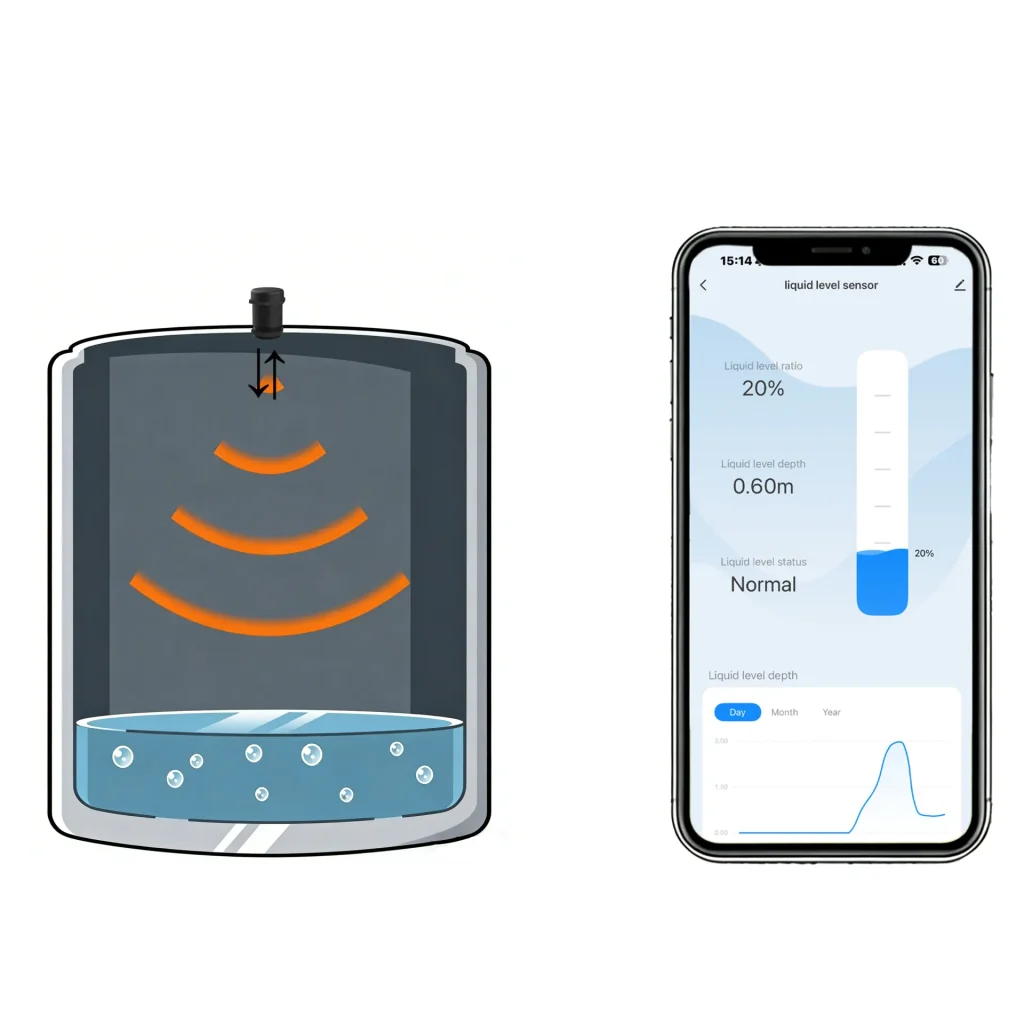
Pain Point 1: Manual “Dipstick” Method – Time‑Consuming, Inaccurate
Many families still rely on climbing up to check the water tank manually or shaking an oil container to estimate remaining oil. This method is not only time‑consuming and laborious but also prone to missed or incorrect readings, leading to dry supply or overflow. For oil storage, manual probing also poses safety risks.
Pain Point 2: Float Switches – The Dreaded “Sticking”
Float switches are the most common mechanical solution, but after prolonged use they easily stick in scale or debris. Once stuck, no alarm is given when water is low (dry running) or when full (overflow), resulting in equipment damage and resource waste.
Pain Point 3: Electrode Sensors – Hidden Dangers
Electrode sensors detect level by measuring liquid conductivity. However, long‑term use may generate electrolytic by‑products that can be harmful to health and affect water taste and quality.
Pain Point 4: Optical Sensors – Probes “Hate Dirt”
Optical sensors work by infrared refraction, but the probe must contact the liquid. When the liquid is dirty or scale builds up, detection accuracy drops significantly.
Pain Point 5: Fragmented Apps – Split Management
Some smart level monitors require dedicated apps. Different devices from different brands use different apps, forcing users to switch back and forth – a fragmented experience with low efficiency.
Conclusion
These pain points trouble countless families, turning the simple question “Is there water in the tank?” into a daily headache. However, technological progress is changing this – a smart level monitorPain Point 3: Electrode Sensors – Hidden Dangers
Electrode sensors detect level by measuring liquid conductivity. However, long‑term use may generate electrolytic by‑products that can be harmful to health and affect water taste and quality.
Pain Point 4: Optical Sensors – Probes “Hate Dirt”
Optical sensors work by infrared refraction, but the probe must contact the liquid. When the liquid is dirty or scale builds up, detection accuracy drops significantly.
Pain Point 5: Fragmented Apps – Split Management
Some smart level monitors require dedicated apps. Different devices from different brands use different apps, forcing users to switch back and forth – a fragmented experience with low efficiency.
Conclusion
These pain points trouble countless families, turning the simple question “Is there water in the tank?” into a daily headache. However, technological progress is changing this – a smart level monitorULS-03GW that truly understands household needs may be the answer you have been looking for. Contact us to learn more in detail


