
Alternative au capteur de niveau optique Banner T30
Si vous vous procurez un Capteur optique de niveau liquide T30, cette page vous aide à comparer la solide réputation de capteurs photoélectriques de Banner avec une option de capteur optique de niveau liquide directement en usine pour les projets de volume OEM. HojellyTek prend en charge les acheteurs ayant besoin d’une logique de détection optique comparable, Correspondance pratique des sorties, Personnalisation des logements, et contrôle des coûts sans prétendre être approuvé par Banner ou identique à celui-ci.
Pour un appareil OEM, tank, Réservoir de fluide, et projets d’automatisation, La bonne alternative ne se choisit pas uniquement par la marque. Il doit correspondre au liquide, Position de montage, Logique de sortie, Matériau de logement, câblage, et environnement de test.
Capacités de capteurs de niveau optique directs en usine
HojellyTek est un fabricant de capteurs optiques et de niveau liquide de Shenzhen disposant d’un système R interne&D, Expérience de détection optique photoélectrique, et le soutien OEM/ODM pour les projets d’exportation aux États-Unis, EU, Inde, et autres marchés.
Pour les acheteurs comparant un résultat de recherche de type Banner T30, Notre équipe peut vous soutenir:
- Détection optique du niveau ponctuel pour la présence ou l’absence de liquide
- Détection photoélectrique IR utilisant le changement de réflexion à la pointe du prisme
- Conceptions compactes de capteurs montés sur réservoir pour équipements OEM
- NPN, PNP, Signal haut/bas, et l’appariement de sortie spécifique au projet
- 4–20 mA ou discussion à sortie continue lorsque l’application nécessite une surveillance des tendances de niveau plutôt qu’une simple détection ponctuelle
- Plastique, Acier inoxydable, PTFE, et des options de capteurs à corps de verre selon le liquide
- Fileté, Bride, Mur latéral, et discussions sur le montage personnalisé
- Longueur du câble OEM, Connecteur, câblage, et personnalisation des étiquettes
- Soutien à l’échantillonnage avant la planification de la production
Pour une vue d’ensemble plus large du produit, voir notre Capteur de niveau optique Page.
Honnêtement, correspondre à l’intention de recherche de la bannière T30
Banner est bien connu dans la détection photoélectrique industrielle. Beaucoup d’acheteurs recherchent « T30 » car ils associent ce nom à de robustes familles de capteurs photoélectriques, Styles de logement reconnaissables, et documentation mature. Cette réputation compte, surtout lorsqu’une équipe de maintenance utilise déjà des produits Banner sur plusieurs machines ou lorsqu’un capteur fourni par un distributeur est spécifié dans un design existant.
Cependant, Les acheteurs recherchant un « capteur optique de niveau liquide Banner T30 » doivent vérifier le modèle exact et le principe de détection. Certains résultats de recherche liés au T30 peuvent faire référence à la détection générale d’objets photoélectriques, tandis que d’autres produits Banner T30U sont des capteurs de niveau ultrasonique plutôt que des interrupteurs optiques de niveau liquide de type prisme. Un capteur optique de niveau liquide à contact direct est un dispositif différent: Il détecte si un liquide recouvre une pointe prismatice transparente.
Cette distinction est importante. Un capteur optique à prisme est généralement choisi lorsque l’acheteur a besoin de compact, presque, Détection de présence liquide par contact dans un réservoir, Coupe, réservoir, Chambre de tuyau, ou module d’appareil. Il ne mesure pas le niveau à longue distance dans l’air comme un capteur ultrasonique, et ce n’est pas la même chose qu’un capteur diffus d’objet photoélectrique monté à l’extérieur du liquide.
Comment fonctionne un capteur optique de niveau liquide
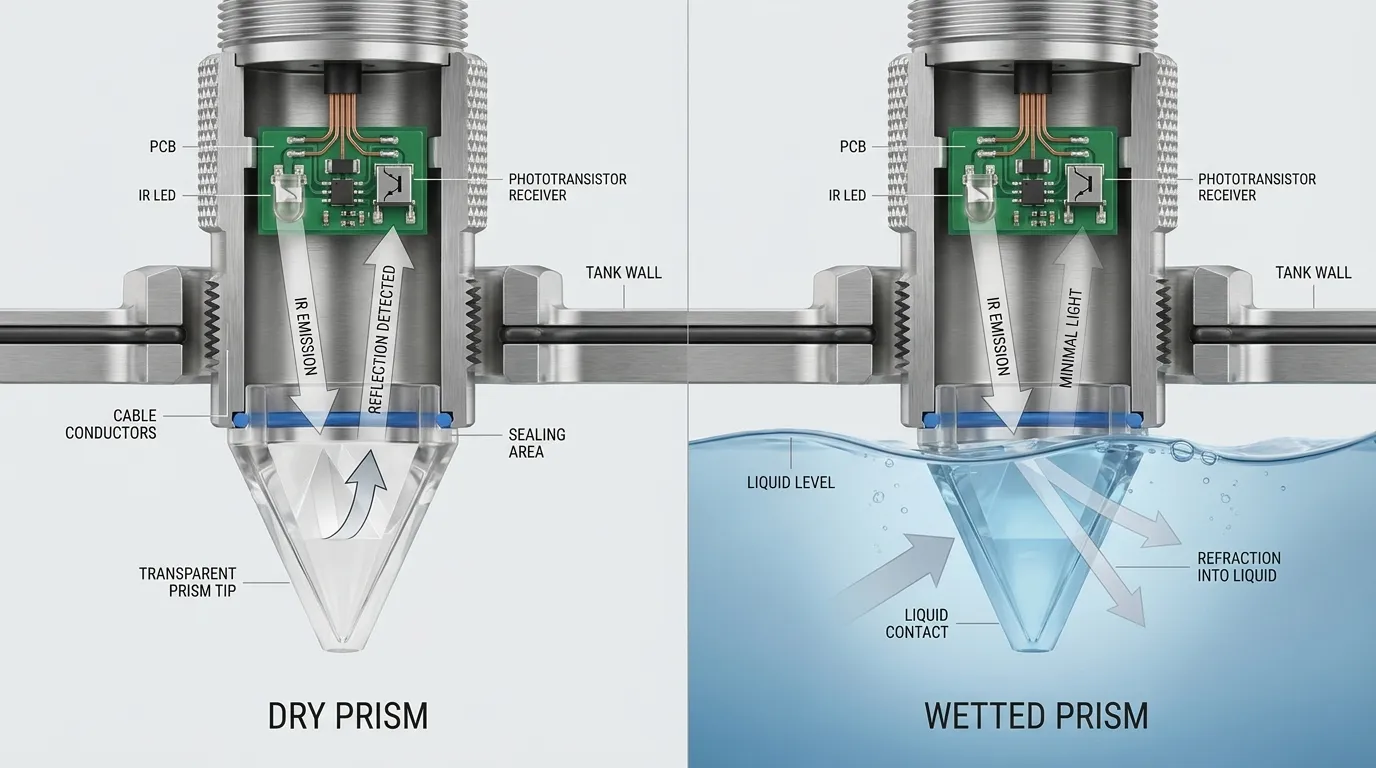
Un interrupteur photoélectrique typique utilise une LED infrarouge, un phototransistor ou un récepteur, et une pointe de détection de prisme transparente. À l’état sec, La lumière infrarouge se réfléchit à l’intérieur du prisme et revient au récepteur. Quand le liquide touche le prisme, Changements de la condition réfractive. Moins de lumière revient au récepteur, et l’état de sortie des commutateurs de circuit.
Cette méthode de détection simple est utile pour:
- Protection de basse altitude dans les pompes et chauffages
- Détection de débordement dans des réservoirs compacts
- Détection vide/pleine dans les réservoirs d’eau
- Réservoirs d’appareils électroménagers tels que les machines à café, Humidificateurs, distributeurs d’eau, et équipements de nettoyage
- Huile, Liquide de refroidissement, et détection de points procédé-liquide lorsque le matériau mouillé est compatible
- Modules OEM où les interrupteurs à flotteur sont trop gros ou mécaniquement instables
L’avantage clé est qu’il n’y a pas de pièces flottantes mobiles. Le capteur peut être compact, répétable, et facile à intégrer dans des cuves moulées ou de petits équipements. La principale limitation est qu’elle dépend de la condition optique à la surface du prisme. Revêtement épais, bulles, écume, résidu collant, Ou un montage incorrect peut affecter la détection. C’est pourquoi il est essentiel de tester l’échantillon avec le liquide réel.
Pour les acheteurs qui ont besoin d’un dispositif ponctuel plutôt qu’une large famille de capteurs, le capteur ponctuel électro-optique Page offre une référence plus ciblée.
Où une alternative directe à l’usine convient
Une alternative directe à l’usine a du sens lorsque votre projet passe du prototype au volume et que vous avez besoin de plus de contrôle sur les coûts, Logement, Câble, Sortie, et continuité de l’approvisionnement. Au lieu d’acheter un article de catalogue et d’adapter la machine autour de lui, Les acheteurs OEM ont souvent besoin que le capteur soit ajusté à la conception du produit.
C’est là que HojellyTek peut bien s’intégrer:
- Le mur de votre bac nécessite un filetage spécifique, Phoque, ou profondeur d’installation.
- Votre contrôleur a besoin de NPN, PNP, Logique haute/basse tension, ou un comportement défini normalement ouvert/normalement fermé.
- Votre liquide nécessite une alimentation, PTFE, 316 Acier inoxydable, ou matériaux humidifiés par verre.
- Votre équipe d’assemblage a besoin d’une longueur de câble définie, Connecteur, Couleur du fil, ou label.
- Votre produit a besoin d’un approvisionnement stable pour des productions répétées.
- Votre projet a besoin d’un équilibre pratique entre performance et coût unitaire.
Par exemple, Les appareils aquatiques peuvent utiliser des capteurs optiques en plastique compacts. Les projets chimiques ou liquides agressifs peuvent nécessiter du PTFE ou des matériaux de contact en verre. Les systèmes d’huile ou de liquide de refroidissement peuvent nécessiter un boîtier métallique ou un scellement spécifique. Un acheteur ne devrait pas choisir uniquement par le nom du capteur; L’installation et le comportement liquide décident souvent de la bonne conception.
Pour l’évaluation des fournisseurs, Visitez notre Fabricant de capteurs optiques Page.
Banner T30 vs Alternative au capteur de niveau optique HojellyTek
| Point de comparaison | Banner T30 / Résultat de recherche lié au T30 | HojellyTek Factory-Direct Alternative |
|---|---|---|
| Position de la marque | Marque reconnue de détection industrielle avec une forte réputation photoélectrique | Fabricant de Shenzhen pour les projets de capteurs optiques de niveau liquide OEM/ODM |
| Principe de détection | Il faut confirmer le modèle exact; Les résultats de recherche T30 peuvent inclure des capteurs photoélectriques ou des dispositifs de niveau ultrasonique | Détection du prisme optique à contact direct pour la présence ou l’absence de liquide |
| Acheteur le plus adapté | Les équipes ont déjà standardisé Banner ou ont besoin d’un catalogue soutenu par des distributeurs | Les acheteurs OEM ayant besoin de contrôle des coûts, personnalisation, et communication en usine |
| Fonction du niveau liquide | Cela dépend du modèle exact de la bannière; tous les résultats T30 ne sont pas un interrupteur de niveau liquide à prisme | Conçu autour de la détection optique du niveau ponctuel dans les réservoirs, Réservoirs, et l'équipement |
| Appariement de sortie | Déterminé par la partie Banner sélectionnée et la fiche technique | NPN, PNP, Logique haut/basse, et la confirmation de sortie spécifique au projet au stade RFQ |
| Boîtier et montage | Basé sur la famille de modèles Banner spécifique | Plastique, PTFE, 316 Acier inoxydable, verre, fileté, Bride, ou discussion sur un montage personnalisé |
| Personnalisation | Généralement dirigé par un catalogue, selon la disponibilité du distributeur et du modèle | Câble OEM, Connecteur, Logement, étiquette, et prise en charge de la configuration de détection |
| Là où Banner gagne | Reconnaissance de la marque, Écosystème de documentation, Réseau de distribution, et a établi un Industrial Trust | Valeur directe d’usine, Flexibilité de personnalisation, et support orienté volume |
Production, Logement, et la réalisation de vérifications avant commande
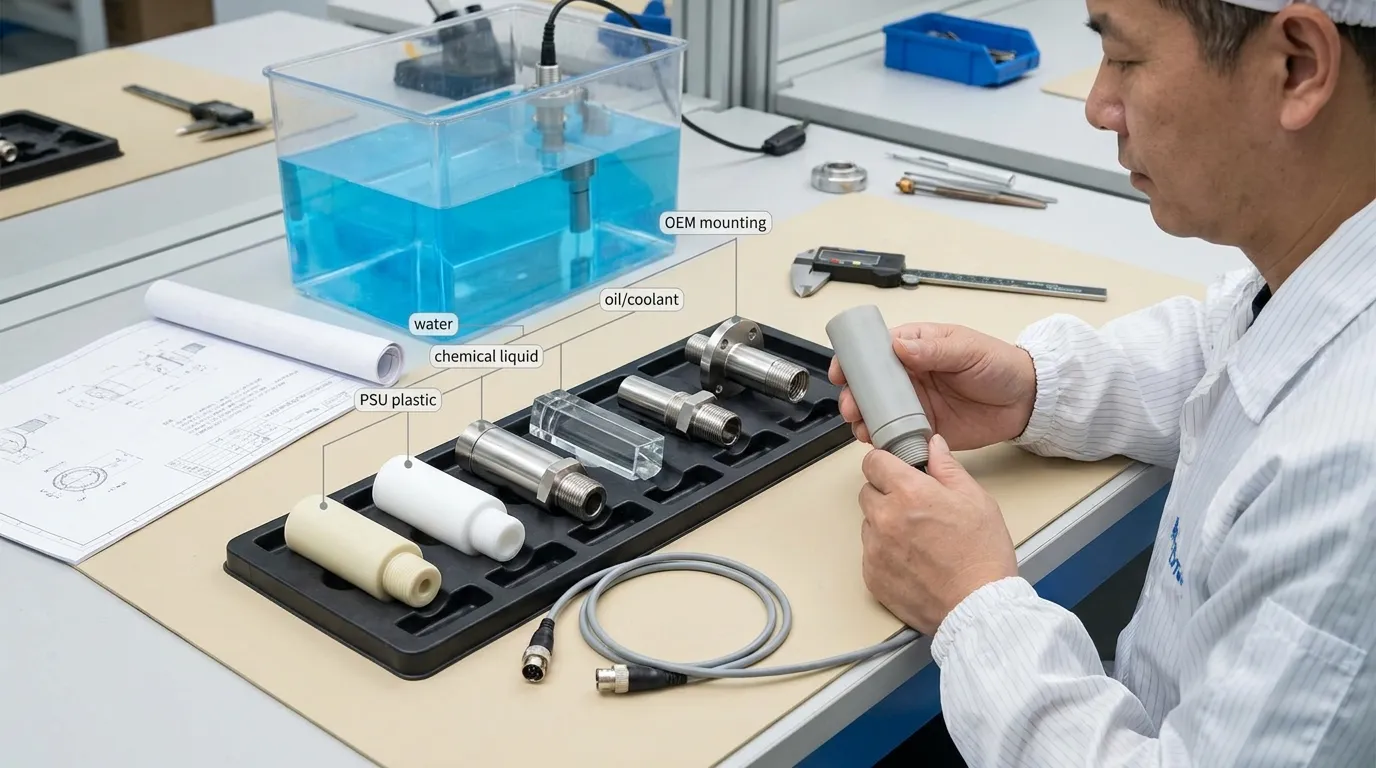
Avant de choisir une alternative compatible, Confirmez d’abord la sortie électrique. Les sorties NPN et PNP sont courantes dans les systèmes de contrôle industriel, Mais les cartes de contrôle des appareils peuvent nécessiter une logique simple de signaux haut/bas. Certains projets nécessitent un comportement normalement ouvert ou normalement fermé. D’autres peuvent demander 4 à 20 mA pour la surveillance liée au niveau, Mais cela doit être discuté avec soin car un interrupteur optique à prisme est normalement un capteur ponctuel, pas un dispositif de mesure continu complet.
Le choix du logement compte aussi. L’alimentation ou le plastique d’ingénierie peuvent convenir à de nombreux appareils à base d’eau. Le PTFE est souvent sélectionné pour sa résistance chimique plus forte. 316 L’acier inoxydable est utile pour l’installation mécanique robuste ou les systèmes liés à l’huile. Le verre peut être utile lorsque la compatibilité chimique et la stabilité optique sont des priorités. Le bon choix dépend du liquide réel, Environnement thermique, Méthode de nettoyage, Condition de pression, et conception de l’étanchéité.
Le montage ne doit jamais être deviné. Les acheteurs doivent confirmer le type de fil, Épaisseur de paroi du réservoir, installation direction, Sortie du câble, Rondelle d’étanchéité ou arrangement de joints toriques, et si le capteur est monté de l’intérieur ou de l’extérieur du réservoir. Un léger décalage mécanique peut provoquer des fuites, Fausse commutation, ou défaillance d’assemblage.
Pour référence sur le produit fini, voir notre Interrupteur photoélectrique de niveau liquide.
Modes de défaillance courants à éviter
Les capteurs optiques de niveau liquide sont fiables lorsqu’ils sont correctement appliqués, Mais de mauvaises informations d’application peuvent créer de faux signaux. Les problèmes les plus courants incluent le revêtement prismatice, bulles d’air piégées autour de la pointe, De la mousse repose sur la zone de détection, condensation, Résidus forts après séchage, Matériau humide incompatible, Logique de sortie incorrecte, Mauvais scellement, et la déformation des câbles lors de l’assemblage.
La méthode la plus sûre consiste à tester les échantillons dans la cuve réelle avec le liquide réel. Test à l’état sec, État mouillé, Remplir, Drain, vibration, Changement de température, Cycle de nettoyage, et comportement résiduel à long terme. Si votre produit inclut une surveillance intelligente ou des alertes d’applications, L’intégration de Tuya ou Smart Life peut être discutée au niveau du système, Mais l’interrupteur optique lui-même doit d’abord être validé comme une source de signal de niveau stable.
5-Processus d’approvisionnement OEM en étapes
- Enquête: Envoyez votre candidature cible, Type liquide, Référence actuelle du capteur, Dessin, Photos, Exigence de production, et le plan de production attendu. Si vous remplacez un design lié à la bannière, Partagez la fiche technique exacte ou les besoins en câblage.
- Revue des spécifications et de la personnalisation: Notre équipe d’ingénierie vérifie le mode de détection, matériel, fil, Logement, Sortie, Câble, Connecteur, et risques d’installation. L’objectif est d’aligner la fonction, pas simplement copier un nom de marque.
- Exemple de confirmation: Les échantillons sont préparés pour l’installation dans le réservoir, câblage, et les tests à liquide réel. Les acheteurs doivent tester à la fois les conditions de fonctionnement normal et les conditions de défaillance.
- Production et contrôle qualité: Après approbation de l’échantillon, La production suit la configuration convenue. La QC se concentre sur la production électrique, Réponse optique, Scellement, Apparence, et la cohérence du câblage.
- Soutien au transport maritime: Les capteurs finis peuvent être emballés pour l’exportation selon les exigences du projet de l’acheteur. Demandez un devis via WhatsApp ou email pour confirmer la meilleure communication et la meilleure voie de livraison.
Exigences pour demander un devis plus rapide
Veuillez inclure:
- Modèle actuel du capteur ou référence cible « T30 »
- Type liquide et s’il laisse des résidus
- Matériau du réservoir et dessin de montage
- Sortie requise: NPN, PNP, Haut/bas, analogique, ou autre
- Tension d’alimentation requise par votre contrôleur
- Longueur du câble, Connecteur, et définition du câblage
- Préférence pour les matériaux de logement: Alimentation, PTFE, 316 Acier inoxydable, verre, ou autre
- Filetage de montage, Taille du trou, Type de joint, et direction de l’installation
- Quantité d’échantillon et volume de production estimé
- Toute exportation, étiquetage, ou exigences d’emballage
Pourquoi les acheteurs choisissent HojellyTek
HojellyTek combine R interne&D, Expérience en production de détection optique, et un support OEM/ODM pour les acheteurs ayant besoin de plus qu’une pièce de catalogue. L’usine peut aider à examiner le comportement des liquides, Installation mécanique, Appariement de sortie, et configuration de production avant l’échellement.
La bannière peut toujours être un meilleur choix lorsque votre projet nécessite spécifiquement une pièce déjà approuvée par la bannière, Remplacement basé sur le distributeur, Normalisation établie des installations, Ou le dossier documentaire exact lié à une machine actuelle. Nous positionnons nos capteurs comme des alternatives compatibles pour l’évaluation des acheteurs, pas en tant que remplaçants officiels de la bannière.
Foire aux questions
Le capteur optique de niveau liquide T30 est-il toujours un interrupteur optique de niveau liquide Banner?
Pas forcément. Les résultats de recherche T30 peuvent concerner différents types de capteurs, y compris les capteurs photoélectriques ou les dispositifs ultrasoniques de niveau. Les acheteurs doivent confirmer le modèle exact et le principe de détection avant de choisir une alternative.
HojellyTek peut-il fournir une alternative compatible au capteur de niveau optique Banner T30?
Oui, Nous pouvons examiner votre application et proposer une configuration compatible du capteur de niveau optique. La compatibilité doit être confirmée en correspondant au mode de détection, Sortie, Logement, Montage, câblage, et les tests à liquide réel.
Un capteur à prisme optique est-il le même qu’un capteur de niveau ultrasonique?
Non. Un capteur optique à prisme détecte le contact liquide en un point fixe. Un capteur de niveau ultrasonique mesure la distance à la surface du liquide à travers l’air. Ils résolvent différents problèmes de détection de niveau.
Quelle sortie devrais-je choisir: NPN, PNP, Haut/bas, ou 4–20 mA?
Choisissez en fonction de l’entrée de votre manette. Les systèmes PLC utilisent souvent NPN ou PNP. Les cartes d’appliance peuvent utiliser une logique high/low. 4–20 mA doit être évoqué uniquement si votre projet nécessite une surveillance liée au niveau analogique.
Quel matériau humidifié est le meilleur pour les liquides chimiques?
Cela dépend du produit chimique, Concentration, température, et méthode de nettoyage. PTFE, 316 Acier inoxydable, verre, Ou du plastique d’ingénierie peut être envisagé après examen de compatibilité et tests d’échantillons.
Que dois-je envoyer avant de demander un devis?
Envoyez le type liquide, Dessin de char, Exigence de production, Tension d’alimentation, Filetage de montage, Besoins en câble/connecteur, Référence actuelle du capteur, et volume attendu. Les photos de la zone d’installation sont également utiles.
Demandez un devis pour une alternative au capteur de niveau optique Banner T30
Besoin d’une alternative de capteur optique de niveau directement en usine pour la production OEM? Envoyez votre référence Banner T30, Dessin de char, Détails sur le liquide, et l’obligation de câbler vers HojellyTek via WhatsApp ou e-mail. Notre équipe va examiner le mode de détection, Sortie, Logement, et exigences de montage, puis recommander une configuration d’exemple pour les tests.


