
Capteur optique de niveau liquide DIY: Build & Guide des pièces
A Capteur optique de niveau liquide DIY peut être construit de deux manières pratiques: assemblez votre propre tête optique à partir d’une LED IR, Phototransistor, et la pointe prismatice, Ou commencer avec un module de niveau optique prêt à l’emploi et se concentrer sur le câblage, montage, et étalonnage. Le premier chemin vous apprend comment fonctionne réellement la détection photoélectrique des liquides. Le second chemin est plus rapide, nettoyeur, et généralement plus fiable pour un projet de char fonctionnel.
Ce guide explique les deux itinéraires, y compris des parties, Facteurs de coût, Choix de montage, Étapes d’étalonnage, Modes de défaillance courants, et quand il serait plus logique d’acheter un capteur fini chez HojellyTek plutôt que de continuer une construction DIY.
Comment un capteur optique de niveau liquide détecte les états humides et secs
Un capteur de niveau optique utilise la détection photoélectrique. À l’intérieur de la tête du capteur, une LED infrarouge envoie la lumière dans un prisme transparent ou une pointe optique. Un phototransistor, photodiode, ou le récepteur détecte la lumière retournée.
Quand la pointe du prisme est dans l’air, la lumière IR se réfléchit à l’intérieur et revient fortement au récepteur. Lorsque le liquide recouvre le prisme, Le comportement de la lumière change car le liquide a un indice de réfraction différent de celui de l’air. Le récepteur perçoit un signal plus faible ou différent, et le circuit convertit ce changement en une sortie humide/sèche.
Pour une explication plus approfondie au niveau du produit, voir HojellyTek’s Capteur de niveau optique Guide.
Pour un usage bricolage, Cela signifie que vous ne mesurez pas la hauteur totale de l’aquarium. Vous construisez un détecteur ponctuel: vide à ce stade, À ce stade complet, Débordement atteint, Niveau de protection de la pompe atteint, ou un remplissage du réservoir nécessaire.
Choisissez d’abord votre voie de construction DIY
Chemin A: Utilisez un module capteur optique prêt à l’emploi
C’est l’option la plus simple pour Arduino, ESP32, Raspberry Pi Pico, Automatisation des loisirs, Aquariums, réservoirs d’eau, et de petits réservoirs. La tête optique, émetteur, Récepteur, Logement, et le circuit de base sont déjà construits. Vous ne gérez que l’alimentation basse tension, Lecture du signal, montage, et étalonnage.
Un module prêt est idéal lorsque vous voulez un résultat fonctionnel rapidement et que vous n’avez pas besoin de concevoir vous-même la géométrie optique.
Chemin B: Construire la tête optique à partir de pièces
C’est la voie éducative. Vous utilisez une LED IR, phototransistor ou photodiode, Résistances, une entrée comparateur ou microcontrôleur, et un prisme ou une pointe optique transparente. C’est utile pour apprendre, Formes personnalisées, ou des prototypes de laboratoire.
Cette voie est plus difficile à cause de l’alignement optique, Blindage de la lumière ambiante, Étanchéité, Clarté prismaticale, et calibration répétable de toute matière. Un léger changement d’angle ou de finition de surface peut modifier la lecture.
Tableau de planification des pièces et des coûts
Les prix exacts varient selon les fournisseurs, qualité, Matériau de logement, et quantité, Utilisez donc ce tableau comme guide de planification plutôt qu’un devis de prix.
| Partie ou matériau | Objectif dans la construction | Impact sur les coûts du bricolage | Quoi vérifier avant d’acheter |
|---|---|---|---|
| IR LED | Envoie de la lumière infrarouge dans la pointe optique | Low | Longueur d’onde, Angle de vue, Taille du paquet, Sortie stable |
| Phototransistor ou photodiode | Reçoit la lumière IR réfléchie | Low | Sensibilité, Vitesse de réponse, Alignement des paquets |
| Prisme ou embout optique transparent | Crée le changement optique humide/sec | Douleur moyenne | Clarté optique, Forme, Compatibilité liquide, Qualité polonaise |
| Résistances | Régler le courant LED et le niveau du signal du récepteur | Low | Valeurs correctes pour la tension de votre carte |
| Étage comparateur ou transistor | Convertit le signal analogique en sortie numérique stable | Faible à moyen | Ajustement du seuil, Immunité au bruit |
| Arduino, ESP32, ou conseil du MCU | Lit le signal et contrôle la logique | Douleur moyenne | Tension d’entrée, Comportement ADC/broche numérique |
| Module de niveau optique prêt | Remplacement de LED séparées, Récepteur, et la conception des prismes | Douleur moyenne | Tension d’alimentation, Type de sortie, Étanchéité des câbles |
| Logement ou enceinte | Protège l’électronique contre les éclaboussures | Douleur moyenne | Étanchéité, Sortie du câble, Résistance mécanique |
| Prédentie-étoile ou câble scellé | Cela empêche l’humidité de s’infiltrer dans le câblage | Douleur moyenne | Qualité du joint, Soulagement de la déformation, Environnement du réservoir |
| Filetage ou support de montage | Maintient la pointe au bon niveau | Douleur moyenne | Taille du filetage, Épaisseur du mur, Orientation |
| Capteur industriel fini | Alternative prête à la production | Plus haut en avance, Risque de remise en état réduit | Production, matériel, montage, Câble, Installation OEM |
Le coût caché en bricolage n’est généralement pas la LED ou le récepteur. C’est de l’étanchéité, Montage répétable, Alignement optique, et du temps passé à corriger de fausses lectures.
Itinéraire de rassemblement 1: Utilisation d’un module optique prêt à l’emploi
Pour la plupart des constructeurs, Un module prêt est le meilleur point de départ.
- Identifier les broches basse tension. La plupart des modules simples fournissent de l’énergie, terre, et signal. Certains modules peuvent fournir une sortie numérique, Sortie analogique, ou les deux. Ne supposez pas les couleurs des fils; Vérifiez le schéma des fournisseurs.
- Connectez-vous uniquement à une carte de contrôle basse tension compatible. Utilisez Arduino, ESP32, un enregistreur de données, ou une entrée PLC basse tension lorsque cela est approprié. Ne connectez pas directement le capteur au secteur ou au câblage de la pompe AC.
- Test en vol d’abord. Lisez la sortie à l’état sec avant de mettre le capteur dans le liquide.
- Ne plongez que la pointe optique. Enregistrer la sortie en état humide. Si le signal est analogique, notez la différence entre les valeurs sèches et humides.
- Fixe ton seuil. Utilisez un point médian clair entre les relevés secs et humides, Ajoutez ensuite un petit délai dans le code pour éviter les fausses commutations dues à des ondes ou des éclaboussures.
Pour des exemples de microcontrôleurs basse tension, voir le Guide Arduino. Pour la référence générale de connexion de signal, Utiliser le Schéma de câblage.
Itinéraire de rassemblement 2: Construire à partir de LED infrarouge, Phototransistor, et Prism
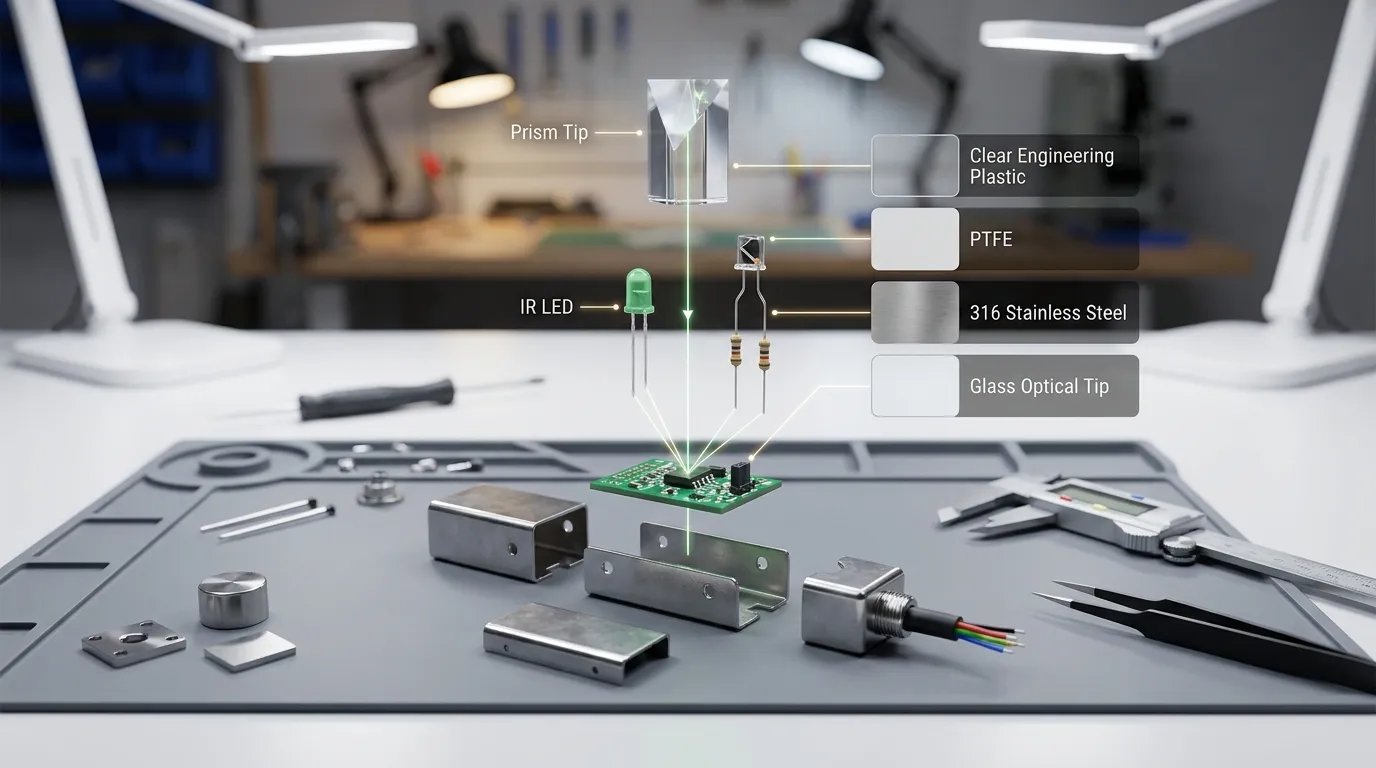
Si tu veux fabriquer la tête sensorielle toi-même, La disposition optique est la partie la plus importante.
La LED IR doit éclairer le prisme ou la pointe transparente à un angle répétable. Le récepteur doit être positionné de façon à ce que la lumière réfléchie revienne fortement à l’état sec. Quand le liquide touche le prisme, la lumière réfléchie diminue ou se déplace. Votre circuit détecte alors ce changement.
Un prototype de base peut être organisé ainsi:
- LED IR dirigée vers le corps du prisme transparent
- Phototransistor placé pour recevoir l’IR réfléchi
- Résistance pour limiter le courant des LED
- Résistance de tirage vers le haut ou tirage vers le bas pour le signal récepteur
- Entrée analogique ou entrée de comparateur microcontrôleur
- Blindage autour de la paire optique pour bloquer la lumière de la pièce
- Tête mécanique scellée pour que le liquide n’atteigne que la pointe du prisme
La partie la plus difficile est de fabriquer le prisme. Une embout en plastique rugueux, surface rayée, Époxy trouble, ou une LED mal alignée peut rendre le capteur instable. Pour l’eau, Une pointe optique en plastique transparent peut fonctionner pour l’apprentissage. Pour le pétrole, combustible, Produits chimiques, Détergents, ou des liquides chauds, Le choix des matériaux devient beaucoup plus sérieux.
Matériaux humidifiés: Plastique, PTFE, Inox, et Verre
Le « matériau humidifié » est la partie qui touche le liquide. Pour un projet DIY, Les gens se concentrent souvent uniquement sur le circuit, Mais le matériau en contact avec le liquide décide si le capteur survit.
Alimentation ou plastique d’ingénierie peut être utile pour des conceptions compactes de niveaux d’eau où l’exposition chimique est légère. Il est plus facile à usiner ou à mouler que le métal.
PTFE est choisie lorsque la résistance chimique ou un comportement antiadhésif plus fort est nécessaire. Il peut être utile lorsque les résidus ou un liquide agressif sont un problème.
316 Acier inoxydable est courant pour les boîtiers industriels car il confère une résistance mécanique, résistance à la corrosion, et un corps fileté professionnel.
Embouts optiques en verre sont souvent utilisés lorsque la clarté optique est utilisée, Résistance thermique, ou la stabilité chimique est importante. Le verre peut aussi aider à la détection répétable à la surface du prisme.
Pour l’apprentissage DIY, Un simple plastique peut être acceptable. Pour l’équipement OEM, appareils, Projets carburant/huile, ou produits exportés, Vérifiez la compatibilité des matériaux avant de commander un capteur.
Types de sorties que vous pouvez voir: Numérique, NPN, PNP, et 4–20 mA
De petits modules de loisir fournissent généralement un signal numérique simple ou une tension analogique. Les capteurs industriels peuvent utiliser le NPN, PNP, Interface de type relais, ou une sortie de 4 à 20 mA selon le système de contrôle.
Sortie NPN est courant lorsque le capteur transmet le courant à l’entrée de commande.
Sortie PNP est courant lorsque le capteur fournit du courant à l’entrée de commande.
4Sortie de –20 mA est généralement utilisé pour la transmission analogique industrielle, Surtout lorsque de longs câbles ou l’immunité au bruit sont importants. Pour un capteur DIY simple au niveau ponctuel, La sortie numérique suffit généralement.
Avant de commander, Vérifie le type d’entrée de ta manette. Un capteur avec une mauvaise sortie peut quand même être un bon capteur, Mais il ne se connectera pas proprement à votre carte sans électronique d’interface.
Montage correct du capteur
Le montage détermine si votre capteur optique donne des lectures claires.
Le montage latéral est courant pour la détection au niveau ponctuel. La pointe du prisme traverse la paroi du réservoir et se situe exactement au niveau que vous souhaitez détecter. Le montage fileté est plus résistant que la colle ou le ruban adhésif, Surtout quand le réservoir vibre ou que le câble est tiré.
Pour les petits contenants DIY, Un support peut maintenir le capteur depuis le dessus, mais la pointe doit rester fixe à la hauteur choisie. Si le capteur bouge, Votre niveau de déclenchement évolue aussi.
Vérifiez ces points de fixation:
- Gardez la pointe du prisme propre et exposée au liquide.
- Évitez de placer la pointe trop près des parois réfléchissantes ou des pièces métalliques brillantes.
- Ne laissez pas les câbles suspendus d’une manière qui tire sur le capteur.
- Scellez correctement l’ouverture du réservoir.
- Garde la partie électronique à l’écart de la condensation et des éclaboussures.
- Choisissez le filetage et le style de fixation avant de percer le réservoir.
Pour les équipements de production, Les décisions courantes incluent le corps droit vs le corps à angle droit, Montage fileté vs montage à bride, Plastique vs boîtier en inox, et longueur de câble.
Étalonnage: Transformez les relevés humides et secs en un signal fiable
La calibration est simple mais ne doit pas être ignorée.
D'abord, Alimente le capteur dans l’air et enregistre la lecture sèche. Ensuite, humidifier complètement le prisme et enregistrer la lecture humide. Si on utilise une entrée analogique, Choisissez un seuil de commutation entre ces deux valeurs. Si on utilise la sortie numérique, vérifiez si le module indique HAUT quand il est mouillé ou HAUT lorsqu’il est sec.
Testez alors les conditions réelles:
- Remplissage lent
- Remplissage rapide
- éclaboussures
- bulles
- écume
- Des gouttes s’accrochent à la pointe
- eau sale ou résidus
- Exposition à la lumière ambiante
- vibrations près du réservoir
Ajouter un debounce dans le code ou la logique. Un court délai avant de confirmer si c’est humide ou sec évite les fausses alertes lorsque le liquide touche brièvement le prisme.
Erreurs courantes de bricolage et comment les éviter
Interférence de lumière ambiante: Les récepteurs IR peuvent être affectés par la lumière du soleil, lampes puissantes, ou environnement réfléchissant. Protégez la LED et le récepteur, et tester près de l’environnement d’installation final.
Prisme sale: Film à huile, Tarche minérale, Algues, poussière, Ou un liquide collant peut modifier le chemin optique. Nettoyez la pointe et choisissez un matériau qui correspond au liquide.
Mauvaise hypothèse de sortie: Certains capteurs s’allument lorsqu’ils sont mouillés; d’autres s’allument quand ils sont secs. Testez toujours les deux états avant de connecter la logique de contrôle.
Mauvaise étanchéité: Un prototype d’établi fonctionnel peut échouer dans une zone humide de réservoir. Scellement des sorties de câble, Protéger la carte électronique, et éviter les soudures exposées près du liquide.
Mauvaise géométrie prismique: Les prismes DIY nécessitent des surfaces propres et des angles répétables. L’acrylique brut ou l’adhésif trouble peuvent réduire la réflexion.
Aucun soulagement mécanique de la contrainte: Le mouvement du câble peut desserrer le capteur ou fissurer un joint.
Pas de démarche: Vagues, écume, et les gouttelettes peuvent créer de courtes fausses transitions. Confirmez l’état pendant une courte période avant d’agir en conséquence.
Acheter un capteur fini coûte moins cher que de faire soi-même
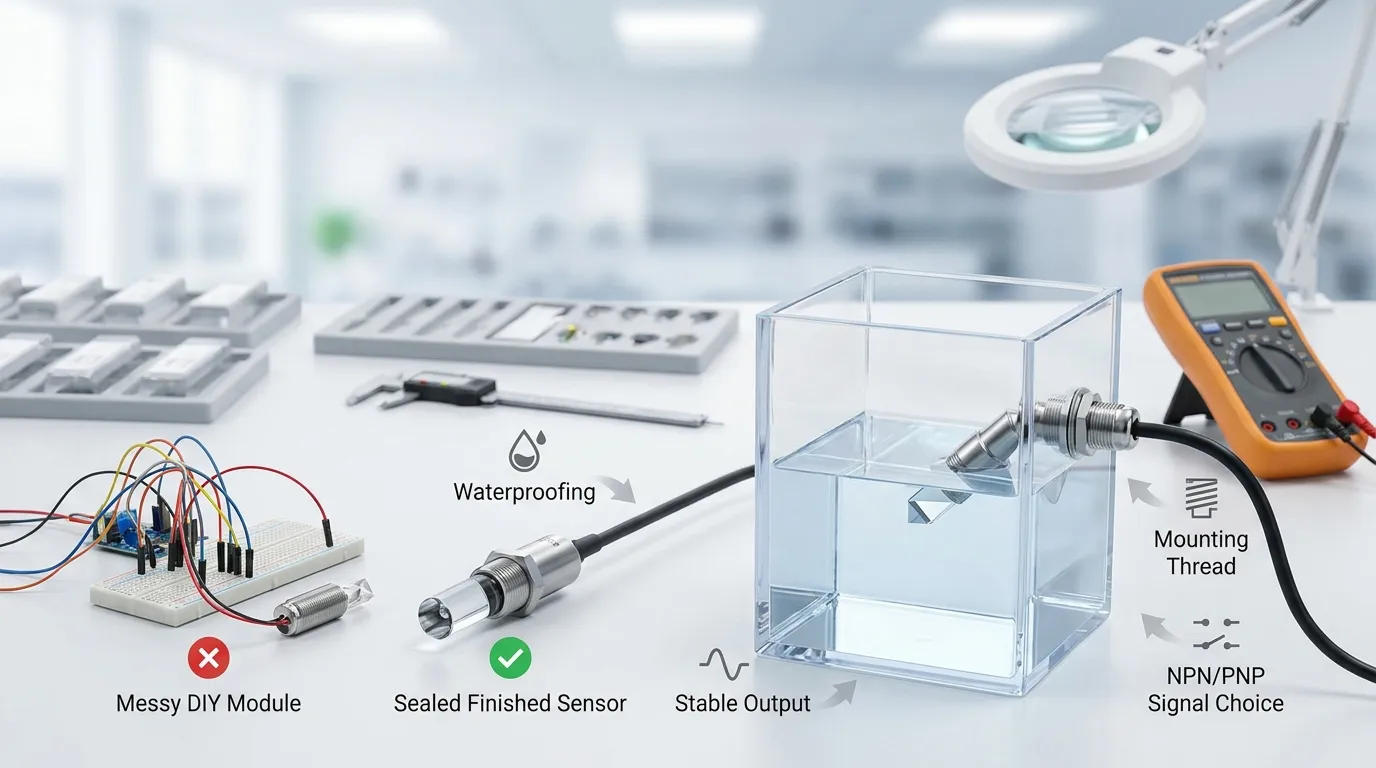
Le bricolage est moins cher quand on apprend, Test d’une idée, Ou construire un prototype rapide à partir de pièces que vous possédez déjà. Mais un capteur de niveau optique fini est souvent moins cher quand on compte le coût total du projet.
Achetez un capteur fini quand vous en aurez besoin:
- Détection humide/sec répétable
- câble et boîtier scellés
- NPN stable, PNP, ou production industrielle
- corps compact pour un espace limité
- PTFE, 316 Inox, verre, ou d’autres options de matériaux humides
- Personnalisation OEM/ODM
- Constance de la quantité de production
- Communication avec les fournisseurs prêts à l’exportation
- Moins de défaillances de champ
HojellyTek est un fabricant et exportateur de Shenzhen spécialisé dans la détection optique photoélectrique, R interne&D, et des projets de capteurs de niveau liquide OEM/ODM pour des clients aux États-Unis, EU, Inde, et autres marchés. Si votre prototype DIY évolue vers un vrai produit, notre Microcapteur optique fini peut réduire la refonte, Risque d’étanchéité, et temps d’assemblage.
Quoi vérifier avant de commander un capteur de niveau optique terminé
Avant d’envoyer une RFQ, Préparez ces détails:
- Type liquide: eau, huile, combustible, Détergent, Liquide de refroidissement, ou chimique
- Matériau du réservoir et épaisseur des parois
- Position de montage et style de filetage requis
- Exigence de logique humide/sèche
- Type de sortie: NPN, PNP, analogique, ou une autre interface
- Tension d’alimentation requise par votre carte de contrôle
- Longueur de câble et préférence pour les connecteurs
- Préférence pour les matériaux humides: plastique, PTFE, 316 Inox, verre
- si le projet nécessite une taille de carrosserie OEM, Marque privée, ou câble personnalisé
- si le capteur est pour prototype, Pilote, ou production de masse
Pour la surveillance de réservoirs intelligents ou les projets d’appareils connectés, Vous pouvez aussi discuter des besoins d’intégration tels que les cartes contrôleurs, Modules sans fil, ou la conception de systèmes liés à Tuya/Smart Life, lorsque c’est pertinent.
FAQ
Puis-je construire un capteur optique de niveau liquide DIY avec une LED IR et un phototransistor ??
Oui. Vous pouvez construire un détecteur optique de niveau ponctuel basique avec une LED IR, Phototransistor, Pointe prismatice, Résistances, et une carte de contrôle basse tension. Les parties difficiles sont l’alignement optique, Étanchéité, Blindage de la lumière ambiante, et étalonnage stable.
Est-ce qu’un module de niveau optique prêt à l’emploi est-il mieux que de construire à partir de pièces séparées?
Pour la plupart des projets pratiques, oui. Un module prêt à l’emploi fait gagner du temps car la tête optique et le circuit de base sont déjà assemblés. Construire à partir de parties séparées est mieux pour apprendre, Expériences personnalisées, Ou comprendre comment fonctionne le principe de détection.
Ce capteur peut-il mesurer le niveau complet du réservoir?
Un capteur optique de niveau basique détecte le liquide à un moment donné. Il indique si la pointe du prisme est humide ou sèche. Pour la mesure continue du niveau des réservoirs, Il faut une approche de détection différente ou plusieurs points de détection.
Pourquoi mon capteur optique se déclenche-t-il incorrectement?
Les causes courantes incluent la lumière du soleil, Surfaces sales du prisme, Gouttes collées à la pointe, Murs de réservoir réfléchissant, Câblage desserré, Mauvais scellement, et aucun rebond dans la logique de contrôle. Tester les lectures sèches et humides dans des conditions de montage réelles.
Puis-je utiliser ce capteur pour contrôler une pompe ??
Vous pouvez utiliser le signal capteur basse tension comme entrée pour un contrôleur adapté. Ne branchez pas le capteur directement sur l’alimentation ou une pompe AC. Tout circuit d’alimentation de pompe doit être conçu avec une isolation appropriée et une protection de sécurité par une personne qualifiée.
Quand devrais-je contacter HojellyTek au lieu de continuer le DIY?
Contactez HojellyTek lorsque votre prototype a besoin d’un corps scellé, Sortie stable, taille compacte, Matériau humide spécial, Personnalisation OEM/ODM, ou la cohérence prête à la production. Envoyez votre type liquide, Méthode de montage, Exigence de production, et planifier la quantité par WhatsApp ou email pour demander un devis.


