
Alternative optique au capteur de niveau liquide Keyence
Pour les acheteurs à la recherche Niveau du capteur de fluide optique Keyence, HojellyTek propose une alternative directe d’usine pour capteurs optiques de niveau liquide pour les OEM qui ont besoin d’une détection fiable au niveau du point sans payer un prix premium de marque sur chaque unité.
Keyence est bien connu pour ses capteurs d’automatisation haut de gamme, Documentation solide, et un support technique rapide. Mais lorsque l’application est un travail clair et ponctuel — détecter si un liquide est présent ou absent à un endroit donné — un capteur optique moins coûteux d’un fabricant de Shenzhen peut être le choix le plus judicieux pour un volume OEM sensible au budget.
Capacités des capteurs de niveau optique pour équipements OEM
Nos solutions de détection optique sont conçues pour des réservoirs compacts, Systèmes d’eau, Réservoirs d’appareils, Surveillance du carburant et du mazout, Équipement médical ou de laboratoire, Machines de nettoyage, Systèmes de distribution automatique, Détection de condensats CVC, et des équipements de procédé industriels où un simple signal humide/sec est nécessaire.
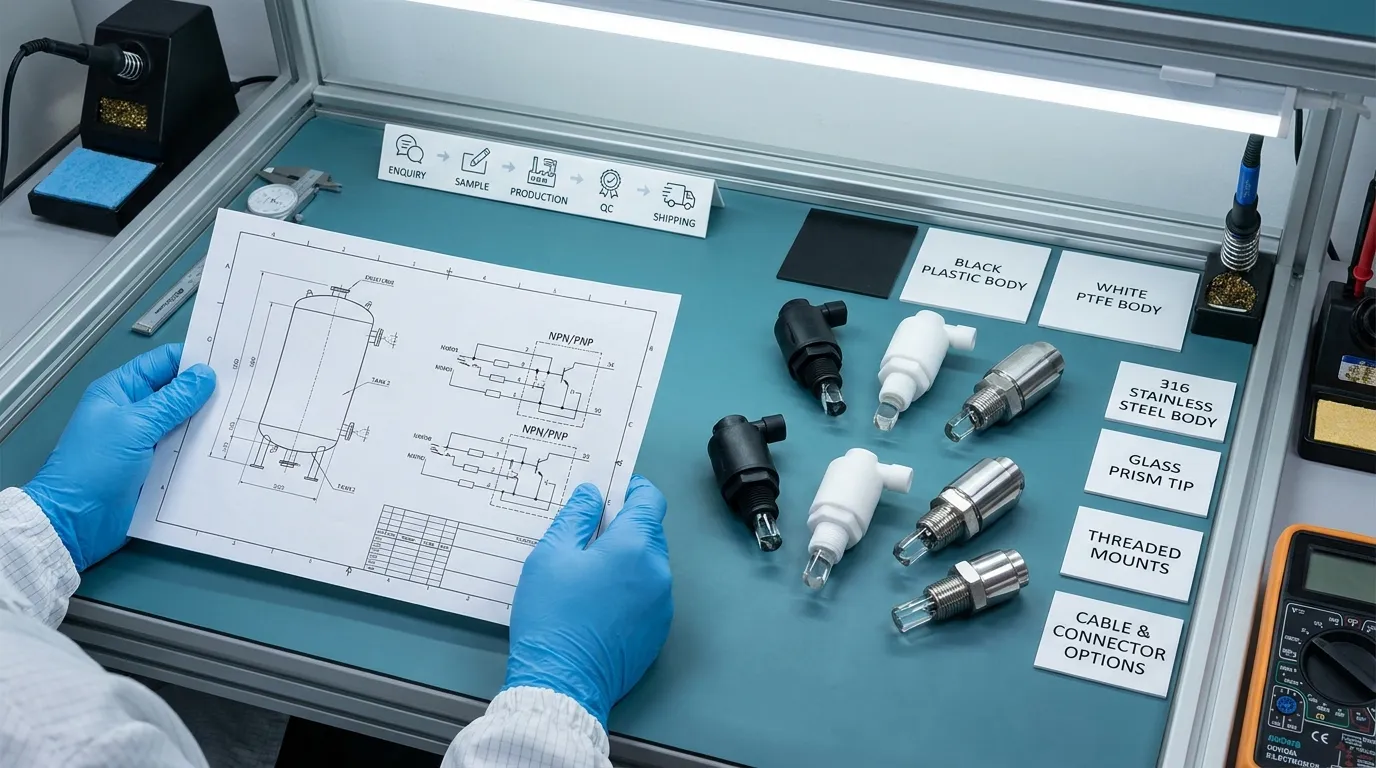
Un exemple typique Capteur de niveau optique peuvent être configurés en fonction de la conception mécanique et électrique du client, y compris:
- Détection de la présence de liquide photoélectrique
- Commutation de niveau de point à pointe de prisme compacte
- Protection contre les essais à sec, Alarme de débordement, Alarme de bas niveau, et détection de présence de chars
- Montage horizontal ou vertical selon la conception des parois du réservoir
- Plastique, métal, ou des parties humidifiées en verre selon le liquide
- NPN, PNP, normalement ouvert, normalement fermé, ou une logique de signal personnalisée
- Câble, Connecteur, fil, Forme du corps, et la personnalisation de la sortie pour les builds OEM/ODM
L’objectif n’est pas de copier toutes les catégories de produits Keyence. Keyence couvre un large éventail de technologies de détection, y compris la fibre optique, radar, ultrasonique, et systèmes de niveaux continus. Notre offre est axée sur la détection ponctuelle optique/photoélectrique où une alternative OEM pratique peut réduire les coûts tout en répondant aux exigences réelles de l’application.
Quand une alternative HojellyTek a plus de sens qu’un capteur de keyence premium
La keyence est souvent choisie lorsqu’une plante a besoin d’un soutien local rapide, un écosystème d’automatisation large, ou un ensemble de détection prêt à l’emploi avec une documentation détaillée. Cela a du sens pour les lignes d’automatisation à forte valeur ajoutée, Dépannage urgent, ou des installations standardisées autour des contrôleurs et amplificateurs Keyence.
Mais de nombreux acheteurs OEM ne cherchent pas à résoudre un problème complexe d’automatisation. Ils ont besoin de milliers d’interrupteurs compacts à niveau liquide installés dans des produits reproductibles: Humidificateurs, Réservoirs, Pompes, Dispositifs de traitement de l’eau, distributeurs, Matériel de nettoyage, Petits réservoirs, et modules fluides. Dans ces projets, Les principales préoccupations de l’acheteur sont la détection stable, Qualité de fabrication reproductible, Ajustement personnalisé, et le coût unitaire total.
C’est là qu’un capteur optique direct à l’usine devient attrayant. Si la demande doit seulement confirmer « liquide présent » ou « liquide absent » à un niveau fixe, Un capteur à prisme photoélectrique peut souvent fournir la fonction requise avec une structure de coûts plus simple. Au lieu de payer pour un écosystème premium sur chaque appareil, Les OEM peuvent spécifier le matériau exact de la carrosserie, fil, Câble, Type de signal, et la norme de test de production dont ils ont besoin.
Le principe de détection est simple. À l’intérieur du capteur, une LED infrarouge émet de la lumière dans une pointe de prisme transparente. À l’état sec, La lumière se réfléchit à l’intérieur du prisme et revient vers un phototransistor ou un récepteur. Lorsque le prisme est humidifié par un liquide, Changements de la condition réfractive, donc moins de lumière revient au récepteur. L’électronique convertit ce changement optique en signal de commutation pour la carte de contrôle ou un PLC.
Cette conception fonctionne particulièrement bien lorsque le liquide est compatible avec la détection optique et que la pointe du capteur reste propre. Eau claire, De nombreuses huiles, et les liquides chimiques compatibles peuvent être détectés efficacement. Cependant, Les acheteurs doivent confirmer le liquide réel, Parce que les liquides laiteux, mousse épaisse, Fluides cristallisants, résidus collants, ou des solides en suspension peuvent réduire le contraste optique ou recouvrir le prisme. Une comparaison équitable doit inclure ces conditions réelles, Pas juste une case à cocher pour le catalogue.
Le choix des matériaux compte aussi. Les plastiques d’alimentation et autres plastiques d’ingénierie peuvent convenir aux applications sensibles aux coûts liés à l’eau ou aux appareils électroménagers. Le PTFE est préféré lorsque la résistance chimique est importante. 316 L’acier inoxydable est utilisé lorsqu’un boîtier plus solide ou une meilleure résistance à la corrosion est nécessaire. Les embouts en verre peuvent supporter certains designs optiques de haute clarté et des environnements chimiques, Mais la compatibilité complète des liquides doit toujours être vérifiée avant de commander.
La sortie électrique est une autre décision clé. De nombreux systèmes OEM utilisent des sorties NPN ou PNP pour la connexion directe à une entrée contrôleur. Certains modèles nécessitent une logique normalement ouverte ou normalement fermée selon que l’alarme doit se déclencher à sec ou à l’état humide. Si votre système de contrôle nécessite 4 à 20 mA, Vérifiez si vous avez besoin d’un capteur de niveau continu ou d’une sortie analogique; Un commutateur optique de base ne doit pas être supposé fournir une mesure continue.
Le montage doit être considéré comme faisant partie de la conception du capteur, Ce n’est pas une pensée après coup. Type de filetage, Méthode d’étanchéité, Épaisseur du mur, Courbure du réservoir, Matériau du joint, Contrôle du couple, Direction du câble, et la position du prisme affectent toutes la fiabilité sur le champ. Un capteur fonctionnant sur un établi d’essai peut échouer en production si la pointe est placée dans une zone de bulle, installé trop près d’une entrée de remplissage, exposé à l’accumulation de sédiments, ou monté là où le liquide s’écoule trop lentement du prisme.
Pour les fabricants d’origine comparant Keyence à un Fabricant de capteurs optiques, la question la plus importante n’est pas « Quelle marque est célèbre?« C’est « Quel package de détection offre la performance de détection requise, personnalisation, et l’économie unitaire pour ce produit?”
Modes de défaillance courants que les acheteurs devraient vérifier avant de changer
Une alternative moins coûteuse peut bien fonctionner, mais seulement lorsque l’application est correctement spécifiée. Avant de remplacer ou de concevoir autour d’un capteur optique de niveau liquide alternatif, Vérifiez ces points de risque:
- Film liquide à feuilles, huile, Échelle, ou des cristaux sur la pointe du prisme
- La mousse ou les bulles touchent le prisme avant que le niveau réel du liquide ne l’atteigne
- Le liquide est opaque, Milky, Fortement coloré, ou rempli de particules
- La paroi du bac est trop fine, trop épais, courbe, ou flexible pour le fil sélectionné
- La direction de sortie du câble entre en conflit avec l’enceinte ou la disposition du circuit imprimé
- La logique NPN/PNP ou NO/NC ne correspond pas à l’entrée du contrôleur
- Le matériau du corps du capteur n’est pas compatible avec le liquide ou l’agent nettoyant
- Condensation, Lavage, Ou une mauvaise étanchéité des câbles provoque l’entrée d’humidité
- Le capteur est installé près de la turbulence, Jets de remplissage, ou vibration de la pompe
- L’acheteur compare un commutateur optique à un niveau continu Keyence et s’attend à une mauvaise fonction
Une alternative appropriée doit être basée sur le poste de détection, Pas seulement la marque concurrente.
Comment fonctionne notre procédé alternatif OEM
- Enquête — Envoyez le liquide cible, Dessin de char, Fonction attendue, Exigence de câblage, et la référence actuelle du capteur si disponible.
- Revue des spécifications et de la personnalisation — Notre équipe d’ingénierie vérifie le matériau de la carrosserie, Conception du prisme, Câble, fil, Logique de sortie, et position d’installation.
- Exemple de confirmation — Un échantillon peut être préparé pour un essai d’ajustement, Essai liquide, Test d’entrée de contrôleur, et la revue de l’assemblée.
- Production et contrôle qualité — Après confirmation, La production suit les normes électriques convenues, mécanique, et exigences d’inspection pour la commande OEM.
- Soutien à l’expédition et à l’exportation — En tant que fabricant/exportateur de Shenzhen, nous soutenons les expéditions pour les clients aux États-Unis, EU, Inde, et autres marchés.
Exigences à confirmer avant de commander
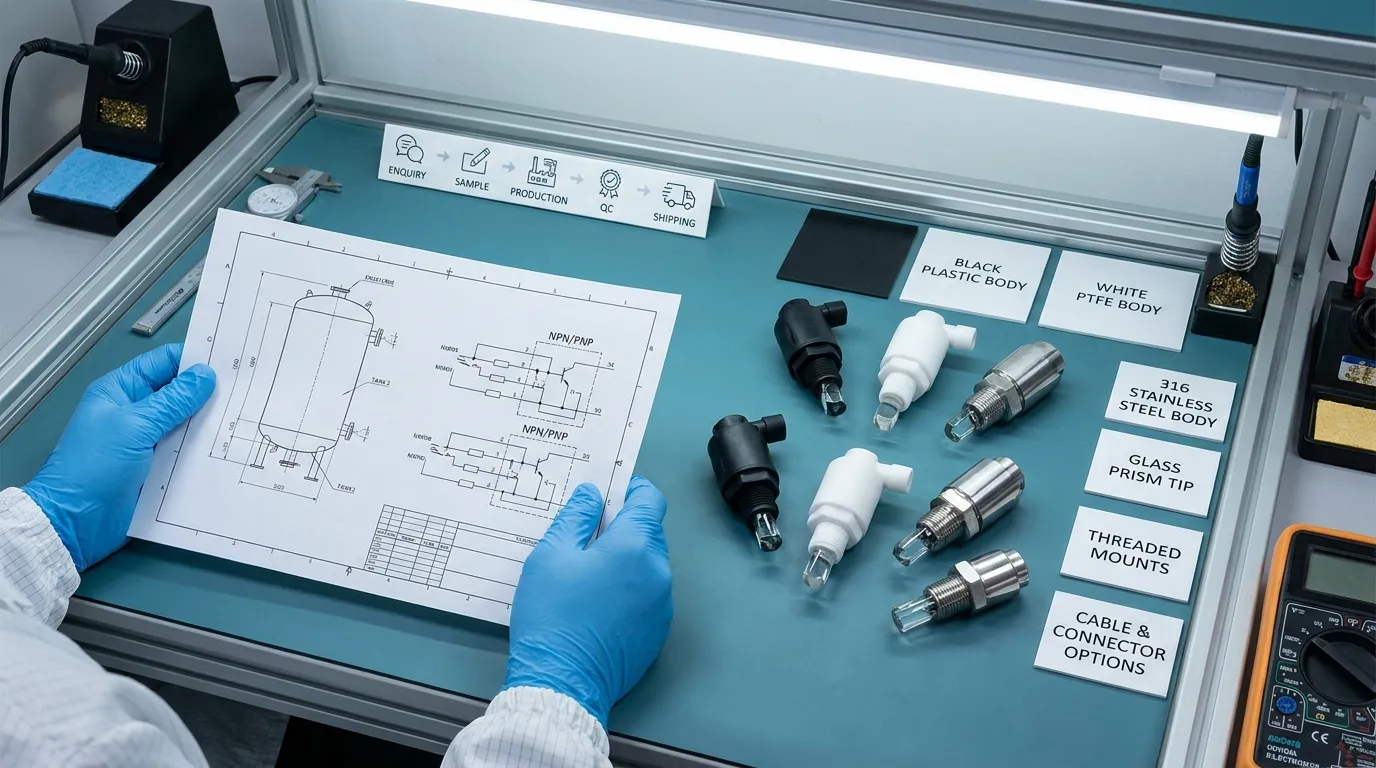
Pour choisir le bon Commutateur de niveau optique OEM, Préparez ces détails avant de demander un devis:
- Type liquide, Concentration, Couleur, viscosité, et si la mousse ou les résidus sont attendus
- Matériau du réservoir, Épaisseur du mur, Orientation de montage, et méthode d’étanchéité
- Sortie requise: NPN, PNP, NON, NC, ou une autre logique d’entrée de contrôleur
- Que l’application nécessite une détection ponctuelle ou une mesure de niveau continue
- Longueur du câble, Style de connecteur, Couleur du fil, et l’exigence de soulagement de la contrainte
- Préférence pour les matériaux humidifiés: Alimentation, PTFE, 316 Acier inoxydable, verre, ou d’autres options
- Environnement d’exploitation: vibration, Lavage, condensation, Exposition à la température, et méthode de nettoyage
- Volume annuel attendu, Quantité d’échantillon, Besoins en matière d’emballage, et exigences d’étiquetage
Pour les appareils électroménagers intelligents ou les systèmes fluides liés à l’IoT, L’intégration Tuya/Smart Life peut être pertinente au niveau de l’appareil, Mais la spécification du capteur devrait tout de même commencer par l’exigence physique de détection des liquides.
Keyence vs HojellyTek Alternative au capteur optique de niveau liquide
| Zone de comparaison | Keyence Optical / Options de capteurs de niveau de fluide | HojellyTek Factory-Direct Alternative |
|---|---|---|
| Positionnement | Marque d’automatisation haut de gamme avec un soutien solide et un écosystème produit large | Le fabricant OEM de Shenzhen s’est concentré sur les solutions optiques de détection de liquides |
| Meilleur choix | Plantes nécessitant un soutien rapide, Documentation, Démos, et l’intégration avec les systèmes Keyence existants | Les OEM ayant besoin de capteurs ponctuels personnalisés à un coût unitaire moindre |
| Gamme technologique | Comprend plusieurs catégories de détection de niveaux selon la famille de produits sélectionnée | Axé sur la détection optique photoélectrique au niveau ponctuel |
| Rôle de détection | Peut couvrir l’optique, fibre, et d’autres technologies de niveau selon le modèle | Idéal pour détecter la présence de liquides humides/secs à un point fixe |
| Personnalisation | Écosystème solide de produit standard; La personnalisation dépend du projet et du canal | Carrosserie, fil, Câble, Sortie, matériel, et l’emballage peut être discuté pour les montages OEM |
| Structure des prix | La tarification des marques premium est souvent acceptable pour les projets d’automatisation à forte valeur ajoutée | Plus adapté aux achats en volume sensibles au budget |
| Là où il gagne | Soutien local rapide, Documentation large, Confiance d’automatisation établie | Contrôle des coûts, Communication en usine, Flexibilité OEM, et la conception de capteurs spécifiques à l’application |
| Important caution | Ne supposez pas que tous les produits de niveau Keyence soient des commutateurs de point optique | N’utilisez pas un commutateur de point où une mesure continue est requise |
Pourquoi travailler avec HojellyTek
HojellyTek fabrique des capteurs optiques et photoélectriques de niveau liquide à Shenzhen avec R interne&Support D et OEM/ODM. Notre équipe travaille avec des fabricants d’équipements qui ont besoin de solutions pratiques de détection des liquides, Pas seulement le remplacement de pièces par catalogue.
Les acheteurs peuvent commencer par Notre capteur de niveau optique puis demander des modifications à la conception mécanique, Sortie électrique, Câble, Connecteur, matériel, ou emballage. Cela est utile lorsque le capteur doit s’adapter à un réservoir existant, PCB, Enceinte, ou une gamme de produits d’exportation.
FAQ
HojellyTek est-il un remplaçant direct de Keyence?
Nous proposons des alternatives compatibles pour des capteurs optiques de niveau liquide adaptées aux applications ponctuelles, mais nous ne sommes pas approuvés par Keyence et ne prétendons pas remplacer toutes les technologies de détection de niveau Keyence. Le bon choix dépend du liquide, installation, Sortie, et si le travail est une détection ponctuelle ou une mesure continue.
Que devrais-je comparer pour les projets de niveau de capteur de fluide optique Keyence?
Comparez la méthode de détection, Compatibilité liquide, Position de montage, Matériaux humides, Type de sortie, câble ou connecteur, Logique de contrôle, et fonction de détection requise. Ne comparez pas uniquement l’apparence de marque ou de capteur.
Quand devrais-je encore choisir Keyence?
Choisissez Keyence lorsque votre usine nécessite un support local premium, Dépannage rapide, Intégration avancée en automatisation, ou une technologie Keyence spécifique déjà approuvée dans votre système. Il peut aussi être préférable pour des applications de niveau complexe au-delà de la simple détection optique de points.
Les capteurs optiques peuvent-ils détecter l’huile et l’eau ??
Oui, Les capteurs optiques de niveau ponctuel sont couramment utilisés pour l’eau, huile, et liquides compatibles, Mais le liquide lui-même doit être testé ou examiné. Écume, Revêtement, Opacité, Particules en suspension, et la compatibilité chimique peut affecter la performance.
Peut-on personnaliser NPN, PNP, NON, ou sortie NC?
Oui. La logique de sortie peut être examinée selon l’entrée de la carte de contrôle ou de l’API. L’acheteur doit confirmer si le système prévoit un enfoncement, Sources, normalement ouvert, normalement fermé, ou un autre comportement de signal.
Comment puis-je demander un devis?
Envoyez votre type liquide, Dessin de char, installation photo, Exigence de production, Préférence en matière, Détails du câble, et le volume de commandes attendu par WhatsApp ou email. Notre équipe examinera la demande et recommandera une alternative adaptée au capteur optique de niveau liquide.
Demandez un devis pour un capteur de niveau optique alternatif Keyence
Si vous comparez des capteurs de liquide ou de liquide optiques Keyence pour un produit OEM, contactez HojellyTek avec les détails de votre candidature. Nous vous aiderons à vérifier si un capteur optique direct en usine à moindre coût peut répondre aux exigences de détection, Réduction du coût unitaire, et soutenir votre plan de production grâce à la conception sur mesure, Échantillonnage, et l’approvisionnement OEM.


