
IFM Optical Level Sensor Alternative
HojellyTek is not positioned as a full IO-Link ecosystem replacement. We are a Shenzhen factory-direct manufacturer focused on photoelectric optical liquid level sensing, Saincheaptha OEM / ODM, and cost-effective supply for volume projects where discrete liquid level switching is the real requirement.
Cumas Braiteoir Leibhéal Optúil Monarcha-Dhíreach
For buyers comparing IFM optical level sensors with a factory-direct option, the main question is not only “Can it replace the brand?” but “Does the sensing method, Aschur, ábhar, and installation match my machine?”
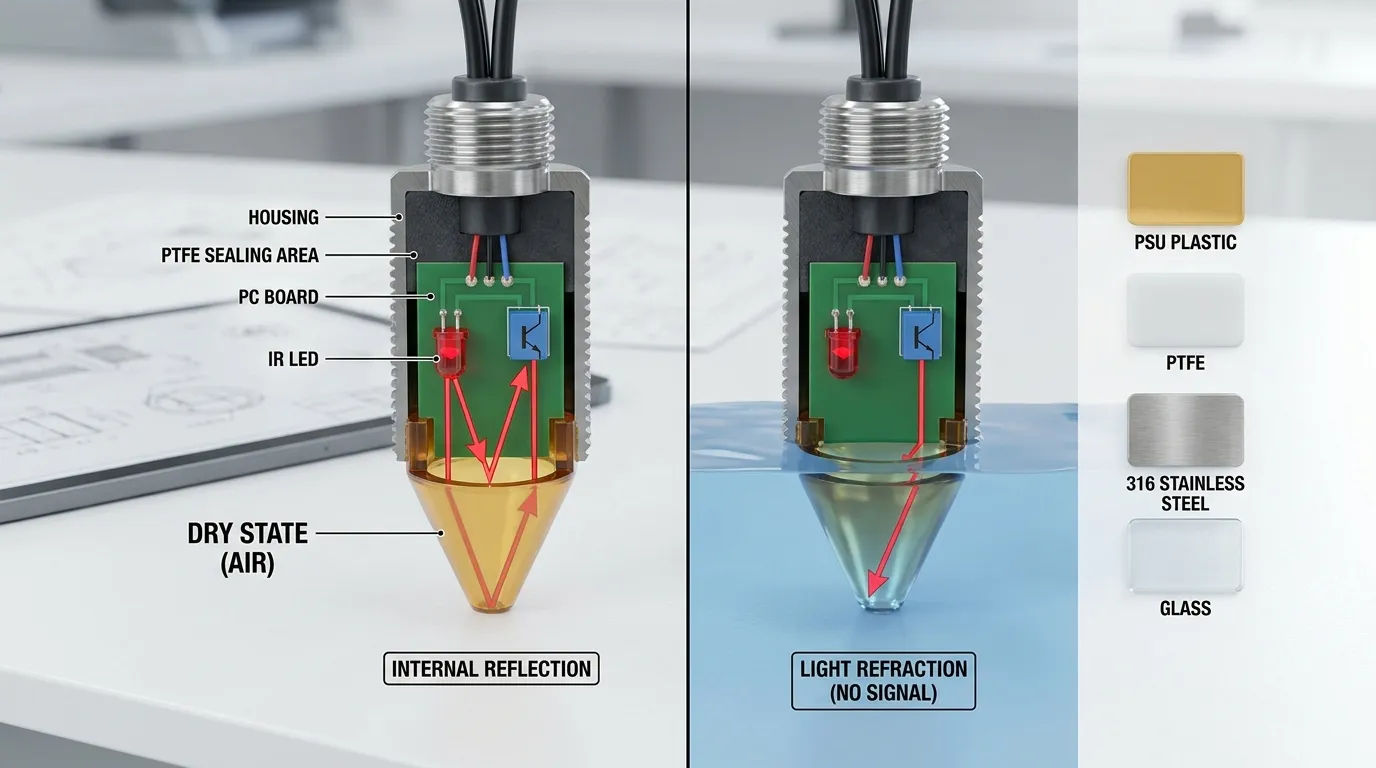
Our optical liquid level sensors are designed for point-level detection in tanks, fearais, córais dosing, trealamh uisce, oil-related systems, meaisíní glantacháin, and compact OEM assemblies. The core sensing principle uses an infrared LED, fóta-trasraitheoir, and an optical prism tip. San aer, the IR light reflects internally inside the prism. When liquid touches the prism surface, Athraíonn an coinníoll athraonta, light escapes into the liquid, and the receiver signal changes. The electronics convert this wet/dry state into a switching output.
This makes the sensor suitable when you need a compact “liquid present / liquid absent” signal rather than long-range distance measurement. Buyers can review our general Braiteoir Leibhéal Optúil guide for broader application examples, or check Ár Braiteoir Leibhéal Optúil product page for the standard product direction.
Common project options include:
- Compact optical prism sensing tip
- NPN or PNP switching output
- Loighic oscailte de ghnáth nó dúnta de ghnáth, depending on control design
- Threaded mounting for tank walls, small vessels, and equipment housings
- Cábla, cónascaire, and wiring customization by project
- Housing material selection based on liquid compatibility
- OEM/ODM support for sensor body, fad cábla, loighic aschuir, agus struchtúr suiteála
Where IFM Still Wins — and Where a Factory-Direct Alternative Fits
IFM has a strong position in industrial automation because many buyers need standardized catalog products, global distribution, PLC-friendly integration, IO-Link communication, advanced setup tools, and detailed industrial documentation. For factories already using IFM automation platforms, staying with IFM can reduce engineering risk.
That is especially true when the application requires an IO-Link optical sensor, Aschur analógach, distance-based measurement, advanced parameter setting, or integration into a larger IFM automation ecosystem. If your machine design depends on IO-Link diagnostics, configurable parameters, or a specific IFM communication profile, we should not describe a standard HojellyTek optical switch as a drop-in replacement.
The factory-direct alternative fits better in a different buying situation: Toirt OEM, customized mechanical design, repeated production orders, and cost-sensitive equipment where the level signal only needs to tell the controller whether liquid is present at a fixed point. Sna cásanna seo, paying for a broader automation platform may not be necessary.
Mar shampla, an appliance maker, tank module supplier, dosing equipment manufacturer, or water system OEM may only need:
- A reliable wet/dry switching point
- A compact body that fits a custom tank wall
- A specific thread, séala, or cable exit
- NPN or PNP output matching the control board
- Material compatibility with water, glantach, cuisnithe, ola, or other liquids
- Stable supply from a manufacturer instead of buying through layers of distribution
This is where our Shenzhen factory model becomes useful. We can support OEM/ODM projects through in-house R&D, photoelectric sensing design, Roghnú ábhair, tástáil samplach, and export supply to markets such as the US, TÁIMID, agus an India.
IO-Link, Analógach, and Discrete Output: The Honest Difference
The biggest technical comparison is output type.
Many IFM optical level sensor buyers are familiar with automation-grade outputs such as IO-Link, programmable switching, and in some product families analog signals such as 4–20 mA or voltage output. Those features are useful when a system needs device diagnostics, parameter setting, continuous measurement, or PLC-level monitoring beyond a simple wet/dry state.
Our standard optical liquid level sensor direction is different. It is mainly a discrete point-level switch. The usual output discussion is NPN vs PNP, and whether the logic should be normally open or normally closed. You can learn more about these wiring choices on our Roghanna aschuir NPN/PNP Leathanach.
Plainly stated: a standard HojellyTek prism optical level switch should not be sold as an IO-Link equivalent. If your specification requires IO-Link, confirm that requirement before quoting. If your application requires 4–20 mA continuous level output, that should also be discussed as a separate continuous-level project, not assumed for a standard point-level optical switch.
For many OEM products, discrete output is enough. The sensor only needs to tell the controller:
- Tank empty or tank filled at one point
- Liquid reached the safety level
- Pump should stop before dry-run
- Overflow point has been reached
- Cartridge, taiscumar, or small tank is installed and wet
When this is the true requirement, a customized discrete optical level sensor can be more practical than specifying an automation-grade sensor with features the machine will never use.
Ábhar, Gléasta, and Application Checks Before Ordering
Optical level sensors are sensitive to the real installation environment. A fair alternative comparison must include more than output type.
The first check is liquid compatibility. PSU plastic may suit many water-based applications. PTFE may be needed for more chemically aggressive liquids. 316 stainless steel can help where mechanical strength, friotaíocht creimeadh, or industrial appearance matters. A glass prism tip can be useful for optical stability and chemical compatibility, but the final selection depends on the liquid, brú, Modh glantacháin, and installation design.
The second check is the optical behavior of the liquid. Optical prism point sensors work best when the liquid can change the reflection condition at the prism surface. Cúr, iarmhar greamaitheach, sciath, heavy bubbles, criostalú, or thick contamination can cause false switching or delayed recovery. Transparent liquids, olaí, glantaigh, and coolants should be reviewed case by case because the refractive index and residue behavior matter.
The third check is mounting. Méid an snáithe, Tiús Balla, Modh séalaithe, Treo cábla, and sensor tip position all affect performance. A sensor mounted too close to a tank wall, at a turbulent inlet, or inside a bubble-heavy area may behave differently from a clean lab test. Do thionscadail OEM, we usually recommend testing samples in the real tank before production approval.
The fourth check is electrical matching. NPN and PNP outputs are not interchangeable. The buyer should confirm controller input type, supply design, Riachtanas reatha luchtaithe, wiring color preference, loighic aschuir, and whether the signal should be active when wet or active when dry.
5-Step OEM Project Process
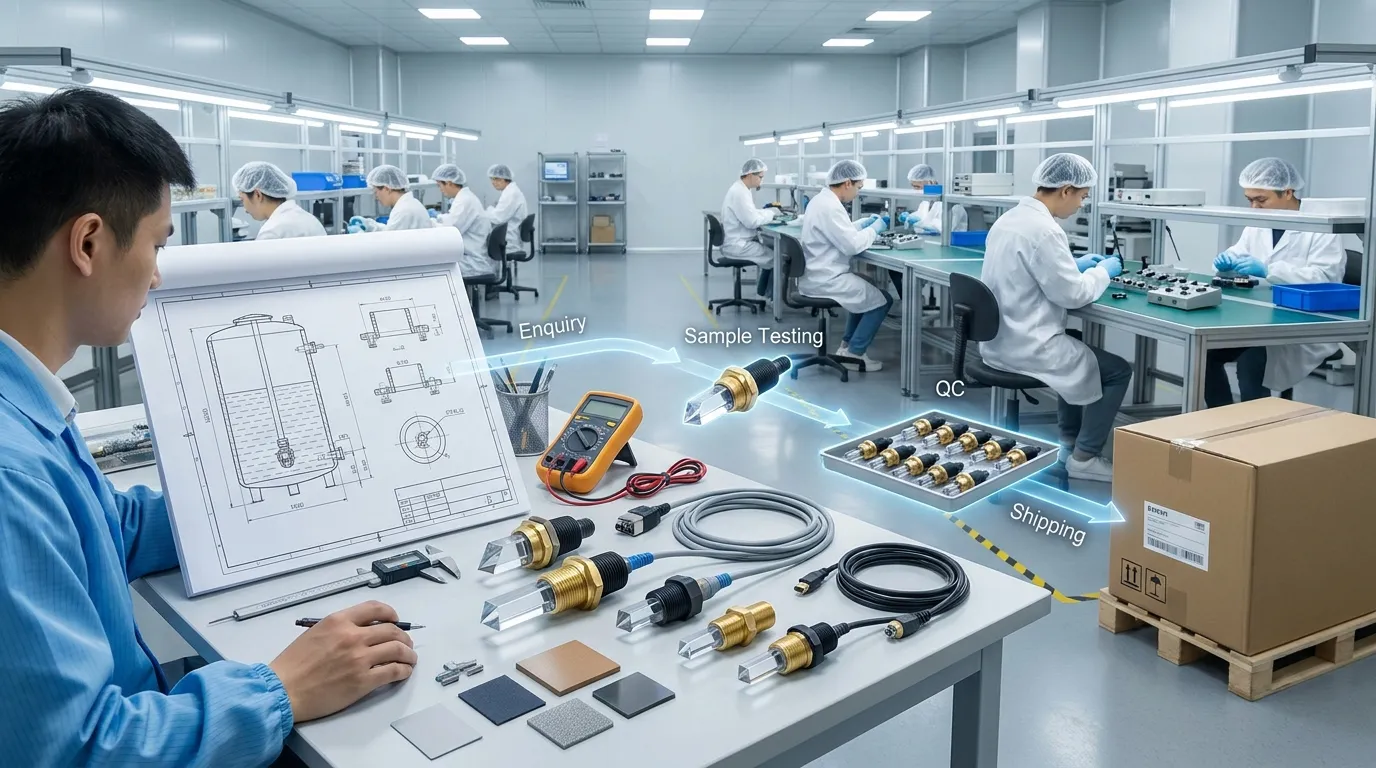
- Fiosrúchán: Send your IFM reference requirement, application drawing, cineál leachtach, ábhar umar, and expected function. We check whether a discrete optical switch is suitable or whether your project needs IO-Link, analógach, or continuous measurement instead.
- Sonraíocht agus Saincheaptha: Our team reviews output type, ábhar tithíochta, snáthaid, Modh séalaithe, cábla, cónascaire, and installation space. Do thionscadail OEM / ODM, we can discuss custom sensor structure and production requirements.
- Tástáil Samplach: Samples are prepared for validation in your actual liquid and tank design. This step is important because optical sensors can be affected by bubbles, sciath, cúr, and installation angle.
- Táirgeadh agus QC: Tar éis ceadú samplach, Leanann an táirgeadh an líníocht agus an tsonraíocht dheimhnithe. Quality checks focus on optical response, sreangú, Séalaithe, Cuma, and output function.
- Tacaíocht Loingseoireachta agus Easpórtála: We support export orders for OEM buyers and distributors. Lead time is confirmed after the final specification, ábhar, sample status, and order quantity are reviewed.
RFQ Requirements and Specs to Confirm
Before asking for a quote, na sonraí seo a ullmhú:
- Target application and machine type
- Ainm leachtach, tiúchan, coinníoll teochta, agus próiseas glantacháin
- Aschur riachtanach: NPN, PNP, Oscailte de ghnáth, nó dúnta de ghnáth
- Whether IO-Link or analog output is mandatory
- Tank wall material and wall thickness
- Thread or mounting method
- Fad cábla, cineál cónascaire, agus sainmhíniú sreangaithe
- Rogha ábhair tithíochta: PSU, PTFE, 316 cruach dhosmálta, barr gloine, or custom structure
- Expected order quantity and sample requirement
- Any drawings, grianghraif, or replacement notes from the existing IFM installation
For buyers who need a long-term supplier instead of a one-time replacement, ár monaróir braiteoir optúil page explains the broader factory capability.
Fair Comparison: IFM Optical Level Sensor vs HojellyTek Alternative
| Buyer Criteria | IFM / ifm efector Optical Level Sensor | Malartach Monarcha-Díreach HojellyTek |
|---|---|---|
| Seasamh an bhranda | Established global automation brand | Shenzhen optical liquid level sensor manufacturer/exporter |
| Is fearr a oireann | Uathoibriú tionsclaíoch, PLC systems, standardized catalog buying | Toirt OEM, custom tank design, cost-sensitive equipment |
| Cineál braiteora | Often selected for automation-grade optical sensing and advanced integration | Prism-based photoelectric liquid point-level detection |
| Measurement style | May support advanced measurement depending on model family | Wet/dry point-level switching |
| IO-Link | IFM is strong in IO-Link automation products | Not offered as standard for our prism optical level switch; must be confirmed separately |
| Analog output | Available in some automation-grade sensor configurations | Not assumed for standard point-level models; discuss separately if required |
| Discrete output | Common in automation sensors | NPN/PNP switching is the main fit |
| Saincheaptha | Usually catalog-driven | Saincheaptha OEM / ODM le haghaidh tithíochta, snáthaid, cábla, ábhar, agus loighic |
| Struchtúr costais | Brand and distribution value included | Factory-direct option for suitable volume projects |
| Where they still win | IO-Link ecosystem, global catalog, advanced automation documentation | Customized discrete liquid detection for OEM production |
Cén fáth a roghnaíonn ceannaitheoirí HojellyTek
HojellyTek focuses on photoelectric optical sensing for liquid level applications, not general automation catalogs. That focus helps when buyers need a compact sensor designed around a tank, taiscumar, or OEM machine rather than a standard off-the-shelf part.
Key trust points include:
- Shenzhen-based manufacturing and export support
- Intí R&D for optical liquid sensing
- OEM/ODM customization for volume projects
- Experience with optical, photoelectric, and compact liquid level sensors
- Support for US, TÁIMID, An India, agus margaí onnmhairithe eile
- Mise / Smart Life integration experience where wireless tank monitoring is relevant to the project scope
Ceisteanna CCanna
Is HojellyTek a direct ifm optical level sensor replacement?
Ní i gcónaí. If your IFM sensor requires IO-Link, Aschur analógach, or advanced automation functions, our standard optical point-level switch is not a direct equivalent. If your application only needs wet/dry liquid detection with NPN or PNP output, we can review a compatible factory-direct alternative.
Do you offer IO-Link optical level sensors?
Our standard prism optical liquid level switch should not be assumed to include IO-Link. If IO-Link is mandatory, state it clearly in the RFQ so we can confirm whether a suitable option exists or advise that the IFM-style automation sensor remains the better fit.
Can I use NPN or PNP output instead of an IFM IO-Link sensor?
Only if your controller does not require IO-Link data, diagnostics, or parameter setting. Many OEM machines only need a simple switching signal, but PLC systems designed around IO-Link should not be changed without engineering approval.
What liquids can an optical level sensor detect?
Optical point-level sensors are commonly used for water-based liquids and many industrial fluids, but every liquid should be checked. Cúr, iarmhar, boilgeoga, sciath, high viscosity, and refractive-index differences can affect performance.
Can you customize the sensor housing or mounting thread?
Tá. Do thionscadail OEM / ODM, we can discuss housing material, snáthaid, fad cábla, cónascaire, loighic aschuir, and mechanical structure. Final feasibility depends on drawing review, Comhoiriúnacht leachtach, agus tástáil samplach.
What should I send for a quote?
Send the existing sensor requirement, application photo or drawing, cineál leachtach, Riachtanas aschuir, Modh gléasta, rogha ábhartha, Sonraí Cábla, quantity estimate, and whether IO-Link or analog output is mandatory.
Request a Factory-Direct Alternative Quote
If your project needs IFM-level IO-Link automation, IFM may still be the better choice. If your real requirement is a compact optical liquid point-level sensor with NPN/PNP switching, Gléasadh saincheaptha, and OEM volume support, HojellyTek can help review a cost-effective alternative.
Seol do líníocht, liquid information, Riachtanas aschuir, and target quantity by WhatsApp or email to request a quote, sample review, or OEM customization discussion.


