
Braiteoir Leibhéal Optúil Sábháilte go Bunúsach
Cumas Braite Leibhéal Optúil Sábháilte go Bunúsach
Is HojellyTek monaróir Shenzhen agus onnmhaireoir dírithe ar bhraite leibhéal leachtach optúil fótaileictreach. Tacaíonn ár bhfoireann innealtóireachta le dearaí braiteoir pointe optúla saincheaptha do thógálaithe trealaimh thionsclaíocha, Soláthraithe Córas Umar, agus comhtháthóirí uathoibrithe a dteastaíonn dlúth uathu, Braite leachtach neamh-mheicniúil.
Brazzers físeán catagóir Inexperienced, Déagóirí, Seapáinis, Aziatochki, Téalainnis, Físeán HD ar a dtugtar Téalainnis Cailín Kim watch gan chlárú sa HD, Is féidir leis an raon feidhme:
- Brath leibhéal pointe priosma-bhunaithe optúil le haghaidh leachtach i láthair / Stádas neamhláithreach leachtach
- Struchtúir braite IR LED agus phototransistor le haghaidh aitheantas stáit tirim agus fliuch
- Plé ar ábhar an chomhlachta braiteora, lena n-áirítear PSU, PTFE, 316 cruach dhosmálta, agus gloine nuair is oiriúnach
- NPN, PNP, nó plé aschuir analógach bunaithe ar an gcóras rialaithe
- Snáithithe, painéal, umar - balla, agus coincheapa gléasta saincheaptha
- Cábla, cónascaire, agus athbhreithniú leagan amach sreangaithe le haghaidh lúb braite ísealchumhachta
- Tithíocht OEM / ODM, fad an tóireadóra, Sreang Scoir, agus saincheaptha loighic aschuir
- Tacaíocht RFQ do chustaiméirí a onnmhairíonn trealamh go SAM, TÁIMID, An India, agus margaí tionsclaíocha eile
Maidir le prionsabail oibre ghinearálta agus roghanna braiteoirí caighdeánacha, féach ar ár Braiteoir Leibhéal Optúil forbhreathnú agus an táirge braiteoir leibhéal optúil Leathanach.
Coincheap IS: Cosc a chur ar adhaint trí fhuinneamh a theorannú
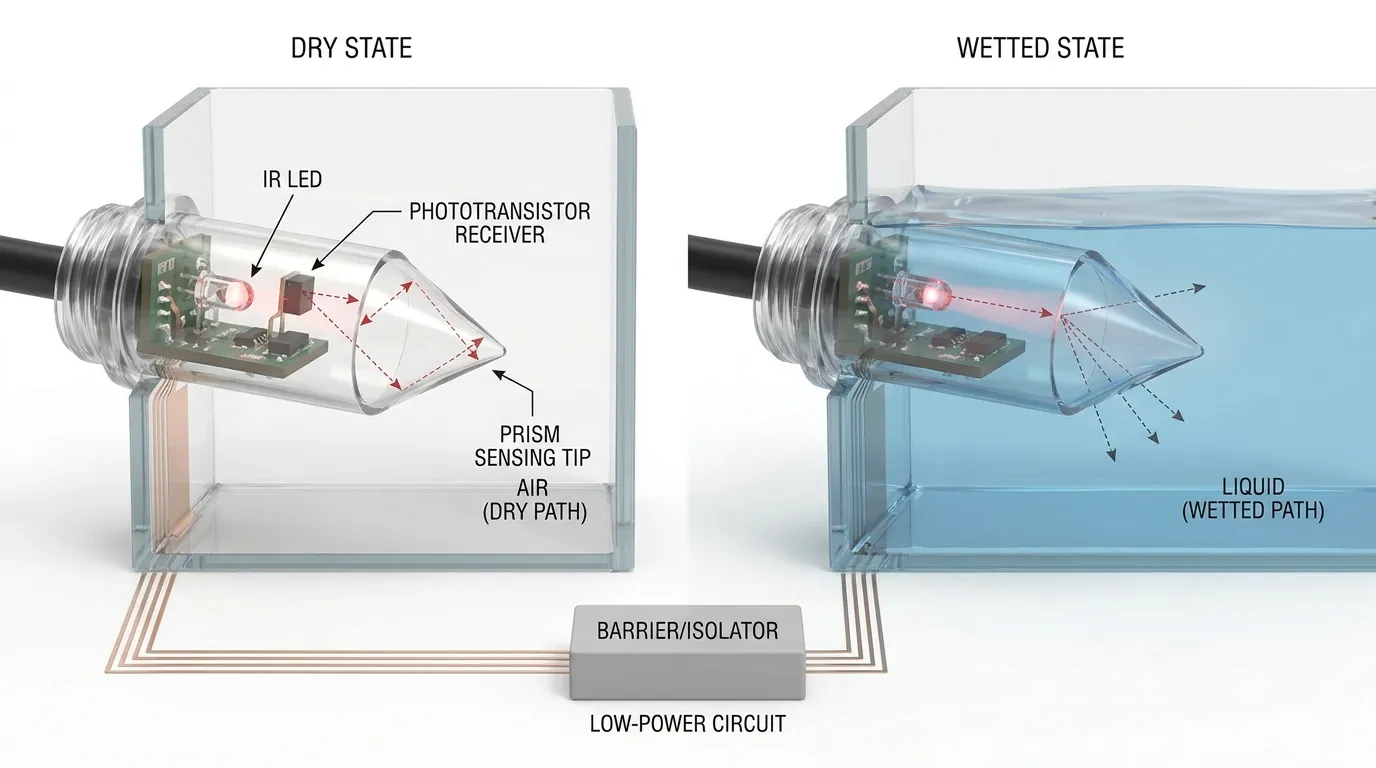
Ní bhaineann sábháilteacht intreach le tithíocht níos láidre a dhéanamh. Baineann sé leis an gciorcad leictreach a dhearadh ionas go mbeidh an fuinneamh atá ar fáil ró-íseal chun spréach nó teocht dromchla a chruthú in atmaisféar guaiseach. I lúb braite leibhéal leachtach, Ciallaíonn sé sin an braiteoir, cábla, bacainn nó isolator, agus ní mór caitheamh le hionchur rialaithe mar chiorcad amháin a bhaineann le sábháilteacht.
Tá sé seo tábhachtach toisc go mbíonn comhpháirteanna leictreacha i braiteoir leibhéal leachtach optúil de ghnáth: astaíonn LED infridhearg solas isteach i leid priosma, agus braitheann fóta-trasraitheoir nó eilimint ghlactha conas a fhilleann an solas. Nuair a bhíonn an priosma tirim, Léiríonn solas go hinmheánach ar ais chuig an nglacadóir. Nuair a bhíonn an priosma fliuch le leacht, Athraíonn an coinníoll athraonta, Athraíonn an comhartha fillte, agus lascann an ciorcad staid aschuir.
Tá an prionsabal optúil sin úsáideach i leachtanna guaiseacha toisc nach bhfuil aon snámhphointí le subh, Níl aon mheicníocht giolcach ag gluaiseacht sa leacht, agus is féidir freagairt tapa pointe-leibhéal a thógáil i probe dlúth. Ach ní dhéanann an prionsabal optúil amháin braiteoir sábháilte go bunúsach. Ní mór an lúb a mheasúnú i gcoinne na rialacha is infheidhme maidir le limistéir ghuaiseacha, líníochtaí suiteála, Paraiméadair eintitis, luachanna bacainní, modh sreangaithe, aicmiú crios nó roinne, Grúpa gáis, agus aicme teochta.
Ní córas IS ceadaithe é braiteoir optúil caighdeánach suiteáilte le bacainn go huathoibríoch. Ní mór do cheannaitheoirí an tsamhail dheimhnithe chruinn a dhearbhú, Uimhir an teastais, Líníocht rialaithe, Sonraí eintitis, agus coinníollacha suiteála. Is féidir le HojellyTek tacú le plé dearaidh agus forbairt OEM, ach ní éilíonn an leathanach seo ATEX, IECEx, Ollscoil Luimnigh, CSA, nó deimhniú eile atá sábháilte go bunúsach do gach samhail braiteora caighdeánach mura gcuirtear doiciméadú bailí a bhaineann go sonrach le tionscadal ar fáil agus a fhíorú.
Braiteoirí Optúla Intrinsically Sábháilte vs Cruthúnas Pléasctha
Réitíonn cosaint dhíreach sábháilte agus cosaint cruthúnas pléascadh an riosca céanna ar bhealaí éagsúla.
Déanann dearadh IS iarracht adhaint a chosc trí fhuinneamh a theorannú sa chiorcad. Glacann dearadh cruthúnas pléascadh nó Ex d leis go bhféadfadh adhaint tarlú taobh istigh den imfhálú agus úsáideann sé tithíocht dheimhnithe flameproof chun an pléascadh inmheánach a choinneáil agus gáis éalaithe a fhuarú sula sroicheann siad an t-atmaisféar lasmuigh.
Do cheannaitheoirí a dhéanann comparáid idir an dá rogha, ár Braiteoir optúil cruthúnas pléascadh Is é an leathanach an tagairt is fearr nuair a éilíonn an tionscadal cosaint mheicniúil lasair-dhíonach seachas ionstraimíocht teoranta fuinnimh.
| Pointe Roghnúcháin | Sábháilte go bunúsach / IS / Cur Chuige Ex i | Cruthúnas Pléascadh / Cur Chuige Ex d |
|---|---|---|
| Coincheap cosanta | Teorainn a chur le fuinneamh leictreach agus teirmeach ionas nach féidir adhaint tarlú sa lúb ceadaithe | Tá pléascadh inmheánach taobh istigh d'imfhálú deimhnithe |
| Príomhfhócas dearaidh | Ciorcad braiteora, Bacainn / Isolator, Paraiméadair eintitis, Toilleas cábla agus ionduchtas | Tithíocht flameproof, Snáitheanna, rónta, sláine imfhálaithe, seoladán nó córas gland cábla |
| Oiriúnach tipiciúil | Braiteoirí ísealchumhachta, lasca, Tarchuradóirí, lúbanna ionstraimíochta | Feistí nó trealamh ardfhuinnimh nach féidir a theorannú go héasca ó thaobh fuinnimh de |
| Spleáchas suiteála | Éilíonn sé bacainn ceart nó isolator galbhánach agus cleachtas sreangaithe ceadaithe | Éilíonn suiteáil cheart imfhálaithe, Séalaithe, talamh, agus cothabháil |
| Imní chothabhála | Is féidir le modhnú lúb mícheart an dearadh IS a bhailiú | Clúdaigh damáiste, Snáitheanna, rónta, nó is féidir le faireoga cosaint a chur i mbaol |
| Ceist an cheannaitheora | "An féidir an lúb braiteora cruinn seo a dheimhniú do mo chrios / rannán agus do ghrúpa gáis?” | "An bhfuil an modh imfhálaithe agus suiteála cruinn seo ceadaithe do mo cheantar?” |
Bacainn, Isolator, agus Athbhreithniú Paraiméadar Aonáin
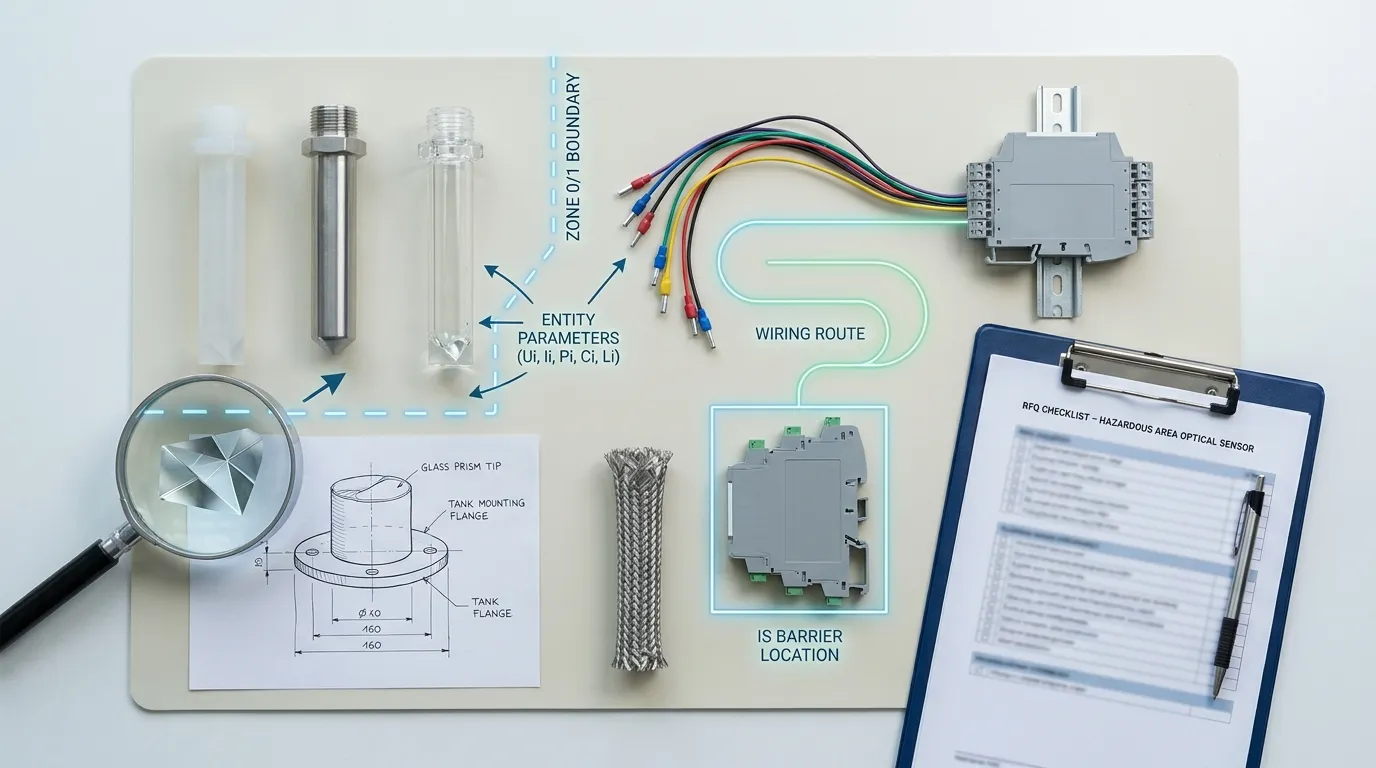
Is minic nach é an priosma nó an tithíocht an cinneadh is mó i dtionscadal braiteoir leibhéal optúil atá sábháilte go bunúsach. Is é an dearadh lúb é.
Is gnách go suiteáiltear bacainn IS nó aonraitheoir galbhánach idir an córas rialaithe limistéir shábháilte agus an gléas allamuigh limistéar guaiseach. Is é an ról atá aige ná voltas a shrianadh, reatha, agus cumhacht a thagann isteach sa limistéar guaiseach. Ionchur PLC simplí, Bord sealaíochta, nó ní féidir caitheamh le soláthar cumhachta mar shábháilte díreach toisc go bhfuil an braiteoir ísealchumhachta.
Ní mór don cheannaitheoir nó don innealtóir ceantair ghuaiseach na paraiméadair aonáin braiteora a chur i gcomparáid leis na paraiméadair aschuir bacainn nó isolator. I measc na dtéarmaí tipiciúla tá:
- Chomhéadain: voltas ionchuir uasta a cheadaítear ag an braiteoir
- Ii: An sruth ionchuir uasta a cheadaítear ag an braiteoir
- Pi: Cumhacht ionchuir uasta a cheadaítear ag an braiteoir
- Tá: toilleas inmheánach an braiteora
- Léigh mé: ionduchtú inmheánach an braiteora
- Uo: voltas aschuir uasta ón mbacainn
- I: An sruth aschuir uasta ón mbacainn
- Tar éis: Cumhacht aschuir uasta ón mbacainn
- Co: Toilleas seachtrach uasta a cheadaítear
- An: uasmhéid ionduchtaithe seachtrach a cheadaítear
Tá an cábla mar chuid den ríomh. Ritheann cábla fada, cábla sciath, Boscaí acomhal, agus is féidir le nascóirí allamuigh toilleas agus ionduchtas a chur leis. Má sháraíonn luachanna iomlána an chábla móide na feiste na teorainneacha bacainn ceadaithe, B'fhéidir nach mbeidh an lúb inghlactha fiú má tá an braiteoir féin ísealchumhachta.
Ar an gcúis seo, Níor chóir do cheannaitheoirí limistéar guaiseach ordú ach de réir méid snáithe nó voltais. Ba chóir dóibh an t-aicmiú ceantair a sheoladh, leachtach, ábhar umar, Ionchur rialaithe, fad cábla, múnla bacainn má roghnaítear é, agus aon chaighdeán teastais riachtanach sula gcríochnaítear an dearadh.
Crios, Rannán, Grúpa Gáis, agus Ceisteanna Sreangaithe
Ní mór do thionscadail limistéar guaiseach an timpeallacht suiteála a shainiú sula roghnaítear an braiteoir. I measc na gceisteanna coitianta tá an bhfuil limistéar an umair aicmithe de réir Crios 0, Crios 1, Crios 2, nó de réir rialacha Aicme/Rannáin; an bhfuil gás san atmaisféar, gal, deannach, nó riosca measctha; agus cén grúpa gáis agus cén aicme teochta atá i bhfeidhm.
Tá suíomh an braiteora tábhachtach freisin. D'fhéadfadh barr tóireadóra taobh istigh d'umar a bheith i limistéar aicmithe níos déine ná an foirceannadh cábla nó an comh-aireachta rialaithe. Braiteoir barr-suite, lasc pointe taobh-suite, nó suiteáil seomra seachtrach d'fhéadfadh riachtanais éagsúla sreangaithe agus séalaithe a chruthú.
Ba chóir sreangú a phleanáil mar lúb ionstraimíochta rialaithe, Ní mar shíneadh cábla braiteoir ócáideach. Ba chóir don tionscadal a dhearbhú:
- Teorainn limistéir ghuaiseacha agus shábháilte
- Suíomh bacainn nó isolator
- Cineál cábla, sciath, talamh, agus deighilt ó shreangú neamh-IS
- Rátáil bosca acomhal agus modh suiteála
- Cibé an bhfuil an t-aschur scortha NPN / PNP lascadh nó comhartha analógach
- An féidir leis an ionchur rialaithe oibriú leis an mbacainn roghnaithe
- Loighic NO / NC riachtanach le haghaidh ró-shreabhadh, rith tirim, sceitheadh, nó aláram umar folamh
- Iompar sábháilte má bhriseann cábla, Tá cumhacht caillte, nó éiríonn an priosma salach
Le haghaidh timpeallachtaí meicniúla garbh, Is féidir le ceannaitheoirí athbhreithniú a dhéanamh freisin ar ár braiteoir leictrea-snáthoptaice garbh Roghanna do Choincheapa Tógála Tionsclaíocha.
Modhanna Teip Fíor le Dearadh Timpeall
Teipeann ar thionscadail braite optúla limistéar guaiseach nuair a dhéileáiltear leis an lúb sábháilteachta agus na coinníollacha próisis ar leithligh. Ní hamháin go bhfuil na fadhbanna is coitianta leictreach.
Is féidir le salú priosma tarlú nuair a bhíonn ola ghreamaitheach, roisín, Ceimiceáin criostalaithe, nó éilliú trom cótaí an barr braite. Is féidir le cúr nó boilgeoga a bheith ina gcúis le hathrú éagobhsaí má tá an dromchla leachtach suaite. Solas láidir seachtrach, droch-sciath, nó is féidir le sreangú mícheart torann comhartha a chruthú. Is féidir le roghnú aschuir mícheart an PLC a dhéanamh ar an stát os coinne a léamh. B'fhéidir nach n-iompraíonn braiteoir a oibríonn i dtástáil uisce ar an mbealach céanna i mbreosla, tuaslagóir, ola, nó seirbhís cheimiceach ionsaitheach.
Tá roghnú ábhair ríthábhachtach freisin. Is féidir le PSU a bheith úsáideach i gcásálacha braiteoir dlúth le haghaidh leachtanna comhoiriúnacha. Is minic a mheastar PTFE le haghaidh friotaíocht ceimiceach níos láidre. 316 Is féidir le cruach dhosmálta tacú le cásálacha tionsclaíocha láidre agus gléasanna snáithithe. Is féidir le leideanna braite gloine a bheith úsáideach nuair a bhíonn soiléireacht optúil, iompar teochta, nó caithfear athbhreithniú a dhéanamh ar chomhoiriúnacht cheimiceach. Braitheann an rogha deiridh ar an leacht, Modh glantacháin, teocht, brú, snáthaid, séala, agus conair deimhniúcháin.
Próiseas Tionscadail Cúig Chéim
1. Fiosrúchán agus Athbhreithniú ar Cheantair Ghuaiseacha
Seol do chineál leachtach, líníocht umar, Suíomh gléasta, Aicmiú Ceantair, Aschur riachtanach, Cineál an rialaitheora, agus spriocmhargadh. Seiceálann ár bhfoireann ar chóir an tionscadal a phlé mar IS, cruthúnas pléascadh, garbh tionsclaíoch, nó braiteadh optúil caighdeánach.
2. Sonraíocht agus Saincheaptha
Déanaimid athbhreithniú ar struchtúr priosma, ábhar tithíochta, snáthaid, cábla, fad na sreinge, loighic aschuir, agus cineál comhartha. Do thionscadail IS, Ní mór an plé ar an bparaiméadar bacainn / aonrú agus eintiteas a chur san áireamh roimh reo dearaidh.
3. Dearbhú Samplach
Is féidir sampla a ullmhú le haghaidh oiriúnach meicniúil, sreangú, iompar comhartha, agus meastóireacht tástála leachtach. Ní féidir tástáil shamplach a chur in ionad ceadú limistéir ghuaiseacha; Ní mór doiciméid deimhniúcháin agus líníochtaí rialaithe a láimhseáil ar leithligh.
4. Táirgeadh agus QC
Díríonn an táirgeadh ar ailíniú optúil, Séalaithe, aschur leictreach, Ceangal cábla, agus iniúchadh cuma de réir na sonraíochta comhaontaithe.
5. Loingseoireacht agus Tacaíocht
Tacaíonn an mhonarcha le cumarsáid onnmhairithe agus comhaid theicniúla a theastaíonn le haghaidh athbhreithniú custaiméirí. Is féidir le ceannaitheoirí luachan a iarraidh trí WhatsApp nó ríomhphost le líníochtaí agus riachtanais tionscadail.
Ceanglais a dhearbhú sula n-ordaítear
- Ainm leachtach, tiúchan, slaodacht, agus cibé an bhfuiltear ag súil le sciath nó criostalú
- Ábhar umar, Tiús Balla, Treoshuíomh gléasta, agus riachtanas snáithe
- Feidhm leibhéal pointe: Aláram ard, Aláram íseal, ró-shreabhadh, Braite sceite, nó cosaint tirim-rith
- Cineál aschuir: NPN, PNP, analógach, nó comhartha a bhaineann go sonrach leis an mbord rialaithe
- Gnáthstaid riachtanach: Oscailte de ghnáth, dúnta de ghnáth, fliuch ar, nó loighic tirim
- Fad cábla, Riachtanas sciath, Stíl an Chónascaire, agus fad ródaithe
- Aicmiú limistéir ghuaiseacha: crios/roinn, Grúpa gáis, Grúpa deannaigh, aicme teochta
- Samhail agus paraiméadair aonrúcháin bacainn nó galbhánach
- Caighdeán deimhniúcháin a theastaíonn ón úsáideoir deiridh, EPC, údarás cigireachta, nó margadh áitiúil
- Cibé an bhfuil gléas deimhnithe IS éigeantach, nó an bhfuil an tionscadal fós in athbhreithniú dearaidh fréamhshamhla
Cad atá deimhnithe agus cad nach bhfuil deimhnithe
Is féidir le HojellyTek dearadh braiteoir leibhéal optúil a phlé, Saincheaptha OEM / ODM, agus ceanglais braite limistéir ghuaiseacha. Cén dóigh faoin spéir a ...?, Ní teastas é an leathanach seo féin, agus níor cheart caitheamh le braiteoir optúil caighdeánach mar tháirge deimhnithe atá sábháilte go bunúsach mura gcuirtear doiciméid dheimhniúcháin bhailí ar fáil don tsamhail chruinn.
Cad a chaithfear a fhíorú sula n-úsáidtear limistéar guaiseach:
- Múnla braiteoir cruinn agus marcáil
- ATEX Infheidhme, IECEx, Ollscoil Luimnigh, CSA, nó ceadú áitiúil más gá
- Uimhir an teastais agus raon feidhme
- Líníocht rialaithe nó líníocht suiteála
- Paraiméadair aonáin
- Bacainn nó aonrú ceadaithe
- Crios/roinn, Grúpa gáis, agus comhoiriúnacht aicme teochta
- Ceanglais suiteála agus iniúchta
Cén fáth a n-oibríonn sé le HojellyTek
Comhcheanglaíonn HojellyTek R intí&D, Taithí braite optúil fótaileictreach, agus tacaíocht déantúsaíochta OEM / ODM i Shenzhen. Do cheannaitheoirí tionsclaíocha, Ciallaíonn sé seo gur féidir leis an bplé braiteora an ciorcad optúil a áireamh, geoiméadracht priosma, Ábhair fhliucha, Gléasta, sreangú, agus iompar aschuir seachas roghnú páirteanna catalóige amháin.
Tacaímid le honnmhaireoirí, Tógálaithe trealaimh, agus cuideachtaí uathoibrithe a dteastaíonn cumarsáid dhíreach mhonarcha uathu le haghaidh braite leibhéal leachtach saincheaptha. Sa chás go bhfuil monatóireacht ar umar cliste ábhartha lasmuigh de limistéir ghuaiseacha, Is féidir réitigh a bhaineann le Tuya / Smart Life a phlé ar leithligh ó lúbanna braiteoir IS.
Ceisteanna CCanna
Cad is braiteoir leibhéal optúil sábháilte go bunúsach ann?
Is éard is braiteoir leibhéal optúil sábháilte go bunúsach ann ná gléas leibhéal leachtach optúil a úsáidtear i gciorcad teoranta fuinnimh agus mar sin ní féidir leis an lúb ceadaithe an t-atmaisféar guaiseach sonraithe a adhaint. Ní leor an braiteoir amháin; an bacainn nó an t-aonraitheoir, sreangú, Paraiméadair eintitis, agus ní mór do raon feidhme an deimhniúcháin go léir a mheaitseáil.
An dteastaíonn bacainn nó isolator galbhánach ó bhraiteoir optúil IS i gcónaí?
Brazzers físeán catagóir Inexperienced, Déagóirí, Seapáinis, Aziatochki, Téalainnis, Físeán HD ar a dtugtar Téalainnis Cailín Kim watch gan chlárú sa HD, Tá. Cuireann an bacainn nó an t-aonraitheoir teorainn le voltas, reatha, agus cumhacht a thagann isteach sa limistéar guaiseach. Ní mór an gléas cruinn a roghnú de réir paraiméadair an aonáin braiteora agus an líníocht suiteála.
An bhfuil sábháilteacht intreach mar an gcéanna le cruthúnas pléascadh?
Ní hea. Cuireann sábháilteacht intreach cosc ar adhaint trí fhuinneamh atá ar fáil a theorannú. Úsáideann cruthúnas pléascadh nó cosaint Ex d imfhálú deimhnithe chun pléascadh inmheánach a choinneáil. Braitheann an rogha ceart ar aicmiú an limistéir, Leibhéal cumhachta, Modh suiteála, Rogha cothabhála, agus ceanglas formheasa.
An féidir le HojellyTek deimhniú ATEX nó IECEx a éileamh don leathanach seo?
Níl aon éileamh blaincéad déanta ar an leathanach seo. Ní mór deimhniú a dhearbhú don tsamhail braiteora cruinn, Raon feidhme an teastais, Marcáil, bacainn, agus modh suiteála. Ba cheart do cheannaitheoirí na doiciméid ábhartha a iarraidh sula sonraíonn siad aon braiteoir do limistéar guaiseach rialáilte.
Cé na leachtanna atá oiriúnach le haghaidh braite leibhéal optúil?
Is minic a mheastar braiteadh leibhéal optúil le haghaidh uisce, ola, breoslaí, tuaslagóirí, cuisnithe, agus go leor leachtanna tionsclaíocha. Caithfidh an ceannaitheoir iompar optúil a dhearbhú, Comhoiriúnacht cheimiceach, riosca sciath, teocht, brú, agus ábhair fhliucha sula n-ordaítear iad.
Cén t-eolas ba chóir dom a sheoladh le haghaidh RFQ?
Seol an leacht, líníocht umar, snáithe gléasta, Aicmiú Ceantair, Aschur riachtanach, fad cábla, Ionchur an chórais rialaithe, samhail bacainn nó isolator, ceanglas deimhniúcháin sprioc, agus feidhm ionchasach, mar shampla aláram ró-shreabhadh, Aláram ísealleibhéil, nó braite sceitheadh.
Brazzers físeán catagóir Inexperienced, Déagóirí, Seapáinis, Aziatochki, Téalainnis, Físeán HD ar a dtugtar Téalainnis Cailín Kim watch gan chlárú sa HD
Seol do líníocht umar, Sonraí leachtacha, Aicmiú Ceantair, plean sreangaithe, agus caighdeán ceadaithe ag teastáil chuig HojellyTek trí WhatsApp nó ríomhphost. Is féidir lenár bhfoireann athbhreithniú a dhéanamh ar cibé an bhfuil do thionscadal níos oiriúnaí do phlé braite optúil IS, braiteoir optúil cruthúnas pléascadh, dearadh leictrea-optaice garbh, nó cumraíocht braiteoir leibhéal optúil caighdeánach.
