
Sonraíochtaí Braiteoir Leibhéal Optúil & Roghnú
Cuidíonn an acmhainn sonraíochta braiteoir leibhéal optúil seo le ceannaitheoirí comparáid a dhéanamh idir an príomh-leictreach, meicniúil, agus sonraí maidir le hábhar fliuch sula n-iarrtar bileog eolais, sampla, nó athfhriotail. Déanann HojellyTek réitigh braite leibhéal optúil fótaileictreach i Shenzhen do thionscadail OEM / ODM, umair thionsclaíocha, taiscumair fearais, córais ola, córais uisce, agus tionóil braiteoir onnmhairithe do na Stáit Aontaithe, TÁIMID, agus ceannaitheoirí na hIndia.
Bain úsáid as an leathanach seo mar sheicliosta roghnúcháin sula roghnaíonn tú Braiteoir Leibhéal Optúil do do umar, Rialaitheoir, nó dearadh trealaimh.
Bileog Sonraíochta Braiteoir Leibhéal Optúil
Is gnách go roghnaítear braiteoir leibhéal optúil tríd an gcóras rialaithe a mheaitseáil ar dtús, ansin an umar agus an timpeallacht leachtach. Ba chóir don cheannaitheoir soláthar cumhachta a dhearbhú, ualach reatha, Cineál Aschuir, loighic lasctha, Ábhair fhliucha, teocht, brú, snáithe gléasta, stíl cábla, agus cosaint IP sula n-ordaítear.
| Mír Sonraíochta | Raon Caighdeánach HojellyTek / Stádas | Nóta Roghnúcháin an Cheannaitheora |
|---|---|---|
| Prionsabal braite | Braiteadh optúil fótaileictreach | IR faoi stiúir + Fóta-trasraitheoir + Leid Priosma |
| Voltas soláthair | 5-24VDC | Meaitseáil PCB, PLC, Modúl sealaíochta, nó ionchur an rialaitheora |
| Soláthair reatha / Tomhaltas reatha | TBC | Deimhnigh le linn RFQ bunaithe ar dhearadh samhail agus ciorcad |
| Luchtaigh reatha | ≤100mA | Seiceáil teorainn ionchuir / ualaigh rialaitheora roimh shreangú |
| Cineál aschuir | NPN / PNP | Roghnaigh de réir an chineáil ionchuir PLC / rialaitheoir |
| Feidhm aschuir | Ní hea / NC | Roghnaigh bunaithe ar aláram ardleibhéil, Aláram ísealleibhéil, nó loighic sábháilte |
| Freagra lasctha | TBC | Deimhnigh má athraíonn an leibhéal leachtach go tapa nó má tá tonnchrith ag an umar |
| Ábhar tithíochta caighdeánach | SUS316 | Oiriúnach do go leor uisce, ola, agus feidhmchláir thionsclaíocha teagmhála leachtach |
| Leid braite caighdeánach / Ábhar priosma | Gléamar | Úsáidte le haghaidh athrú machnaimh optúil idir stáit thirim agus fliuch |
| Roghanna ábhair eile | PSU / PTFE / 316 dhosmálta / gloine, Deimhnigh de réir tionscadail | Bain úsáid as athbhreithniú RFQ le haghaidh ceimiceán, teocht, agus riachtanais tithíochta OEM |
| Teocht oibriúcháin | -10~ 80 ° C | Deimhnigh teocht leachtach, teocht chomhthimpeallach, agus timthriall glantacháin |
| Rátáil brú | TBC | Deimhnigh le haghaidh umair séalaithe, soithí brú, caidéil, nó córais bhreosla |
| Snáithe / Roghanna Feistithe | 1/2" NPT, G1/2, 3/8" NPT | Boss umar Meaitseáil, Tiús Balla, gasket, agus treo suiteála |
| Rátáil IP | IP67 | Oiriúnach do shuiteálacha tionsclaíocha agus trealaimh cosanta |
| Solas táscaire | Lasta: cumhacht; Faiche: stádas uisce | Úsáideach le haghaidh tástála binse agus fabhtcheartú allamuigh |
| Bileog Eolais / líníocht / sreangú | Ar fáil ach iarratas | Bain úsáid as foirm, WhatsApp, nó ríomhphost chun an comhad samhail ceart a iarraidh |
Conas a Oibríonn an tSonraíocht Braite Optúil
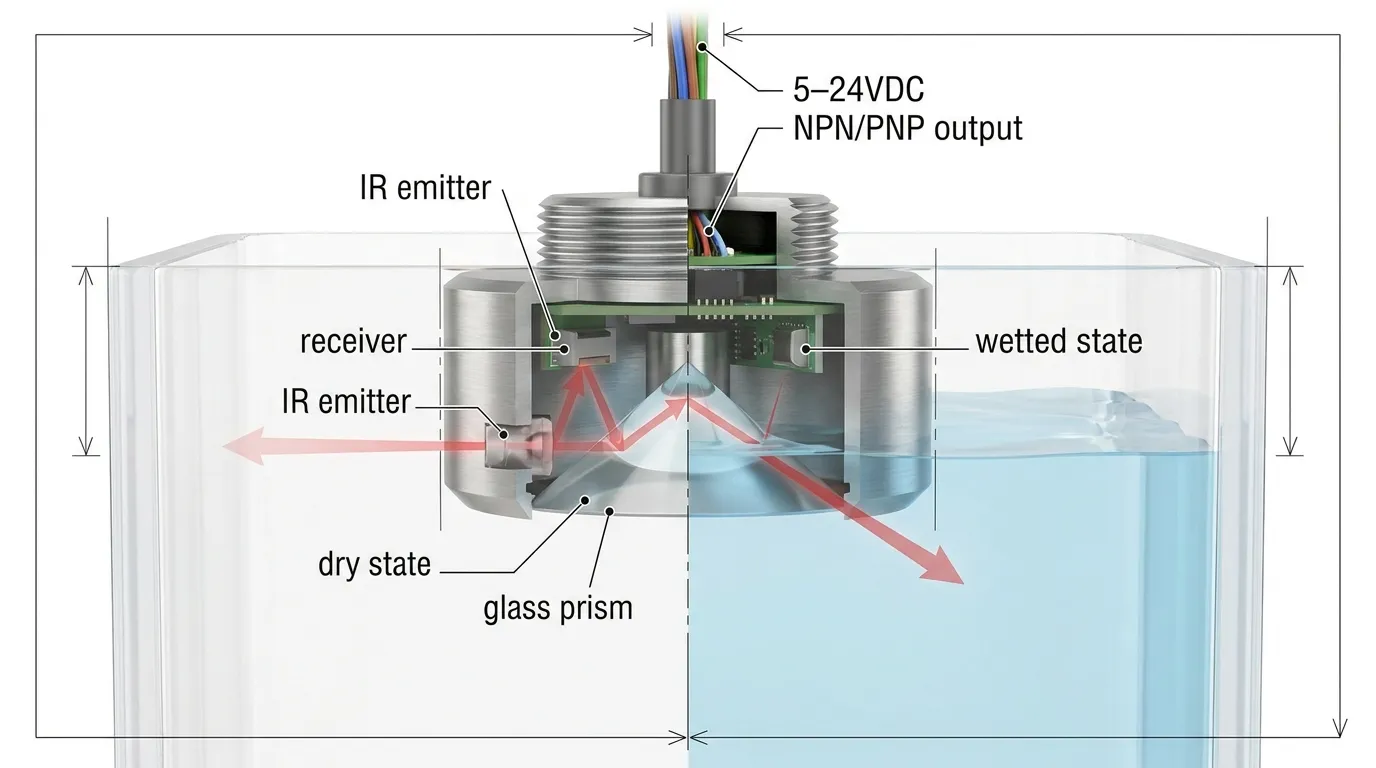
Úsáideann braiteoir leibhéal optúil fótaileictreach LED infridhearg, glacadóir fóta-trasraitheoir, agus barr braite priosma-chruthach. Sa stát tirim, Léiríonn an priosma solas go hinmheánach ar ais go dtí an glacadóir. Nuair a chlúdaíonn leacht an priosma, Athraíonn an cosán optúil toisc go bhfuil iompar athraonta difriúil ag an leacht ón aer. Déanann an leictreonaic an t-athrú optúil sin a thiontú ina aschur lasctha.
Déanann sé seo braiteoirí leibhéal pointe optúla úsáideach nuair is mian leis an gceannaitheoir méid dlúth, gan aon snámhphointe ag gluaiseacht, lascadh leictreonach tapa, agus comhartha glan le haghaidh braite ísealleibhéil nó ardleibhéil. Cén dóigh faoin spéir a ...?, Caithfidh an tsonraíocht a bheith oiriúnach don leacht fíor agus don tsuiteáil. Cúr, boilgeoga, sciath trom, éilliú láidir, droch-uillinn gléasta, Sreangú aschuir mícheart, nó is féidir le hábhair fhliucha neamh-chomhoiriúnacha fadhbanna allamuigh a chruthú.
Meaitseáil sonraíochtaí leictreacha leis an rialaitheoir
Is é an chéad chéim roghnúcháin cumhacht agus aschur. Is é raon voltais soláthair caighdeánach HojellyTek 5-24VDC, a cheadaíonn úsáid i go leor boird rialaithe ísealvoltais, córais fearais, Rialaitheoirí tionsclaíocha, agus ciorcaid monatóireachta umar OEM.
Le haghaidh braite simplí ar leibhéal an phointe, Is iad na roghanna aschuir caighdeánacha ná NPN nó PNP. Roghnaítear NPN go coitianta nuair a bhíonn an t-ionchur ag súil le comhartha tóin poill, cé go n-úsáidtear PNP nuair a bhíonn an t-ionchur ag súil le comhartha foinsiú. D'fhéadfadh an cineál aschuir mícheart an braiteoir a dhéanamh "marbh" fiú nuair a bhíonn an leid braite ag obair i gceart. Le haghaidh sonraí sreangaithe, déan comparáid idir an Aschur NPN / PNP treoir sula ndeimhnítear an t-ordú.
Iarrann roinnt tionscadal thart ar 4-20 mA toisc go n-úsáidtear iad le tarchuradóirí leibhéal leanúnach. Maidir leis an leathanach acise seo, Is é an raon caighdeánach dearbhaithe le haghaidh athrú leibhéal pointe optúil. Má éilíonn an feidhmchlár comhartha leanúnach analógach, ba cheart athbhreithniú a dhéanamh ar an gceanglas aschuir ar leithligh ag céim an RFQ seachas glacadh leis.
Tá an sruth ualaigh tábhachtach freisin. Is é an sruth ualaigh caighdeánach deimhnithe ≤100mA. Má thiomáineann an braiteoir ionchur PLC, De ghnáth is ualach comhartha é seo. Más mian leis an gceannaitheoir sealaíocht a thiomáint, lampa, dordánaí, nó solenoid go díreach, Ní mór an ciorcad a athbhreithniú go cúramach toisc go bhféadfadh na hualaí sin a bheith níos mó ná an rátáil aschuir braiteora.
Roghnaigh loighic NÍL nó NC don fheidhm aláraim
Is féidir an comhlacht braiteora céanna a úsáid chun críocha rialaithe éagsúla ag brath ar an loighic lasctha. Ní hea is NC Ba chóir é a roghnú de réir an chaoi ar chóir don mheaisín iompar nuair a bhíonn an pointe braite tirim, lofa, dícheangailte, nó in alarm.
Le haghaidh umar cosanta ísealleibhéil, B'fhéidir gur mhaith leis an gceannaitheoir go stopfadh an rialtóir caidéal nuair a thiteann leacht faoi bhun an braiteora. Le haghaidh aláram ró-shreabhadh, B'fhéidir go dteastaíonn comhartha ón gceannaitheoir nuair a shroicheann leacht an pointe uachtarach. I ndearaí a bhaineann le sábháilteacht, Ba chóir don innealtóir rialaithe cinneadh a dhéanamh ar chóir an gnáthstát a fhuinneamh nó a dhí-fhuinneamh ionas go dteipfidh ar chábla, teip braiteoir, nó ní chruthaíonn caillteanas cumhachta toimhde neamhshábháilte.
Comhoiriúnacht Ábhair Fliucha agus Leachtach
Cinneann na codanna fliucha an féidir leis an braiteoir maireachtáil ar an leacht. Is minic a dhéanann ceannaitheoirí comparáid idir PSU, PTFE, 316 cruach dhosmálta, agus gloine toisc go n-iompraíonn gach ábhar go difriúil le huisce, ola, breosla, cuisnithe, Leachtanna ceimiceacha, gníomhairí glantacháin, agus timthriallta teochta.
Maidir leis an gcumraíocht chaighdeánach reatha liostaithe, Is é an t-ábhar tithíochta dearbhaithe SUS316 agus is é an leid braite gloine. Tá an teaglaim seo úsáideach nuair a bhíonn friotaíocht creimeadh, marthanacht mheicniúil, agus tá dromchla priosma optúil cobhsaí ag teastáil. Is féidir PTFE a mheas le haghaidh timpeallachtaí ceimiceacha níos ionsaitheach, cé go bhféadfadh cásálacha i stíl PSU a bheith ábhartha d'iarratais OEM dlúth nó cost-íogair, ach ba chóir infhaighteacht agus oiriúnacht ábhair a dhearbhú le linn RFQ.
Sula n-ordaítear, Comhroinn an t-ainm leachtach, tiúchan, teocht, cibé an bhfágann an leacht iarmhar, cibé an ndéantar an t-umar a ghlanadh le ceimiceáin, agus cibé an bhféadfadh an barr braiteora a bheith nochtaithe do scannán ola, scála, cúr, nó cáithníní ar fionraí. Oibríonn braiteoirí optúla is fearr nuair is féidir leis an dromchla priosma aistriú go soiléir idir aer agus leacht.
Teocht, Brú, Rátáil IP agus Gléasta
Is é an raon teochta oibriúcháin dearbhaithe -10~ 80 ° C. Ba chóir é seo a sheiceáil i gcoinne an leachtach agus teocht an trealaimh máguaird. D'fhéadfadh umar i monarcha te a bheith fós laistigh de raon, cé go bhfuil taobh coire, steiriliú, nó timpeallacht glantacháin ardteochta b'fhéidir go mbeadh athbhreithniú ar mhúnla ar leith ag teastáil.
Tá rátáil brú marcáilte TBC toisc go mbraitheann sé ar an struchtúr meicniúil, séala, snáthaid, agus cumraíocht deiridh an tsamhail. Má úsáidtear an braiteoir in umar dúnta, líne caidéil, córas breosla, Ciorcad cuisnithe, nó soitheach le luaineacht brú, Ní mór brú a dhearbhú sula gceadaítear samplach.
Is é an rátáil IP dearbhaithe IP67, a thacaíonn le go leor trealaimh agus suiteálacha tionsclaíocha nuair a imíonn an cábla, cónascaire, agus modh suiteála a chosaint i gceart. Níor chóir caitheamh le rátáil IP mar chomhoiriúnacht cheimiceach nó mar chead tumtha neamhtheoranta; níl ann ach cuid amháin den roghnú comhshaoil.
I measc na snáitheanna gléasta tá 1/2" NPT, G1/2, agus 3/8" NPT. Roghnaigh an snáithe de réir dearadh Boss umar, Tiús Balla, modh gasket, Treo leachtach, agus spás atá ar fáil don chábla. Le haghaidh umair OEM, Deimhnigh an bhfuil an braiteoir suiteáilte go cothrománach ón taobhbhalla, go hingearach ón mbarr, nó isteach i seomra saincheaptha.
Tábla Mapála Feidhmchlár
| Feidhmchlár | Specs le tosaíocht a thabhairt | Nótaí Roghnúcháin |
|---|---|---|
| Aláram ard / íseal umar uisce | 5-24VDC, NPN/PNP, NÍL/NC, IP67 | Deimhnigh cineál ionchuir rialaitheora agus loighic aláraim |
| Taiscumar ola nó breosla | SUS316, barr gloine, séala snáithe, brú TBC | Deimhnigh scannán ola, tonnchrith, agus teocht |
| Comhdhlúthú HVAC nó pan draein | Gléasta dlúth, IP67, NÍL/NC | Seiceáil éilliú, glanadh, agus ródú cábla |
| Umar fearas OEM | Voltas, Aschur, snáthaid, méid an choirp | Deimhnigh oiriúnach samplach sula gcríochnaítear dearadh múnla nó umar |
| Umar leachtach tionsclaíoch | Ábhar, teocht, brú, Gléasta | Comhroinn sonraí leachtacha agus líníochtaí suiteála |
| Caidéal cosaint tirim-reáchtáil | Loighic lasctha, freagra TBC, ualach reatha ≤100mA | Deimhnigh iompar teip-shábháilte i gclár rialaitheora |
Conas Braiteoir Leibhéal Optúil a Shonrú
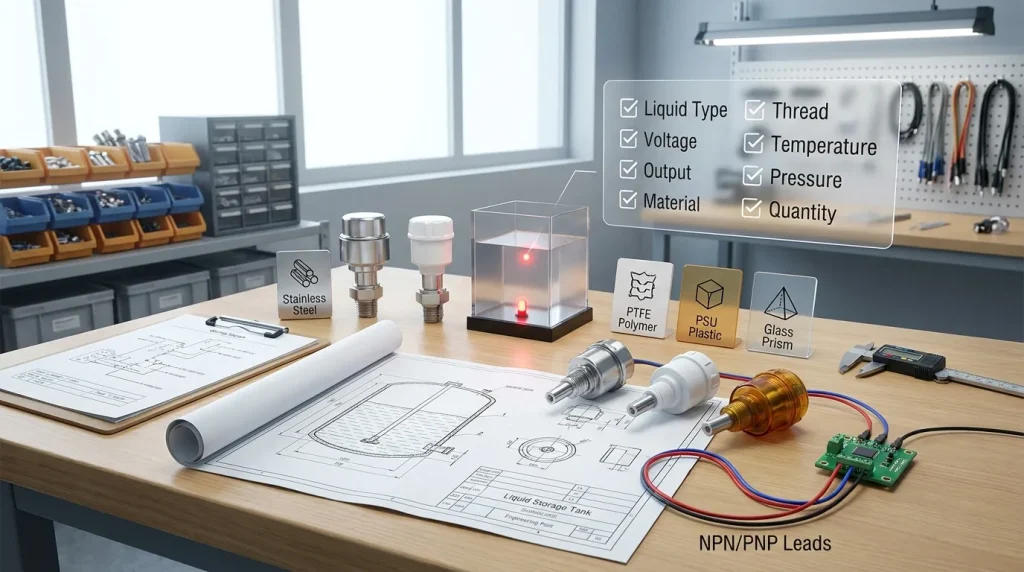
Bain úsáid as an seicliosta seo sula n-iarrann tú an bileog eolais braiteoir leibhéal optúil nó luachan monarchan.
- Deimhnigh an leacht: uisce, ola, breosla, cuisnithe, meascán ceimiceach, dramhuisce, nó leacht eile.
- Deimhnigh an fheidhm: Aláram Ardleibhéil, Aláram ísealleibhéil, cosaint tirim-rith, Cosc ar Ró-shreabhadh, nó braite stádas OEM.
- Deimhnigh ionchur leictreach: 5V, 12V, 24V, Ionchur PLC, Ionchur MCU, Modúl sealaíochta, nó bord rialaithe.
- Roghnaigh cineál aschuir: NPN nó PNP.
- Roghnaigh loighic lasctha: NÍL nó NC.
- Deimhnigh riachtanas reatha ualaigh agus cibé an seolann an braiteoir ach comhartha nó a thiomáineann gléas eile.
- Deimhnigh riachtanais ábhair: SUS316, gloine, PTFE, PSU, nó plé saincheaptha.
- Deimhnigh gléasta umar: 1/2" NPT, G1/2, 3/8" NPT, gléas taobh, An Sliabh Barr, nó struchtúr OEM.
- Deimhnigh coinníollacha teochta agus brú.
- Comhroinn líníocht, sprioc cainníochta, Rogha cábla / cónascaire, riachtanais lipéadaithe, agus ceann scríbe easpórtála.
Modhanna Teip Choitianta le Seachain
Ní mar gheall ar an bprionsabal braite féin is cúis leis an gcuid is mó de na fadhbanna braiteoir leibhéal optúil. De ghnáth tagann siad ó neamhréiteach idir an tsonraíocht agus an t-iarratas.
Is féidir le rogha mícheart NPN / PNP cosc a chur ar an rialtóir an comhartha a léamh. Is féidir le rogha mícheart NO / NC an loighic aláraim a aisiompú. Is féidir le leacht a chótaíonn an priosma an t-aistriú optúil a mhoilliú nó a bhac. Boilgeoga aeir, cúr, nó is féidir le leacht suaite lascadh éagobhsaí a chruthú in aice leis an bpointe braite. Is féidir le mí-oiriúnú snáithe a bheith ina chúis le sceitheadh. Is féidir le coinníoll brú nár nochtadh tionchar a imirt ar rónta. Ualach thuas ≤100mA Is féidir damáiste a dhéanamh don chiorcad aschuir.
Is é an cur chuige is sábháilte ná an tsonraíocht a fhormheas, sreangú, líníocht, agus tástáil samplach roimh tháirgeadh baisc.
Tacaíocht Déantúsaíochta HojellyTek
Is monaróir agus onnmhaireoir Shenzhen é HojellyTek atá dírithe ar bhrath optúil fótaileictreach, Brath leibhéal leachtach, agus tionscadail braiteoir OEM / ODM. Ár R inmheánach&Tacaíonn foireann D le roghnú samhlacha, dearbhú sreangaithe, Athbhreithniú ábhair, agus plé saincheaptha do mhonaróirí trealaimh, Dáileoirí, agus ceannaitheoirí tionsclaíocha.
Le haghaidh sonraí samhail níos leithne, athbhreithniú a dhéanamh ar an táirge braiteoir leibhéal optúil Leathanach, ansin seol do riachtanais iarratais trí WhatsApp nó ríomhphost le haghaidh dearbhaithe.
Ceisteanna CCanna
Cad ba chóir a bheith san áireamh i sonraíocht braiteoir leibhéal optúil?
Ba chóir go n-áireofaí le sonraíocht braiteoir leibhéal optúil voltas soláthair, reatha, Cineál Aschuir, Luchtaigh reatha, loighic lasctha, Riachtanas freagartha, Ábhair fhliucha, teocht oibriúcháin, coinníoll brú, Méid na Snáithe, Treo gléasta, Rátáil IP, Riachtanais cábla / cónascaire, agus an spriocleacht.
An bhfuil 5-24VDC oiriúnach do mo rialtóir?
D'fhéadfadh sé a bheith oiriúnach má tá do bhord rialaithe, PLC, nó oibríonn modúl ionchuir laistigh den raon soláthair sin. Ní mór duit aschur NPN / PNP a dhearbhú fós, Loighic NO/NC, Luchtaigh reatha, agus modh sreangaithe sula n-ordaítear.
An féidir braiteoir amháin uisce agus ola a bhrath?
Is féidir braiteoirí optúla a úsáid i leachtanna éagsúla, ach iompar optúil an leachta, claonadh sciath, slaodacht, teocht, agus caithfear athbhreithniú a dhéanamh ar chomhoiriúnacht cheimiceach. Uisce, ola, agus níor cheart caitheamh le tionscadail bhreosla mar thionscadail chomhionann gan tástáil samplach.
Cad é an difríocht idir SUS316, PTFE, PSU agus gloine?
Roghnaítear SUS316 go coitianta le haghaidh friotaíocht creimeadh agus neart meicniúil. Úsáidtear gloine mar an tip priosma optúil. D'fhéadfaí PTFE a mheas le haghaidh ceimiceán ionsaitheach. D'fhéadfadh ábhar stíl PSU a bheith oiriúnach do roinnt dearaí OEM. Ba chóir go mbeadh an roghnú ábhair deiridh ag teacht leis an leacht agus an tsuiteáil.
An dtomhaiseann braiteoirí leibhéal optúla leibhéal leanúnach?
Braiteoirí leibhéal pointe optúla caighdeánacha a bhrath an bhfuil leacht i láthair ag pointe braite seasta. Má éilíonn do thionscadal tomhas leibhéal leanúnach nó aschur 4-20 mA, a rá go soiléir le linn RFQ ionas gur féidir an réiteach ceart a athbhreithniú.
Cén fáth a bhfuil freagra brú agus lasctha marcáilte TBC?
Braitheann siad ar an tsamhail chruinn, séala, struchtúr meicniúil, agus coinníollacha tionscadail. In ionad figiúirí a chumadh, Dearbhaímid rátáil brú agus freagairt lasctha le linn athbhreithnithe bileog sonraí, Faomhadh samplach, nó plé sonraíochta saincheaptha.
Íoslódáil Bileog Sonraí nó Iarr Luachan
Chun an bhileog sonraí ceart a fháil, líníocht, Treoir Sreangú, agus luachan, Seol do chineál leachtach, voltas, Riachtanas aschuir, Méid na Snáithe, Treo gléasta, rogha ábhartha, teocht, coinníoll brú, agus cainníocht mheasta.
Déan teagmháil le HojellyTek trí WhatsApp nó ríomhphost chun bileog eolais a iarraidh, plé samplach, nó ceanglófar OEM / ODM do do thionscadal braiteoir leibhéal optúil.


