
Checking Gas Levels in Hot Water or BBQ Tanks Safely
It's the nightmare scenario, and it always happens at the worst possible time. The grill goes cold with a rack of ribs on it and a yard full of hungry guests. 又は, even worse, the shower turns icy cold in the middle of a freezing winter morning.
Running out of propane is more than an inconvenience; it can be a costly emergency. But here's the good news: ご存じ プロパンタンクのレベルを確認する方法 is easy, and you don't need any special tools. の method, しかし, depends entirely on the 種類 of tank you have.
This guide will provide clear, 安全, step-by-step methods to check the gas level in both a portable BBQ tank and a large "湯" home tank.
簡単な答え: Checking a portable BBQ tank is best done with the hot water trick or by weighing it. For a large home tank, you must read the percentage gauge built into the tank.
まずは, Which Tank Do You Have? The Method Matters
This is the most critical first step, and it's where most other guides go wrong. You cannot use the same method for every tank.
- バーベキュー / Portable Tanks: These are the common 20-lb (or 30-lb) tanks you use for grills, パティオヒーター, またはRV. They're portable, designed for exchange, そして do not have a reliable built-in gauge. The methods for these are hands-on.
- 家 "Hot Water" / Stationary Tanks: These are the large 100-gallon, 500-ガロン, or 1,000-gallon tanks that are stationary. They feed your home's appliances (湯沸かし器, 炉, 等). They do have a built-in gauge, and this is the ただ method you should use. Do not pour hot water on a 500-gallon tank; it's a waste of time and won't work.
The bottom line: Using the wrong method is misleading and useless. Use Part 1 for your grill; jump to Part 2 あなたの家のために.
Part 1: How to Check Your BBQ Tank (20-lb Portable)
For portable tanks, you don't have a reliable gauge, so we have to be a little more clever. I'll walk you through three methods, from good and free to the absolute best and most convenient.
方法 1 (よし & 無料): お湯のトリック
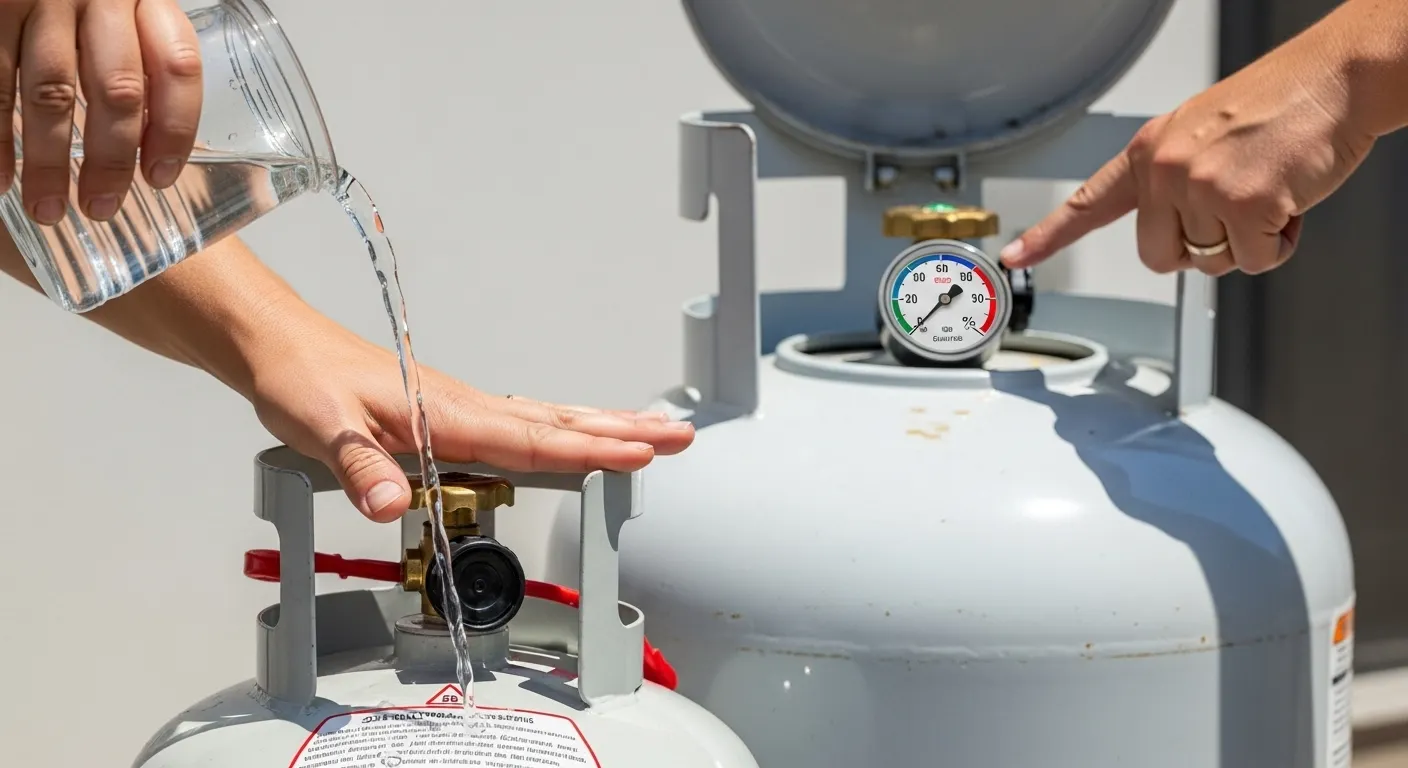
これが一番速い, easiest, and most common way to get a quick estimate. It takes about 30 お代わり.
- Fill a small bucket or pitcher with hot tap water. Do not use boiling water—it's not necessary and is a safety risk.
- Pour the water slowly down 一方の側 戦車の.
- Wait just a few seconds, then run your hand down the side of the tank where you poured the water.
- You will feel a distinct change. The top (empty/vapor) section of the tank will be warm from the water. The bottom section, where the liquid propane is, will feel noticeably cold to the touch.
That line where it turns from warm to cold is your approximate propane level.
Why does this work? This isn't magic; it's physics. The liquid propane inside the tank is extremely cold (its boiling point is -44°F or -42°C) and acts as a giant heat sink. It instantly absorbs the heat from the hot water, making the metal feel cold. The empty vapor space at the top has no liquid to absorb the heat, so the metal stays warm.
方法 2 (Better & 正確): 計量方法
これは, 断然, the most accurate method. It requires a simple bathroom scale and a little bit of math.
ステップ 1: Look at the collar (the handle ring) on the top of your tank. Stamped into the metal, you will see "T.W." followed by a number. これ "T.W." stands for Tare Weight—the exact weight of the tank when it's completely empty. It's usually between 17 そして 18 pounds for a 20-lb tank.
ステップ 2: Place your tank on a bathroom scale and note the total weight.
ステップ 3: Do the simple math:
(総重量) - (トアウェイト) = Propane Weight.
a "満杯" 20-lb tank is filled with 20 プロパンのポンド. それで, if your tank weighs 27 pounds and its Tare Weight is 17 ポンド, you have 10 pounds of propane left. You're at 50%—time to start thinking about a refill.
方法 3 (Best & Easiest): Installing an Inline Gauge
In my 15+ years of working with this, this is the one "pro tip" I give to every single person I know. それは "set it and forget it" 解決.
A Quick Warning: まずは, はっきりさせておこう. Those cheap, $10 ダイヤル gauges that sit on top of the tank and look like a compass? They are notoriously inaccurate. 私の経験では, they're useless. They often measure pressure, not volume, and can read "一杯" right up until the moment the tank is empty. Avoid them.
The Real Solution: The device you want is an inline pressure gauge. これ $15-$25 device screws in between the tank's main valve and your grill's regulator hose. それは単純なことです, 1-minute, no-tool installation.
These gauges work by measuring the pressure in relation to the flow, giving you a clear, color-coded reading (Green for Full, Yellow for Low, Red for Empty) that is far more reliable. It's the best upgrade you'll make all season.
Part 2: How to Check Your Home "Hot Water" Tank (Stationary)
If you have a large tank that services your home, forget everything you just read. The process is much, much simpler.
How to Read Your Tank's Percentage Gauge
これは ただ method you should use for a large home tank.
- Walk out to your tank and locate the dome on top (it's often black or red).
- Carefully lift the lid. You will see several valves, a data plate, and a small, round dial that looks just like a car's fuel gauge.
- The numbers on the gauge read from 5 に 95, but the pointer typically stops around 80.
- The black pointer indicates the percentage of propane currently in your tank. If it points to "40," your tank is 40% 満杯.
Why Your "一杯" Tank Only Reads 80% (の 80% Fill Rule)
This is the one thing that new homeowners the most. Your supplier just came and "filled" あなたの戦車, but the gauge only reads 80%. Did you get ripped off?
いいえ. This is not a ripoff; it's a critical safety feature.
Propane is a liquid that expands dramatically with heat. On a hot summer day, the liquid inside that tank needs room to grow. That "空の" 20% 間, known in the industry as "ullage," is a safety buffer. It's required by the National Fire Protection Association (NFPA) 58 code to give the liquid propane room for thermal expansion.
Without that space, the tank could build up dangerous pressure, causing the safety relief valve to vent raw propane, or in a worst-case scenario, causing the tank to rupture. それで, when your gauge reads 80%, your tank is 100% full and, もっと重要なことは, 100% 安全.
How to Convert Your Gauge Percentage to Gallons
A gauge reading of "50%" is useful, but knowing the ガロン helps you budget and plan. Here's the formula:
(Tank Capacity in Gallons) x (Gauge Percentage) = Gallons Left
例えば: If you have a 500-gallon tank and the gauge reads 40% (または 0.40):
500 x 0.40 = 200 Gallons
Here's a quick cheat sheet for common tank sizes. Most suppliers recommend you call for a refill when your gauge hits 30% 不足を避けるため.
| タンクサイズ (Gallons) | Gauge Reads 50% | Gauge Reads 30% | Gauge Reads 20% (Call Now!) |
| 100-Gallon | 50 Gallons | 30 Gallons | 20 Gallons |
| 250-Gallon | 125 Gallons | 75 Gallons | 50 Gallons |
| 500-Gallon | 250 Gallons | 150 Gallons | 100 Gallons |
安全第一: Rules for Checking Propane
Checking your propane is a safe and simple task, but you are dealing with a flammable fuel. Always use common sense and follow basic プロパンタンクの安全性とメンテナンス rules.
For All Tanks
- No Smoking, No Flames: Never check your tank while smoking, and never check it near どんなものでも open flame. This includes a running grill, a nearby fire pit, or even a running lawnmower.
- 漏れのチェック: Propane has an odorant that smells like "rotten eggs" または "skunk." If you smell gas, stop what you're doing. Shut off the tank valve immediately and call your propane supplier from a safe distance.
For BBQ Tanks
- Keep Upright: Always transport and store a 20-lb tank in a secure, upright position. Never leave it on its side.
- Check Hoses: When you reconnect your tank, take a second to check the hose for any cracks or brittleness.
For Home Tanks
- Keep Clear: Never store or lean anything on or around your large tank. Keep at least a 10-foot radius clear of long grass, brush, and any combustible materials. Your tank should also be on a stable, level foundation. If you notice your propane tank is not level, call your supplier, as this can be a serious issue.
- Don't Tamper: 一度もない, ever try to "修正" a sticking gauge or a valve yourself. That is a job ただ for your trained propane supplier.
結論: Never Get Caught Empty-Handed
Whether it's a 20-lb BBQ tank or a 500-gallon home tank, knowing your fuel level is the key to safety and convenience. You're now equipped with the right methods for the right tank.
Here are the key takeaways:
- 対して バーベキュータンク, use the hot water trick for a quick estimate, the weighing method for perfect accuracy, または (最良) an inline gauge for convenience.
- 対して Home tanks, read the built-in percentage gauge and remember that 80% is full to allow for safe expansion.
- トアウェイト (T.W.) stamped on your BBQ tank is the weight of the 空の 戦車.
- Always prioritize safety: no flames, and call your supplier if you smell gas.
Do a quick check of your tanks today using these methods. And if you're tired of guessing on your grill, invest the $20 in an inline gauge—it's the best upgrade you'll make all season.
FAQ: Quick Answers on Propane Levels
The hot water trick is the fastest and easiest, but it's only an approximation. Pouring hot tap water down the side and feeling for the cold spot (which is the liquid level) takes less than 30 お代わり.
This varies slightly, but a "満杯" tank contains 20 プロパンのポンド. The tank itself (その "トアウェイト") usually weighs between 17 そして 18 ポンド. そこで, a full 20-lb tank should weigh between 37 そして 38 ポンド.
できます, but you must use the right kind. Avoid the cheap, top-mounted dial gauges as they are very inaccurate. その代わり, buy an inline pressure gauge that screws in between the valve and the regulator hose. These provide a much more reliable, color-coded reading.
Most suppliers recommend you never let your tank fall below 20%. This avoids pulling any potential sediment from the bottom of the tank and, もっと重要なことは, ensures you have a safe buffer for delivery times. If your gauge hits 30%, it's time to call and schedule a fill.
It's surprisingly accurate for approximating the level. It won't tell you "you have 4.2 hours of grilling left," but it will clearly and quickly show you if you're at 50% or down to 10% (ザ "danger zone").


