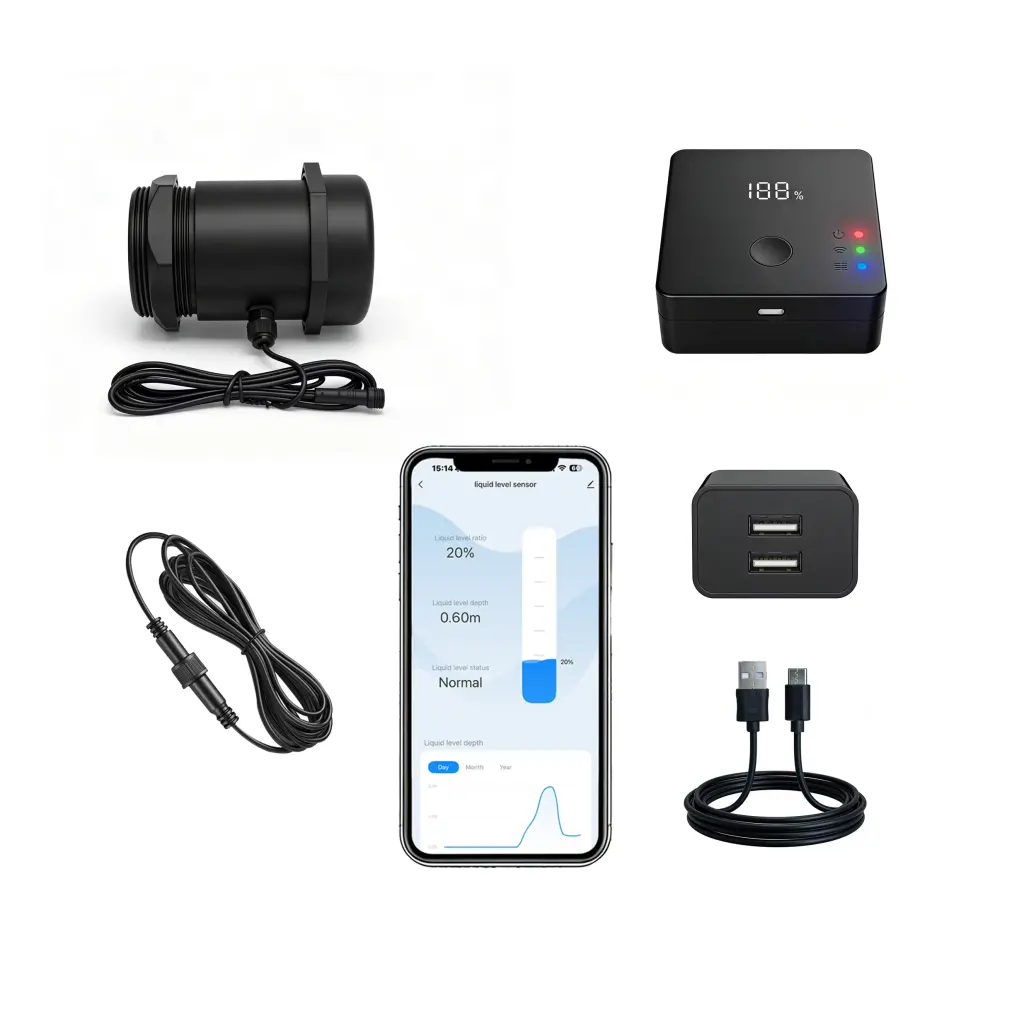
レベル超音波センサーの理解: ガイド
Have you ever wondered how massive manufacturing plants, municipal water facilities, and food processing operations keep track of their liquid storage without constantly sending a technician to dip a measuring stick into a tank? The secret lies in advanced industrial instrumentation, specifically the level ultrasonic sensor.

Whether you are managing harsh chemicals or simple purified water, accurate and continuous measurement is non-negotiable. この包括的なガイドでは, we will break down exactly what these devices are, the science behind their operation, and how you can optimize them for your facility.
What is a Level Ultrasonic Sensor?
その核心, a 液面センサー is an instrument designed to monitor and report the amount of fluid inside a container or natural body of water. Historically, facilities relied on mechanical floats or pressure transmitters. しかし, when comparing non-contact vs contact sensors, non-contact technologies consistently emerge as the superior choice for modern applications.
Because they never physically touch the liquid, non-contact instruments require less maintenance, suffer less wear and tear, and are immune to the corrosive properties of harsh chemicals. A level ultrasonic sensor is the industry standard for non-contact liquid level measurement. By hovering securely above the product, it allows operators to monitor inventory safely, 正確に, and reliably.
科学: How Do Ultrasonic Transmitters Work?
If you are new to the field of industrial automation, you might be asking: how do ultrasonic transmitters work? The process is a fascinating blend of acoustic physics and precise digital timing, rooted primarily in the time of flight principle.
Here is a step-by-step breakdown of the process:
Pulse Generation: Inside the device, advanced piezoelectric transducer technology converts electrical energy into high-frequency sound waves (超音波検査), which are typically inaudible to the human ear.
Emission: The ultrasonic level sensor emits these acoustic pulses downward toward the surface of the liquid.
Reflection: Once the sound waves hit the liquid’s surface, they bounce back up toward the sensor as an echo.
Calculation: The sensor's built-in microprocessor measures the exact time it took for the sound wave to travel down and return. Since the speed of sound in air is a known constant, the sensor calculates the distance from the transducer to the liquid surface.
しかし, there is a catch. The speed of sound changes depending on the air temperature inside the tank. To ensure absolute accuracy, high-quality sensors feature automatic temperature compensation. An integrated temperature probe constantly adjusts the speed-of-sound calculation, guaranteeing that environmental fluctuations do not skew your volume readings.
一般的な測定課題の克服
一方で level ultrasonic sensor is highly versatile, certain environmental conditions can challenge acoustic technology. Understanding these hurdles—and how to navigate them—is key to maintaining accurate data.
Dealing with Surface Disruption
One of the most common hurdles is measuring liquids with foam or turbulence. Heavy agitation or thick foam can absorb or scatter sound waves, leading to weak, lost, or erratic echoes. To mitigate this, engineers often install a stilling well (a pipe that shields the liquid surface from turbulence) or utilize a lower-frequency ultrasonic transducer, which yields a stronger acoustic wave capable of penetrating light foam.
Eliminating Blind Spots
すべての超音波装置には "ブランキング距離" or dead band—a small space directly below the sensor face where it cannot accurately receive an echo. Knowing how to reduce sensor dead zones is crucial for maximizing tank capacity. The best practice is to mount the sensor on an elevated standpipe or nozzle. This ensures that even when the tank is filled to its maximum capacity, the liquid never reaches the sensor’s blind spot.
Avoiding False Echoes
Inside a busy tank, sound waves can accidentally bounce off internal ladders, agitator blades, or the tank walls. This is where beam angle optimization comes into play. By selecting a sensor with a narrow beam angle (typically between 5 そして 10 度) and aiming it carefully, you ensure the sound pulse travels in a tight, focused column, bypassing internal obstructions and returning a clean signal.
超音波送信機とレーダーレベル送信機の違い: 正しい選択をする
When designing or upgrading industrial tank monitoring systems, facility managers often face a choice: ultrasonic vs radar level transmitters.
超音波センサー: Rely on sound waves. They are highly cost-effective, セットアップが簡単, and perfect for standard water, 廃水, and mild chemical applications. しかし, they struggle in vacuums (since sound cannot travel without air) and extreme vapor environments.
レーダーセンサー: Utilize electromagnetic microwaves. They are unaffected by temperature variations, 重蒸気, vacuums, or thick foam. While they are more robust in extreme environments, they come at a higher price point.
For the vast majority of standard atmospheric tanks, an ultrasonic system provides the best return on investment.
Essential 超音波センサー インストールガイド
Proper physical installation and electrical integration make or break your system's accuracy. Follow this brief ultrasonic sensor installation guide for optimal performance:
Positioning is Key: Always mount the sensor perfectly perpendicular to the liquid surface. Avoid placing it directly in the center of a domed roof, as domed shapes can act like a parabolic mirror, amplifying unwanted acoustic noise.
配線: When wiring ultrasonic transducers to PLC (プログラム可能なロジックコントローラー) システムズ, always use shielded twisted-pair cables. This prevents electromagnetic interference (EMI) from heavy machinery from disrupting the 4-20mA analog signal. Ensure your grounding is solid according to the manufacturer's manual.
System Setup: After the hardware is mounted and wired, calibrating digital level meters is your final step. You must input the tank's dimensions into the sensor's software, defining the "ゼロ" (空の) そして "スパン" (満杯) points. This calibration allows the PLC to translate the raw distance measurement into meaningful metrics like gallons, リットル, またはパーセンテージ満員.
未来: Connectivity and Automation
The days of isolated, uncommunicative hardware are behind us. 今日, integrating a level ultrasonic sensor with wireless remote monitoring solutions is transforming how industries operate.
Modern smart sensors can transmit data via cellular, Wi-Fi(無線インターネット接続), or LoRaWAN networks directly to cloud-based dashboards. This allows facility managers to monitor inventory on their smartphones in real-time, receive instant text alerts if a tank is at risk of overfilling, and automate supply chain reordering. These connected industrial tank monitoring systems reduce operational downtime, 安全性の向上, and drastically cut down on manual labor.
最終的な考え
Achieving reliable inventory management doesn't have to be complex or overly expensive. By utilizing a level ultrasonic sensor, you leverage a proven, highly accurate technology that keeps your operations running smoothly. Whether you are optimizing your beam angles, integrating automatic temperature adjustments, or wiring your system to a modern PLC, understanding the fundamentals of acoustic level measurement empowers you to build a safer, more efficient facility.