
Smart Waste Management Solutions: A 5-Step Implementation Playbook & ROI Guide
Your city or business is likely wasting thousands of dollars sending trucks to empty bins that are only 20% full.
It’s the default model of waste collection: a fixed schedule, a fixed route. It's also incredibly inefficient, expensive, and unsustainable. This old "analog" approach wastes a fortune in fuel and labor costs, all while your high-traffic bins are overflowing and creating sanitation issues.
Smart waste management solutions fix this.
But this isn't just another "what is it" article. This is a decision-maker's playbook. Based on our analysis of dozens of real-world municipal and commercial deployments, we've built a practical guide to take you from concept to implementation.
We'll cover the core technology, a 5-step deployment plan for your first pilot, and—most importantly—a clear framework for calculating your ROI.
Why Traditional Waste Management Is a Costly, Inefficient Problem
Let's call the "traditional" waste model what it is: guessing.
It’s a system built on a fixed-schedule, fixed-route guess. "The truck comes on Tuesday" is a guess that the bins will be full on Tuesday. And most of the time, that guess is wrong.
This isn't just inefficient; it's a massive financial drain. This is the "analog" model, and it's broken in three specific ways:
- It Burns Money (Literally). You are paying for fuel, driver hours, and fleet maintenance to pick up air. When a truck rolls 10 miles to empty a bin that's only 10% full, you've just paid 90% of that cost for nothing. Multiply that by hundreds of bins and thousands of collection cycles, and the waste is staggering.
- It Creates a Terrible Public Experience. The fixed-schedule model has an evil twin: the overflowing bin. That same truck emptying half-empty bins on the quiet side of town is completely missing the high-traffic bins that overflowed two days before their scheduled pickup. This leads to sanitation issues, rodent problems, and a flood of public complaints.
- You're Flying Blind. You have zero data. Which bins are always full? Which are never used? Where should you add new bins as the city grows? You can't answer any of these questions. You're stuck making multi-million dollar budget decisions based on anecdotes and assumptions.
This is the core problem: the old model treats all bins as if they're the same. The smart model knows they're not.
| Metric | Traditional Model (The Guess) | Smart Model (The Data) |
| Collection | Fixed-schedule (e.g., "Every Tuesday") | Dynamic, on-demand |
| Data | None. Relies on complaints. | Real-time, bin-by-bin fill levels |
| Efficiency | Extremely low (high cost per pickup) | Extremely high (only full bins are serviced) |
| Public Service | Poor (frequent overflows) | High (bins emptied before they overflow) |
What Are Smart Waste Management Solutions? (The Core Components)
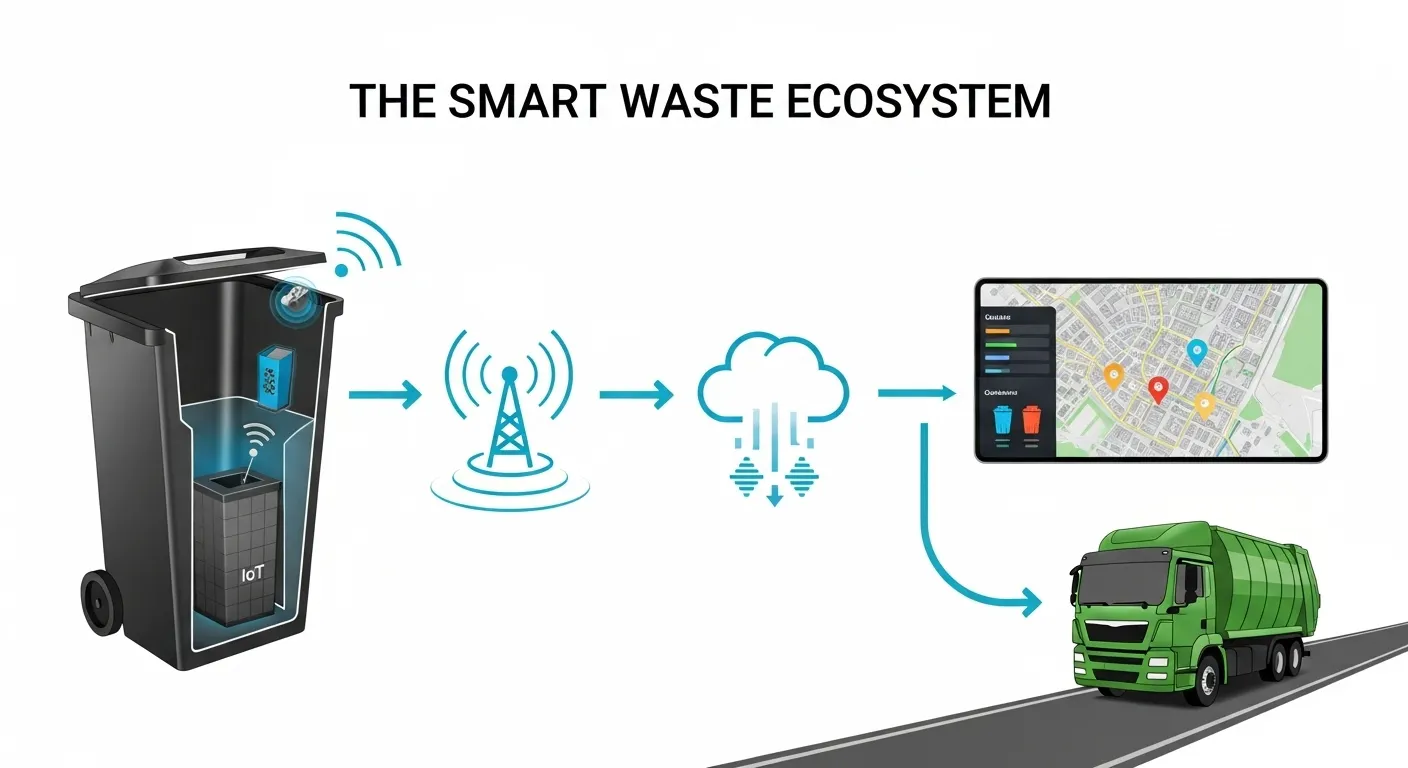
So, what’s the alternative to "guessing"? Data.
Smart waste management solutions stop the guessing game by installing a small, rugged IoT sensor inside each waste bin. This sensor does one simple thing: it measures how full the bin is, in real-time.
That's it. That one piece of data changes everything.
Instead of a fixed schedule, you get a dynamic, data-driven one. Your collection crews only visit the bins that are actually full, or predicted to be full soon.
But it's not just about the sensors. A "smart solution" is really an ecosystem with four core components working together:
- The "Senses": IoT Fill-Level SensorsThese are the eyes on the ground. Usually mounted inside the top of a bin, these ultrasonic or infrared sensors "see" the distance to the trash. They are tough, waterproof, and run on a single battery for 5-10 years. It's the same core technology used in other fields, like in a smart propane tank monitoring guide to read fuel levels.
- The "Network": Low-Power CommunicationThe sensor needs to report what it "sees." It sends its small data packet (e.g., "Bin #101 is 85% full") over a low-power, long-range network. Think of it like a tiny cell phone signal for "things." (We'll cover the specific tech like LoRaWAN and NB-IoT later).
- The "Brain": A Central Management PlatformThis is where all the data from thousands of bins shows up. It's a cloud-based dashboard—a live map of your city showing every bin's status. It's the central command center for your entire operation.
- The "Action": AI-Driven Route OptimizationHere's the magic. The platform's "brain" doesn't just show you the data; it acts on it. It automatically calculates the single most efficient collection route for your trucks, telling the driver exactly which 30 bins to pick up (and which 70 to ignore).
When these four pieces work together, you're no longer in the waste collection business. You're in the waste logistics business.
The Business Case: 3 Tangible Benefits of Smart Waste
So, you get the tech. But what's the actual business case? What do you tell the city manager or the CFO who needs to sign the check?
This is where "smart" moves from a cool feature to a core financial strategy. The benefits aren't just fuzzy "green" buzzwords; they are hard, measurable numbers.
1. Drastic Operational Efficiency & Cost Reduction
This is the most immediate and undeniable win. Smart waste management is, first and foremost, a massive cost-reduction tool.
Most deployments see a 40-50% reduction in collection frequency. Right off the bat, that's half the fuel, half the wear-and-tear on your vehicles, and half the labor hours for those routes.
Your fleet and staff are your biggest expenses. This technology allows you to:
- Do more with less: Service the entire city with fewer trucks and fewer daily routes.
- Reallocate staff: Move crews from wasteful "drive-by" collections to more valuable tasks like bulk pickup, graffiti removal, or bin maintenance.
- Extend fleet life: Fewer miles driven per day means your trucks last years longer, pushing a massive capital expense further into the future.
2. Quantifiable Sustainability & a Cleaner City
"Sustainability" is often a vague goal. This makes it quantifiable.
You can now prove your green credentials with a data report. The C02 reduction is no longer a marketing guess; it's a simple calculation: fewer truck rolls directly equals fewer tons of C02 pumped into the air. (Your local EPA data on medium-duty truck emissions will make this calculation easy).
But it's also about a cleaner, better public service. The system's predictive analytics mean you dispatch trucks before bins overflow. You're not just reacting to public complaints; you're preventing them from happening in the first place.
3. Data-Driven Insights & Asset Optimization
This is the long-term benefit that many people miss. For the first time, you have data.
After six months, you can definitively answer questions that were once pure guesswork:
- Asset Allocation: Which bins are always empty? Let's move them. Which bins are always full? They clearly need a second bin beside them.
- Resource Planning: You can see exactly which neighborhoods are producing more waste and adjust your long-term city planning.
- Prove Your Work: When a budget meeting comes up, you have charts and data that prove your department's efficiency, justify your costs, and model future needs.
You're no longer just managing trash; you're managing an intelligent city asset.
The Tech Stack Explained: A CTO's Guide to Sensors, Networks, and Platforms
Okay, let's get technical for a minute. If you're the one who has to make this technology actually work, this part is for you.
Your vendor will handle the fine details, but you need to understand the core components you're buying. Get these wrong, and the whole system fails.
Tech Showdown 1: Which Smart Sensor is Right for You?
The "smart" part of the smart bin is the sensor. Its job is to "see" the trash. But how it sees matters.
- Ultrasonic (The Standard): This is the most common type. It works like a tiny bat, sending out a sound wave that bounces off the waste. It measures the time it takes for the echo to return to calculate the distance. It's the reliable, all-around workhorse.
- Infrared (IR) / Laser (The Specialists): These use light (either infrared or a focused laser beam) to measure the distance. They can be incredibly precise but sometimes struggle with factors like direct sunlight (for IR) or very dark materials that absorb light. Laser is top-tier for accuracy but often costs more.
For 90% of use cases (general waste, recycling), ultrasonic is the proven, cost-effective choice. You'd only look at IR or laser if you have a specific, challenging need, like measuring liquids or fine powders.
| Sensor Type | How it Works | Pros | Cons | Best For |
| Ultrasonic | Bounces sound waves | Reliable, all-weather, low cost, long battery life | Can be confused by odd shapes (e.g., a single pole) | General waste, recycling, most outdoor bins |
| Infrared | Measures reflected light/heat | Good for specific materials, not fooled by shapes | Can struggle in direct sunlight, less common | Liquids, specific industrial materials |
| Laser | Bounces a focused light beam | Extremely accurate, fast | Higher cost, can be too precise (measures one small point) | Silos, high-value materials, indoor use |
Tech Showdown 2: Which IoT Network is Best for Waste?
Here's the problem: you can't use Wi-Fi (it doesn't reach) and you can't use 4G/5G (it would kill the battery in a week and cost a fortune).
The solution is a Low-Power Wide-Area Network (LPWAN). These networks are built to send tiny data packets (like "Bin #101 is 85% full") over long distances using almost no battery.
You have two main choices here, and it's a critical decision:
- LoRaWAN (The "Build Your Own" Option): This is an open standard. You (or your vendor) can set up your own private network by placing a few "gateways" on tall buildings. You get long range and have no monthly data fees, but it requires setup. It's fantastic for covering a whole city, campus, or industrial park.
- NB-IoT (The "Telco" Option): This stands for Narrowband-IoT. It's a service you buy from your existing cellular provider (like T-Mobile, AT&T, or Vodafone). It "piggybacks" on their existing cell towers. It's great for getting deep into buildings and basements.
This is the same connectivity solution used for other remote monitoring needs, such as smart propane monitoring for RVs that are often on the move or in remote campsites.
| Feature | LoRaWAN | NB-IoT |
| Network Model | Open standard (private or public) | Licensed (sold by mobile carriers) |
| Data Cost | Zero to low (if private) | Low monthly fee per device |
| Battery Life | Excellent (often 10+ years) | Good (often 5-10 years) |
| Range/Coverage | Excellent (miles) | Good (piggybacks on cell network) |
| Best For | Wide-area municipal, campus, or park deployments | Bins in dense urban areas, basements, or single-site buildings |
The "Brain": What to Look for in a Management Platform
The sensors and networks are just data collectors. The value comes from the software platform.
Don't get wowed by a flashy map with dots. The "brain" needs to do three specific things for you:
- Show You What's Happening NOW: A real-time dashboard of all bin statuses. This is the minimum requirement.
- Tell You What's Happening NEXT: This is the AI part. The platform must have predictive analytics. It should learn your fill patterns and alert you before a bin is full, allowing you to build routes for tomorrow, not just for today.
- Play Nice With Others: This is the one everyone forgets. The platform must have a clean API. You need to be able to feed its data into your existing systems—your driver's routing software, your billing system, your maintenance logs. If it's a locked-down, proprietary box, you'll regret it.
The 5-Step Implementation Playbook (From Pilot to Full Rollout)
This is the most important section of this guide.
In our experience, the number one mistake organizations make is trying to "boil the ocean." They get excited and try to budget for 10,000 smart bins at once. That's how these projects die in finance.
A successful, scalable rollout always starts with a small, strategic pilot. Here's your 5-step playbook.
Step 1: Needs Assessment & Pilot Program Scoping
Before you talk to a single vendor, you need to define your problem. Don't just say "waste is inefficient." Get specific.
Your goal here is to identify a small, high-impact area for a 50 to 100-bin pilot program. Look for your biggest "problem bins":
- The ones in the city park or downtown core that are always overflowing.
- The remote ones that cost a fortune to check, only to be found empty.
- A single collection route that you know is inefficient.
Once you have your pilot area, define what success looks like. Be specific. This is what you'll take back to your CFO.
Good Success Metric: "Reduce truck rolls on Route 7 by 30% within 60 days."
Bad Success Metric: "Make the city greener."
Step 2: Vetting Vendors & Technology
Now that you know your "why," you can go find the "what." You're not just buying sensors; you're choosing a long-term partner and a software platform.
The market is flooded with options. You need to ask tough, specific questions that go beyond the sales pitch:
- Hardware: What's the real-world battery life? (Get references.) How durable is the unit against vandalism, water, and heat?
- Data: Who owns the data? (The answer must be "you.") How open is the API? Can I integrate this with my existing fleet management software?
- Network: Are you selling me a LoRaWAN solution or an NB-IoT one? What happens if the network goes down?
- Cost: What's the total cost of ownership? Break down the per-sensor hardware cost vs. the monthly per-sensor software (SaaS) fee.
Pro-Tip: To help you with this, we've built a free Vendor Vetting Checklist. It includes these questions and over a dozen more to send to potential vendors, so you can compare their answers side-by-side. You'll find the download link at the end of this guide.
Step 3: The Pilot Deployment (Testing & Data Collection)
This is the 30- to 90-day test. Get your 50-100 sensors and install them in your chosen "problem" area.
This phase has two goals:
- Test the Tech: Does it work? Do the sensors report reliably? Is the platform easy to use?
- Gather the Data: This is the real goal. For 30-90 days, you just watch. You let the platform gather data on your fill rates, truck rolls, and inefficiencies.
You'll also do your first round of training. Get the 1-2 drivers on that pilot route and the dispatcher on board. Show them the platform and explain what you're testing.
Step 4: Analyze Pilot Data & Build the Business Case
This is the "Aha!" moment. After 60-90 days, you'll have a dashboard full of data that proves the problem.
You'll see a chart that shows, "We sent a truck to Bin #103 12 times, and it was never more than 30% full." You can now calculate exactly what that cost.
You'll take this data and build your business case. You'll go to your CFO or city council not with an idea, but with a proven result.
You'll say: "Our 60-day pilot on Route 7, using just 50 bins, saved us $4,200 in fuel and 85 staff-hours. We now have a proven model to save $1.8M annually by scaling this to our other 40 routes."
How do you get those numbers? We'll cover that in the very next section.
Step 5: Phased Rollout & Change Management
This is the most overlooked step, and it's the one that can kill your project even after you get the budget.
This is not a tech project. It's a people project.
Your drivers have been running the same routes for 20 years. They "know" their routes. Now, a computer screen is telling them to skip a bin they've always stopped at. You will face resistance.
Your "full-scale rollout" must be a phased rollout that includes change management:
- Train, Train, Train: Don't just show them the software; explain why it helps them. It means fewer stops on a blazing hot day, less overtime, and an end to the angry calls about overflowing bins.
- Create Champions: Find the one or two drivers from the pilot who "get it" and make them the champions. Let them explain it to the other drivers.
- Trust the Data: This goes for management, too. The data will tell you to change routes, move bins, and alter schedules. Your job is to listen to it.
A smart waste system is only as smart as the people who are willing to use it.
The CFO's Guide: Calculating the Real-World ROI of Smart Waste

This is the big one. It's the question everyone has, and the one most vendors avoid answering directly: What does this actually cost, and what will it save?
The business case for smart waste isn't built on vague "green" metrics; it's built on a hard-nosed calculation of your Return on Investment (ROI).
Let's break down the simple, back-of-the-napkin math. You have two sides to the equation: what you spend (the investment) and what you get back (the savings).
Part 1: The Upfront Investment (The "Cost")
To calculate ROI, you first need a clear-eyed view of the costs. Be wary of any vendor who only gives you a per-sensor price. The real cost is in the platform.
Your investment has four parts:
- Sensor Hardware: The one-time cost for the physical sensor in each bin. This can range from $50 to $150 per sensor depending on the technology and vendor.
- Installation: A one-time labor cost. This is often low, as city crews can be trained to install a sensor in under 10 minutes.
- Platform Subscription (SaaS): This is the most critical number. This is the ongoing monthly or annual fee you pay per sensor to access the software, the map, and the analytics. This is the "brain" you're paying for.
- Staff Training: A small, one-time cost to get your drivers and dispatchers up to speed.
Part 2: The Long-Term Gains (The "Savings")
This is the "return" side of the equation. These are the budget lines you'll see shrink.
- Fuel: The easiest one to measure. Your pilot data will tell you, "We cut 120 truck rolls." You just multiply
(Truck rolls saved) x (Avg. miles per roll) x (Cost per mile). - Labor: This is
(Staff-hours saved) x (Avg. hourly wage). This isn't about cutting jobs. It’s about reallocating those 85 saved hours from "driving around" to high-value work like bulky-item pickup or bin repair. - Fleet Maintenance: This is a huge long-term win. Fewer miles driven means fewer oil changes, fewer new tires, and less wear and tear. You'll extend the life of a $300,000 collection truck by years.
- Landfill/Tipping Fees: (If applicable) If your program includes smart recycling or compost bins, the data will help you dramatically improve diversion rates, cutting down on your tonnage at the landfill.
The Back-of-the-Napkin ROI Formula
You don't need a complex algorithm. You just need this simple formula from your pilot data.
Sample 100-Bin Pilot Program ROI
A. Upfront Investment (One-Time):
- (100 sensors @ $100/ea) = $10,000
- (Installation Labor) = $2,000
- Total Upfront (A): $12,000
B. Ongoing Costs (Annual):
- (100 sensors @ $3/mo SaaS fee) x 12 = $3,600
C. Hard Savings (Annual):
- (Fuel saved from 50% fewer pickups) = $8,000
- (Labor hours reallocated) = $6,000
- (Maintenance savings) = $1,000
- Total Annual Savings (C): $15,000
The Payback Period:
Total Upfront (A) / (Total Savings (C) - Ongoing Costs (B))$12,000 / ($15,000 - $3,600) = 1.05 YearsIn this simple model, the entire system pays for itself in just over 12 months.
This is the exact math you can take to your city council. And to make it even easier, our free downloadable "ROI Calculation Worksheet" has this entire formula pre-built for you.
The Unspoken Challenges (And How to Solve Them)
As good as this all sounds, it's not magic. Any vendor who tells you this is a "plug-and-play" solution with zero problems is lying.
In the real world, you will face challenges. The good news is they are all 100% solvable if you see them coming. Here are the three big ones.
- The "Sticker Shock" (High Initial Investment)
- The Challenge: You look at the cost for 10,000 sensors and the finance department says, "Absolutely not." It's a high-capital-cost project, and that's a hard "no" for most municipal budgets.
- The Solution: Don't ask for 10,000 sensors. You now have a playbook to avoid this. You ask for a 100-bin, 90-day pilot program (Step 1). You use that small, low-risk investment to prove the ROI (Step 4), and then you're not asking for a cost—you're presenting a vetted savings plan.
- The "Real World" Problem (Maintenance, Batteries & Vandalism)
- The Challenge: What happens when a sensor's battery dies in year three? What if a bin is steam-cleaned, or set on fire, or just hit by a truck?
- The Solution: This is 100% a vendor-vetting issue (Step 2). Don't just ask about battery life; ask for proof and a warranty. A good sensor is an IP67-rated, rugged, sealed unit built to withstand exactly this kind of abuse. A 5-10 year battery life is the standard. Anything less is a red flag. This is similar to the rugged requirements for any outdoor sensor, where tank safety and maintenance are a top priority.
- The "We've Always Done It This Way" Problem (Staff Resistance)
- The Challenge: This is the most dangerous one. Your drivers will resist. They'll say, "That computer is stupid, I know this bin is full," and they'll stop at it anyway, destroying all your efficiency gains.
- The Solution: This is a change management problem, not a tech problem (Step 5). You must involve your drivers from day one. Explain the "why"—it's not about "big brother," it's about ending overflow complaints and cutting the routes that waste their time. Make them part of the pilot and listen to their feedback.
The Future: AI, Robotics, and the Circular Economy
This whole system is just the beginning. The "smart" part of waste management is evolving fast, and it's moving from collection to recovery.
The AI we've discussed—route optimization—is already being lapped by advanced predictive analytics. New platforms aren't just telling you what's full now; they're accurately predicting what will be full three days from now, based on weather, local events, and historical trends.
The next leap is in sorting. Right now, this tech focuses on getting the bin to the truck. Soon, it will focus on the trash inside the bin. Think AI-powered sorting robots at waste facilities that can identify and separate a #5 plastic from a #2 plastic at superhuman speeds.
But the real future isn't just about efficiency; it's about ending the very idea of "waste."
The data from these sensors is the missing link for a true circular economy. When a city can see, in real-time, exactly what materials it's throwing away (and where), it can finally create targeted programs to recover those materials. The data from smart waste won't just optimize truck routes; it will one day optimize our entire supply chain.
Frequently Asked Questions (FAQs) About Smart Waste Management
The sensor hardware itself is just one piece of the cost, usually ranging from $50 to $150 per unit. The real cost to budget for is the ongoing software (SaaS) subscription for the management platform, which is often a few dollars per sensor, per month. The hardware is a one-time cost, but the software is what provides the actual value.
There is no single "best" one. The "best" company for a dense city (maybe needing NB-IoT) is different from the "best" for a sprawling national park (needing LoRaWAN). The right partner is the one whose technology, network, and platform features best match your specific pilot program goals.
You can expect a 5 to 10-year battery life. These sensors are designed to be extremely low-power. They "wake up" a few times a day to send a tiny data packet over a Low-Power Wide-Area Network (LPWAN) and then go back to sleep. This is why they don't use 5G or Wi-Fi, which would drain the battery in days.
The three main disadvantages are: 1) The high initial investment, 2) The need for ongoing sensor maintenance and dealing with potential vandalism, and 3) Staff resistance from drivers who are used to their old routes. All three of these are solvable with a good plan.
Yes. In fact, the impact can be even greater in a small town. If a large city cuts 10% of its routes, it's a good saving. But if a small town with only three collection trucks can use this data to remove one entire truck from the road, they've just saved a massive 33% of their entire fleet and operational budget.
Your Next Step: Moving from a Fixed Schedule to a Smart Solution
We've covered a lot—moving from the broken, "guessing" model of waste collection to a data-driven, efficient one. You now have the core components, a 5-step playbook for deployment, and a clear-cut formula for proving its financial value.
Smart waste management solutions are about more than just high-tech bins. They're about making an informed, data-driven decision to stop wasting money, fuel, and time.
You don't need a million-dollar budget to start. You just need a 50-bin pilot.
The first step isn't a massive purchase; it's a simple test. Use the framework in this guide to build your business case, run a small pilot, and prove the ROI for yourself. Your budget, your crews, and your citizens will thank you for it.
Your Toolkit for What's Next
To help you take that first step and have the right conversations, we've bundled our two key resources.
Download Your Free "Smart Waste Vendor Vetting & ROI Checklist"
This 2-in-1 toolkit includes a pre-built spreadsheet for calculating your ROI and a checklist of the tough questions to ask potential vendors. It's everything you need to start building your business case today.
Ready to plan your pilot program?
If you want to talk through your specific situation, our team is here to help you scope your pilot and navigate the technology. Contact us for a no-obligation consultation.


