
RV Propane Safety: The Complete Guide to Detecting Leaks, Monitoring Levels, and Refilling
There are two moments of anxiety every RVer knows: the first is seeing your battery voltage dip into the red. The second, and far more common, is waking up on a freezing night to a dead furnace, wondering how you could possibly be out of propane already.
Propane is the lifeblood of our rigs. It runs our heat, our stoves, our water heaters, and our refrigerators. But for many owners, it's an intimidating black box. Misinformation is everywhere, and the stakes feel high—because they are.
I roto i to'u 15+ years working with compressed gases and industrial safety systems, I've learned that 'safe handling' is just a synonym for 'understanding the system.' We're going to treat your RV's propane system just like a professional industrial process: with respect, Te mau mana'o tauturu no te, and expertise.
This isn't another post telling you to just "A faaohipa i te pape pu'a." This is a complete guide. By the time you're done, you will understand:
- How your entire propane system actually works, from tank to flame.
- Pro-level methods for detecting leaks that go beyond just your nose.
- Nahea ia rave Oia mau know how much propane you have left and ditch the guesswork for good.
- The safe, correct procedure for refilling both portable and on-board tanks.
Let's get started.
What Is an RV Propane System? A Quick Field Guide
Before you can find a leak or fix a problem, you need to know the hardware. Your RV's propane system is simple, Te mau mana'o tauturu no te, and designed with multiple layers of safety. Let's walk the line from the tank to the appliance.
DOT vs. ASME Tanks: What’s Strapped to Your Rig?
This is the first and most important distinction, one that 90% of owners don't know. The type of tank you have dictates how it's refilled and certified.
- DOT (Department of Transportation) Tanks: These are the portable "cylinders" you see on travel trailers and fifth wheels, usually in 20, 30, or 40-pound sizes. They look like a taller version of your backyard BBQ tank and are designed to be removed for refilling.
- Key Fact: DOT tanks require recertification 12 years from their original manufacture date (it's 10 years for some older tanks) and every 5 years after that. The date is stamped right into the metal collar. No certification, no refill.
- ASME (American Society of Mechanical Engineers) Tanks: This is the large, permanently mounted "Te mau mana'o tauturu no te" you see on Class A, B, and C motorhomes. It's built directly into the RV's frame and is not designed to be removed.
- Key Fact: ASME tanks do Eiaha require the same recertification schedule. They are built to a different, more robust standard and are inspected as part of the vehicle. You refill this tank by driving the motorhome to a propane station.
| Hoho'a | DOT Cylinders | ASME Tanks |
| Typical Use | Travel Trailers, 5th Wheels | Motorhomes (Class A, B, C) |
| Te ti'araa pĭpĭ | Te amoraa i te tauihaa (removable) | Permanent (frame-mounted) |
| Refilling | Removed and taken to station | Drive the RV to the station |
| Parau faati'a apî | E: 10-12 years from mfg. date, then every 5 te mau matahiti | Aita: Inspected, but no set recertification schedule |
The Unsung Hero: Your Two-Stage Regulator
That flying-saucer-shaped device your tanks connect to? That's the most critical piece of hardware you own. It's not just a simple valve; it’s a two-stage regulator.
Ia au i to'u iteraa, a failing regulator is the source of 90% of appliance problems that owners blame on their stove or furnace.
Here’s what it does:
- Stage 1: Propane in the tank is at very high pressure (100-200 Te mau nota, depending on the outside temperature). The first stage knocks this pressure down to an intermediate, stable level (ati a'e 10-15 Te mau nota).
- Stage 2: This intermediate pressure is still way too high for your furnace. The second stage drops it again, delivering a low, Te mau mana'o tauturu no te, and usable pressure (no ni'a 11 inches of water column) to all your appliances.
This two-stage process ensures you get a steady, efficient flame whether your tank is 90% full on a hot day or 10% full on a cold one.
Valves and Devices You Need to Know (The Safety Net)
Your tank is loaded with safety features. Here are the big ones:
- OPD (Overfill Prevention Device): This is the law. Inside your tank (both DOT and ASME) is a float. When the liquid propane level hits 80%, this float trips a valve and stops the flow. Teie te te most critical safety device.
- Relief Valve: This is the small valve on the tank designed to safely vent pressure if it gets too high (ei hi'oraa, if the tank was overfilled or gets extremely hot). If you ever hear hissing from this valve, move away from the tank and let it do its job.
- Solenoid Valve: On most modern RVs, this is an electric on/off valve wired directly to your internal propane detector. If the detector goes off, it sends a signal to this valve, which instantly slams shut the flow of propane from the tank, long before you can even react.
Tuhaa 1: Leak Detection — From Your Nose to Your Tools
Your propane system is a "Parau opaniraa" Faanahoraa. E mea ti'a ia Aita roa Te mau mana'o tauturu no te, not even a little bit. Here’s how to hunt down a problem.
The Smell Test and Your Built-In Detector: The First Lines of Defense
A tahi, a crucial bit of technical expertise: propane itself is completely odorless and colorless. Ua haapii mai te "huero moa pê" e aore râ, "garlic" smell is an odorant called Ethyl Mercaptan, which is added to the gas specifically so you can detect it.
Your nose is a great first alarm, but never, ever rely on it alone.
Your primary safety device is your internal propane detector, usually mounted near the floor (since propane is heavier than air and sinks). This device is your electronic nose, and it's far more sensitive than yours.
Here's the part most owners miss: These detectors expire.
Check the back of your detector. There is a "replace by" date printed on it. Most last only 5-7 te mau matahiti. If yours is expired, a mono i te reira. I teie mahana. This is absolutely non-negotiable for your safety. A detector past its service life is a detector you can't trust.
How to Perform a "Soapy Water Test" Like a Pro
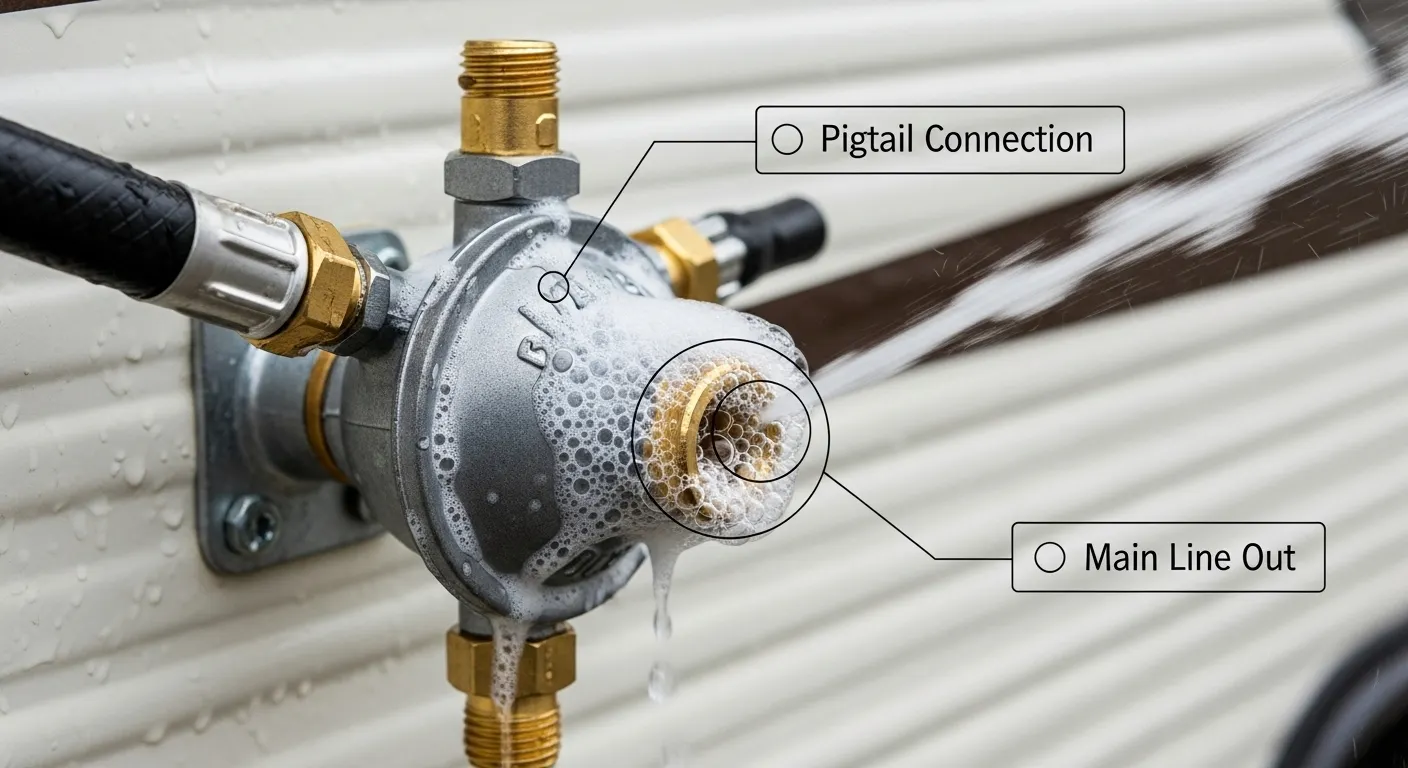
The tank itself almost never leaks. What leaks are the Te mau nota e Te mau nota where the hardware joins together. A "soapy water test" is the gold standard, and here’s how to do it right.
- Make sure all your RV appliances (Te mau mana'o tauturu no te, Te mau mana'o tauturu no te, e te vai atu ra.) are turned off.
- Go to your propane tank and open the main valve (turn it counter-clockwise) to pressurize the system.
- Mix a 50/50 solution of dish soap and water in a spray bottle or a small cup. You want it to be very sudsy.
- Generously spray or dab the solution onto every single connection point. Don't be shy.
- The Hit List:
- The main tank valve fitting (where your pigtail hose screws on)
- Both ends of the "aero puaa" hoses (at the tank and at the regulator)
- All fittings on the regulator itself (in and out)
- Anywhere the main gas line connects to the frame
- At the connection point for each appliance (matini haamahanahana i te pape, Te mau mana'o tauturu no te, fridge, Te mau mana'o tauturu no te)
- I teie nei, A hi'o maitai. O outou te Eiaha looking for tiny "champagne" Te mau hu'ahu'a. You are looking for bubbles that grow and pop, forming a foam. E is your leak.
- Mai te mea e, e itehia ia outou te hoê, shut off the tank valve and gently tighten the fitting (Te mau mana'o tauturu no te 1/4 turn past hand-tight is enough). Turn the tank on and test again. If it still leaks, the fitting or hose may be damaged and needs to be replaced.
"I Smell Propane!" Your 5-Step Emergency Action Plan
If you enter your RV and smell that strong "huero moa pê" hau'a, or your detector is screaming, do Eiaha panic. Follow these steps precisely.
- NO SPARKS. Do not touch te mau mea atoa electrical switch. Don't turn a light on, don't turn one off. Don't use your phone. Don't unplug anything. Any of these can create a tiny, invisible spark.
- EXTINGUISH. A tupohe oioi i te auahi (like the stove).
- EVACUATE. Get all people and pets out of the RV immediately. Leave the door wide open behind you.
- SHUT IT OFF. If you can do so safely (meaning the tank is outside and you can get to it without re-entering the RV), turn off the main valve at the propane tank. Turn it clockwise ("righty-tighty") until it's snug.
- CALL. Mai te hoê atearaa papû, well upwind from the RV, piiraa 911 or your campground's emergency line. Let the professionals handle it.
Tuhaa 2: Monitoring Levels — Ditching the Guesswork
Running out of propane in the middle of a 35°F night is a rite of passage, but it doesn't have to be. Here’s how to Oia mau know what you have left.
Ua haapii mai te "Old School" Methods (And Why They're Unreliable)
- The Built-In Gauge: On DOT tanks, that little plastic gauge on the valve is notoriously inaccurate. It's a simple float, and in my experience, it's only good for telling you two things: "Te taatoaraa" e "Empty." It's almost useless for anything in between.
- Te pape veavea: You've probably heard this one. Pour a cup of hot water down the side of the tank, then run your hand down it. The tank will feel cold where there is liquid propane and warm where there is only vapor. It’s a neat party trick, but it's messy, temporary, and not a reliable way to plan a week-long boondocking trip.
- Te faitoraa: This is the only accurate buka haapiiraa method, but it only works for portable DOT tanks. You have to disconnect the tank and put it on a scale. A "20-Te mau mana'o tauturu no te" tank weighs about 17-18 lbs empty (te "Te mau nota" e aore râ, "T.W." is stamped on the collar) and holds 20 lbs propane, for a full weight of ~37-38 lbs. It's a hassle, but it works.
Te ravea no teie nei tau: Smart Tank Monitors (The Best Upgrade You'll Make)
Here’s the single best upgrade you can make for your RV's propane system. Ditch the guesswork and get an ultrasonic tank monitor.
This is the E-E-A-T recommendation I give to everyone. Brands like Mopeka or AP Products make small, magnetic sensors that you stick to the Raro of your DOT or ASME tank.
Teie te huru o to'na tereraa: The sensor uses ultrasonic pulses to read the actual liquid level inside, just like a submarine's sonar. It then sends this reading—as a precise percentage—directly to a smartphone app via Bluetooth. Some modern RV LPG tank monitors also use Wi-Fi to let you check levels from anywhere, not just when you're near the rig.
Ia au i to'u iteraa, this is a total game-changer for peace of mind. You can open your phone and see, "I have 62% in tank one and 81% in tank two." You can track Oia mau how much propane the furnace used overnight.
Are there limitations? Sure. They cost money ($50-$80) and the sensor runs on a small coin battery that needs replacing once a year. But compared to the anxiety of not knowing, or the misery of running out of heat at 3 I ni'a i te, the return on investment is immediate. Plus, learning how to install a wireless propane gauge is a simple DIY project that takes less than 15 Te mau minuti.
Tuhaa 3: Refilling Efficiently and Safely
Knowing how to refill safely is just as important as knowing how to detect leaks.
Exchange vs. Refill: A Cost and Convenience Breakdown
If you have portable DOT tanks, you have a choice: exchange them at a cage or get them refilled.
- Exchange: This is fast and convenient. You drop your empty tank and grab a "Te mau mana'o tauturu no te" hoê. Te e'a i te maitai-roa-raa? Oe lose any propane left in your tank, and you often don't know the tank's age or history. It's also more expensive.
- Refill: This is where you take your tanks to a qualified station (like a Flying J, Tractor Supply, U-Haul, or local propane dealer) and they fill to outou Te mau mana'o tauturu no te. You only pay for the gallons you need, and you keep your own, known-good equipment.
My expert take: I always recommend refilling. It is significantly cheaper, and you are in control of your own equipment's maintenance and certification.
The Step-by-Step Refilling Process (For ALL Tank Types)
When you pull up to the fill station, here is the safe, professional procedure.
- Find a Qualified Station: Look for a propane-filling specialist.
- Te parururaa na mua: Pull up to the filling area and shut off your RV engine.
- ALL APPLIANCES OFF: Go inside your rig and turn off everything that uses propane: the furnace, the water heater, the refrigerator (switch it to "FAAOREHIA," not just "Auto"), and the stove. Extinguish all pilot lights. This is a critical, non-negotiable safety step.
- Inform the Attendant: Let the attendant (who should be properly trained) know what you have (portable DOT tanks or a permanent ASME tank).
- What the Attendant Is Doing (And Why):
- They will connect the fill hose. They e mea ti'a be wearing proper safety gloves (liquid propane is -44°F and causes instant, severe frostbite).
- They will open the "bleeder valve" (also called the 80% Te mau mana'o tauturu no te). You will hear hissing and see white vapor come out. Teie te normal and necessary.
- This bleeder valve is a small, open-ended tube that goes inside the tank to the 80% Te mau mana'o tauturu no te Te mau mana'o tauturu no te.
- As they pump liquid propane in, that vapor will keep hissing until the Te mau mana'o tauturu no te level reaches the end of that tube, at which point the valve will "spit" white liquid propane instead of just vapor.
- When they see that liquid, they know the tank has reached its 80% capacity and immediately shut off the pump. The OPD valve inside should also shut off the flow as a backup.
Trust but Verify: Ua haapii mai te 80% rule is a critical safety law. E 20% of empty space (piihia "headspace") is left for the liquid to expand into vapor as it warms up. If an attendant aita use the bleeder valve or tries to "top it off" past that point, stop them immediately. A tank filled to 100% on a cool morning can become dangerously over-pressurized by a hot afternoon.
The Great Debate: Is It Safe to Drive with Propane On?
You'll hear this one argued at every campground. People leave their propane on to run the refrigerator while driving. No reira, can you?
- The Risk: In the event of an accident, you have a live, open fuel source connected to an appliance with an open flame (on older fridges) or an electrical igniter.
- The Law: Many tunnels and ferries (like the Baltimore Harbor Tunnel) legally require you to stop and shut off your tanks before entering.
- The Expert Take (E-E-A-T): My professional opinion is simple: Turn it off. Your modern RV refrigerator is extremely well-insulated. It will easily stay cold for 8+ Te mau hora, the duration of a full travel day. The minuscule risk of a propane-fueled fire in an accident is just not worth the tiny convenience. Period.
Advanced Propane Maintenance
You've mastered the basics. Here’s how to keep your system in top shape.
Recognizing a Failing Regulator
Remember that two-stage regulator? They are wear items. They don't last forever, as the internal diaphragms and springs wear out.
- Symptoms of Failure:
- Re'are'a, sooty flames on your stove instead of crisp blue ones.
- Furnace "popping" or sputtering when it tries to ignite.
- Appliances that won't stay lit or seem to have a "Te mau mana'o tauturu no te" flame.
- The Fix: Don't try to service a regulator. They are sealed units. The good news is they're cheap ($40-$70) and relatively easy to replace. Plan to replace yours every 5-10 years as preventative maintenance.
Tank Recertification and Care
- DOT Tanks: Look at the metal collar. You'll see a date stamped into it, mai te "06 21" (June 2021). That's the manufacture date. Your tank is good for 12 years from that date. I muri a'e i te reira, it needs a 5-year recertification.
- Tank Care: There's a reason tanks are painted white or light grey. It's to reflect ve'ave'a. A dark-colored tank will absorb sunlight, increasing the internal pressure significantly. Never paint your tanks a dark color.
Faaotiraa: Respect the System, Enjoy the Trip
Your RV's propane system is a reliable, powerful workhorse, not a ticking time bomb. Like any industrial system, it simply demands your respect and your understanding. When you know what the parts do, why they're there, and how to check them, all the fear and guesswork disappear.
Let's review the key takeaways:
- Trust Your Sensors: Your nose and your electronic detector are your primary alarms. Test your detector monthly and a mono i te reira based on its expiration date (Te mau mana'o tauturu no te 5-7 te mau matahiti).
- Test Your Fittings: A 5-minute soapy water test at the start of every season (or any time you swap tanks) is the best preventative maintenance you can do.
- Monitor Smartly: A faaea i te feruri. Te hoê mana'o tauturu no te tuatapaparaa e te haapiiraa "Te mau mana'o tauturu no te" monitor is the only way to know your true propane level and plan your trips with confidence.
- Refill Safely: Always turn off all appliances and pilot lights before refilling. And always ensure the attendant uses the 80% bleeder valve.
Be safe, be prepared, and enjoy the trip.
Te mau uiraa e ui-pinepine-hia (FAQ)
How often should I test for propane leaks in my RV?
You should perform a full "soapy water test" on all connections at the beginning of every camping season, and any time you disconnect and reconnect a tank. It's also wise to do a quick check after driving on particularly rough roads, as vibrations can loosen fittings.
What is an OPD valve and why is it important?
An OPD, or Overfill Prevention Device, is a safety float inside your propane tank. It's legally required on all modern DOT and ASME tanks. It automatically stops the flow of propane during refilling once the liquid reaches 80% Te mau mana'o tauturu no te, leaving 20% of the tank as "headspace" for safe vapor expansion.
How long does an RV propane detector last?
Most RV propane detectors have a service life of 5 i te 7 te mau matahiti. After this time, the sensor's accuracy degrades. There is an expiration or "replace by" date printed on the unit itself. It is critical for your safety to replace the entire unit when it expires.
Why does my propane tank only fill to 80%?
This is the most important safety rule in propane handling. Liquid propane expands dramatically with heat. Ua haapii mai te 20% of empty space (piihia "headspace") is left in the tank to allow the liquid to safely expand into a vapor as the ambient temperature rises. A tank filled to 100% has no room for expansion and can become dangerously over-pressurized.
Is it safe to use a "propane extend-a-stay" adapter?
These adapters, which let you hook up an external propane tank, are generally safe if they are installed, used, and maintained correctly. Always follow the manufacturer's instructions, check all new connections for leaks with soapy water, and ensure the external tank is properly secured.
What's the difference between propane and butane?
Both are LPG (Liquefied Petroleum Gas), but their boiling points differ. Propane boils at -44°F (-42°C), meaning it will turn to a gas and work even in very cold weather. Butane boils at 31°F (0°C), so it will stop vaporizing and be useless in freezing temperatures. Propane is the standard for all-weather RVing.
Can I use a regular BBQ grill tank on my RV?
E, if your RV uses portable DOT tanks (like a travel trailer). A standard 20-pound BBQ tank is a DOT-certified cylinder, just like the 30 or 40-pound tanks that came with your rig. It uses the same valve and will connect to your regulator pigtail. Tera râ,, it must have a modern OPD valve.
How do I find my propane tank's certification date?
On a portable DOT tank, look at the metal collar or handle. You will see dates and letters stamped into the steel. Ua haapii mai te "manufacture date" is usually a two-digit month and two-digit year (e.g., "08 22" for August 2022). The tank is good for 12 years from this date. Any subsequent recertification dates will be stamped nearby.


