
Why Ultrasonic Sensors Dominate Waste Management: A Technology Deep Dive
Ultrasonic sensors are the core technology in modern waste management. They are the workhorse devices that provide accurate, real-time data on bin fill levels. These sensors use sound waves to measure the distance to the waste inside a container. This simple yet powerful capability is the foundation of smart waste collection.
The data they generate enables the optimization of collection routes. This, in turn, reduces operational costs and dramatically improves service efficiency. Understanding how this specific technology works is essential. It is the key to understanding the entire smart waste industry and the value it delivers. This guide provides a deep dive into the science, application, and benefits of ultrasonic sensors.
What is an Ultrasonic Sensor and How Does It Work?
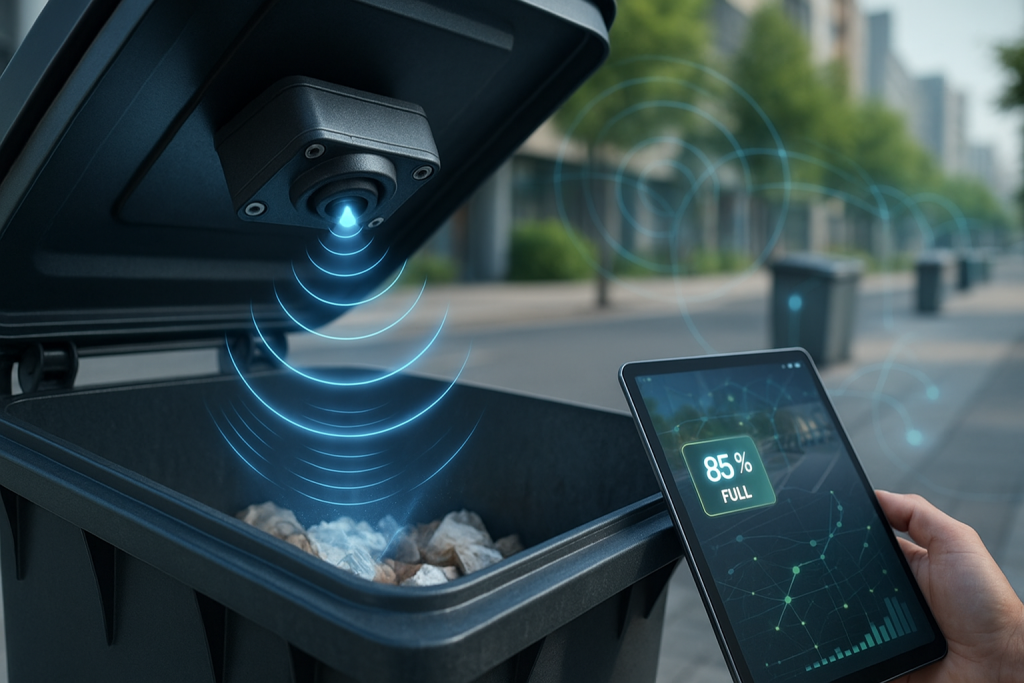
An ultrasonic sensor is a device that measures distance using sound waves. The term "ultrasonic" refers to sound frequencies that are higher than the upper limit of human hearing. The sensor operates on a principle of nature called echolocation. This is the same method used by bats and dolphins to navigate and find objects in the dark. The sensor emits a sound pulse and listens for the echo. By measuring the time it takes for the echo to return, it can calculate distance with remarkable precision.
The key component inside an ultrasonic sensor is a piezoelectric transducer. This is a special crystal that has a unique property. When an electric voltage is applied to it, it vibrates rapidly and produces a sound wave. Conversely, when a returning sound wave (an echo) strikes the crystal, it generates an electric voltage. The transducer therefore acts as both a tiny speaker and a microphone for ultrasonic frequencies.
The measurement process, known as time-of-flight (ToF), happens in a fraction of a second. First, the sensor's microcontroller sends an electrical pulse to the transducer. The transducer vibrates, emitting a short "ping" of ultrasound into the bin. This sound wave travels through the air. It continues until it hits the surface of the waste material. The wave then reflects off the surface. This creates an echo that travels back up towards the sensor. The returning echo strikes the transducer, which converts the sound energy back into an electrical voltage. The sensor's internal clock measures the precise time elapsed between sending the ping and receiving the echo. Based on this time, the microcontroller calculates the distance to the waste.
Why Ultrasonic Technology is Ideal for Waste Management
Ultrasonic sensors have become the industry standard for waste management for several clear and compelling reasons. Their unique combination of performance, reliability, and cost-effectiveness makes them perfectly suited for this demanding application. This is the only section where we will use bullet points to clearly list these advantages.
- High Accuracy and Precision: Ultrasonic sensors provide highly accurate distance measurements, often with a precision of within a single centimeter. This level of accuracy is essential for a waste management system. It allows the software platform to know the exact fill level of a container, not just an estimate. This precision is crucial for making informed decisions about when to schedule a collection.
- Versatility with Different Materials: The technology works very effectively with a wide variety of materials commonly found in waste streams. Sound waves reflect reliably off most solid surfaces. This includes mixed municipal waste, paper, cardboard, plastics, and glass. This versatility ensures that the sensor will provide consistent performance across a diverse network of bins with different contents.
- Cost-Effectiveness for Large-Scale Deployments: Ultrasonic technology is mature and well-established. The sensors can be manufactured at a reasonable cost. This economic feasibility is critical for smart waste projects, which often involve deploying thousands or even tens of thousands of sensor units across a city or a large enterprise. The technology hits a sweet spot between high performance and affordability.
- Extremely Low Power Consumption: The process of sending a sound pulse and performing a calculation is very energy efficient. The sensors are designed to spend most of their time in a low-power "sleep" mode. They only wake up for a few seconds to take a reading and transmit data. This allows them to operate on a single, long-life battery for many years, minimizing the need for costly maintenance visits.
- Inherent Durability and Reliability: An ultrasonic sensor is a solid-state device with no moving parts. This simple design makes it inherently reliable and resistant to mechanical failure. When the electronics are protected within a rugged, weatherproof housing, the sensor can easily withstand the harsh conditions found inside a waste bin for its entire lifespan.
- Safe, Non-Contact Measurement: The sensor performs its measurement from the top of the bin without ever physically touching the waste. This non-contact method is crucial. It prevents the sensor from being damaged or contaminated by the bin's contents. It also ensures that its measurements are not affected by the compaction of the waste material below.
The Sensor in Context: From Measurement to Action
An ultrasonic sensor is the starting point of a powerful data journey. The sensor itself only provides a single, raw data point: the distance to the waste. For this data to become useful, it must be integrated into a larger smart waste management system.
The journey begins when the sensor transmits its reading. Using a built-in IoT communication module, it sends the data wirelessly. This is usually done over a Low-Power Wide-Area Network (LPWAN), like LoRaWAN or NB-IoT. These networks are designed to carry small amounts of data efficiently over long distances.
The data then arrives at a central, cloud-based software platform. This platform acts as the brain of the entire operation. It receives the distance reading from the sensor. The platform's software knows the total height of the specific bin from which the data came. It performs a quick calculation to convert the distance measurement into an intuitive fill-level percentage.
This percentage is what transforms the raw data into actionable intelligence. The platform displays this information on a dashboard, often on a live map. A bin at 10% full might be color-coded green, while a bin at 85% full would be red. When a bin's level crosses a pre-set threshold, the platform can trigger an automatic alert. Most importantly, it adds the bin to the list of containers that need to be collected. The platform's route optimization engine then uses this list to create the most efficient collection route for the day. This seamless process connects a simple sound wave to a real-world reduction in fuel costs and emissions.
Overcoming Technical Challenges in a Waste Bin Environment
The inside of a waste bin is a challenging place for any electronic device. High-quality ultrasonic sensors are specifically engineered to overcome these challenges and deliver reliable data.
One of the biggest challenges is temperature fluctuation. The speed of sound changes slightly with air temperature. A simple sensor might become inaccurate during a hot day or a cold night. To solve this, advanced ultrasonic sensors include a built-in temperature sensor. The device's microcontroller uses this temperature data to constantly recalibrate its calculations. This temperature compensation ensures that the distance measurements remain accurate regardless of the weather.
Another challenge is the irregular surface of the waste. Unlike a flat liquid surface, the top of a pile of trash is uneven. An ultrasonic sensor does not measure a single point. It emits a sound wave in a cone shape. The returning echo is an average of the reflections from the area covered by this cone. Sophisticated signal processing algorithms then analyze this echo to determine a reliable average distance, preventing a single high point from giving a false "full" reading.
False echoes and obstructions can also be an issue. For example, a stray plastic bag could get stuck near the top of the bin, blocking the sensor's view. Intelligent software can filter out these false readings. The platform can be configured to require multiple, consistent "full" readings over a period of time before it triggers a collection. This prevents a truck from being dispatched for a bin that is not actually full. The combination of smart hardware and smart software creates a highly reliable system.
The Impact of Ultrasonic Data on Waste Collection Logistics
The accurate and reliable data provided by ultrasonic sensors has a direct and profound impact on waste collection logistics. It enables a range of efficiencies that are impossible to achieve with a traditional system.
The most significant impact is enabling dynamic routing. Dynamic routing is the process of creating a new, optimized collection route each day based on real-time data. This is only possible if you have accurate fill-level information from the field. The ultrasonic sensor is the key enabler of this entire process.
This leads directly to the prevention of overflows and under-collections. With real-time data, bins are collected at the optimal time. This means they are serviced just before they become full. This prevents the unsightly and unhygienic overflows that frustrate citizens. It also stops the wasteful practice of collecting bins that are nearly empty.
This efficiency allows for much better asset utilization. With optimized routes, collection fleets drive fewer miles and spend less time on the road. This allows organizations to service the same area with fewer vehicles and staff. Alternatively, it allows them to expand their service area without increasing their resources. The data from ultrasonic sensors is what makes this "do more with less" approach a reality for smart bins.
Finally, the historical data gathered from the sensors is a goldmine for strategic planning. By analyzing this data over months and years, managers can identify long-term trends. They can see which areas generate the most waste and at what times. This information is invaluable for making decisions about the optimal size, number, and placement of bins to best serve the public.
Conclusion: The Sound of Efficiency
The ultrasonic sensor is, for many clear and proven reasons, the workhorse of the smart waste industry. Its dominance is a result of its ideal combination of high accuracy, operational versatility, cost-effectiveness, and unwavering reliability. It provides the foundational data that makes intelligent waste management possible.
While it operates unseen and unheard, this remarkable piece of technology is constantly working. It is sending out sound waves and listening for the echoes that tell the story of a city's waste. It is this sound of efficiency that enables cleaner communities, leaner operations, and a more sustainable approach to resource management. Its role as the primary data source makes it the most critical component in the ongoing transition to an intelligent, data-driven future.


