
The Engineer's Guide to Waste Bin Level Sensors
A waste bin level sensor is a highly specialized electronic device. It is designed to accurately measure the volume of waste inside a container. Its core function is to provide the real-time, reliable data that powers modern smart waste management systems. This component is the single most critical piece of hardware in the entire ecosystem.
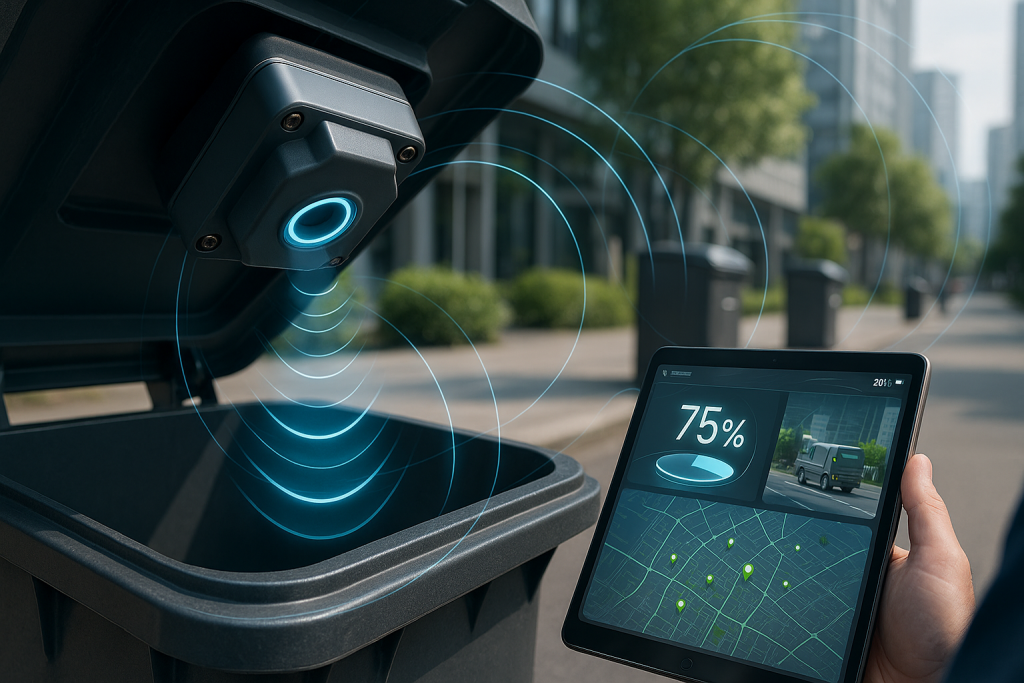
It acts as the primary data source for all subsequent optimizations, from route planning to operational analytics. The sensor effectively gives a voice to the bin, allowing it to communicate its status. This guide provides an engineer's perspective on the technology, performance, and application of these essential devices.
From Simple Container to Intelligent Asset
For generations, the waste bin was a passive, unintelligent object. Its status could only be known through manual, physical inspection. This inefficient process was the accepted norm. The integration of a level sensor marked a profound technological leap. It transformed the bin from a simple container into an intelligent, connected asset.
This evolution is a textbook example of the Internet of Things (IoT) in action. By embedding a sensor and a communication module, a mundane object becomes a source of valuable data. This data eliminates the guesswork that defined traditional waste collection. It allows for a transition from a reactive, schedule-based model to a proactive, data-driven one. The sensor is the catalyst for this entire transformation. Understanding its technology is fundamental to understanding the value of smart waste solutions.
Core Sensor Technologies Explained
The term "waste bin level sensor" primarily refers to a few key non-contact measurement technologies. Each technology has a distinct operating principle, offering a unique set of advantages and considerations for different applications. This is the only section where we will use bullet points to clearly compare these technologies.
- Ultrasonic Sensors: The Versatile Standard This is the most prevalent technology in the smart waste industry. Ultrasonic sensors operate on the principle of time-of-flight (ToF) measurement using sound waves. A piezoelectric transducer in the sensor generates a short, high-frequency ultrasonic pulse. This sound wave travels through the air, reflects off the surface of the waste, and returns as an echo to the transducer. The sensor's microcontroller measures the precise time elapsed between sending the pulse and receiving the echo. Since the speed of sound is a known value that can be adjusted for temperature, the device calculates the distance with high precision. This distance is then subtracted from the bin's total height to determine the exact fill level. Ultrasonic sensors are highly valued for their accuracy, reliability with diverse solid waste materials, and overall cost-effectiveness, making them the standard for most public and commercial smart bins.
- Infrared (IR) ToF Sensors: Precision with Light Infrared sensors also use the time-of-flight principle but rely on a pulse of light instead of sound. An IR ToF sensor emits a very short pulse of infrared laser light. This light travels to the waste surface, reflects, and is detected by a highly sensitive optical receiver in the sensor. By measuring the light's round-trip time, the sensor can calculate the distance with exceptional precision. Unlike simple IR proximity sensors used for lid opening, ToF sensors provide continuous distance measurements. They are not affected by air pressure or vacuums. However, their performance can be influenced by the optical properties of the waste material, such as its color, transparency, and reflectivity. The cleanliness of the sensor's lens is also a factor in maintaining accuracy.
- Radar Level Sensors: Unmatched Robustness Radar sensors represent the most robust level-sensing technology. They operate using microwaves, which are a form of radio wave. The sensor emits a radio signal that reflects off the waste surface. By analyzing the reflected signal, the device determines the distance. The primary advantage of radar is its immunity to environmental conditions. Radio waves can easily penetrate dust, condensation, moisture, and temperature variations that can sometimes challenge ultrasonic or infrared sensors. This makes radar the ideal choice for the most demanding industrial applications. This includes monitoring containers with liquids, chemicals, powders, or those in extremely harsh outdoor environments. While their higher cost makes them less common for standard city waste bins, their reliability is second to none for specialized use cases.
The Anatomy of a Modern Sensor Unit
A waste bin level sensor is a self-contained, highly engineered unit. It comprises several key components that are designed to work together seamlessly for years in a harsh environment.
The core is the transducer or emitter. This is the element that sends and receives the signal, whether it is an ultrasonic pulse, an infrared beam, or a radar wave. This component determines the fundamental sensing capability of the device.
The "brain" of the unit is the microcontroller. This is a tiny, low-power computer that controls the sensor's operations. It processes the raw signal from the transducer, performs the time-of-flight calculation, and converts it into a usable data point, such as a fill-level percentage.
The communication module is the sensor's link to the outside world. This is an integrated IoT radio, most commonly designed for LoRaWAN or NB-IoT networks. This module takes the data from the microcontroller and transmits it wirelessly to the network gateway.
The power source is almost always a long-life, industrial-grade lithium battery. The entire device is designed for extreme power efficiency. It spends most of its time in a "deep sleep" mode, waking up only for a few seconds to take a measurement and transmit data. This sophisticated power management allows the battery to last for many years.
All these electronics are protected by the housing. This is a rugged, sealed enclosure, typically with an IP67 rating or higher. This rating ensures the device is completely protected from dust ingress and can be submerged in water without damage. This robust housing is critical for protecting the sensitive electronics from the harsh conditions inside a waste bin.
Key Performance Metrics for Evaluation
When evaluating a waste bin level sensor, technical specifications are paramount. Several key performance metrics determine the quality and suitability of a sensor for a given application.
Accuracy and resolution are the most important metrics. Accuracy refers to how close the sensor's measurement is to the true value. Resolution refers to the smallest change in level that the sensor can detect. For most waste applications, an accuracy of plus or minus one or two centimeters is considered excellent.
The sensor's range is another critical specification. This defines the maximum distance the sensor can reliably measure. The range must be greater than the depth of the deepest container it will be installed in.
Battery life is a crucial factor for total cost of ownership. It is typically specified in years or as a total number of transmissions. A standard of five to ten years is expected from a high-quality sensor. This is dependent on the reporting frequency.
The operating temperature range indicates the environmental conditions the sensor can withstand. A sensor destined for outdoor use must be able to function reliably in both extreme heat and sub-zero temperatures.
Finally, the IP (Ingress Protection) rating is a non-negotiable specification. An IP67 rating is the minimum standard. It signifies that the device is completely dust-tight and can withstand temporary immersion in water. This ensures the sensor survives cleaning processes and heavy rain.
From Raw Data to Actionable Intelligence
The journey of data from the sensor is what unlocks its value. The sensor's primary job is to generate a raw data point, such as "distance to waste is 1.2 meters." This data is then transmitted through the IoT network to the cloud platform.
The software platform is where this raw data is converted into actionable intelligence. The platform knows the total height of the bin. It performs the simple calculation to convert the distance reading into a more useful metric, like "bin is 75% full."
The platform then visualizes this information. It places a pin on a map and color-codes it based on its status. It logs this data point in a historical database. It compares the reading to preset thresholds. If the 75% level exceeds the collection threshold, the platform automatically triggers an action. This action could be sending an email alert to a manager or, more importantly, adding that specific bin to the list for the next optimized collection route. This seamless process is what connects a simple distance measurement to a real-world reduction in operational costs.
Conclusion: The Bedrock of Smart Waste Management
The waste bin level sensor is the bedrock of any modern smart waste management system. It is a sophisticated piece of engineering that provides the fundamental data upon which all other efficiencies are built. Its accuracy, reliability, and durability are the most important factors that determine the success and ROI of a smart waste deployment.
While often unseen, this component is doing the most critical work. It is constantly measuring, processing, and communicating. It provides the visibility that was once thought impossible. As sensor technology continues to advance, becoming even more accurate, efficient, and affordable, its role in creating data-driven, sustainable communities will only continue to grow. Understanding this core technology is essential for anyone involved in the future of urban resource management.
Frequently Asked Questions (FAQ)
1. What is the main difference between an ultrasonic and an infrared level sensor?
The main difference is the medium they use. Ultrasonic sensors use high-frequency sound waves to measure distance, making them very versatile for various waste types. Infrared sensors use a beam of light, which is excellent for proximity detection and can also be used for distance measurement.
2. How often does a waste bin level sensor report data?
The reporting frequency is configurable through the software platform. A typical setting might be to report a new level reading every few hours. The frequency can be increased if a bin is filling up quickly. The device can also be set to report immediately if a critical event occurs, like a fire or tilt alert.
3. Can these sensors be installed in any type of bin?
Yes, the sensors are designed to be highly adaptable. They can be installed in a wide variety of containers, from small public litter bins to large industrial dumpsters and even underground waste systems. The key is to mount them correctly at the top of the container with a clear view of the contents.
4. How do you ensure the sensor's data is accurate and reliable?
Reliability is ensured through several factors. It starts with choosing a high-quality sensor with proven technology. Advanced sensors also have internal algorithms that filter out false echoes and compensate for temperature changes. Finally, proper installation is critical to ensure the sensor has a clear line of sight to the waste.


