
5V Optical Infrared Water Level Sensor (Low-Current Module)
The 15ma 5v optical infrared water liquid level sensor is a low-current photoelectric point-level sensor module for water tanks, small reservoirs, appliances, test equipment, and MCU-based liquid detection systems. Buyers usually verify four items first: 5V DC supply, approximately 15mA current draw, NPN open-collector output, and direct MCU input compatibility. HojellyTek supplies optical water level sensors from Shenzhen with OEM/ODM support for housing material, cable, connector, mounting, and output configuration.
Low-Current 5V Optical Water Level Sensor Capabilities
This 5V infrared optical water level sensor is designed for single-point liquid presence detection. It does not measure continuous tank height; it confirms whether liquid has reached the sensor tip position. For buyers comparing a standard optical level sensor with a compact PCB-friendly module, the key value is fast, contactless optical switching at a defined level point.
Typical project use cases include:
- Water tank low-level or high-level detection
- Small appliance reservoir protection
- Smart dispenser and humidifier liquid detection
- Laboratory device liquid presence sensing
- Pump dry-run protection input
- Embedded MCU water detection modules
- OEM smart tank products using gateway, WiFi, Tuya/Smart Life, or local controller logic
The module is suitable when the control board already works on 5V logic and the buyer wants a low-current sensor input without adding a relay, float arm, or mechanical moving part.
Electrical Specs Buyers Verify First
For this product type, the most important buying decision is not the appearance of the sensor; it is whether the electrical output matches the controller. A low-current 5V optical infrared sensor is usually selected because it can be powered from the same regulated 5V rail as the MCU board.
| Electrical Item | Specification / Buyer Check |
|---|---|
| Supply voltage | 5V DC |
| Current draw | Approximately 15mA |
| Sensing method | Infrared photoelectric optical sensing |
| Output type | NPN open-collector output |
| Controller compatibility | Direct MCU input compatible when pull-up and logic level are correctly designed |
| Detection mode | Point-level wet/dry detection |
| Signal use | Digital level input for alarm, pump control, tank status, or embedded logic |
| Wiring check | Confirm VCC, GND, and signal line before powering the sensor |
The NPN open-collector output is especially important. It is not the same as a push-pull output. In many MCU circuits, the output line needs a pull-up to the controller’s logic voltage. When the sensor switches, the output transistor pulls the signal line low or releases it, depending on the wet/dry state and circuit design. Before ordering, buyers should confirm the expected output logic with the control board firmware.
For a hands-on microcontroller wiring explanation, use our Arduino optical sensor guide. This product page focuses on specification selection, not Arduino programming.
How the Infrared Optical Tip Detects Water
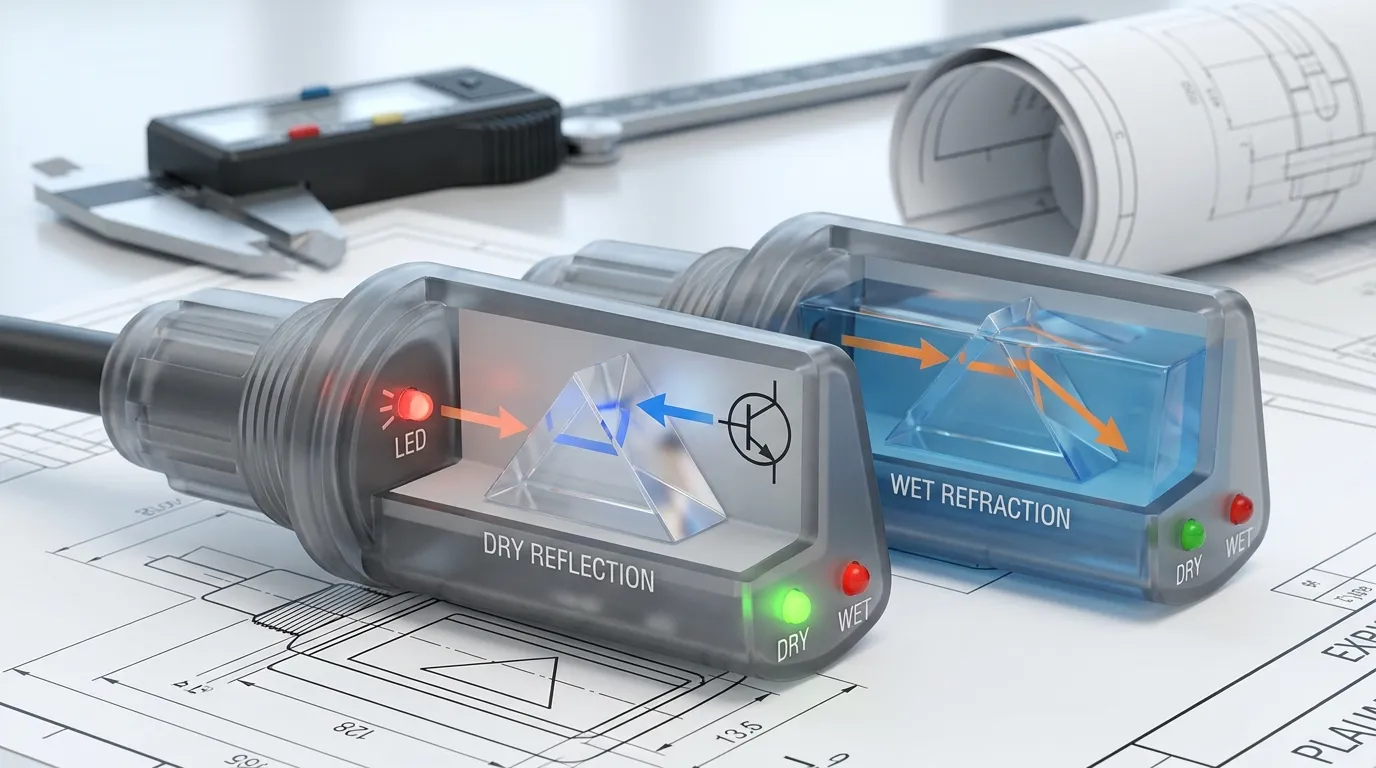
The sensing principle uses an infrared LED, a phototransistor receiver, and a transparent optical prism tip. In the dry state, infrared light reflects internally inside the prism and returns to the receiver. When the prism is wetted by liquid, the refractive condition changes, so less light returns to the receiver. The circuit converts that optical change into an electrical output.
This is why optical sensors are different from float switches. There is no magnet, reed switch, hinge, or moving float. The sensor responds to the optical condition at the tip. That makes it useful in compact tanks, narrow spaces, and equipment where a moving float could jam, stick, or become noisy.
However, the buyer must check the detection liquid. Clean water is the most common target for this 5V module, but real-world liquids can behave differently. Foam, bubbles, heavy scaling, thick oil films, condensation, or sticky residue on the optical tip may delay or disturb detection. If the liquid is not clean water, share the medium name, temperature condition, cleaning method, and whether residue is expected.
Dimensions, Housing Material and Mounting Choices
Compact 5V optical water level modules are often used where space is limited. Dimensions should be confirmed from the product drawing before purchase because tank wall thickness, thread length, cable exit direction, and sealing area all affect installation.
HojellyTek can support optical sensor structures for different OEM projects, including plastic-bodied modules, compact sensor heads, and custom cable assemblies. For very tight equipment layouts, buyers can also review our micro optical sensor options.
Common wetted-material choices include:
- PSU housing for general water and appliance applications
- PTFE body for chemically aggressive liquid environments
- 316 stainless steel housing for stronger mechanical protection or industrial tanks
- Glass sensing tip for selected high-cleanliness or special media requirements
Material selection should follow the liquid, cleaning chemical, temperature exposure, mechanical stress, and sealing method. A low-current 5V electrical design does not automatically mean the same housing works for every liquid.
Panel and Inline Mounting Notes
Panel mounting is the most common approach. The sensor tip passes through a tank wall or panel opening, and the optical tip is positioned at the required level point. The buyer should confirm:
- Sensor tip direction
- Tank wall thickness
- Thread or locking-nut requirement
- Seal position
- Cable exit direction
- Whether the sensor is installed from inside or outside the tank
- Whether the liquid level rises slowly, splashes, or creates foam near the sensing point
Inline mounting is different. Instead of being mounted directly into a tank wall, the sensor may be placed in a small liquid path, tube, chamber, or transparent/opaque flow section. For inline use, the buyer should provide a drawing of the fluid path so the factory can review whether the optical tip will be fully exposed to the liquid and whether trapped air bubbles may affect detection.
Quick-Test Checklist Before Production Use
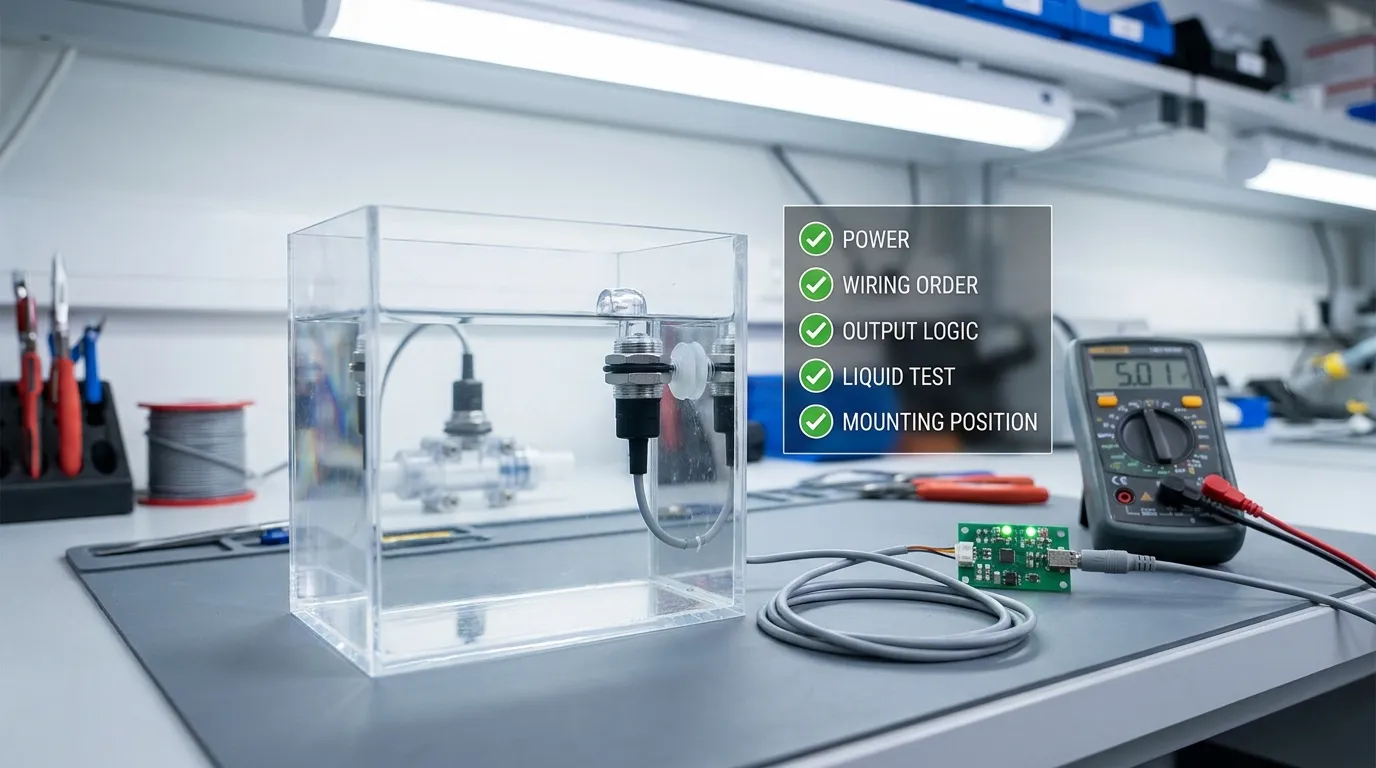
Before moving to batch production, test the module with the real control board and real liquid condition.
- Confirm power first
Supply the sensor with stable 5V DC and verify the current draw is suitable for the controller power budget. - Check wiring order
Confirm VCC, GND, and NPN signal output before connection. Incorrect wiring can damage the module or create false output. - Verify output logic
Test dry state and wetted state with a multimeter or MCU input. Confirm whether the firmware expects active-low or active-high behavior. - Test the actual liquid
Do not rely only on clean water if the final product uses detergent, coolant, oil-water mixture, chemical solution, or liquid with residue. - Test mounting position
Install the sensor in the real tank wall or chamber position. Check splashing, bubbles, condensation, and whether the optical tip is fully exposed. - Run repeated wet/dry cycles
Cycle the liquid level multiple times to confirm repeatability before approving the sensor for production.
5-Step OEM Supply Process
- Enquiry
Send the target liquid, supply voltage, output type, mounting method, cable length preference, and application photos or drawings. - Spec and customization review
Our team confirms the 5V, approximately 15mA, NPN open-collector requirement and reviews housing material, connector, seal, and installation constraints. - Sample confirmation
Sample units can be prepared for electrical, liquid, and mechanical fit testing before batch approval. - Production and QC
The factory checks electrical function, optical response, wiring, housing condition, and customer-specific configuration. - Export and shipping support
HojellyTek exports optical liquid level sensors to US, EU, India, and other markets with support by WhatsApp and email.
Ordering Requirements to Share With the Factory
To quote the correct version, send these details:
| Requirement | Why It Matters |
|---|---|
| Liquid type | Confirms optical detection reliability and wetted material |
| Supply voltage | This page focuses on 5V DC modules |
| Current budget | Confirms suitability for approximately 15mA sensor draw |
| Output requirement | NPN open collector is standard for this selection; PNP or 4–20 mA can be reviewed for other projects |
| Mounting style | Panel, tank wall, chamber, or inline installation |
| Housing material | PSU, PTFE, 316 stainless steel, or glass options depend on the liquid |
| Cable / connector | Needed for OEM assembly and serviceability |
| Controller type | MCU, PLC input board, IoT module, or appliance control PCB |
5V vs 12V vs Micro Optical Sensor Options
| Option | Best For | Buyer Note |
|---|---|---|
| 5V low-current optical module | MCU boards, appliances, compact water detection | Choose when 5V supply and direct digital input are preferred |
| 12V optical sensor | Industrial controls and 12V systems | Better when the control cabinet or machine already uses 12V power |
| Micro optical sensor | Very small reservoirs and tight OEM layouts | Review drawing and mounting depth carefully |
| 316 stainless / PTFE versions | Industrial or chemical liquid projects | Select based on liquid compatibility and mechanical environment |
Why Choose HojellyTek
HojellyTek is a Shenzhen manufacturer and exporter focused on photoelectric optical liquid level sensing. Our in-house R&D team supports sensor structure selection, OEM/ODM customization, cable and connector matching, and application review for water, appliance, tank, and industrial liquid detection projects.
Buyers work with us when they need factory-direct support instead of only a generic module listing. We help confirm the electrical interface, liquid compatibility, mounting approach, and production test requirements before the order is finalized.
FAQ
Is the 15ma 5v optical infrared water liquid level sensor a continuous level sensor?
No. It is a point-level sensor. It detects whether liquid is present at the optical tip position. For continuous tank height measurement, a different sensor structure is required.
Can the 5V optical water level sensor connect directly to an MCU?
Yes, when the MCU input circuit is designed for an NPN open-collector signal with the correct pull-up and logic expectation. Always test wet and dry output states before production.
What liquid can this optical infrared sensor detect?
Clean water is the most common target. Other liquids should be tested because foam, residue, oil film, bubbles, or heavy contamination can affect the optical tip response.
Does the sensor need a relay?
Not for most MCU input designs. The NPN open-collector output is normally used as a digital signal input. A relay is only needed if the wider control system requires one.
Can I order a different output type?
Yes. This page focuses on the 5V, approximately 15mA, NPN open-collector module. For PNP, analog, 4–20 mA, or other interface needs, send your controller specification for review.
Can this sensor be used for inline mounting?
Yes, inline use can be reviewed if the liquid path allows the optical tip to contact the liquid properly. Send the chamber, tube, or flow-path drawing before ordering.
Request a Quote
Send your liquid type, 5V controller details, output logic requirement, mounting drawing, cable or connector preference, and estimated order quantity. HojellyTek can review the specification and provide a suitable low-current 5V optical infrared water level sensor quotation by WhatsApp or email.


