
316 Stainless Steel Optical Level Sensor
For buyers comparing PSU, PTFE, 316/316L stainless steel, and glass sensor bodies, this page focuses on where 316SS is useful, what must be verified, and when another wetted material is safer.
316/316L Stainless Steel Optical Level Sensor Capabilities
Our stainless steel optical sensors are built for point-level detection in tanks, reservoirs, process vessels, small chambers, and OEM equipment where liquid contact, cleaning cycles, or mechanical strength matter. The sensor uses photoelectric optical sensing: an infrared LED and phototransistor are positioned behind an optical prism. In air, light reflects internally through the prism. When liquid covers the prism, the reflected signal changes, and the sensor electronics convert that change into a switching output.
Typical project options can include:
- 316 or 316L stainless steel wetted body construction
- Optical prism tip matched to the medium and temperature requirement
- Seal material selected according to liquid, temperature, and cleaning exposure
- NPN, PNP, or other control-board output configuration
- Normally open or normally closed logic
- Threaded or customized mounting design
- Cable, connector, or harness options for OEM assembly
- Point-level detection for high, low, overflow, dry-run, or leak monitoring
For broader sensor body choices, see our main optical level sensor range.
Why Buyers Choose 316SS Over Plastic for Optical Level Sensing
Plastic optical level sensors are cost-effective for many water, low-temperature, and light-duty applications. However, buyers often move to 316 stainless steel when the application has one or more of these risks: higher temperature, mechanical stress, thread wear, pressure exposure, fuel contact, cleaning chemicals, or wash-down.
316/316L stainless steel offers better strength and corrosion resistance than common plastic housings in many industrial liquids. It is often considered for diesel, fuel oil, lubricating oil, hydraulic oil, water-based process liquids, mild chemicals, and equipment that requires repeated cleaning. It also gives the sensor a stronger threaded body for metal tanks, machinery, and compact industrial assemblies.
The key point is that stainless steel does not make the whole sensor universally chemical-proof. The actual wetted system includes the stainless body, optical prism, seals, and any exposed bonding or interface area. A buyer should verify the complete wetted-material stack before approval.
Wetted-Part Construction: Body, Prism, Seal, and Cable Exit
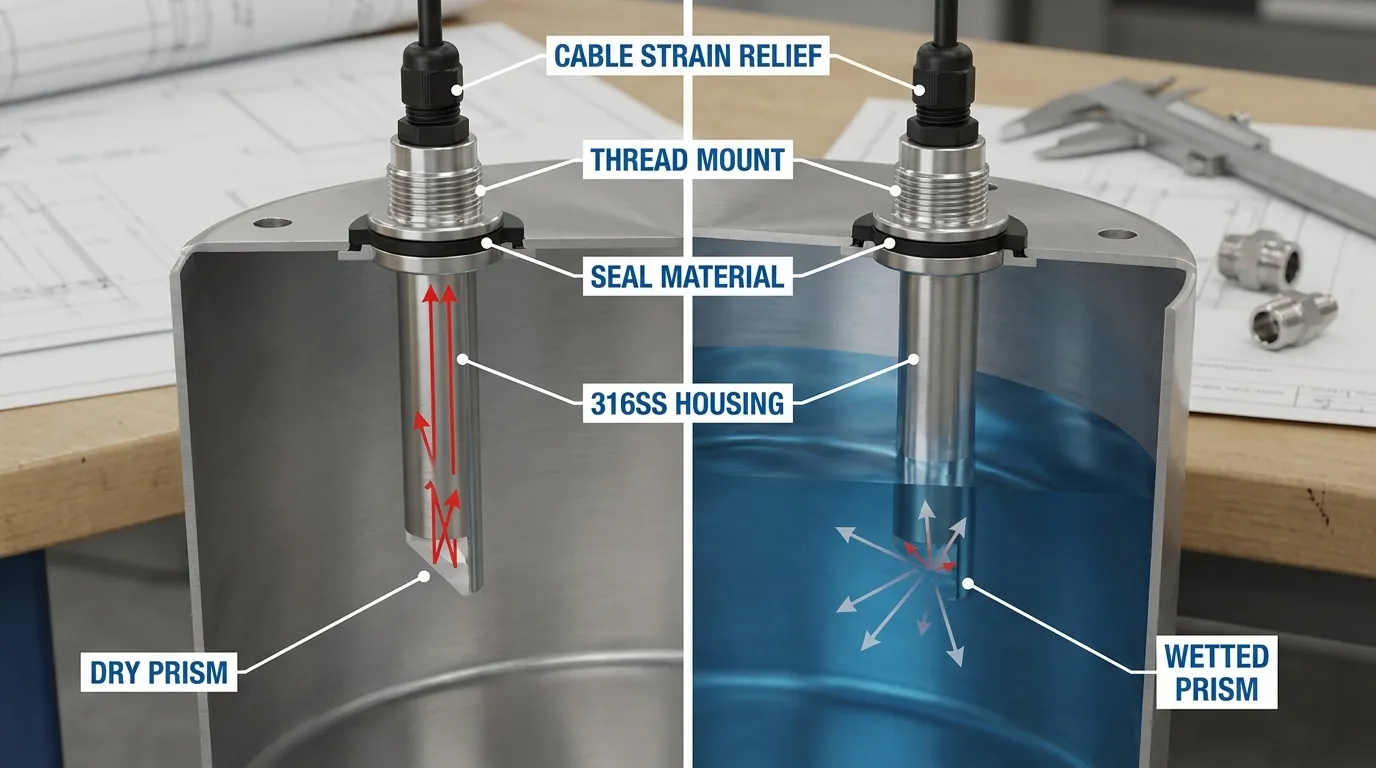
For a stainless optical liquid level sensor, “316SS” normally refers to the metal body or housing that contacts the liquid and provides the mounting thread. In some projects, 316L may be requested for improved corrosion performance in welded or sanitary-style environments. The final grade should be confirmed during RFQ based on tank design, cleaning method, and fluid exposure.
The optical prism is the sensing surface. Its material must be compatible with the fluid, temperature, and cleaning cycle. In many stainless optical sensors, a glass or optical-grade prism is used so the infrared signal can reflect correctly between dry and wetted states. The prism must remain clean enough for light transmission; heavy coating, crystallisation, sludge, or sticky liquid can reduce response reliability.
Seals are equally important. Even if the stainless body is suitable, the wrong O-ring or seal can swell, crack, harden, or leak. Fuel, solvent, hot water, detergent, and alkaline cleaning fluid may require different seal choices. HojellyTek confirms seal options at the RFQ stage instead of assuming one seal fits every liquid.
The cable exit or connector area should also be checked. For wash-down equipment, the buyer should discuss cable direction, strain relief, enclosure protection, and whether the sensor will be splashed, submerged, exposed to steam, or cleaned with pressure spray.
Material Compatibility Guide for 316SS Optical Level Sensors
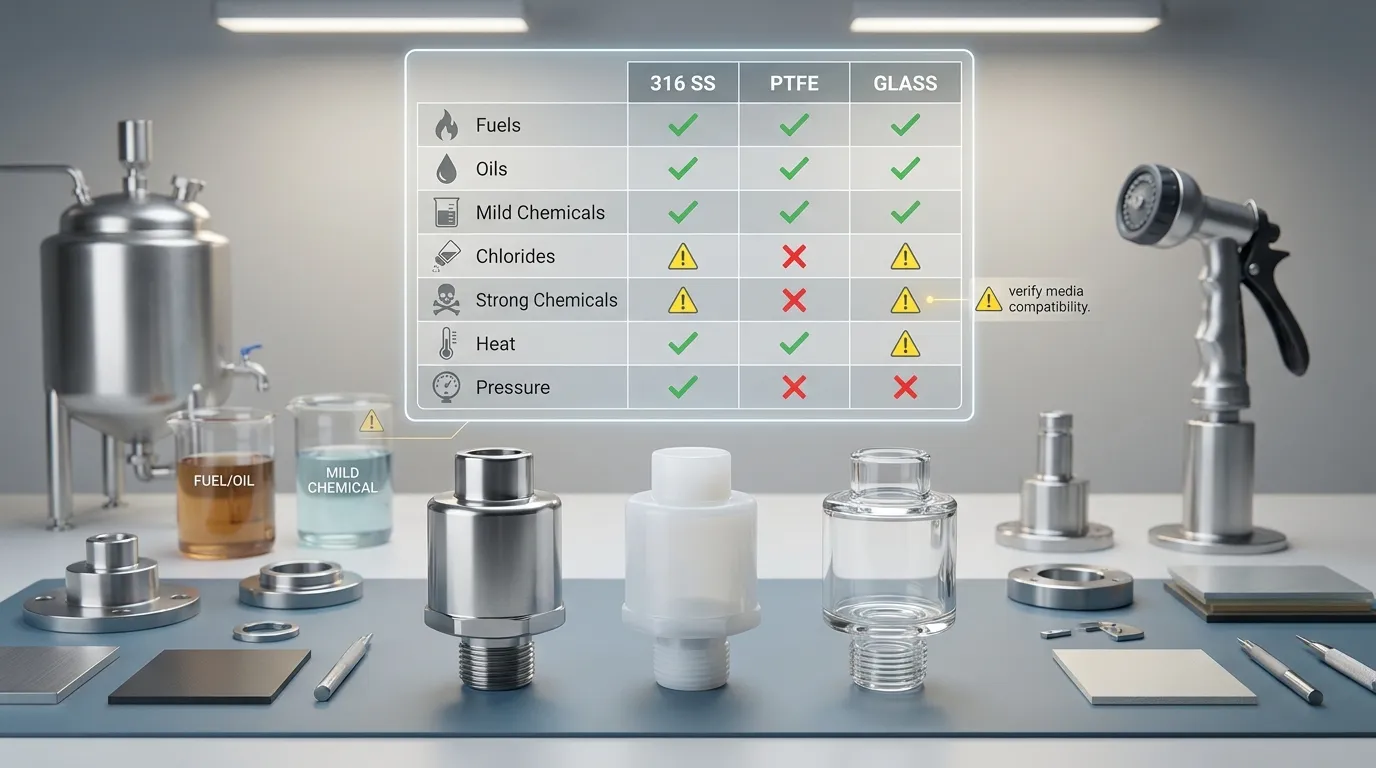
The table below is a selection guide, not a final compatibility guarantee. Always verify media name, concentration, temperature, pressure, and cleaning process before ordering.
| Media or condition | 316/316L stainless steel suitability | What to verify before ordering | Alternative to consider |
|---|---|---|---|
| Diesel, fuel oil, lubricating oil | Often a strong reason to choose stainless over plastic | Seal material, prism fouling, temperature, tank vibration | Stainless with verified seal |
| Hydraulic oil and machine oil | Suitable for many equipment-level monitoring projects | Oil additives, pressure pulse, thread type, cable protection | Stainless or glass depending on heat |
| Water and mild water-based liquids | Usually suitable, especially where strength or wash-down matters | Chloride level, cleaning chemicals, temperature | Plastic for low-cost water use |
| Mild chemicals | Possible, but must be verified | Chemical name, concentration, exposure time, seal swelling | PTFE or glass if aggressive |
| CIP wash-down or cleaning cycle | Useful for stronger body and thread construction | Cleaning agent, temperature, pressure spray, seal material | PTFE/glass for harsher cleaning fluids |
| Hot or pressurised media | Often better than plastic housings | Required temperature and pressure limits, thermal cycling | High-temperature version |
| Chloride-rich liquids or salt exposure | Requires caution | Pitting/corrosion risk, concentration, temperature | PTFE or glass |
| Strong acids, strong alkalis, aggressive solvents | Do not assume compatibility | Full chemical compatibility review | PTFE optical sensor |
| High-purity, high-temperature, or special chemical service | Stainless may not be the best wetted surface | Purity, thermal shock, chemical attack, cleaning method | glass optical sensor |
Temperature and Pressure: What to Confirm
316 stainless steel can support more demanding mechanical and thermal conditions than many plastic sensor bodies, but the complete sensor rating depends on more than the metal shell. Temperature and pressure limits are affected by the prism, internal electronics, sealing structure, cable, potting material, and mounting design.
For hot liquid, buyers should confirm continuous temperature, short cleaning temperature, steam or hot-water exposure, thermal cycling, and whether the electronics are close to the process heat. For pressure, confirm normal working pressure, pressure spikes, vacuum conditions, thread sealing method, and installation torque.
If the application is mainly about elevated process temperature, a dedicated high-temperature optical sensor may be more suitable than a standard stainless model.
Where 316 Stainless Steel Still Falls Short
316SS is a strong industrial material, but it is not the safest answer for every liquid. It can still face corrosion risk in chloride-rich media, some acids, some alkalis, oxidising chemicals, and high-temperature chemical exposure. In some applications, the stainless body may survive but the seal or prism may fail first.
Real failure modes include:
- Pitting or corrosion on the wetted body
- Seal swelling, cracking, or compression loss
- Prism coating from oil sludge, foam, scale, or sticky media
- False switching from bubbles, deposits, or incorrect mounting angle
- Leakage caused by poor thread sealing or incompatible gasket material
- Cable damage during wash-down or vibration
- Output mismatch with PLC, relay, or control board
For aggressive chemicals, PTFE is often a better wetted-body choice. For high-temperature, purity, or special optical requirements, glass may be better. The safest approach is to send the actual fluid details before selecting the sensor body.
5-Step Project Process
- Enquiry
Share the liquid, tank drawing, mounting position, expected output, quantity, and target market. - Spec and customization review
Our engineering team checks wetted materials, prism design, seal choice, wiring, thread, cable, connector, and control logic. - Sample confirmation
Samples can be prepared for fit, switching logic, installation, and media testing before production. - Production and QC
The factory checks assembly, electrical output, appearance, and functional response according to the confirmed order specification. - Shipping support
HojellyTek exports sensors for customers in the US, EU, India, and other markets, with support through WhatsApp or email for order coordination.
RFQ Requirements and Specs to Prepare
Before requesting a quote, prepare the following information:
- Liquid name, concentration, additives, and cleaning chemicals
- Normal and maximum liquid temperature
- Normal and maximum pressure condition
- Tank material and wall thickness
- Mounting position: side, top, bottom, horizontal, or vertical
- Thread size or custom mounting drawing
- Required output: NPN, PNP, relay interface, analog signal, or control-board signal
- Supply voltage requirement
- Normally open or normally closed logic
- Cable length, connector, or harness request
- Prism exposure: clean liquid, foam, coating, bubbles, sludge, or sticky media
- Sample quantity and expected production quantity
- Any Tuya/Smart Life or smart monitoring integration requirement, if used in a connected tank-level device
Material Selection Comparison
| Sensor body material | Best-fit applications | Strengths | Limitations |
|---|---|---|---|
| PSU / plastic | Water tanks, low-cost appliances, light-duty OEM equipment | Economical, compact, easy to integrate | Limited for heat, pressure, fuel, and some chemicals |
| 316/316L stainless steel | Fuels, oils, mild chemicals, hot or pressurised media, wash-down equipment | Strong body, durable thread, better industrial resistance than plastic | Not universal chemical resistance; seals and prism must be verified |
| PTFE | Aggressive chemical liquids and corrosive environments | Excellent chemical resistance in many harsh fluids | Mechanical design and temperature limits still need project review |
| Glass | High-temperature, high-purity, or special chemical applications | Strong optical and chemical performance in selected conditions | More fragile than metal; mounting protection matters |
Why Work With HojellyTek
HojellyTek is a Shenzhen manufacturer and exporter focused on photoelectric optical sensing for liquid level detection. We support OEM/ODM projects where buyers need more than a catalog part: material review, mounting adaptation, wiring configuration, and sample testing support.
Our in-house R&D team can help compare stainless steel, PTFE, plastic, and glass options based on the actual fluid and installation. Instead of overselling 316SS as a universal solution, we help buyers verify the wetted materials before production.
FAQ
What is a 316 stainless steel optical level sensor used for?
A 316 stainless steel optical level sensor is used for point-level detection in tanks or equipment where plastic may not be suitable, such as fuel tanks, oil reservoirs, mild chemical containers, hot liquid systems, pressurised vessels, or wash-down equipment.
Is 316L better than 316 for optical liquid level sensors?
316L has lower carbon content and may be preferred for certain welded, sanitary, or corrosion-sensitive constructions. The best choice depends on the liquid, cleaning method, temperature, and tank design. Confirm the material grade during RFQ.
Can 316SS optical sensors be used with fuel or oil?
Yes, stainless optical sensors are commonly selected for fuels and oils, but the seal, prism, cable exit, temperature, and additives still need verification. Oil sludge or coating can also affect the prism if the liquid leaves deposits.
Is 316 stainless steel suitable for strong chemicals?
Not always. 316SS has good resistance in many mild environments, but strong acids, alkalis, chlorides, and aggressive solvents may require PTFE or glass instead. Always provide the exact chemical name and concentration before ordering.
What output types are available?
Depending on the project, the sensor can be configured for common industrial or OEM control systems such as NPN, PNP, switching logic, or other interface requirements. The output should be matched to your PLC, relay, PCB, or controller.
How do I request the right stainless optical sensor?
Send your liquid details, temperature, pressure, mounting thread, tank drawing, output type, voltage, cable or connector request, and sample quantity. Our team will review the wetted construction and recommend a suitable configuration.
Request a Quote
Need a 316/316L stainless optical level sensor for fuel, oil, mild chemical, hot liquid, or wash-down equipment? Send your application details by WhatsApp or email to request a quote, datasheet discussion, or sample review.


