
Glass Optical Liquid Level Sensor
For buyers comparing glass, plastic, PTFE, and stainless optical sensor designs, this page explains the material choice, wetted parts, sealing, temperature considerations, thermal-shock limits, cleaning, output options, and RFQ details needed before ordering.
Glass Optical Sensor Capabilities
Our glass-prism optical level sensors use photoelectric sensing to detect whether the prism tip is in air or submerged in liquid. Inside the sensor, an infrared LED sends light into the prism. In a dry state, the light reflects internally and returns to the phototransistor. When liquid covers the prism, the refractive condition changes, so less light returns to the receiver. The circuit then switches the output.
Depending on the project, the sensor can be configured for:
- Point-level detection for high or low liquid level
- Dry-to-wet or wet-to-dry switching logic
- Glass-tipped or glass-prism sensing structures
- Stainless steel, PTFE, PSU, or other housing material options
- NPN, PNP, or other control-board output requirements
- Digital switch output or analog output discussion for continuous level projects
- Threaded, tank-mounted, side-mounted, or custom OEM installation
- Cable, connector, or potted lead-wire termination
- OEM/ODM customization for equipment manufacturers
If you need a general reference before selecting the glass version, see our optical level sensor overview.
Why Glass Is Used for Harsh and High-Temperature Media
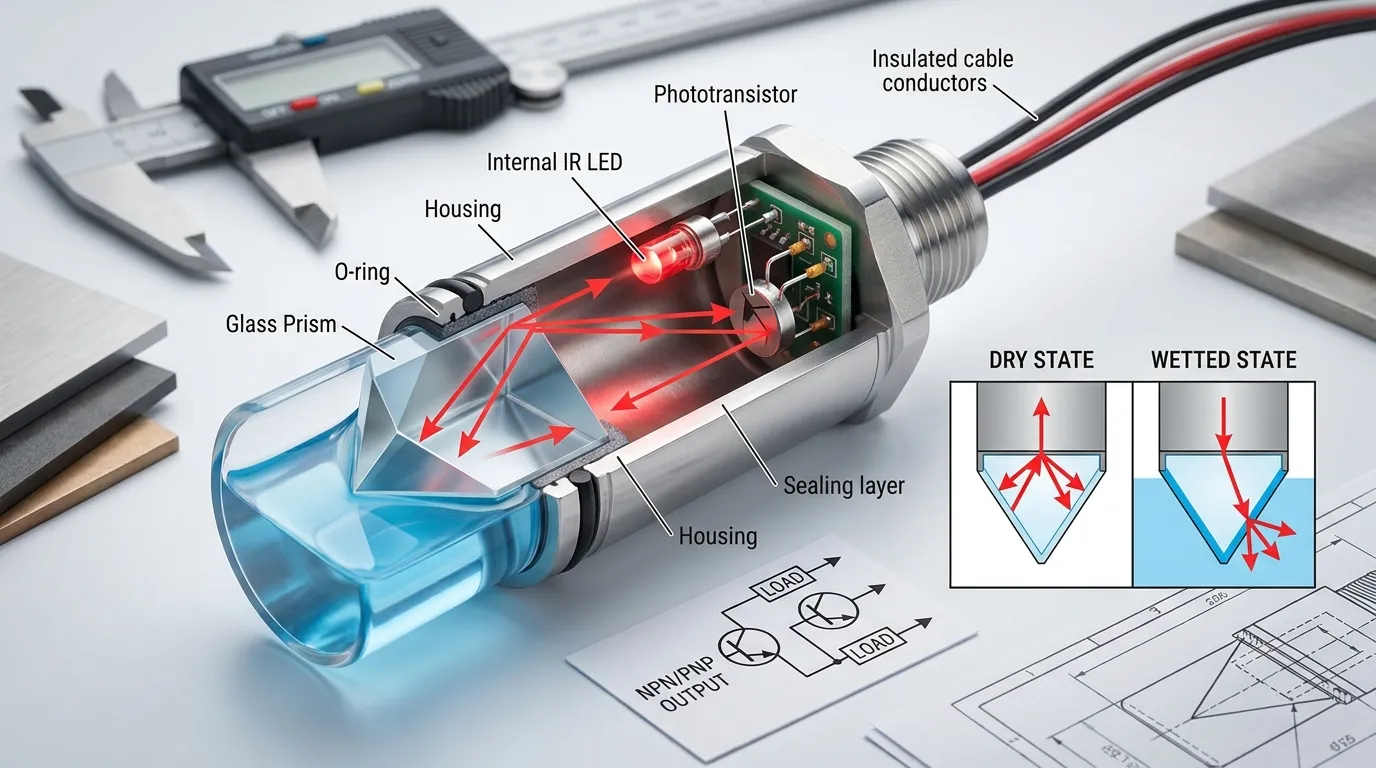
Glass is selected when the sensing tip must stay optically stable in a liquid that may be too aggressive, too hot, or too abrasive for a standard plastic prism. The value is not only chemical resistance. The real benefit is the combination of optical clarity, surface hardness, dimensional stability, and cleanability.
Chemical Resistance in Aggressive Liquids
In chemical tanks, cleaning systems, solvent handling, plating equipment, and industrial process containers, the sensor tip is exposed directly to the fluid. Plastic prisms can absorb, swell, soften, discolor, or craze when exposed to certain solvents or aggressive chemicals. A glass sensing tip provides a more stable optical surface for many harsh liquids.
However, glass is not universal. The buyer must still confirm the exact liquid, concentration, temperature, cleaning agent, and exposure time. Certain chemicals can attack glass, and the sealing system around the glass may become the real weak point if it is not matched to the liquid.
Abrasion Resistance and Surface Stability
A glass-prism sensor is useful where the liquid contains particles, powders, slurry traces, cleaning residue, or moving fluid that can scratch softer plastics. A scratched prism can scatter light and cause unstable switching, especially in small tanks where the level repeatedly crosses the sensing point.
Glass has better surface hardness than common plastic optical tips, so it can maintain a cleaner optical path for longer in abrasive or frequently cleaned environments. Still, glass can chip or crack if hit by hard tools, metal parts, or strong mechanical impact during installation.
Optical Clarity That Resists Coating Problems
Optical level sensors depend on a clear prism surface. Oils, sticky additives, crystallized chemicals, biological film, scale, or dried residue can make any optical sensor switch incorrectly. Glass helps because its smooth, hard surface is easier to wipe and inspect than many plastic materials.
For liquids that leave heavy film, the sensor should be mounted where flow can wash the tip naturally, not in a dead corner. If the tank has thick coating, foam, or crystallization, the RFQ should include cleaning frequency and residue behavior so the factory can recommend a suitable tip shape and mounting position.
High-Temperature Tolerance vs Plastic Prisms
Glass is often chosen for higher-temperature liquids because it keeps its shape and optical stability better than many plastics. In heated water systems, hot oil equipment, process tanks, and industrial cleaning machines, plastic prisms may soften, deform, discolor, or drift in performance.
For more demanding temperature projects, compare with our high-temperature optical sensor options. Temperature approval should always consider the whole sensor, not just the glass. The housing, cable, seal, potting, connector, and electronics must also match the real operating environment.
Do Not Ignore Thermal-Shock Limits
Glass can handle heat better than many plastic prisms, but sudden temperature change can still damage it. Thermal shock may happen when a hot sensor tip is rinsed with cold water, when a cold sensor is suddenly filled with hot liquid, or when cleaning cycles rapidly change the liquid temperature.
This is different from normal operating temperature. A sensor may be suitable for a steady high-temperature liquid but still be at risk if the tip faces sudden hot-to-cold or cold-to-hot shock. For glass optical level sensors, buyers should describe heating cycles, cleaning cycles, tank fill temperature, and washdown conditions before approval.
Wetted Glass Type, Sealing, and Body Material
A reliable glass optical sensor is not just “glass.” The complete wetted structure must be reviewed.
Glass Sensing Tip or Glass Prism
The glass part may be a small optical tip, a molded or machined prism, or a glass element integrated into a stainless body. The key requirement is that the optical path remains clear and stable at the detection point. Buyers should confirm whether the glass is directly exposed to liquid and whether the liquid touches only the tip or additional parts of the assembly.
Housing Material Choices
Common housing choices include:
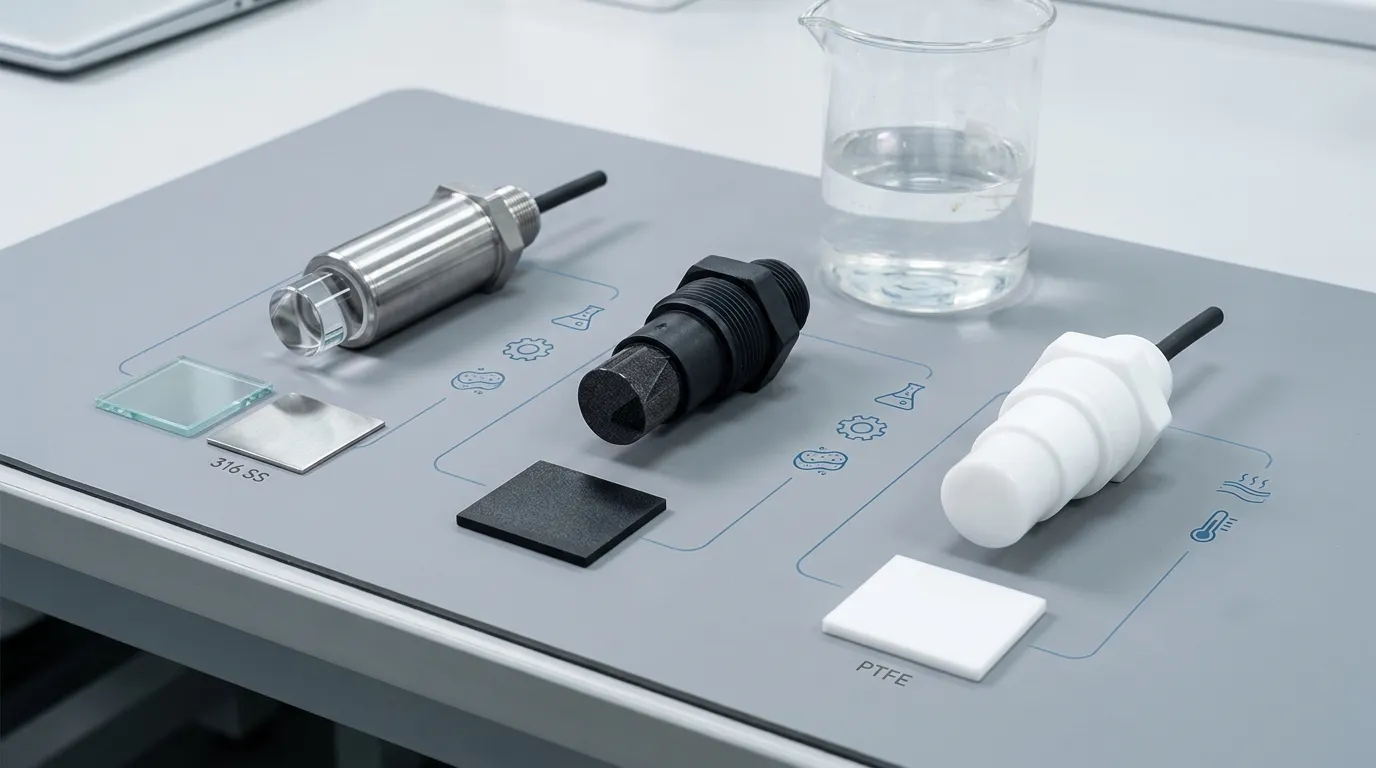
- 316 stainless steel for strength, threaded mounting, oils, fuels, industrial liquids, and many chemical environments
- PTFE for highly corrosive applications where fluoropolymer compatibility is preferred
- PSU or engineered plastic for lower-cost industrial and appliance applications
- Glass tip with metal body where optical clarity and mechanical strength are both required
For metal-body projects, review our 316 stainless optical sensor options. For corrosive media where the whole wetted structure needs fluoropolymer protection, compare with our PTFE optical sensor.
Sealing and Potting
The seal is often the most important selection point. Even when the glass tip is compatible, the O-ring, adhesive, potting compound, cable jacket, or connector may fail if exposed to the wrong liquid or temperature. A good RFQ should confirm:
- Whether the sensor is installed from inside or outside the tank
- Whether the seal is continuously immersed or only splash-exposed
- Whether pressure or vacuum is present
- Whether cleaning chemicals touch the cable or only the tip
- Whether the tank material expands during heating
- Whether vibration or mechanical stress is present
Mounting, Output, and Integration Options
Glass optical level sensors are usually used as compact point-level switches. They can be mounted through a tank wall, threaded port, flange, bracket, or OEM molded tank feature. The mounting position must allow the prism to contact the liquid cleanly without trapping air bubbles.
For control output, buyers commonly request NPN or PNP switching for PLCs, control boards, pumps, alarms, and filling systems. Output logic can often be selected according to whether the system needs a signal when the tip is wet or dry. For continuous level projects, analog output such as 4–20 mA should be discussed separately because it requires a different sensing structure than a simple point-level optical switch.
Before ordering, confirm supply voltage, output type, cable length, connector, thread, mounting direction, tank wall thickness, and whether the sensor must fail safe in high-level or low-level conditions.
Glass vs Plastic vs PTFE Optical Sensors
| Material option | Best fit | Strengths | Limits to check |
|---|---|---|---|
| Glass optical tip / prism | Harsh, hot, abrasive, or frequently cleaned liquids | Good optical clarity, hard surface, easier cleaning, better high-temperature stability than many plastics | Thermal shock, impact damage, glass chemical compatibility, seal compatibility |
| Plastic optical prism | General water, appliances, compact tanks, lower-cost OEM designs | Low cost, lightweight, easy to customize, suitable for many standard liquids | Lower chemical and abrasion resistance, lower heat tolerance, possible discoloration or swelling |
| PTFE optical sensor | Strong corrosive chemicals and demanding wetted-material requirements | Excellent chemical resistance for many aggressive media, low surface energy, good anti-stick behavior | Higher cost, mechanical design limits, optical structure and sealing must be confirmed |
| Glass + 316 stainless body | Oils, fuels, industrial equipment, high-strength threaded installation | Strong body, clean optical tip, robust industrial mounting | Metal compatibility, galvanic/corrosion risk, sealing material, installation torque |
Fit Checklist Before You Specify Glass
A glass-prism optical sensor is a strong candidate if most of these points match your application:
- The liquid is chemically aggressive to common plastic tips
- The sensor must work in heated liquid or near a high-temperature process
- The medium contains particles, residue, or cleaning cycles that may scratch plastic
- The optical tip needs regular wiping or chemical cleaning
- The tank uses a threaded or stainless industrial installation
- The liquid is clear, translucent, or predictable enough for optical switching
- Foam, bubbles, and sticky coating can be managed by mounting position
- Thermal shock can be controlled or designed around
- The seal, cable, and body material can be matched to the liquid
- A sample can be tested in the real liquid before mass production
Glass may not be the best option if the application has strong mechanical impact, rapid extreme temperature cycling, heavy crystallization, or a chemical known to attack glass. In those cases, PTFE, stainless, ultrasonic, float, or another level-sensing method may be safer.
5-Step Supply Process
- Enquiry: Send the liquid name, tank drawing, mounting position, temperature condition, output requirement, and quantity plan by WhatsApp or email. Photos or drawings help our team understand the real installation.
- Spec and Customization: Our engineers review the wetted material, glass tip, seal, housing, thread, output logic, cable, and connector. For OEM/ODM projects, we can discuss size, wiring, private-label needs, and control-board integration.
- Sample: A sample is recommended for harsh liquids, high-temperature media, coating liquids, or cleaning-cycle applications. The best test is always in the real liquid under real temperature and cleaning conditions.
- Production and QC: HojellyTek manufactures in Shenzhen with in-house R&D and photoelectric optical sensing experience. Production can include function checks, wiring checks, sealing review, and visual inspection according to the agreed specification.
- Shipping: We export optical liquid level sensors to the US, EU, India, and other markets. Shipping method and packing are confirmed according to order quantity, sample urgency, and buyer requirements.
Requirements to Confirm at RFQ Stage
- Liquid name, concentration, viscosity, and residue behavior
- Normal and maximum operating temperature
- Whether sudden heating, cooling, or washdown creates thermal shock
- Tank material, wall thickness, and mounting direction
- Thread, flange, or custom mounting requirement
- Wetted materials: glass, stainless steel, PTFE, PSU, seal, cable
- Output type: NPN, PNP, wet/dry logic, or analog requirement
- Supply voltage and controller type
- Cable length, connector, and IP/environment needs
- Cleaning method: wipe, rinse, chemical wash, CIP, or manual service
- Sample testing plan before batch order
Why Work With HojellyTek
HojellyTek is a Shenzhen manufacturer and exporter focused on optical and liquid level sensing products. We support standard sensor selection as well as OEM/ODM development for tank manufacturers, appliance brands, industrial equipment builders, and system integrators.
Our team can help compare glass, PTFE, stainless steel, and plastic optical sensor structures instead of forcing one material for every case. For connected tank monitoring projects, Tuya/Smart Life integration can also be discussed where it fits the system design.
FAQ
What is a glass optical liquid level sensor used for?
A glass optical liquid level sensor is used for point-level detection in harsh, hot, abrasive, or chemically demanding liquids where a plastic optical prism may not provide enough material stability.
How does a glass-prism optical level sensor detect liquid?
It uses an infrared LED, phototransistor, and optical prism. In air, light reflects inside the prism. When liquid covers the glass tip, the refractive behavior changes, and the sensor switches its output.
Is glass better than plastic for optical liquid level sensing?
Glass is often better for high temperature, abrasion resistance, optical clarity, and cleaning. Plastic is still useful for lower-cost, general-purpose liquid detection where chemical and temperature stress are lower.
Can glass optical sensors be used with chemicals?
Yes, glass can work with many chemical media, but compatibility must be confirmed. The buyer should check the liquid, concentration, temperature, cleaning agent, and exposure time, plus the seal and housing material.
Can thermal shock damage a glass optical sensor?
Yes. Glass may tolerate steady high temperature but can crack under sudden temperature change. Hot-to-cold rinsing, rapid filling, or harsh cleaning cycles should be reviewed before sensor approval.
How should the glass sensing tip be cleaned?
Use a cleaning method compatible with the liquid, glass, seal, and housing. Avoid hard tools that can chip the tip. For sticky residue, plan regular inspection and test whether wiping or rinsing restores stable switching.
Request a Quote
To specify a glass-tipped or glass-prism optical level sensor, send your liquid details, temperature range, tank drawing, mounting requirement, output type, and cleaning process. Contact HojellyTek by WhatsApp or email to request a quote, sample, or OEM/ODM sensor recommendation.


