
PTFE Optical Liquid Level Sensor
HojellyTek manufactures photoelectric optical level sensors with PTFE/Teflon body options, PTFE or sapphire prism options, and OEM/ODM customization for chemical tank builders, dosing equipment manufacturers, laboratory systems, and industrial automation suppliers.
PTFE Optical Sensor Capabilities
A PTFE-bodied optical sensor is a compact point-level switch used to detect whether liquid has reached a fixed level inside a tank, pipe, chamber, or small reservoir. It is often selected when common wetted materials are not suitable for aggressive liquid contact.
Typical capabilities include:
- Photoelectric optical level detection with no float, magnet, or moving mechanical part
- PTFE/Teflon wetted body for strong chemical resistance
- PTFE or sapphire prism options depending on media, purity, optical performance, and mechanical requirements
- Compact threaded mounting for small tanks, chemical reservoirs, and equipment panels
- Digital switching outputs such as NPN or PNP for PLCs, controllers, and alarm circuits
- Analog output options such as 4–20 mA for selected level monitoring designs where required
- Custom cable length, connector, wiring logic, output state, and mounting configuration
- OEM/ODM development for sensor brands, equipment manufacturers, and industrial system integrators
For standard optical level sensing principles and product formats, see our optical level sensor page.
Why Chemical Attack Is the Main Design Problem
In many chemical tanks, the level sensor fails before the control system fails. The reason is simple: the liquid contacts the sensor every day. If the wetted body, prism, seal, cable jacket, or potting material is not suitable, the sensor may suffer chemical swelling, stress cracking, discoloration, leakage, signal drift, or sudden output failure.
This problem is especially important in:
- Acid and alkali storage tanks
- Solvent feed reservoirs
- Chemical dosing equipment
- Etching and cleaning systems
- Laboratory fluid handling equipment
- Battery, plating, and surface-treatment equipment
- High-purity chemical supply systems
- Compact OEM machines with limited maintenance access
A PTFE body helps because PTFE has excellent resistance to many aggressive chemicals and is widely used where metals or engineering plastics may be attacked. In an optical level sensor, the body surrounds the sensing tip and provides the threaded mounting structure. When the prism is also PTFE or sapphire, the liquid-contact area is better suited for harsh media than ordinary plastic-bodied designs.
A sapphire prism may be selected where a hard, stable optical window is preferred. A PTFE prism may be selected where matching the wetted body material is more important for chemical resistance and low surface interaction. The correct choice depends on the exact media and operating conditions.
How the Optical Detection Works
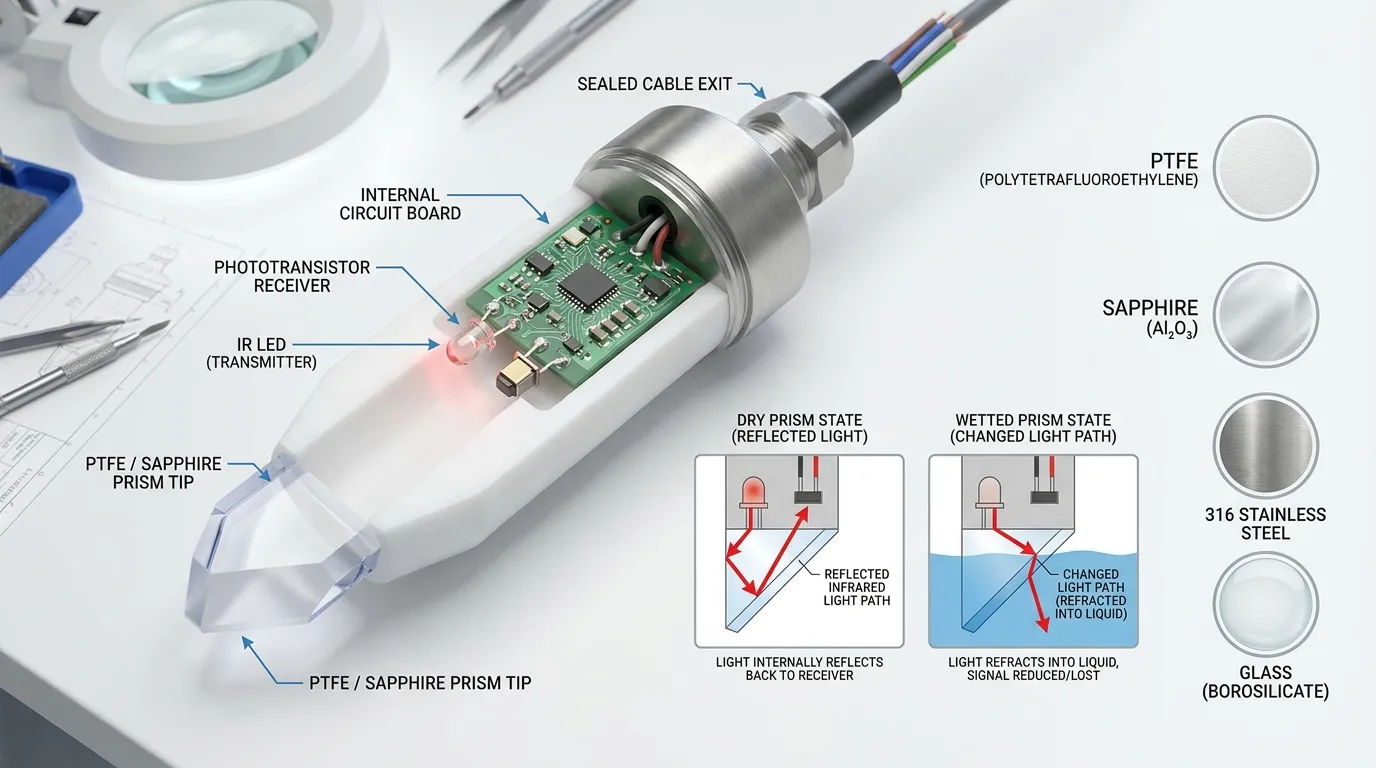
Inside the sensor, an infrared LED sends light toward the prism tip. A phototransistor receives the reflected light. In the dry state, the prism reflects more light internally, so the receiver sees a stronger signal. When liquid covers the prism, the refractive behavior changes and less light returns to the receiver. The circuit converts that change into a level output.
This makes the sensor useful for point-level detection such as:
- Low-level alarm
- High-level alarm
- Empty tank protection
- Overflow prevention
- Chemical refill detection
- Pump dry-run protection
- Small reservoir level confirmation
Because there is no float, the sensor avoids problems related to float sticking, magnet failure, hinge wear, or moving-part contamination. However, optical sensors still need proper media review. Heavy coating, crystallization, sticky residue, bubbles, foam, or opaque buildup on the prism can affect detection stability.
Chemical-Compatibility Guide for PTFE/Teflon Optical Sensors
PTFE is a strong choice for many aggressive liquids, but no sensor should be sold as universally compatible. Compatibility depends on chemical name, concentration, temperature, pressure, exposure time, cleaning process, and all wetted materials, including the body, prism, seals, cable jacket, and potting.
| Media group | Typical examples | PTFE body suitability | Prism option | Key caution |
|---|---|---|---|---|
| Strong acids | Sulfuric acid, hydrochloric acid, nitric acid applications | Often suitable after confirmation | PTFE or sapphire | Concentration and temperature must be checked |
| Alkalis / caustics | Sodium hydroxide, potassium hydroxide solutions | Often suitable after confirmation | PTFE or sapphire | Long exposure and elevated temperature need review |
| Solvents | Alcohols, ketones, cleaning solvents, organic liquids | Often suitable for many solvent systems | PTFE or sapphire | Cable jacket and seal compatibility are critical |
| Oxidizing chemicals | Oxidizing acids, peroxide-based chemicals | Case-by-case | Sapphire may be preferred in some designs | Strong oxidizers require careful material confirmation |
| High-purity media | Semiconductor chemicals, DI water systems, clean chemical lines | Possible with suitable design | PTFE or sapphire | Low leaching and contamination risk must be reviewed |
| Oils and fuels | Fuel, oil, hydraulic fluids | Usually possible, but PTFE may not always be necessary | PTFE, glass, or stainless options | Confirm viscosity, residue, and operating temperature |
| Cleaning chemicals | CIP fluids, detergents, rinse chemicals | Case-by-case | PTFE or sapphire | Repeated cleaning cycles may affect seals and cables |
| Unknown mixed media | Custom blends or process waste | Must be reviewed | To be confirmed | Do not select by chemical name alone |
Media-confirmation note: Before final selection, our team should confirm the exact liquid, concentration, temperature, pressure, cleaning method, immersion time, tank material, and required output. PTFE has broad chemical resistance, but HojellyTek does not claim universal compatibility for every chemical, concentration, or process condition.
Purity, Leaching, and High-Purity Fluid Use
For high-purity media, chemical resistance is only one part of the decision. Buyers also need to consider contamination, extractables, leaching, surface cleanliness, and whether the sensor body or cable materials can introduce unwanted particles or residues.
A PTFE optical sensor can be suitable for high-purity chemical handling when the wetted structure is designed carefully. The body material, prism material, sealing method, cable entry, and cleaning process should be reviewed together. For ultra-clean applications, buyers should tell us whether the sensor will contact DI water, acid, solvent, cleaning fluid, or semiconductor-grade chemicals, and whether any special packaging or handling requirements apply.
Where food-contact or sanitary requirements are more important than chemical attack, our food-grade optical sensor page may be a better reference.
Mounting, Output, and Integration Options
PTFE optical level sensors are commonly mounted through the tank wall or into a threaded port. Side mounting is often used for high-level or low-level alarms. Bottom mounting may be used for empty detection, drain confirmation, or small reservoir monitoring, depending on the tank design.
Buyers should confirm:
- Thread type and port size
- Side, bottom, or custom mounting direction
- Tank wall thickness and sealing method
- Required wetted length
- Cable exit direction
- Liquid turbulence near the sensing point
- Whether the tip may collect bubbles, residue, or crystals
- PLC/controller input type
- NPN, PNP, normally open, normally closed, or custom switching logic
- Whether 4–20 mA output is required for a specific continuous or transmitter-style design
For applications where chemical resistance is less severe but mechanical strength and industrial appearance are priorities, compare with a 316 stainless optical sensor. For transparent or laboratory-style wetted parts, compare with a glass optical sensor.
5-Step Supply Process
- Enquiry — Send the liquid name, concentration, temperature, tank material, mounting method, output type, and order quantity estimate by WhatsApp or email.
- Spec and customization review — Our engineering team reviews the wetted material, prism option, thread, cable, output logic, and electrical interface.
- Sample confirmation — A sample can be prepared for installation testing, media contact review, and signal confirmation in your actual tank or equipment.
- Production and QC — The factory produces according to confirmed drawings, wiring, materials, and inspection requirements. Optical response and electrical output are checked before shipment.
- Shipping and export support — HojellyTek exports optical liquid level sensors from Shenzhen to customers in the US, EU, India, and other markets.
Requirements to Confirm Before Ordering
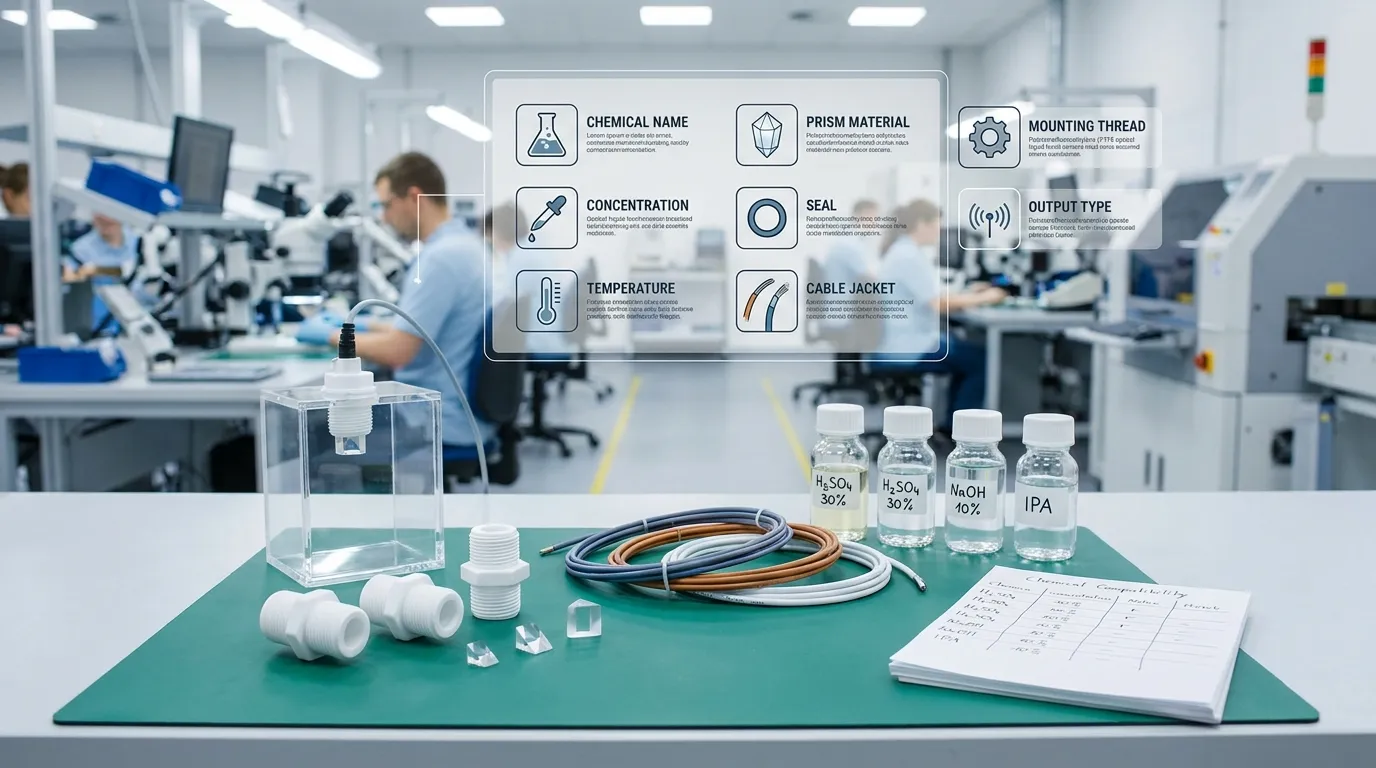
| Requirement | Why it matters |
|---|---|
| Exact chemical name | General categories are not enough for compatibility review |
| Concentration | Stronger concentration may change material behavior |
| Temperature | Chemical resistance and seal performance depend on heat |
| Pressure or tank condition | Thread and sealing design must match the installation |
| Mounting position | Side, bottom, and angled installation affect detection |
| Prism condition | Coating, bubbles, or crystallization can affect optical sensing |
| Output type | PLCs and boards may need NPN, PNP, or analog signal |
| Cable and connector | External environment may require a different jacket or connector |
| Purity requirement | High-purity systems need contamination and leaching review |
PTFE vs Other Wetted Material Options
| Material option | Best-fit use | Strength | Limitation |
|---|---|---|---|
| PSU / engineering plastic | General water or mild liquid detection | Cost-effective and compact | Not ideal for aggressive chemicals |
| PTFE / Teflon | Acids, solvents, high-purity chemicals, corrosive media | Broad chemical resistance and low surface interaction | Must confirm exact media and mechanical design |
| 316 stainless steel | Oils, fuels, industrial tanks, higher mechanical strength | Strong metal body and robust installation | Not suitable for all acids or corrosive chemicals |
| Glass | Laboratory, clean media, selected chemical applications | Stable and transparent wetted surface | More fragile than metal or PTFE designs |
Why Choose HojellyTek
HojellyTek is a Shenzhen optical and liquid level sensor manufacturer with in-house R&D, photoelectric sensing design experience, and OEM/ODM production capability. We support custom wetted materials, compact sensor structures, wiring logic, output formats, and mounting requirements for equipment manufacturers.
Our team works with industrial buyers, sensor distributors, chemical equipment builders, and automation companies that need factory-direct customization rather than only catalog parts. Tuya/Smart Life integration can also be discussed where the level sensor is part of a smart monitoring device rather than a simple wired control circuit.
FAQ
Can a PTFE optical liquid level sensor be used with sulfuric acid or hydrochloric acid?
Often, PTFE is a strong candidate for acid applications, but the exact acid, concentration, temperature, exposure time, prism material, seal, and cable jacket must be confirmed before selection. We recommend media confirmation before sample production.
Is PTFE better than 316 stainless steel for corrosive chemicals?
For many aggressive acids and chemical solutions, PTFE may be more suitable than 316 stainless steel. For oils, fuels, mechanical equipment, or less corrosive media, stainless steel may still be the better choice. The decision depends on media and installation conditions.
Can the sensor work in high-purity chemical systems?
Yes, a PTFE or sapphire wetted design can be considered for high-purity media, but purity requirements must be reviewed carefully. Buyers should share contamination limits, cleaning process, packaging needs, and whether the sensor contacts DI water, solvent, or process chemicals.
What can cause an optical chemical level sensor to fail?
Common failure modes include chemical swelling, seal leakage, cable jacket attack, prism coating, crystallization, bubbles, incorrect mounting, incompatible output wiring, and using a body material that is not suitable for the actual chemical concentration or temperature.
Does the prism material matter?
Yes. The prism is the active sensing surface in contact with the liquid. PTFE and sapphire offer different advantages in chemical resistance, hardness, optical behavior, and purity suitability. The correct choice should be confirmed based on the liquid and operating environment.
How do I request a custom ptfe optical liquid level sensor?
Send your chemical name, concentration, temperature, tank drawing, thread requirement, mounting direction, output type, cable length, and target quantity. HojellyTek can review the specification and provide a quote by WhatsApp or email.
Request a PTFE Optical Sensor Quote
Need a PTFE/Teflon-bodied optical level sensor for acids, solvents, high-purity chemicals, or aggressive process media? Send your media details, installation drawing, and output requirement to our team by WhatsApp or email. We will help confirm the wetted material, prism option, wiring, and mounting structure before quotation.


