
Food-Grade Optical Liquid Level Sensor
As a Shenzhen manufacturer and exporter with in-house R&D, we support OEM/ODM sensor configuration for PSU, PTFE and 316 stainless steel wetted designs, with food-contact documentation confirmed at the RFQ stage.
Food and Beverage Level Sensing Capabilities
Our optical liquid level sensors are used for point-level detection in tanks, small reservoirs, dispensing systems and process equipment. Depending on the installation, the sensor can support overflow prevention, low-level alarm, pump protection, fill confirmation or dosing tank monitoring.
Typical capabilities include:
- Photoelectric optical sensing using an IR emitter, receiver and prism sensing tip
- Compact sensor bodies for OEM appliance integration
- PSU, PTFE, 316 stainless steel or glass-interface options depending on liquid and cleaning conditions
- NPN, PNP, digital switch or 4–20 mA output options depending on control system requirements
- Threaded, tank-mounted or customized mechanical structures
- Cable, connector and housing customization for OEM production
- Support for food, beverage, dairy, water, coffee, syrup and dosing applications after sample validation
For buyers comparing the general sensing principle, see our optical level sensor page.
Compliance Starts with the Wetted Surface
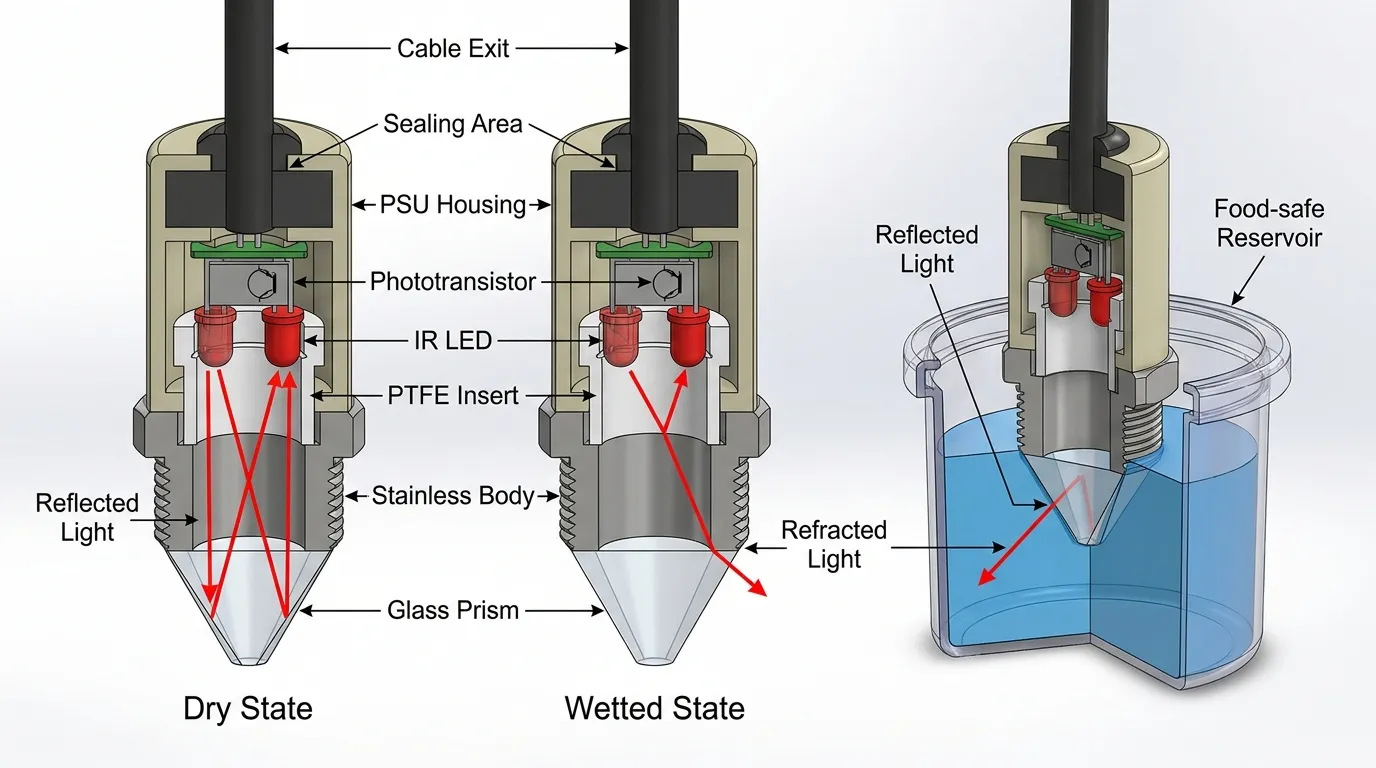
In food and beverage projects, the key question is not simply “does the sensor detect liquid?” The first question is whether every wetted part is suitable for the process. The sensor body, prism, seal, gasket, thread, adhesive exposure and cable entry must be reviewed before the part is approved for food-contact equipment.
Optical level sensors work by sending infrared light through a prism tip. In the dry state, light reflects internally inside the prism and returns to the receiver. When liquid covers the tip, the refractive condition changes, so less light returns to the receiver. The electronics convert this change into a level signal.
This method is useful because there are no moving floats, no magnetic reeds and no mechanical hinge points in the sensing area. For food and beverage equipment, that can reduce moving-part wear and simplify compact mounting. However, hygienic performance still depends on the actual wetted material, sensor geometry and cleaning process.
Food-contact compliance documents such as FDA, EC 1935/2004, LFGB, 3-A or EHEDG should be confirmed with HojellyTek before use in regulated food-contact equipment. We do not recommend publishing certification claims until the relevant material declarations or test documents are checked for the exact sensor model and configuration.
Food-Contact Material Options
Different food and beverage applications need different wetted materials. A coffee machine reservoir, dairy tank, syrup dosing system and cleaning-fluid tank may all require different sensor bodies.
| Wetted material | Typical food/beverage use | Strengths | Confirm before ordering |
|---|---|---|---|
| PSU / PPSU-style engineering plastic | Coffee machines, drinking water tanks, beverage dispensers, small OEM reservoirs | Lightweight, compact, suitable for molded sensor structures, good for appliance integration | Food-contact declaration, hot-water exposure, detergent compatibility, mounting strength |
| PTFE | Dosing tanks, cleaning fluids, acidic/alkaline liquids, sticky ingredients, chemical-contact zones | Strong chemical resistance, low surface adhesion, useful where aggressive liquids may contact the sensor | Mechanical mounting, sealing method, food-contact evidence, cleaning temperature |
| 316 stainless steel | Process tanks, beverage lines, dairy equipment, wash-down areas | Durable housing, strong mechanical protection, suitable for industrial food equipment design | Surface finish, seal material, weld or thread hygiene, actual grade documentation |
| Glass prism / optical interface | Optical sensing tip or transparent detection interface | Stable optical surface, clean sensing point, good optical transmission | Breakage risk, residue behavior, cleaning process, installation protection |
| Seal / gasket material | Process connection, leakage prevention, food-contact boundary | Critical for hygiene, cleaning survival and pressure sealing | EPDM/FKM/PTFE suitability, temperature exposure, detergent and steam compatibility |
For aggressive ingredients, cleaning fluids or low-adhesion wetted surfaces, a PTFE optical sensor may be more suitable than a plastic-bodied option. For industrial tanks, wash-down zones or stronger mechanical protection, a 316 stainless sensor may be the better starting point.
CIP, SIP, Hot-Fill and Wash-Down Survival
Food and beverage sensors often fail because the ordering specification only describes the liquid, not the cleaning cycle. A sensor that works in room-temperature water may not survive repeated hot-fill, caustic wash, acid rinse, steam exposure or pressure wash-down.
Before choosing a food-grade optical liquid level sensor, confirm:
- Normal product temperature during operation
- Maximum hot-fill or pasteurization exposure near the sensor
- CIP or SIP cleaning temperature and duration
- Whether steam touches the sensing tip or only the tank wall
- Cleaning chemicals, concentration and rinse sequence
- Wash-down pressure near the cable exit and connector
- Whether the sensor is submerged continuously or only during filling
- Whether residue dries on the prism after draining
Optical sensing depends on a clean optical interface. If milk solids, syrup, oil film, fruit pulp, crystallized sugar or cleaning residue coats the prism, the sensor may read incorrectly. This does not mean optical sensing is unsuitable, but it means the liquid must be tested under real cleaning and drying conditions.
Hygienic Mounting and Installation Design
A hygienic sensor installation should avoid trapped liquid, dead corners and difficult-to-clean edges. In small appliances, the priority may be compact side-wall mounting. In process tanks, the priority may be drainability, gasket compression and surface finish around the process connection.
Common mounting choices include threaded tank installation, compact side mounting, flange-style mounting or customized OEM housing. The best design depends on tank wall thickness, internal cleaning access, sensor orientation and whether the cable side needs wash-down protection.
For coffee machines, water dispensers and hot beverage equipment, the sensor must fit compact reservoirs while tolerating warm water, steam-adjacent areas and repeated filling. See our coffee machine sensor page for a more appliance-focused example.
Dairy, Beverage and Dosing Applications
Food and beverage manufacturers use optical point-level sensors where a compact, fast liquid/no-liquid signal is more useful than continuous level measurement.
Typical applications include:
- Low-level alarm in milk, water or beverage reservoirs
- Overflow protection in filling equipment
- Empty-tank detection before pump operation
- Dosing tank confirmation for flavor, syrup or additive systems
- Coffee machine and dispenser water level detection
- Cleaning-fluid tank monitoring in food equipment
- Small OEM tanks where floats are too large or unreliable
For dairy and beverage liquids, sample testing is important because foam, fat, protein, pulp, sugar and cleaning residue can affect optical detection. For dosing systems, chemical compatibility is usually the first concern. For coffee and hot-water equipment, temperature, scale and compact mounting are usually more important.
Hygiene Checklist Before RFQ
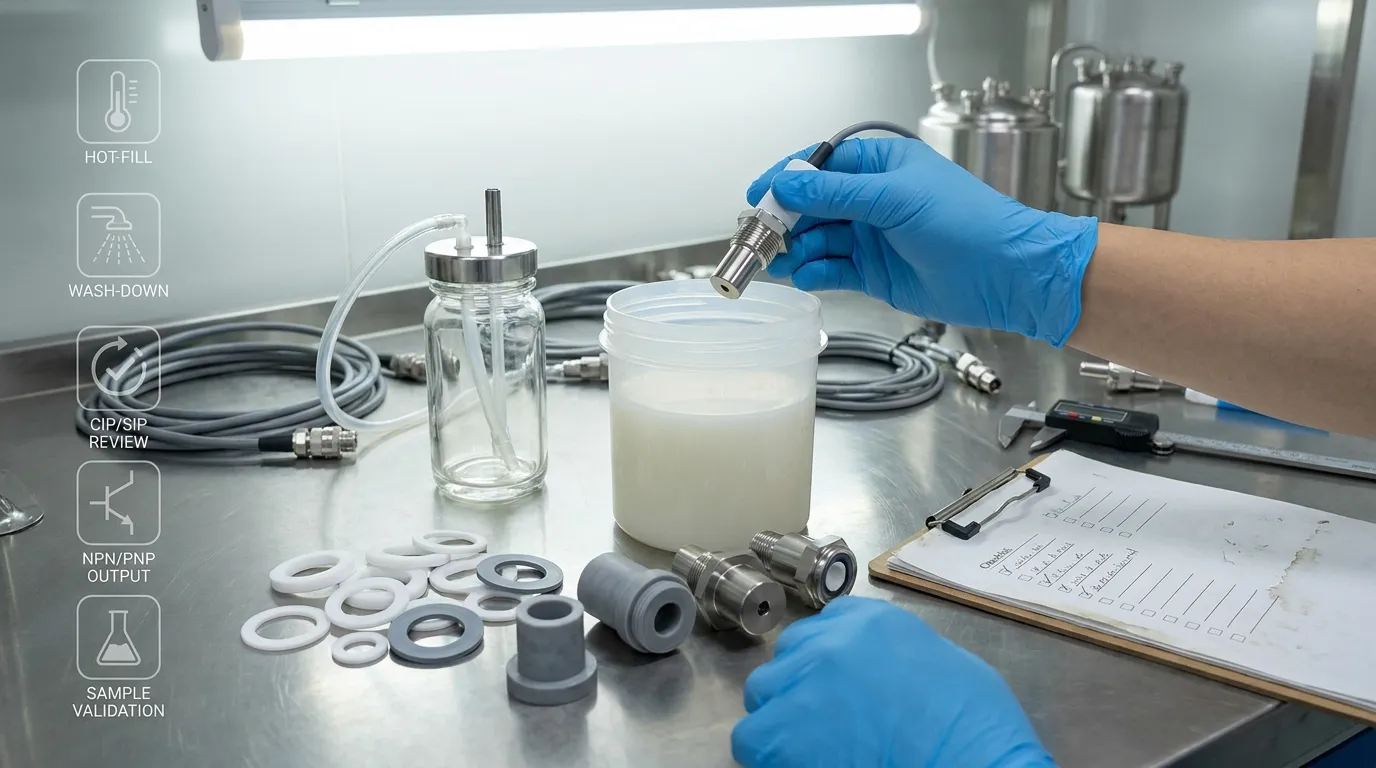
Use this checklist before requesting a sample:
- List every liquid touching the sensor, including cleaning chemicals.
- Confirm all wetted parts: body, prism, seal, gasket and thread.
- State whether food-contact documentation is required for the final product.
- Share cleaning cycle details: hot water, detergent, acid, alkali, steam or rinse.
- Confirm whether the sensor must survive CIP, SIP or external wash-down.
- Check whether liquid can foam, coat, crystallize, ferment or leave solids.
- Define mounting position: side wall, bottom, top, pipe, reservoir or tank.
- Confirm whether the sensing area must be drainable after cleaning.
- Choose output type: NPN, PNP, digital switch or 4–20 mA.
- Request sample validation using the real liquid and cleaning process.
5-Step Application Support Process
- Enquiry
Send the liquid type, tank drawing, cleaning method, temperature exposure, mounting position and required output. - Spec and customization review
Our engineering team checks wetted material, housing, seal, cable, thread, output and control-board compatibility. - Sample confirmation
Samples can be prepared for validation with the real food, beverage, dosing liquid or cleaning cycle. - Production and QC
After confirmation, the factory follows the agreed model, wiring, material and inspection requirements for OEM/ODM production. - Shipping and export support
We support export projects for customers in the US, EU, India and other markets, with packing and documentation aligned to the order requirements.
Requirements to Confirm Before Ordering
| Requirement | Why it matters |
|---|---|
| Wetted material | Determines food-contact suitability, chemical resistance and long-term hygiene |
| Cleaning process | CIP/SIP, hot water, detergent or steam may change material choice |
| Liquid behavior | Foam, film, pulp, fat or crystals can affect optical sensing |
| Mounting design | Poor installation can create crevices, leakage or residue traps |
| Output signal | NPN, PNP, digital or 4–20 mA must match the controller |
| Cable and connector | Wash-down and OEM assembly conditions affect cable exit design |
| Documentation | Food-contact claims must be confirmed with model-specific evidence |
Optical vs Float vs Conductive Level Detection
| Sensor type | Best fit | Main advantage | Food/beverage concern |
|---|---|---|---|
| Optical point-level sensor | Compact tanks, appliances, dosing, overflow/empty detection | No moving float, fast point-level signal, compact design | Prism must stay clean and material must be validated |
| Float switch | Simple tanks with enough space | Low-cost mechanical switching | Moving parts, sticking, cleaning difficulty |
| Conductive probe | Conductive liquids | Simple level detection | Not suitable for non-conductive liquids and may need exposed electrodes |
| Capacitive sensor | Some liquids through wall or probe designs | Can detect without moving parts | Requires tuning and may be affected by buildup |
Why Work with HojellyTek
HojellyTek combines photoelectric optical sensing, in-house R&D and OEM/ODM manufacturing for liquid level sensor projects. Instead of selling one fixed model for every food application, we help buyers review wetted materials, mounting, output, cable structure and sample testing requirements before volume production.
For smart appliance projects, Tuya or Smart Life integration can be discussed where the sensor is part of a connected water tank, dispenser or monitoring device.
FAQ
What makes a food grade optical liquid level sensor suitable for beverage equipment?
It should use appropriate wetted materials, a cleanable sensing structure and a mounting design that fits the cleaning process. Food-contact documentation must be confirmed for the exact material and model before certification claims are used.
Can optical sensors be used in milk or dairy tanks?
Yes, they can be considered for dairy point-level detection, but milk fat, protein film, foam and cleaning residue should be tested. The prism must remain clean enough for stable dry/wet detection.
Is PTFE better than 316 stainless steel for food applications?
Not always. PTFE is useful for chemical resistance and low adhesion, while 316 stainless steel is stronger for industrial tanks and wash-down environments. The right choice depends on liquid, cleaning method and mounting design.
Can the sensor survive CIP or SIP cleaning?
It depends on the selected material, seal, cable exit and cleaning cycle. CIP/SIP temperature, steam exposure, chemicals and duration should be shared during RFQ so the correct configuration can be reviewed.
Will syrup, foam or crystallized liquid cause false readings?
It can. Optical sensors depend on the prism surface. Sticky syrup, heavy foam, dried sugar or crystallized residue may affect detection, so real-liquid testing is recommended before production approval.
What should I send to request a quote?
Send the liquid name, tank drawing, mounting position, wetted material preference, cleaning process, temperature exposure, output type, cable/connector needs, order quantity and any food-contact documentation requirements.
Request a Food and Beverage Sensor Quote
To specify a food-grade optical level sensing solution, send your application details by WhatsApp or email. Share the liquid, tank structure, cleaning method, material preference, mounting drawing and required output, and our team will recommend a suitable sensor configuration for sample testing and OEM production.


