
Optical Water Level Sensor for Coffee Machines
An optical water level sensor for coffee machine OEMs helps appliance makers detect low water, high water, overflow, and dry-run risk without relying on conductive probes that can fur up from scale. For espresso machines, vending machines, coffee brewers, and smart beverage equipment, HojellyTek supplies compact photoelectric level sensors designed for reservoir, boiler-adjacent, drip tray, and internal tank integration.
Our focus is not barista use. It is OEM design-in: small form factor, stable logic output, suitable wetted materials, repeatable switching, wiring options, and custom housing support for appliance manufacturers.
Optical Water Level Sensor Capabilities for Appliance OEMs
HojellyTek develops and exports photoelectric liquid level sensing solutions from Shenzhen for manufacturers that need compact, reliable water detection inside finished appliances. For coffee and vending equipment, the sensor can be configured as a low-level switch, high-level switch, overflow detector, removable tank sensor, or pump-protection input.
Typical OEM support includes:
- Compact optical prism sensor structure for tight appliance spaces
- 5V or 12V logic output design to match appliance control boards
- NPN, PNP, NO, NC, and custom signal logic options
- Food-contact material selection based on tank, water path, and cleaning conditions
- Reservoir, boiler-adjacent, drip tray, and vending tank placement support
- Cable, connector, thread, housing, and mounting customization
- OEM/ODM development for appliance brands and system integrators
- Sample evaluation before production confirmation
For general product background, see our optical level sensor range. For appliance water-contact designs, our food-grade optical sensor page is also relevant.
Why Coffee Machine Makers Replace Conductive Probes
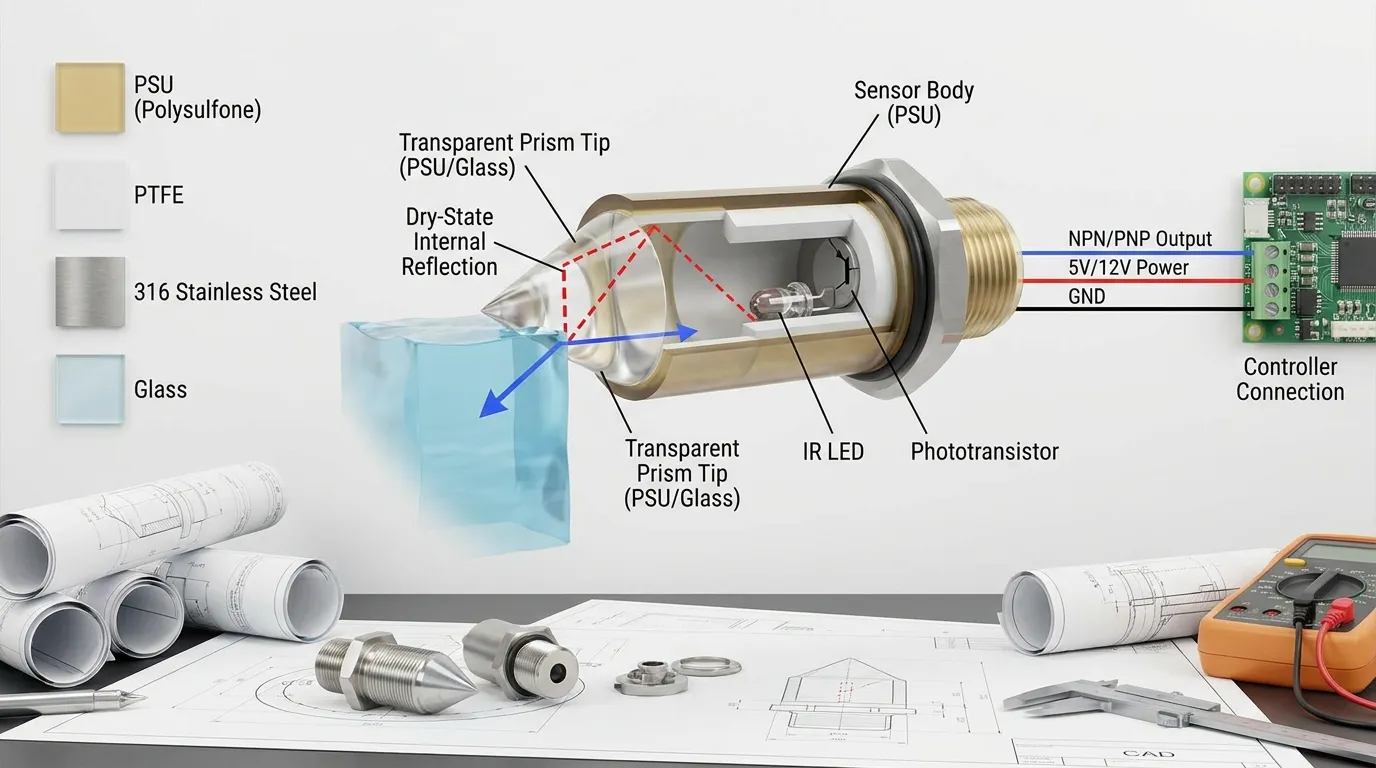
Conductive probes are common in water tanks because they are simple, but they depend on electrical contact with the liquid. In coffee and vending equipment, that contact area can become less reliable when water minerals, scale, coffee residue, cleaning-agent film, or steam condensation build up around the electrode.
An optical sensor uses photoelectric detection instead. Inside the sensor, an infrared LED sends light toward a transparent prism tip. A phototransistor receives the reflected light. When the prism is dry, light reflects internally in a predictable way. When water touches the prism surface, the optical path changes because the refractive condition changes. The electronics convert that change into a switching signal.
For appliance makers, this creates several design advantages:
- No exposed conductive electrode pair is required for detection.
- The sensor can provide a clean high/low signal to the controller.
- The sensing point can be made very small for compact reservoirs.
- It can detect water presence at a fixed point without a float arm.
- It reduces moving-part failure compared with float switches.
- It is better suited to sealed or semi-sealed appliance layouts.
This does not mean the sensor ignores all contamination. The prism face still needs a realistic design environment. Heavy scale coating, trapped air bubbles, opaque residue, or poor mounting angle can affect any point-level sensor. The difference is that the optical method avoids the common conductive-probe problem of electrical contact becoming unstable because the probe surface has furred up.
Coffee, Espresso, and Vending Machine Integration Points
The strongest design value comes from choosing the correct sensing position. A coffee machine may need one sensor, but an OEM beverage platform may need several point sensors with different logic states.
Water Reservoir Low-Level Detection
A low-level optical switch can be installed near the lower safe water line of the reservoir. When the water level drops below the prism, the controller can stop the pump, show a refill alert, or prevent heater operation. This is useful for compact espresso machines, countertop coffee makers, and vending machines where dry running can damage pumps or reduce customer reliability.
High-Level and Overflow Detection
A high-level optical sensor can be positioned near the upper fill line. It can support automatic filling systems, vending tanks, water dispensers, or machines connected to a water inlet valve. When the sensor detects water at the upper point, the controller can stop filling or trigger an overflow protection routine.
Boiler-Adjacent Protection
In boiler-related placement, the sensor design must be reviewed more carefully. OEMs should confirm water temperature, steam exposure, pressure isolation, material compatibility, and whether the sensor is directly wetted or installed in a nearby chamber. For many appliances, the sensor is better placed in the reservoir or auxiliary water path rather than inside a high-stress boiler body.
Drip Tray and Waste Water Detection
An optical point sensor can also be used in a drip tray or waste water container. Here the design focus changes from potable water to residue tolerance, cleaning access, and false-trigger prevention. Mounting position should avoid direct splashing zones when possible.
Vending Machine Internal Tank Detection
For vending and beverage dispensers, optical sensors can support refill control, empty tank detection, high-level cutoff, and maintenance alarms. When the vending machine has IoT or app-connected functions, the sensor output can feed the main control board, and the system can forward status alerts through the appliance platform. Where relevant, our team can discuss Tuya or Smart Life connected product requirements at the device-system level.
Appliance Integration Table
| Appliance area | Sensor role | Suggested design focus | Output need |
|---|---|---|---|
| Removable water reservoir | Low-water warning, pump protection | Compact side or bottom mounting, clean prism exposure, user refill cycle | 5V or 12V logic output |
| Upper reservoir point | High-level cutoff, overflow prevention | Stable fill-line positioning, splash control, defined switching logic | NO/NC, NPN/PNP |
| Espresso machine water path | Low-level or safety interlock | Material compatibility, steam/heat review, sealed wire exit | Custom logic confirmed by RFQ |
| Boiler-adjacent chamber | Dry-run prevention support | Avoid direct over-stress; confirm temperature, mounting, and wetting condition | Controller-matched output |
| Vending tank | Empty/full status, refill control | Long cable routing, connector locking, service access | NPN/PNP or custom signal |
| Drip tray / waste tank | Full-tray alert | Residue tolerance, cleaning access, anti-splash placement | Digital switch output |
Compact Form Factor and Mounting Choices
Coffee machines often have limited space behind the reservoir wall, under the tank, or near the appliance frame. A bulky float switch can interfere with molded plastic parts, tank removal, or service access. A compact optical design allows the sensing point to be placed at a fixed level with a small prism tip.
For tight layouts, our micro optical sensor options are suitable starting points for discussion. The final design may use threaded mounting, a sealed body, a side-wall installation, or a custom bracket depending on the appliance structure.
Mounting decisions to confirm include:
- Side-wall, bottom, or angled installation
- Tank wall thickness and available sealing surface
- Thread or non-thread mounting requirement
- O-ring, gasket, or welded/sealed integration concept
- Cable exit direction and strain relief
- Connector type and harness length
- Whether the tank is fixed or removable
- Whether users can clean around the sensing area
For OEM projects, the sensor should not be selected only by outer size. The real design question is whether the prism tip remains correctly exposed to the water at the required switching point through the appliance’s full use cycle.
Materials for Water, Steam, Scale, and Cleaning Conditions
Material choice depends on where the sensor touches water and what the appliance maker expects during cleaning and operation. Common options include engineered plastic, PSU, PTFE, 316 stainless steel, and glass structures. Each has a different balance of cost, chemical resistance, temperature behavior, and mechanical strength.
For coffee and vending applications, buyers should check:
- Whether the wetted part contacts potable water
- Whether the sensor sees hot water, steam, or only room-temperature reservoir water
- Whether descaling liquid or cleaning agents will touch the prism
- Whether the tank material is transparent, translucent, or opaque
- Whether mineral buildup is expected from hard water markets
- Whether the sensing point is accessible for periodic cleaning
No material should be chosen only from a catalog photo. The safest route is to provide the appliance drawing, water path location, cleaning method, and expected operating condition so the factory can recommend a suitable wetted-material structure.
Electrical Output: 5V, 12V, NPN, PNP, and 4–20 mA
Coffee machine control boards often prefer simple digital status: water present or water absent. For this reason, many appliance projects use 5V or 12V logic output. The controller reads the signal and decides whether to stop the pump, show an alert, open a valve, or allow heating.
Available electrical discussions can include:
- 5V logic output for low-voltage appliance boards
- 12V logic output for vending or internal control systems
- NPN or PNP output depending on controller input design
- Normally open or normally closed logic for fail-safe preference
- Cable and connector customization for appliance harnesses
- 4–20 mA output where a system needs current-loop level signalling rather than a simple point switch
For most coffee machine low/high water detection, a point-level optical switch is enough. For applications requiring level trend or remote industrial monitoring, output type should be reviewed at the RFQ stage.
OEM Customization and Design-In Support
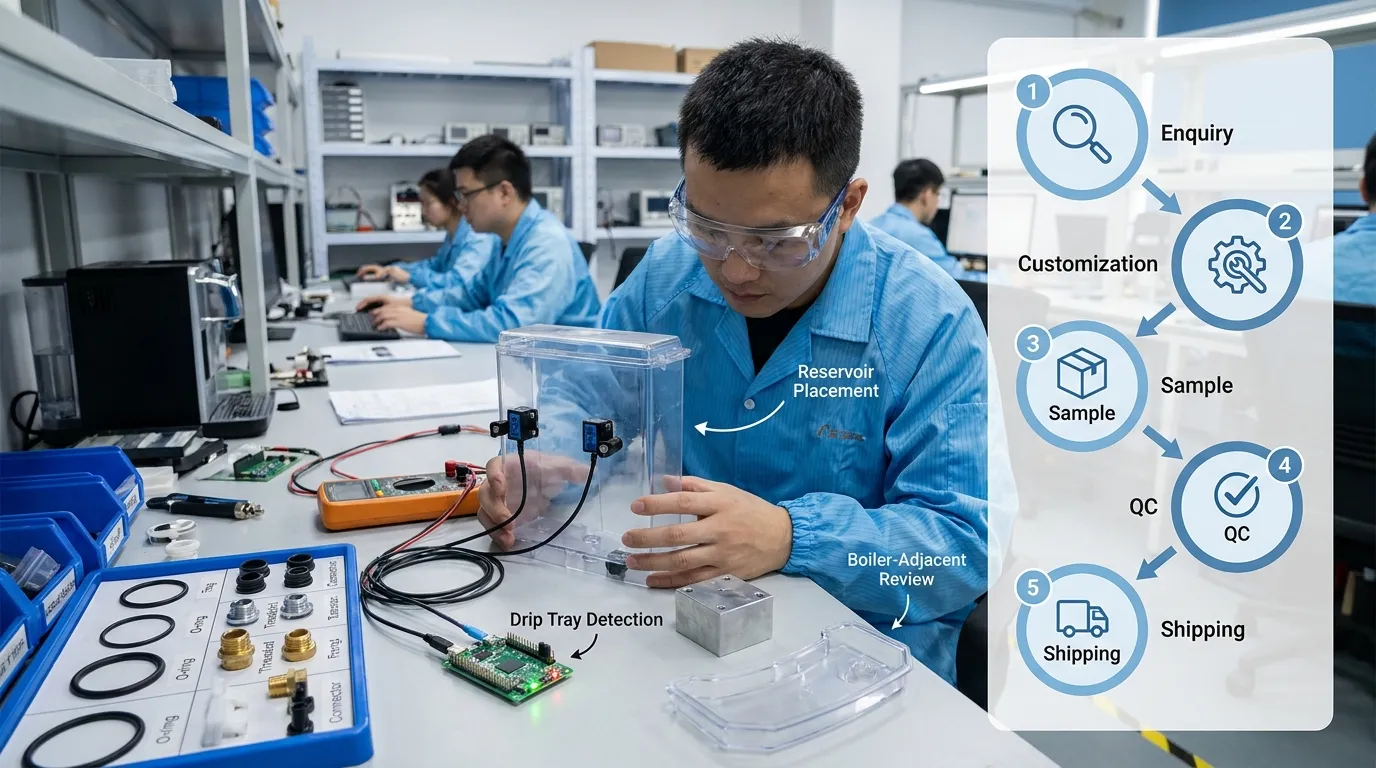
As a Shenzhen manufacturer/exporter with in-house R&D, HojellyTek supports OEM/ODM projects where standard catalog sensors do not fit the appliance design. Our OEM optical level switch service can support housing changes, cable assemblies, connector matching, logo or packaging requirements, and project-specific electrical logic.
OEM design-in may include:
- Prism shape and sensing-point review
- Sensor body material selection
- Thread and mounting structure customization
- Wire length and terminal connector matching
- Output logic adjustment
- Sample preparation for appliance testing
- Production QC plan after sample approval
We export sensor products for customers in the US, EU, India, and other markets, with engineering communication focused on drawings, samples, and practical appliance integration.
5-Step OEM Process
- Enquiry
Send the appliance type, sensor location, water condition, target function, voltage, output type, and drawing if available. - Spec and Customization Review
Our team checks material, housing, cable, connector, mounting, and logic output requirements. - Sample Confirmation
Samples are prepared for reservoir, boiler-adjacent, drip tray, or vending tank testing. - Production and QC
After sample approval, production follows the confirmed specification, wiring, and inspection requirements. - Shipping and Support
We prepare export shipment and support follow-up questions for installation, wiring, and repeat orders.
Design-In Checklist Before Ordering
Before requesting a quote, prepare these details:
- Appliance type: coffee maker, espresso machine, vending machine, water dispenser, or beverage system
- Sensor function: low water, high water, overflow, dry-run protection, drip tray full, or tank presence
- Installation point: reservoir wall, bottom tank, boiler-adjacent area, vending tank, or waste container
- Water condition: clean water, hot water, steam exposure, scale risk, cleaning liquid exposure
- Supply voltage: 5V, 12V, or another controller requirement to confirm
- Output type: NPN, PNP, NO, NC, 4–20 mA, or custom logic
- Material requirement: PSU, PTFE, 316 stainless, glass, or other wetted-material preference
- Mounting: thread, gasket, O-ring, bracket, molded tank interface, or custom housing
- Cable and connector: length, terminal, waterproofing, strain relief, and routing direction
- Fail-safe logic: what the controller should do when water is absent, present, or sensor wiring fails
- Sample quantity and test plan for appliance validation
Optical vs Conductive vs Float Detection
| Option | Strength | Limitation in coffee/vending machines | Best use |
|---|---|---|---|
| Optical point sensor | Compact, no moving float, no exposed conductive probe pair, stable digital water presence signal | Prism face must be positioned and kept suitable for optical detection | OEM low/high water detection |
| Conductive probe | Simple and low cost | Can fur up with scale, needs liquid conductivity, may be affected by mineral film | Basic water-contact detection |
| Mechanical float switch | Easy to understand, direct point switching | Moving part, larger space, possible sticking or mechanical wear | Larger tanks with enough clearance |
| Pressure-based sensing | Can support level estimation | More system design complexity | Larger tanks or non-point measurement |
| 4–20 mA level output | Good for system-level signal transmission | Usually more than needed for basic coffee reservoir point detection | Industrial or connected systems |
Why Work With HojellyTek
HojellyTek combines photoelectric optical sensing experience with OEM manufacturing support for liquid level applications. For appliance makers, this means you can discuss the actual installation problem instead of only choosing a part number from a list.
Key trust signals include:
- Shenzhen-based manufacturer and exporter
- In-house R&D for photoelectric liquid level sensing
- OEM/ODM customization for appliance and equipment brands
- Support for compact optical level switch design
- Wiring, connector, output, and mounting discussions
- Export experience with US, EU, India, and other markets
- Quote and sample communication through WhatsApp or email
FAQ
Can an optical water level sensor for coffee machine projects replace conductive probes?
Yes. An optical water level sensor for coffee machine designs can replace conductive probes when the appliance needs compact water presence detection without relying on liquid conductivity. It is especially useful where mineral buildup or probe furring may reduce conductive-probe reliability.
Can the same sensor detect both low and high water level?
One point sensor detects one fixed level. For both low-level pump protection and high-level overflow control, OEMs usually install two sensing points or design a custom assembly with multiple detection positions.
Is an optical sensor suitable for hot water or boiler placement?
It depends on the exact location. Reservoir use is usually simpler. Boiler-adjacent or hot-water placement requires review of material, temperature exposure, steam, sealing, pressure isolation, and cleaning conditions before sample confirmation.
What voltage should we choose: 5V or 12V?
Choose the voltage that matches your appliance control board. Many coffee machine projects discuss 5V logic output, while vending or internal control systems may use 12V. The final supply and output logic should be confirmed during RFQ review.
Will scale or bubbles cause false triggering?
Heavy scale coating, trapped bubbles, direct splashing, or residue can affect detection. Correct prism placement, material choice, cleaning access, and installation angle help reduce false signals in real appliance use.
Can HojellyTek customize the cable, connector, thread, or housing?
Yes. For OEM/ODM projects, HojellyTek can review cable length, connector type, thread or mounting structure, housing material, output logic, and sample requirements based on your appliance drawing.
Request a Quote for Coffee Machine Sensor Design
Send your coffee machine, espresso machine, or vending machine water-level requirement to HojellyTek by WhatsApp or email. Share the sensor position, voltage, output type, material preference, mounting drawing, and expected water condition, and our team will recommend a suitable optical level sensor design for sample testing.


