
OEM Optical Level Switch
For product teams, the priorities are clear: small footprint, reliable switching, stable 5V/12V logic compatibility, drop-in mounting, repeatable dry/wet detection, and a predictable per-unit cost at volume.
OEM Capabilities for Optical Level Switch Integration
HojellyTek is a Shenzhen manufacturer and exporter focused on photoelectric optical sensing for liquid level applications. We support OEM/ODM projects where the sensor is not just a standalone part, but a component inside the customer’s final product.
Our OEM service can support:
- Optical point level switch design for tanks, reservoirs, cartridges, compact devices, and fluid modules
- Custom body size, sensing-tip position, thread, sealing structure, cable length, and connector
- 5V or 12V logic-level interface planning for embedded control boards
- Open-collector NPN or PNP output selection based on the control circuit
- Normally open or normally closed switching logic discussion at the RFQ stage
- Wetted-material selection for water, oil, fuel, coolant, cleaning liquid, or chemical media
- Qualification samples before annual-volume production
- Tiered quotation based on sample, pilot, and yearly forecast volume
If your team is comparing standard optical sensor families first, you can also review our optical level sensor range before requesting an OEM version.
Design-In Priorities for OEM Optical Level Switch Projects
Compact Footprint for Finished Product Design
In an OEM product, the sensor usually has to fit into an existing mechanical envelope. It may need to sit inside a small tank wall, a molded plastic cartridge, a narrow stainless reservoir, a dosing device, or a compact control module. That means the housing length, thread size, cable direction, prism position, and sealing area matter as much as the electrical output.
For very limited spaces, a small optical switch can replace larger mechanical assemblies because the sensing point is concentrated around the prism tip. The goal is not only “small size,” but a shape that is easy for your mechanical engineer to mount repeatedly during assembly. For highly compact applications, our ultra-miniature optical switch page is a useful reference for the type of small-format design engineers often request.
Fast Switching With Photoelectric Prism Detection
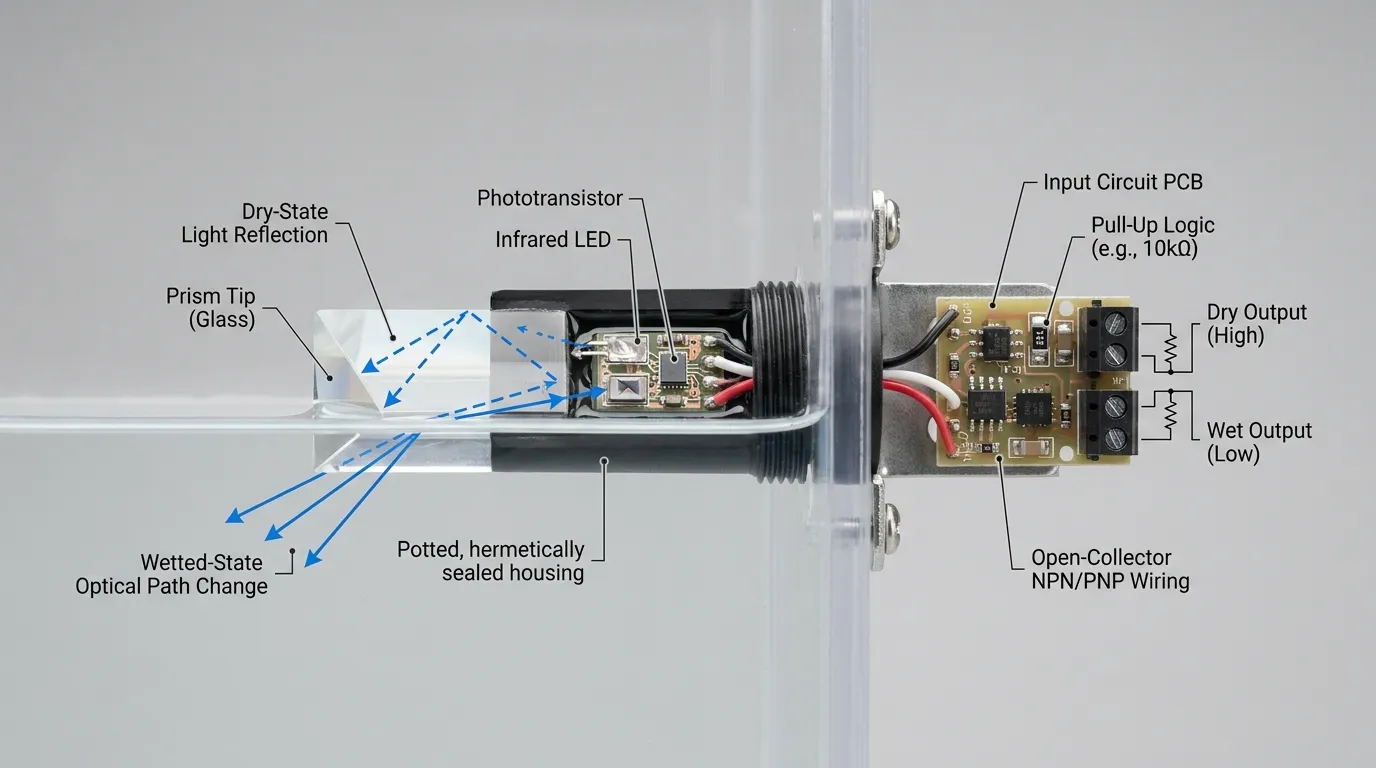
An optical level switch uses an infrared LED, a phototransistor, and a prism sensing tip. In the dry state, the infrared light reflects internally inside the prism and reaches the receiver. When liquid covers the prism, the optical path changes because the refractive condition at the tip changes. The receiver detects this difference and the circuit changes output state.
This design is useful when the product needs quick point-level detection without relying on float movement. There is no float arm to stick, no magnet position to drift, and no moving part inside the sensing tip. For OEM devices such as pumps, condensate tanks, small reservoirs, appliance modules, and process cartridges, this can improve response consistency when the liquid is clean enough for optical sensing.
The real engineering concern is not only switching speed. The design must also consider bubbles, foam, heavy residue, oil film, condensation, ambient light shielding, installation angle, and whether the prism can stay clean during the product’s service life.
Stable 5V / 12V Logic Output for Control Boards
Many OEM projects need the sensor to connect directly to a PCB, microcontroller input, PLC input module, or low-voltage control board. For this reason, 5V and 12V logic planning is central to the design discussion.
A common OEM requirement is an open-collector output, where the sensor output transistor switches the signal and the customer’s circuit defines the pull-up logic. This gives engineers flexibility when matching the sensor to their board voltage, input impedance, and firmware logic.
Before sampling, the design team should confirm:
- Control-board voltage: 5V or 12V logic requirement
- Input type: sinking or sourcing signal expectation
- Output preference: open-collector NPN or PNP
- Logic state: wet-on, dry-on, normally open, or normally closed behavior
- Pull-up design: internal or external pull-up arrangement
- Cable and connector pinout
- Required protection strategy at the system level
For applications that need a discrete point signal, an electro-optic point level sensor structure is typically the right fit. If your system needs continuous level information instead of a point switch, 4–20 mA output can be discussed as a separate sensing configuration during the RFQ stage.
Drop-In Mounting for Easier Production Assembly
OEM buyers often care less about a generic sensor description and more about whether operators can install it correctly on the production line. A good optical switch design should be repeatable to assemble, easy to seal, and clear to inspect.
Mounting options may include threaded installation, custom boss mounting, side-wall mounting, top-down positioning, flange-style adaptation, or a custom plastic/stainless body. The best choice depends on wall thickness, tank material, pressure condition, cleaning method, and whether the sensor must be removable for service.
Drop-in mounting should be reviewed together with the cable exit direction, wrench clearance, sealing surface, O-ring or gasket position, and the depth of the prism inside the liquid area. A small change in mounting depth can affect detection behavior if the sensing tip sits near turbulence, bubbles, or a sloped wall.
Wetted-Material Choices for Real Liquids
Material selection is one of the most important OEM decisions because the sensing tip and body may contact liquid for years. HojellyTek can discuss wetted-material options such as PSU, PTFE, 316 stainless steel, and glass depending on the liquid, temperature, cleaning process, and cost target.
| Wetted material | Typical reason to consider it | Buyer check before ordering |
|---|---|---|
| PSU / engineering plastic | Compact body, cost-sensitive OEM devices, water-based applications | Confirm liquid compatibility, cleaning chemicals, and long-term exposure |
| PTFE | Chemical resistance and low surface adhesion requirements | Confirm mechanical mounting design and cost target |
| 316 stainless steel | Rugged body, industrial liquid contact, stronger mechanical structure | Confirm conductivity environment, corrosion risk, and sealing design |
| Glass prism / glass tip | Stable optical surface for many sensing structures | Confirm impact risk, assembly protection, and liquid residue behavior |
The right material should be selected after reviewing the actual liquid, not only the product category. “Water,” “oil,” and “coolant” can behave very differently depending on additives, viscosity, residue, and cleaning cycles.
Integration Spec Table for OEM Review
| Integration item | Options or review points |
|---|---|
| Sensor type | Optical / photoelectric point level switch |
| Sensing principle | Infrared LED, phototransistor, and prism tip detecting dry vs wetted state |
| Logic voltage planning | 5V or 12V logic output compatibility reviewed at RFQ stage |
| Output interface | Open-collector NPN or PNP; 4–20 mA discussed for separate continuous/analog needs |
| Switching logic | Wet/dry output behavior confirmed before sample approval |
| Mounting | Threaded, drop-in, custom body, or application-specific mounting structure |
| Wetted materials | PSU, PTFE, 316 stainless steel, glass, or project-specific material discussion |
| Cable / connector | Cable length, wire sequence, connector, and pinout customized for assembly |
| Application media | Water, oil, fuel, coolant, cleaning liquid, or chemical media after compatibility review |
| Sample stage | Qualification samples supplied for electrical, mechanical, and liquid testing |
| Volume quotation | Annual-volume tiers quoted according to forecast, customization, and production requirements |
Design-In Checklist Before Requesting a Quote
Use this checklist before sending an RFQ so our engineering team can recommend a practical configuration:
- What liquid will touch the sensing tip, and does it leave film, bubbles, foam, or residue?
- Is the sensor detecting high level, low level, empty tank, overflow, leak, or pump protection?
- Does your control board need 5V or 12V logic?
- Should the output be open-collector NPN or PNP?
- What output state should the controller see when the tip is dry and when it is wetted?
- What mounting style is required: thread, custom boss, side wall, top mount, or compact cartridge fit?
- Which wetted material is preferred: PSU, PTFE, 316 stainless steel, glass, or another material?
- What cable length, connector, and wire color sequence are needed for your assembly line?
- What annual volume should be quoted after sample approval?
- What tests will your team run before production release?
For deeper customization, see our customized optical sensor service page.
OEM Development Process
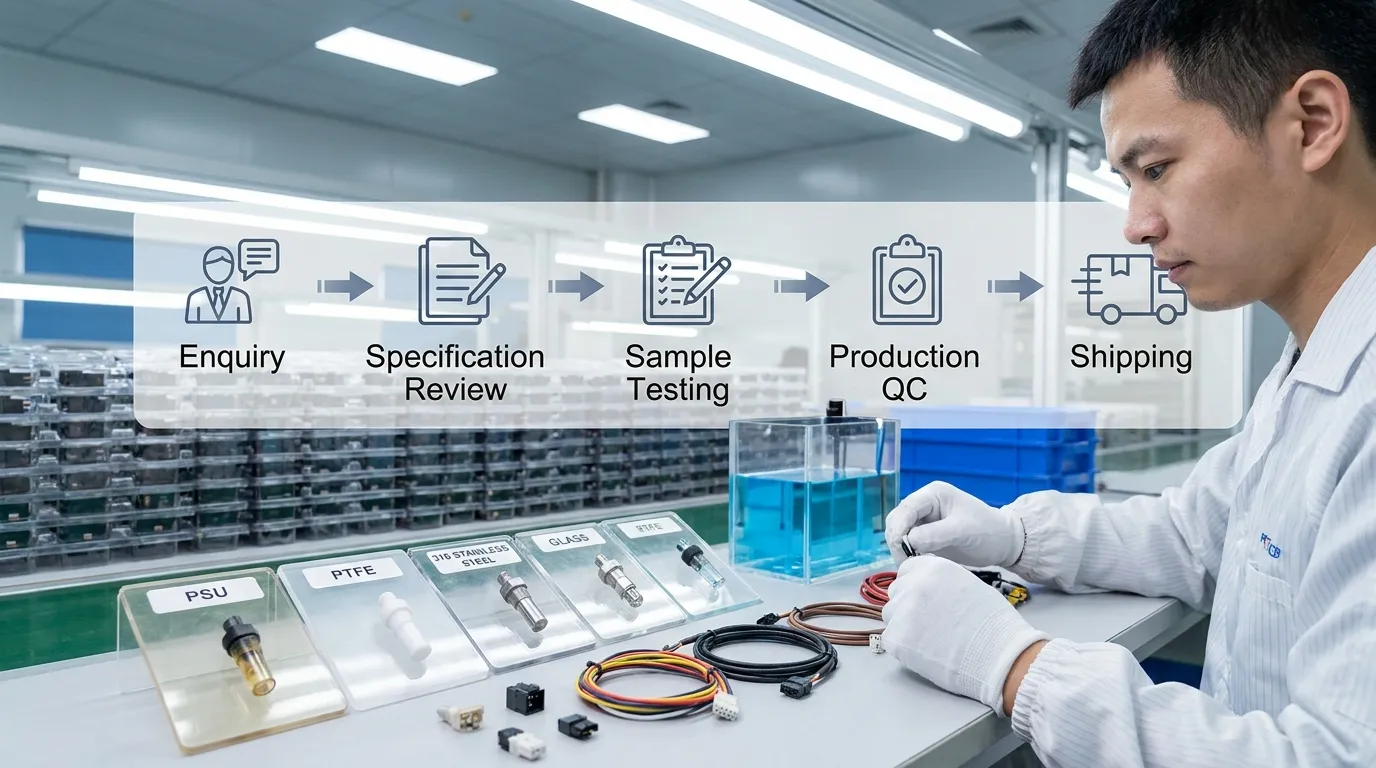
1. Enquiry
Send your liquid type, mounting idea, voltage, output preference, target product, and annual forecast by WhatsApp or email.
2. Specification and Customization
Our team reviews the optical structure, electrical interface, wetted material, cable, connector, and mounting requirements.
3. Qualification Sample
Samples are prepared for your design team to test dry/wet switching, mounting fit, control-board input, and liquid behavior.
4. Production and QC
After approval, the factory prepares production according to the confirmed drawing, wiring definition, material choice, and inspection requirements.
5. Shipping
Orders are packed for export, with support for customers in the US, EU, India, and other markets.
Annual-Volume Pricing Tiers
OEM pricing depends on the confirmed design, material, cable, connector, assembly complexity, and forecast volume. Instead of publishing fixed prices that may not match your design, HojellyTek quotes by practical project stage:
| Stage | Best for | Pricing focus |
|---|---|---|
| Qualification sample | Engineering validation | Confirm fit, output, and material before volume commitment |
| Pilot batch | Pre-production or small product launch | Check assembly workflow and field behavior |
| Annual volume tier | Stable production forecast | Reduce per-unit cost based on yearly demand |
| Custom OEM program | Dedicated configuration | Balance tooling, material, QC, packaging, and repeat orders |
This helps design engineers compare the real cost of an approved part, not just a catalog unit price.
HojellyTek Trust Signals
HojellyTek is a Shenzhen manufacturer/exporter with in-house R&D and practical OEM/ODM experience in photoelectric liquid level sensing. Our team supports custom sensor structures, electrical interface discussion, and factory-direct production for customers integrating sensors into finished equipment.
For connected tank-monitoring or smart fluid systems, Tuya/Smart Life-related integration can be discussed where it fits the broader device architecture. For a simple embedded point-level switch, the priority remains stable sensing, correct output logic, reliable mounting, and repeatable production.
FAQ
Can an oem optical level switch work with 5V or 12V logic?
Yes. The logic voltage should be confirmed at the RFQ stage so the sensor output matches your control board, pull-up design, and firmware logic.
Should I choose NPN or PNP output?
Choose based on your controller input type. NPN is commonly used for sinking-style signal designs, while PNP is used for sourcing-style input designs. Our team can review your wiring requirement before sampling.
Can the mounting thread or body shape be customized?
Yes. Thread, cable exit, body size, sensing-tip position, connector, and mounting structure can be discussed for OEM/ODM projects.
Which wetted material should I choose?
It depends on the liquid. PSU may fit compact cost-sensitive applications, PTFE is considered for chemical resistance, 316 stainless steel for rugged structures, and glass for stable optical sensing surfaces.
What can cause optical level switch failure in real products?
Common issues include residue on the prism, bubbles, foam, wrong mounting angle, incompatible liquid, incorrect output logic, poor sealing, or a control-board input mismatch.
How do I request a volume quotation?
Send the liquid type, voltage, NPN/PNP preference, mounting drawing, cable or connector requirement, sample quantity, and annual forecast. Request a quote via WhatsApp or email for sample and volume pricing.


