
Customized Optical Liquid Level Sensor
For buyers comparing an optical level sensor for a new device, the key question is not only “does it detect liquid?” The real question is whether the sensor can fit your mechanical space, connect to your control board, survive your liquid, pass your sealing requirements and remain stable after production scaling.
OEM/ODM Customization Capabilities
HojellyTek provides OEM/ODM customization for optical liquid level sensors used in tanks, appliances, industrial equipment, water systems, fuel monitoring, dispensing machines, automation devices and compact smart products. The sensor can be customized around your mechanical design, electrical interface and liquid environment.
Customization can include:
- Housing material and body size
- Prism tip size and sensing head structure
- Thread type, such as 1/4 NPT or other mounting threads
- Flange, nut, panel or tank-wall mounting
- NPN, PNP, open-collector, analog or switching output
- 4-20mA output where the system requires industrial signal compatibility
- AC or DC electrical configuration
- 5V, 12V or 24V supply voltage options
- Normally open or normally closed logic
- Cable length, connector type and wire definition
- IP-rating requirements for wet, splash or outdoor environments
- Material selection for water, oil, coolant, fuel, chemical or mixed-liquid use
This makes the service suitable for buyers who need more than a standard product listing from an optical liquid level sensor manufacturer. The goal is to turn your sensor requirement into a manufacturable part that fits your device, production process and field environment.
How the Optical Sensing Core Is Adapted for Your Design
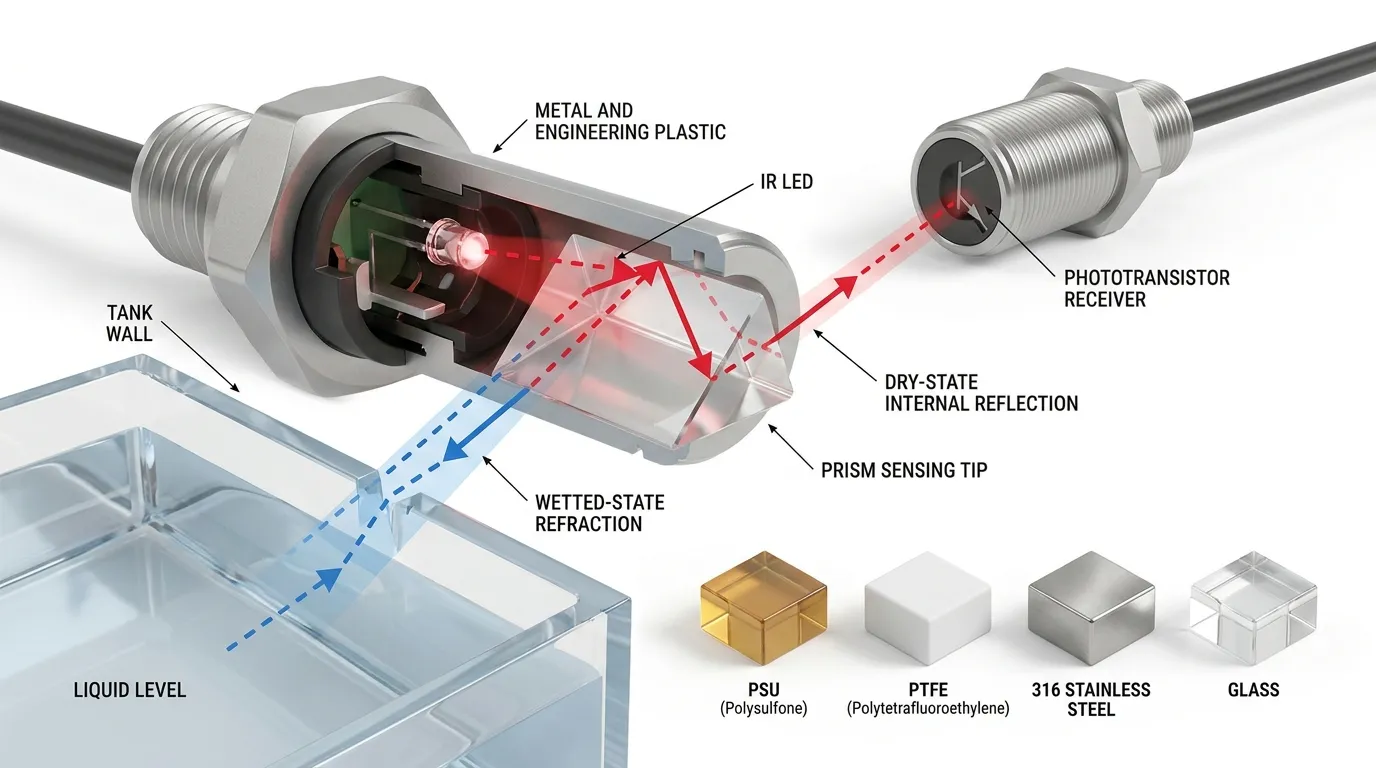
A photoelectric optical liquid level sensor typically uses an infrared LED, a phototransistor and a transparent prism sensing tip. In air, infrared light reflects internally inside the prism and returns to the receiver. When liquid covers the prism, the refractive condition changes, so less light returns to the receiver. The circuit then converts this dry/wetted state into a switching or signal output.
For custom projects, the sensing principle stays stable, but the surrounding design changes based on your product:
- The prism geometry must match the tank wall, liquid contact point and required response behavior.
- The LED and receiver structure must be protected from moisture, vibration and unstable wiring.
- The housing must be compatible with the liquid and installation method.
- The output circuit must match the PLC, MCU, relay board, alarm module or smart controller.
- The cable and connector must match your assembly process and enclosure layout.
This is why a non-standard optical level sensor project should start with mechanical, electrical and liquid data together. A small change in mounting angle, cable exit, thread length, liquid type or output logic can affect long-term performance.
What We Can Customize
| Custom Item | Available Direction | What the Buyer Should Confirm |
|---|---|---|
| Housing material | PSU, PTFE, 316 stainless steel, glass sensing tip or mixed structure | Liquid type, temperature exposure, cleaning method and corrosion risk |
| Sensor size | Standard, compact or micro body | Available installation space and tank-wall thickness |
| Thread and mounting | 1/4 NPT and other thread or panel-mount options | Tank material, sealing method and mounting direction |
| Output type | NPN, PNP, switching output, 4-20mA, AC or DC configuration | Controller input type, load current and wiring logic |
| Logic state | Normally open or normally closed | Alarm behavior when the tank is empty, full or sensor disconnected |
| Voltage | 5V, 12V or 24V | Control board supply and power stability |
| Cable | Custom cable length, wire color, connector or stripped lead | Assembly method, waterproofing and service access |
| Sensing tip | Prism tip size and wetted structure | Liquid clarity, foam, residue and required sensing position |
| IP rating | Splash, sealed or higher protection options by project | Indoor, outdoor, washdown or humid operating environment |
| Branding | OEM label, custom model number or private project design | Packaging, documentation and export requirements |
Material Selection for Target Liquids
The wetted material is one of the most important decisions in a customized optical liquid level sensor. A housing that works well in clean water may not be suitable for fuel, oil, coolant, detergent or aggressive chemical media.
PSU housing is often selected for compact, cost-sensitive water or light-duty liquid applications where good dimensional stability and molded sensor structure are required.
PTFE housing is useful when chemical resistance is a priority. It can be considered for applications involving more demanding liquids, cleaning fluids or corrosive media, depending on the full liquid profile.
316 stainless steel housing is suitable for stronger mechanical protection, industrial installation and liquids where metal housing is preferred. It is often requested for equipment exposed to vibration, harder assembly conditions or metal tank systems.
Glass prism or glass sensing tip options can support applications where optical clarity, chemical compatibility or a specific wetted interface is needed.
Before choosing the material, buyers should confirm the target liquid, concentration, operating temperature, cleaning cycle, pressure environment, tank material and whether the liquid may leave residue on the prism. Optical sensing is reliable, but sticky liquid, heavy foam, crystallization or coating on the prism can create false wet readings if the design is not reviewed early.
Output and Electrical Interface Options
For OEM integration, the output signal must match your controller. Many buyers already have a PCB, MCU, PLC, relay module or alarm controller, so the sensor must be designed around the input circuit rather than selected only by shape.
Common options include:
- NPN output for sinking signal designs
- PNP output for sourcing signal designs
- NO/NC logic to match full, empty or safety alarm behavior
- Open-collector switching output for flexible controller integration
- 4-20mA output where an industrial analog signal is required
- AC or DC configuration depending on the device architecture
- 5V, 12V or 24V voltage to match the control board or field power system
If you are deciding between transistor output types, review the controller input first. A sensor with the wrong output type may power on but fail to trigger the input correctly. For more detail on transistor signal selection, see HojellyTek’s guide to NPN/PNP output options.
Thread, Mounting and Cable Design
Mechanical fit is where many custom projects begin. The sensor may need to mount through a tank wall, plastic housing, metal panel, pipe adapter or compact reservoir. Thread size, thread length, sealing surface and cable direction should be confirmed before sample production.
Typical mounting questions include:
- Do you need 1/4 NPT or another thread?
- Is the sensor installed from inside or outside the tank?
- Will the cable exit vertically, horizontally or at a custom angle?
- Is the tank wall plastic, metal or glass?
- Will the sensor be exposed to vibration, water spray or outdoor humidity?
- Is the sensing point for high level, low level or dry-run protection?
Cable length is also part of OEM design. A short cable may be suitable for internal PCB connection, while industrial equipment may need a longer lead, waterproof connector or custom wire definition. For small product designs, a micro optical sensor may be considered when standard housing size is too large.
Real Failure Modes We Help Buyers Avoid
A custom optical level sensor project should prevent field problems before mass production. The most common risks are not related to the basic sensing principle; they usually come from poor matching between the sensor and the application.
Wrong material selection can cause swelling, corrosion, cracking or loss of sealing after long-term contact with the liquid.
Incorrect output logic can cause the device to read “full” when it should read “empty,” or fail to trigger an alarm in a safe state.
Unstable voltage matching can create false switching, weak output or damage when the sensor is connected to the final control board.
Poor prism placement can make the sensor respond late, remain wetted by residue or sit in a dead zone inside the tank.
Insufficient IP protection can allow moisture to enter the cable exit or housing area, especially in washdown, outdoor or humid environments.
Thread and sealing mismatch can cause leakage, stress cracking or difficult assembly during production.
By reviewing these points before tooling, the factory can adjust material, structure, cable, sealing and output configuration before the project reaches mass production.
5-Step OEM Process

Enquiry and Application Review
Send your target liquid, tank design, installation position, voltage, output requirement, cable request, annual quantity estimate and any drawings or photos. Our team reviews whether a standard base design can be customized or whether a new structure is needed.
Spec and Customization Confirmation
We confirm housing material, size, thread, sensing tip, output logic, supply voltage, wire definition, cable length, mounting style and IP-rating target. If needed, the factory prepares drawings or sample specifications for approval.
Sample or Tooling Decision
For small changes, a sample can often be developed from an existing platform. For special housing, unique mounting or private structure, tooling may be required. Sample and tooling timing are confirmed based on the complexity of the custom request.
Production and QC
After the sample is approved, production follows the confirmed specification. QC checks focus on appearance, wiring, output state, dry/wet switching response, insulation, sealing-related requirements and batch consistency.
Shipping and Export Support
HojellyTek is based in Shenzhen and exports sensor products to markets including the US, EU and India. Buyers can request quotation, sample details and shipping coordination by WhatsApp or email.
RFQ Requirements Before We Quote
To receive an accurate quotation for a custom optical liquid level sensor, prepare the following details:
| Requirement | Why It Matters |
|---|---|
| Target liquid | Determines material, prism design and failure-risk review |
| Tank drawing or installation photo | Confirms thread, length, sealing and cable direction |
| Required voltage | Matches 5V, 12V, 24V or project-specific power design |
| Output type | Confirms NPN, PNP, 4-20mA, AC/DC and NO/NC logic |
| Cable length and connector | Supports final assembly and waterproofing |
| IP-rating expectation | Helps design for splash, humidity, washdown or outdoor use |
| Quantity plan | Determines whether standard modification or custom-run production is suitable |
| Branding/documentation needs | Supports OEM model number, label or private project requirements |
Custom Optical Sensor vs Standard Catalog Sensor
| Item | Standard Catalog Sensor | Customized OEM/ODM Sensor |
|---|---|---|
| Mechanical fit | Fixed size and thread | Built around your tank, housing or device |
| Material | Limited standard options | Selected for water, oil, fuel, coolant or chemical use |
| Output | Fixed output model | NPN, PNP, NO/NC, 4-20mA, AC or DC by project |
| Voltage | Standard supply range | Matched to 5V, 12V, 24V or board requirement |
| Cable | Fixed length or connector | Custom cable length, connector and wire definition |
| IP protection | Catalog rating | Project-based sealing and IP target |
| MOQ | Standard model quantity | Custom-run MOQ confirmed after design review |
| Best for | Simple replacement or general use | New products, private devices and non-standard installations |
Why Work With HojellyTek
HojellyTek is a Shenzhen optical and liquid level sensor manufacturer with in-house R&D and OEM/ODM experience for photoelectric liquid level sensing. The factory supports buyers who need practical engineering help, not only product resale.
Buyers work with us for:
- Custom housing, material, thread, voltage and output development
- Photoelectric optical sensing design using IR LED, receiver and prism structure
- Support for compact and micro sensor designs
- OEM/ODM service for equipment manufacturers and product developers
- Export experience for US, EU and India markets
- Smart product experience where Tuya/Smart Life integration is relevant to the complete device system
- Quote and sample communication by WhatsApp or email
FAQs About Customized Optical Liquid Level Sensors
Can HojellyTek make a customized optical liquid level sensor for my tank or device?
Yes. We can customize the housing size, material, thread, cable, voltage, output type and sensing structure based on your tank drawing, liquid type and control board requirement.
Can I choose NPN or PNP output?
Yes. NPN and PNP output options can be selected according to your controller input. We can also review NO/NC logic, wire definition and voltage matching before sample production.
Can you support 5V, 12V and 24V designs?
Yes. The supply voltage is confirmed during the RFQ stage. Common custom projects may involve 5V, 12V or 24V depending on the equipment power system.
What materials can be customized for the wetted part?
Material options may include PSU, PTFE, 316 stainless steel and glass sensing-tip structures. The final choice depends on the target liquid, temperature, cleaning process and corrosion risk.
Is tooling always required for a custom sensor?
Not always. If the project can be built from an existing sensor platform, a modified sample may be possible. If the housing, thread, mounting or structure is unique, tooling may be required.
What should I send before requesting a quote?
Send the target liquid, voltage, output type, thread or mounting request, cable length, IP-rating expectation, quantity plan and any tank drawing, photo or existing sample reference.
Request a Custom Sensor Quote
Send your drawing, target liquid, voltage, output requirement and mounting details to HojellyTek by WhatsApp or email. Our team will review the customization scope and recommend a practical OEM/ODM path for your optical liquid level sensor project.


