
Electro-Optic Point Level Sensor
If your buyer, engineer, or purchasing team is using different terms, this page helps confirm the right sensor type before you request a quote.
Electro-Optic, Photoelectric, and Optical Point Level Switch: Same Sensor Category
In liquid level purchasing, the terminology is often mixed. One customer may ask for an electro-optic point level sensor, another may request a photoelectric liquid level switch, and a design engineer may call it an optical point level switch. In most practical buying situations, they are referring to a compact sensor that detects whether liquid has reached one fixed point.
This is different from a continuous level transmitter. A point sensor gives an on/off switching signal at one position, while an optical continuous level sensor is selected when the system needs level range measurement instead of a single alarm point.
For buyers comparing products, the key question is not the label. The key question is whether the sensor matches your liquid, tank material, mounting space, output logic, voltage, wiring, and alarm function.
What HojellyTek Can Supply
HojellyTek supplies electro-optic point level sensing solutions for OEM equipment builders, tank manufacturers, automation integrators, and liquid handling system suppliers. Our capabilities include standard optical switch models, customized body material, wiring configuration, connector style, thread or mounting design, and output logic matching for control boards or PLC systems.
Typical service scope includes:
- Optical point level switch selection for high-level or low-level detection
- Photoelectric sensor modules for compact water tanks and small equipment
- NPN or PNP output configuration for automation systems
- Voltage option confirmation based on the customer control board
- Material selection for water, oil, coolant, chemical, and clean liquid applications
- OEM/ODM sensor body, cable, connector, thread, and housing customization
- Export support for buyers in the US, EU, India, and other industrial markets
For buyers who are still comparing the wider sensor category, our optical level sensor page gives a broader product overview.
How the Electro-Optic Point Level Sensor Works
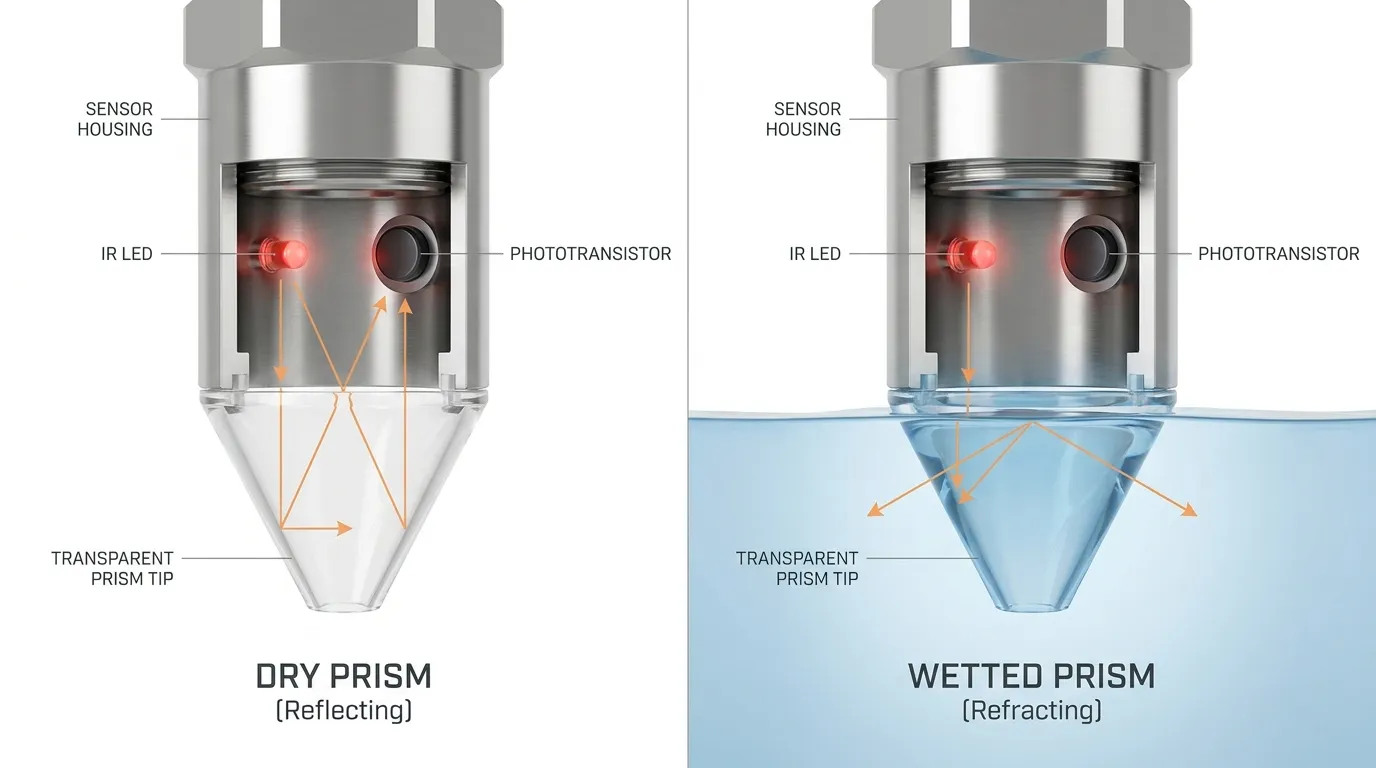
The working principle is simple: an internal LED sends light into a prism tip, a phototransistor receives the reflected light, and the output changes when the prism moves from dry air to a wetted liquid state.
There is no float, magnet, reed switch, or mechanical arm. When the prism is dry, light reflects internally inside the tip. When liquid covers the prism, the optical path changes, the receiver signal changes, and the sensor switches output. This makes the design useful where the buyer wants fast point detection in a compact form factor without moving parts.
For a service page, the practical meaning is more important than academic optics theory: the sensor detects whether liquid is present at the installed point. It can be used as a high-level alarm near the top of a tank, or as a low-level alarm near the bottom of a tank.
Point Level Detection for High and Low Alarms
An electro-optic point level sensor is selected when the control system only needs to know one condition: liquid reached this point, or liquid has dropped below this point.
For high-level detection, the sensor is installed at the alarm position. When liquid touches the prism, the output changes and the controller can stop filling, trigger a warning, close a valve, or start a safety routine.
For low-level detection, the sensor is installed near the minimum allowed level. When the liquid no longer wets the prism, the output changes and the system can stop a pump, protect a heater, prevent dry running, or alert the operator.
This single-point behavior is why the product is often used in small tanks, reservoirs, dispensers, process equipment, coolant systems, water appliances, oil containers, medical equipment reservoirs, and industrial automation modules.
Output, Voltage, and Wiring Options
Output selection is one of the most important purchasing details. Many buyer problems happen not because the sensor cannot detect liquid, but because the output type does not match the controller.
Common switching output choices include NPN and PNP. NPN is often used where the controller expects a sinking output, while PNP is used where the controller expects a sourcing output. The right choice depends on your PLC input card, control board design, wiring standard, and regional machine design practice.
Normally open and normally closed logic should also be confirmed. Some systems want the signal active when liquid is present. Others want a fail-safe alarm when liquid is absent. Our team can help align the logic with your alarm condition.
Voltage options are confirmed during the RFQ stage to match the customer’s board or automation cabinet. For detailed wiring guidance, see our page on NPN/PNP output.
For projects asking about 4–20 mA, the application should be checked carefully. A point level sensor is usually a switch output device. If your system truly needs an analog level signal, the better choice may be a continuous level solution instead of a single-point switch.
Materials, Mounting, and Tank Integration
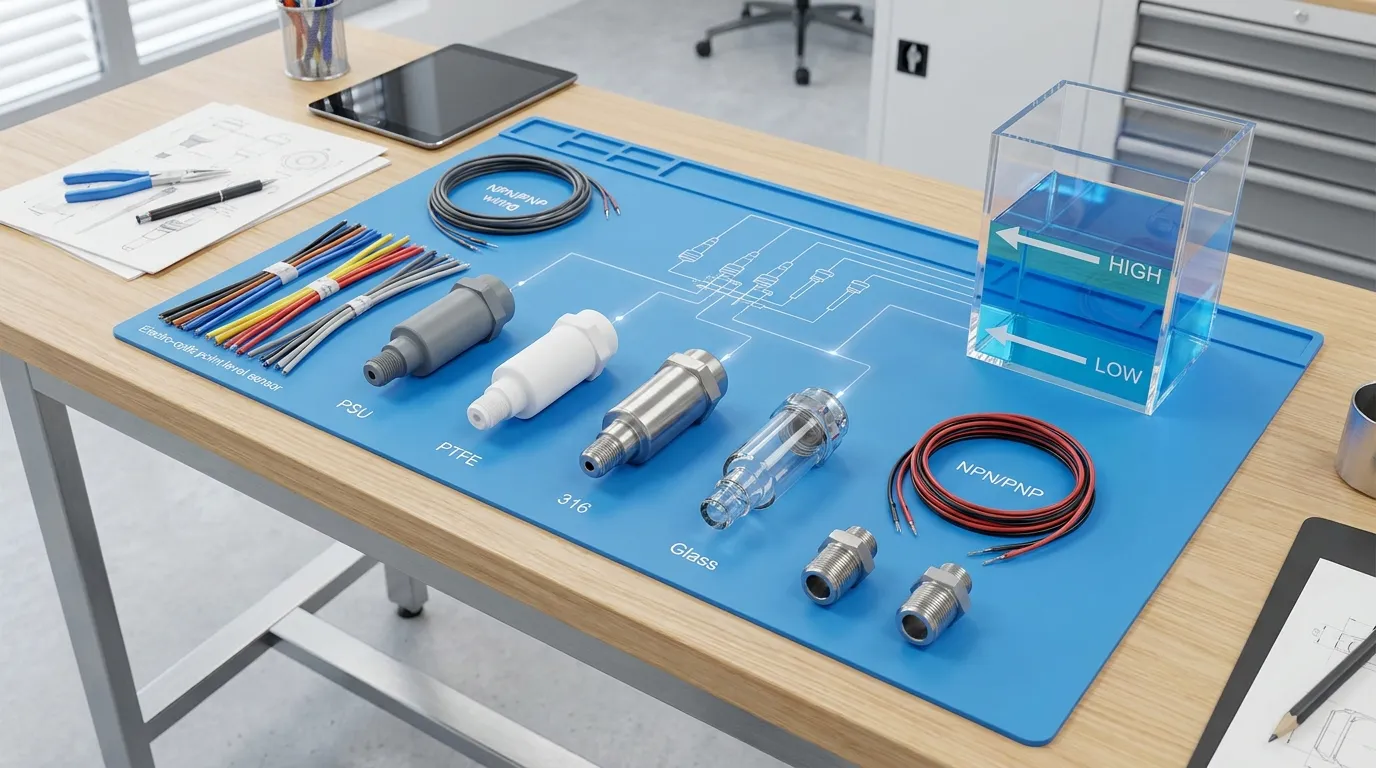
The wetted material must match the liquid and cleaning environment. Common material directions include PSU for compact general-purpose sensor bodies, PTFE for aggressive chemical resistance, 316 stainless steel for rugged industrial installation, and glass for selected clean or chemical applications.
Thread and mounting design depend on the tank wall, sealing method, and service access. Buyers should confirm whether the sensor will be side-mounted, top-mounted into a chamber, installed through a threaded port, fixed into a molded plastic tank, or integrated into an OEM housing. Threaded options, flange-style concepts, cable exit direction, and connector requirements can be reviewed during customization.
Tip position also matters. The prism should be placed at the true alarm point, with enough clearance from tank walls, bubbles, foam zones, heavy turbulence, and residue collection areas. Optical point sensors are strong for many clean liquid applications, but sticky, crystallizing, coating, or heavily contaminated liquids need extra review before selection.
Electro-Optic Point Level Sensor Specification Table
| Specification Area | Options / Selection Notes |
|---|---|
| Detection type | Single-point liquid presence detection |
| Sensing method | LED, phototransistor, and optical prism tip |
| Switching state | Output changes between dry prism and wetted prism condition |
| Alarm use | High-level alarm, low-level alarm, overflow prevention, dry-run protection |
| Output options | NPN, PNP, normally open, normally closed; analog needs reviewed separately |
| Voltage options | Confirmed at RFQ stage to match the customer control board or PLC system |
| Response behavior | Fast electronic switching for point alarm applications; exact response is confirmed by model and control circuit |
| Wetted materials | PSU, PTFE, 316 stainless steel, glass, or project-specific material selection |
| Mounting style | Threaded, tank-mounted, compact OEM installation, or customized mechanical interface |
| Liquid compatibility | Water, oil, coolant, clean liquid, and selected chemical applications after material review |
| Customization | Cable length, connector, body material, thread, output logic, housing, and OEM labeling |
| Typical buyer | Equipment manufacturer, tank supplier, automation integrator, distributor, or OEM project team |
Where to Use This Sensor
Use an electro-optic point level sensor when your project needs:
- A fixed high-level alarm inside a compact tank
- A low-level signal to protect pumps or heaters
- A no-moving-parts alternative to a miniature float switch
- Fast detection in water, oil, coolant, or clean process liquid
- A compact sensor for an OEM device or enclosed reservoir
- PLC or control board input using NPN or PNP output
- A side-mounted sensor where the prism directly contacts the liquid
- A custom body, thread, cable, or connector for repeat production
- A clean installation where mechanical floats may jam, wear, or require more space
Review the application more carefully when the liquid is sticky, leaves scale, contains particles, forms heavy foam, crystallizes after drying, or may coat the prism. These are real failure modes that can affect optical switching performance.
Five-Step Service Process
1. Enquiry
Send your liquid type, tank drawing, alarm point, mounting direction, voltage, controller type, and required output. Photos or sketches are useful for early review.
2. Spec and Customization
Our engineering team checks material, output logic, wiring, thread, cable, connector, sealing approach, and installation position. For OEM/ODM projects, the body structure and cable exit can be adjusted.
3. Sample
A sample can be prepared for fit, wiring, and liquid testing. This helps confirm the dry and wetted states before production planning.
4. Production and QC
The factory produces according to the confirmed specification, with inspection focused on sensing response, wiring, appearance, assembly, and customer-specific configuration.
5. Shipping
Finished sensors are packed for export and shipped according to the customer’s order arrangement. HojellyTek supports international buyers requesting quotes by WhatsApp or email.
Point Sensor vs Continuous Level Sensor
| Requirement | Choose Electro-Optic Point Level Sensor | Choose Continuous Level Sensor |
|---|---|---|
| Need one alarm point | Best fit | Usually unnecessary |
| Need exact level range | Not suitable | Better fit |
| High/low alarm | Strong fit | Possible but more complex |
| Compact tank integration | Strong fit | Depends on tank height |
| Simple PLC on/off input | Strong fit | May need analog or digital processing |
| Inventory cost control | Usually simpler | Usually selected for advanced monitoring |
Why Buyers Work With HojellyTek
HojellyTek is a Shenzhen manufacturer and exporter focused on photoelectric optical sensing and liquid level detection products. Buyers work with us when they need factory-direct communication, in-house R&D support, and sensor customization instead of only catalog selection.
Our team supports OEM/ODM projects for industrial, appliance, automation, and smart monitoring applications. Where relevant, we can also support sensor integration discussions for smart device ecosystems, including Tuya and Smart Life related product concepts.
The goal is practical: help the buyer receive a sensor that fits the liquid, tank, output, voltage, and installation method before mass production.
RFQ Checklist
Before requesting a quote, prepare:
- Liquid type and concentration
- Tank material and wall thickness
- High-level or low-level alarm function
- Mounting direction and thread requirement
- Required wetted material
- Voltage supply
- NPN or PNP output requirement
- Normally open or normally closed logic
- Cable length and connector type
- Quantity forecast and OEM customization needs
- Photos, drawings, or current sensor reference if available
FAQ
Is an electro optic point level sensor the same as an optical point level switch?
Yes. In most buying contexts, electro optic point level sensor, electro-optic level switch, photoelectric liquid level switch, and optical point level switch refer to the same single-point optical liquid detection category.
Can it detect both high level and low level?
Yes. The same sensing principle can be used for high-level or low-level detection. The difference is the installation position and output logic required by your control system.
What output should I choose, NPN or PNP?
Choose NPN or PNP according to your PLC input card or control board. If you are unsure, send the wiring diagram or controller model and our team can help confirm the suitable output type.
Does the sensor give a 4–20 mA signal?
A point level sensor normally provides a switching output. If your project needs 4–20 mA for level range measurement, a continuous level sensor may be more suitable.
What liquids are suitable?
It can work with many clean liquids such as water, oil, coolant, and selected chemicals. Material compatibility and residue risk must be checked before ordering, especially for sticky, crystallizing, or coating liquids.
What details are needed for customization?
Send the liquid, tank drawing, mounting style, voltage, output type, cable length, connector, material preference, and alarm logic. These details help the factory match the sensor to your equipment.
Request a Quote
Need an electro-optic point level sensor for a tank, machine, appliance, or OEM device? Send your liquid type, installation drawing, voltage, output requirement, and target quantity to HojellyTek by WhatsApp or email. Our team will help confirm the right optical point level switch configuration for your application.


