
Optical Continuous Level Sensor
HojellyTek supports optical liquid level sensing projects for buyers who need clearer level feedback, compact installation, and customization beyond standard on/off detection.
Continuous Optical Level Sensing Capabilities
Most optical liquid level sensors use a photoelectric principle: an infrared LED sends light into a prism tip, and a phototransistor or receiver detects the reflected light. In air, the prism reflects light differently than when it is wetted by liquid. The sensor circuit then converts this dry/wet optical change into a usable signal.
For a simple tank alarm, this signal can be an on/off output. For continuous or near-continuous level monitoring, the design may use a longer sensing structure, multiple optical points, or a signal-conversion design that reports level changes to a controller.
Our optical level sensing support can include:
- Custom optical point switches for high, low, empty, overflow, and leak detection
- Multi-point optical level arrays for stepped level indication
- Continuous-level projects where the signal must support process control or dosing feedback
- Output configuration for control boards, PLCs, pumps, alarms, or IoT devices
- Material selection for water, oil, fuel, chemical, and cleaning-fluid applications
- OEM/ODM sensor body, thread, cable, connector, and housing customization
For buyers comparing general solutions, see our optical level sensor guide.
Point Optical Switch vs Continuous Optical Level Measurement
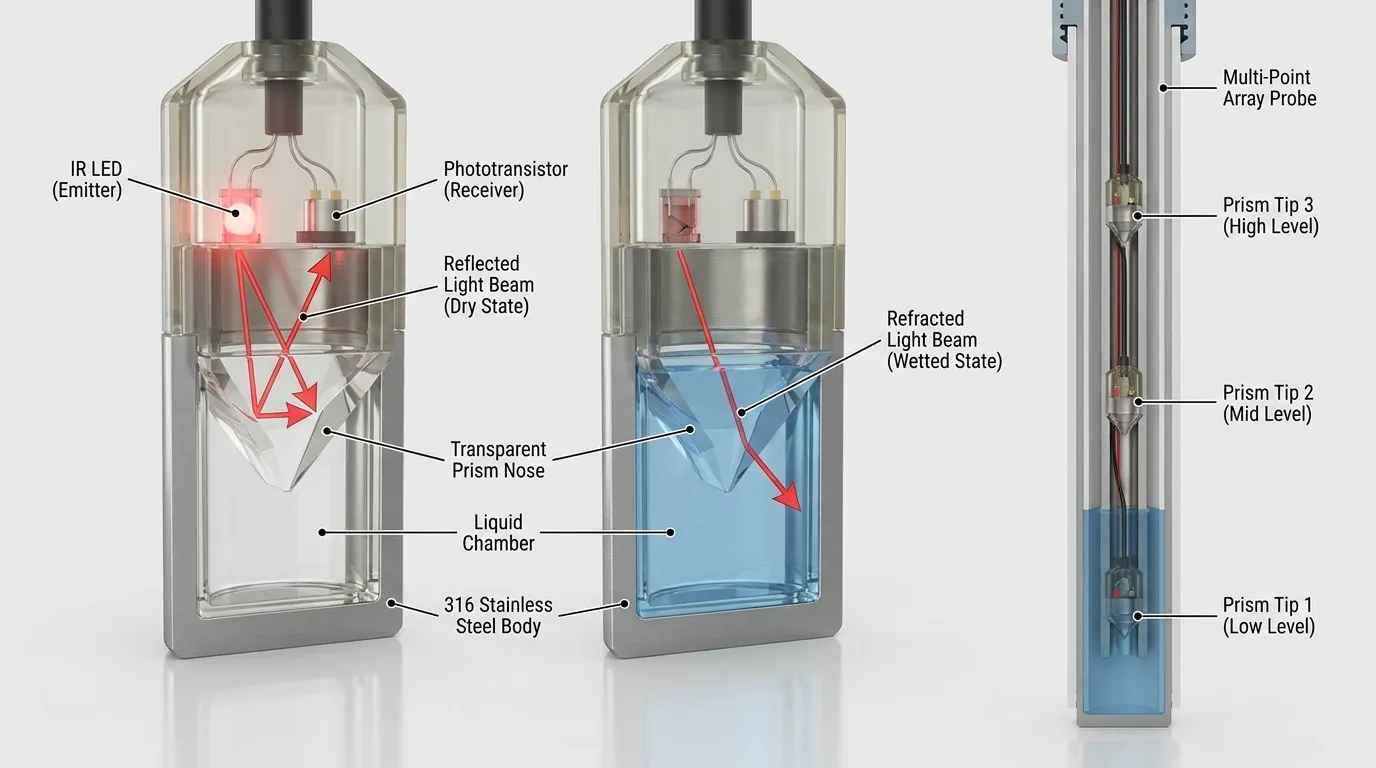
A photoelectric point level switch answers one question: “Is liquid present at this position?” It is ideal when the system only needs a clear dry/wet status. For example, a coffee machine may need a low-water alert, a medical device may need a reagent-present signal, or a small tank may need overflow protection.
Continuous measurement answers a different question: “How much liquid is in the tank now?” This matters when a controller must track level change during filling, draining, dosing, batching, or process operation.
In many projects, buyers first ask for an optical continuous level sensor, but after review, the correct design may be one of three options:
- Single optical point switch for high/low alarm
- Multi-point optical array for several fixed level steps
- Continuous output design where the controller receives a variable analog or digital signal
If your requirement is only “tank full” or “tank empty,” a point device is usually simpler. If you need level trend, refill timing, dosing amount, or process feedback, continuous or multi-point sensing is more suitable.
For fixed-point detection projects, compare our electro-optic point level sensor.
Measurement Range, Resolution, and Signal Design
For continuous optical level projects, the measurement range is not selected like a generic catalogue switch. It must match the tank depth, sensing zone, installation position, liquid behavior, and required control accuracy.
A short reservoir may only need several optical detection points. A taller tank may require a longer probe or a custom sensing structure. A dosing chamber may need higher resolution across a narrow section rather than a long full-tank range.
Resolution depends on the sensing method. With a multi-point array, resolution is based on the spacing between each optical point. Closer spacing gives more level steps, but it also affects probe design, wiring, cost, and controller input requirements. With analog or digital continuous output, the usable resolution depends on the optical sensing design, signal processing, liquid stability, and calibration method.
Buyers should define:
- Total tank depth or target sensing height
- Minimum and maximum liquid levels to monitor
- Required level step or control accuracy
- Whether the system needs smooth output or fixed level zones
- Liquid type, clarity, viscosity, foam, bubbles, and coating risk
- Controller input type: NPN, PNP, voltage, 4–20 mA, pulse, RS485, or custom digital signal
Output Options: NPN, PNP, 4–20 mA, and Digital Signals
Output selection is one of the biggest buying decisions. A point switch normally uses a discrete output such as NPN, PNP, push-pull, or relay-style logic depending on the control circuit. This is suitable for alarms, pump start/stop, refill triggers, and interlock signals.
For continuous or process-level feedback, buyers often ask for analog output. A 4–20 mA signal is common in industrial control because it can represent a changing level over a defined range and is more suitable for longer cable runs than simple voltage signals. Digital output may be used when the sensor needs to communicate with a microcontroller, smart device, or industrial gateway.
HojellyTek can review the controller requirement during RFQ and help match the output logic to your system. Supply voltage, wiring mode, cable length, connector, and signal behavior are confirmed before sample production.
Multi-Point Optical Arrays as a Continuous Alternative
Not every continuous-looking application needs a true continuous transmitter. In many compact OEM systems, a multi-point optical array is a practical alternative.
A multi-point design places several optical sensing positions along one probe or assembly. Each point detects whether liquid has reached that height. The controller then interprets the result as empty, low, medium, high, or full. For many devices, this is enough to control refill, prevent dry running, stop overflow, or estimate remaining liquid.
This approach is useful when:
- The tank is small or irregular
- Exact millimeter-level measurement is not required
- The controller has multiple digital inputs
- The buyer wants optical reliability without a moving float
- The application needs simple level zones for dosing or process control
Multi-point arrays are often used in reagent tanks, water reservoirs, cleaning-fluid cartridges, oil tanks, fuel monitoring modules, smart appliances, lab equipment, and compact industrial devices.
For oil-water or liquid-interface projects, see our optical interface level sensor.
Point vs Continuous Optical Level Sensor Comparison
| Requirement | Photoelectric Point Switch | Multi-Point Optical Array | Continuous Optical Sensing |
|---|---|---|---|
| Main purpose | Detect liquid at one fixed position | Detect several fixed level zones | Track changing level across a defined range |
| Typical output | NPN, PNP, digital on/off | Multiple digital signals or encoded output | 4–20 mA, voltage, digital, or custom signal |
| Best fit | Full, empty, overflow, leak, high/low alarm | Low/medium/high indication, stepped refill control | Dosing, process feedback, tank trend monitoring |
| Resolution | One detection point | Based on point spacing | Based on sensing design and signal processing |
| Design complexity | Lowest | Medium | Highest |
| Buyer should choose it when | Only dry/wet status is needed | Several level steps are enough | The controller needs variable level feedback |
Application Uses for Continuous or Multi-Point Optical Level Detection
Continuous and multi-point optical sensing is useful when mechanical floats are too large, can stick, or do not fit the product design. Because the sensing tip has no moving float arm, it is suitable for compact equipment where space is limited.
Common uses include:
- Dosing tanks that need refill timing or volume-stage feedback
- Process equipment where liquid level affects pump or valve control
- Smart appliances that monitor water, detergent, or cleaning fluid
- Medical and laboratory equipment with reagent or waste tanks
- Oil, coolant, or fuel reservoirs needing low-to-high indication
- OEM systems connected to a control board, display, or IoT module
For smart product designs, Tuya/Smart Life integration may be discussed where the sensor is part of a larger connected monitoring system.
Selection Checklist Before Ordering
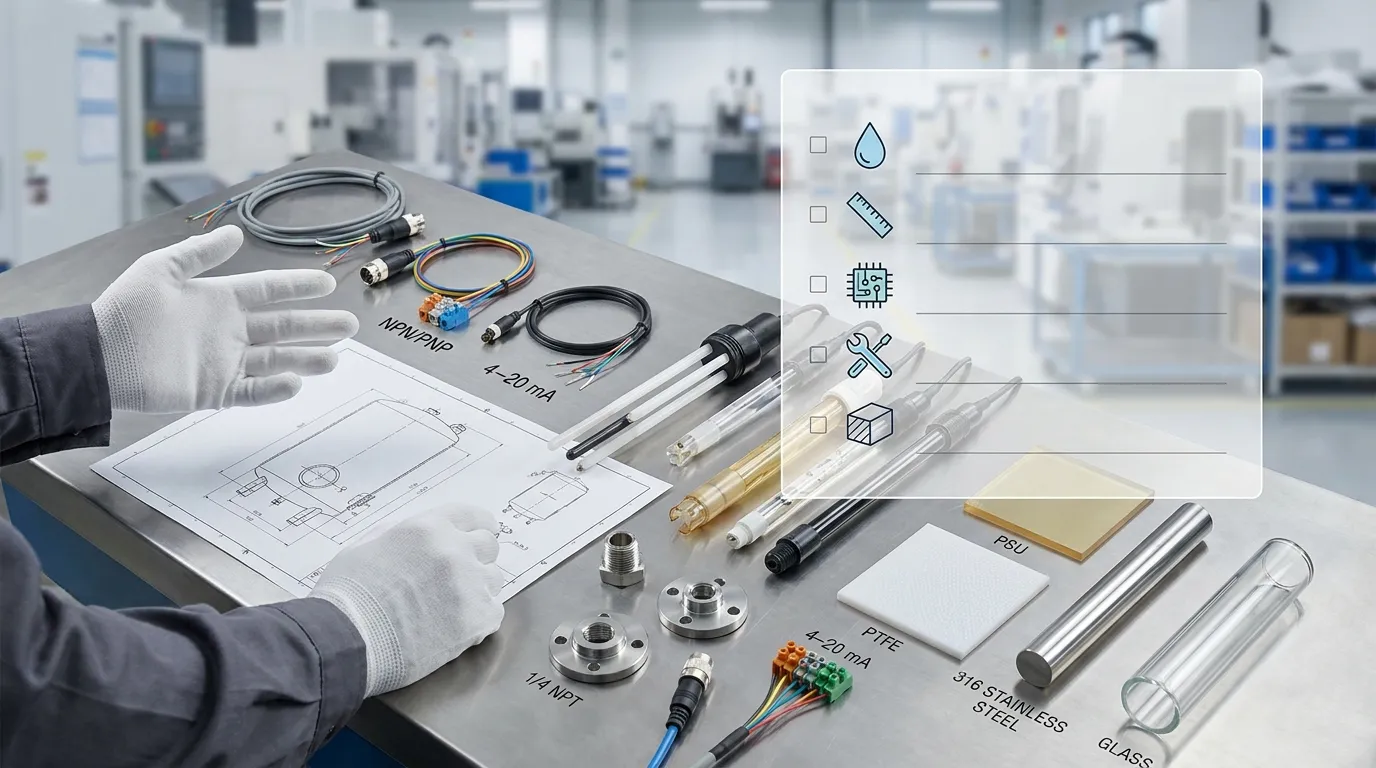
Before requesting a quote, prepare the following details:
- Level function: point alarm, multi-point indication, or continuous output
- Tank drawing: height, wall thickness, installation angle, and available mounting space
- Measurement zone: full range or only the active control section
- Liquid details: water, oil, fuel, chemical, foam risk, bubbles, viscosity, coating, and transparency
- Wetted material: PSU, PTFE, 316 stainless steel, glass, or other material based on chemical contact
- Mounting style: threaded body, panel mount, side mount, top mount, 1/4 NPT, flange, or custom housing
- Output requirement: NPN, PNP, 4–20 mA, voltage, pulse, RS485, or custom digital output
- Electrical details: supply voltage, cable length, connector, wire colors, and controller input
- Operating environment: cleaning method, vibration, condensation, splashing, and temperature conditions
- Project stage: prototype, replacement, new OEM design, or production sourcing
5-Step Custom Service Process
- Enquiry review
Share drawings, liquid details, target level range, output needs, and installation method. - Specification and customization
Our engineering team confirms sensing structure, wetted material, mounting, cable, connector, and signal type. - Sample preparation
A sample can be prepared for fit, wiring, and liquid testing before mass production. - Production and QC
The factory checks optical response, wiring, assembly quality, and consistency based on the approved sample. - Shipping support
We support export buyers in the US, EU, India, and other markets with packing and shipping coordination.
Why Choose HojellyTek
HojellyTek is a Shenzhen optical and liquid level sensor manufacturer with in-house R&D, photoelectric sensing experience, and OEM/ODM customization support. Instead of forcing every buyer into a standard point switch, we help review whether your product needs a point sensor, multi-point array, or continuous-level signal design.
Buyers can also review our optical level sensor product page before sending drawings or application details.
FAQ
Is an optical continuous level sensor the same as an optical point switch?
No. An optical point switch detects liquid at one fixed position. An optical continuous level sensor or multi-point design gives level feedback across a range or several height zones.
Can optical level sensing provide 4–20 mA output?
Yes, 4–20 mA can be specified for projects that need variable level feedback. The sensing range, signal scaling, wiring, and controller input should be confirmed during RFQ.
When should I use a multi-point optical array?
Use a multi-point array when you need several fixed level stages, such as low, medium, and high, but do not need a fully smooth continuous transmitter signal.
Which wetted material should I choose?
PSU is common for many water-based uses. PTFE, 316 stainless steel, or glass may be considered for chemicals, oils, fuels, high cleanliness requirements, or more demanding liquid contact.
What can cause optical level sensing problems?
Common risks include dirty prism tips, coating liquid, foam, bubbles, condensation, poor mounting position, incompatible material, incorrect wiring, or choosing a point switch when the process needs continuous feedback.
How do I request a custom optical level sensor quote?
Send your tank drawing, liquid type, measurement range, output signal, mounting method, voltage, cable requirement, and expected application. You can request a quote by WhatsApp or email.
Request a Quote
Need continuous level feedback instead of a simple on/off signal? Send your drawing, liquid details, required output, and installation plan to HojellyTek. Our team can help you choose between a point optical switch, multi-point optical array, or continuous optical level sensing solution for your OEM or industrial project.
