
High-Temperature Optical Liquid Level Sensor
HojellyTek manufactures photoelectric liquid level sensing solutions in Shenzhen for OEM/ODM and industrial buyers who need material guidance before ordering samples or production batches.
High-Temperature Optical Level Sensing Capabilities
Our high-temperature optical level sensor service covers point level detection for hot-media applications where float switches may jam, absorb residue, or wear mechanically. The sensor uses an infrared LED, phototransistor, and optical prism tip to detect whether the prism is dry or covered by liquid.
In the dry state, infrared light reflects internally inside the prism and returns to the receiver. When liquid covers the prism, the refractive condition changes, light is redirected into the liquid, and the output changes state. This makes optical sensing useful for high-level alarm, low-level alarm, dry-run protection, coolant tank level detection, oil reservoir monitoring, and compact OEM tank integration.
Depending on the project, we support:
- Photoelectric point level sensing for hot liquid detection
- PSU, 316 stainless steel, glass, PTFE, and mixed-material structures
- NPN, PNP, and digital switch output options
- 4–20 mA discussion for continuous level or transmitter-based projects
- Threaded, compact, side-mount, bottom-mount, and customized mounting structures
- OEM cable length, connector, output logic, and housing design
- Sample testing before mass production for hot-media applications
For general optical point level selection, see our optical level sensor range.
The Real Failure Risk: Plastic Prisms and Seals Above Rating
High-temperature buyers usually ask for the maximum temperature first. That is understandable, but a single “max temperature” number can be misleading if it only describes one part of the sensor.
A plastic prism may survive a short hot splash but deform during continuous immersion. A seal may harden, swell, or lose compression before the metal housing fails. A cable jacket may crack near a hot tank wall even if the sensor tip is still functional. Potting compound, adhesive, connector plastic, and internal electronics can also become the real limit.
For this reason, HojellyTek does not recommend selecting a hot-liquid sensor by body material alone. A stainless steel body does not automatically mean the cable, seal, optical window, and electronics share the same ceiling. A glass tip can handle harsher media than many plastics, but the assembly still needs a confirmed seal and cable design.
The safe way to specify a hot-media optical sensor is to confirm:
- Normal continuous liquid temperature
- Maximum peak temperature
- How long peak temperature lasts
- Whether the sensor tip, thread, cable, or connector is exposed to heat
- Whether the liquid is water, coolant, oil, chemical solution, or mixed media
- Whether pressure, vibration, foam, bubbles, or cleaning cycles are present
Temperature Ceiling by Material: PSU vs 316SS vs Glass/PTFE
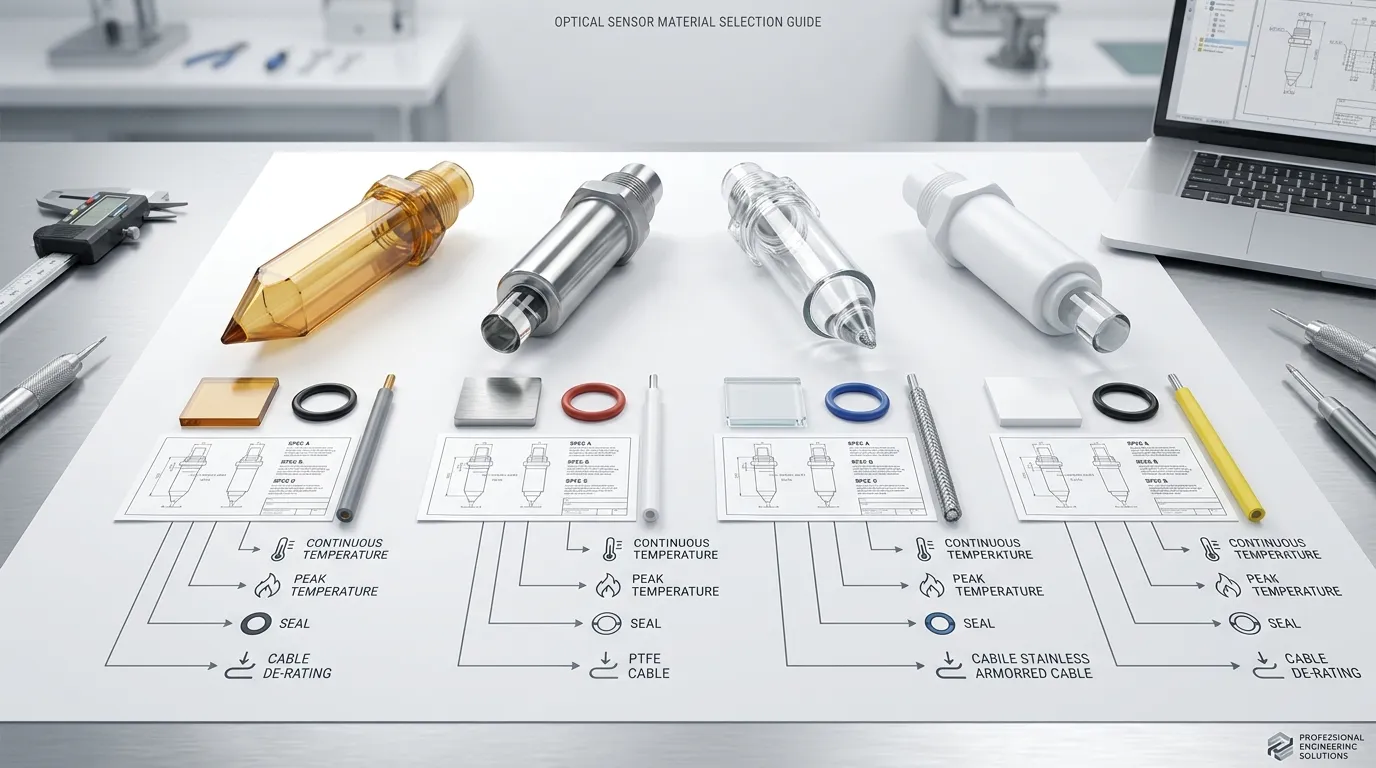
For high-temperature optical liquid level sensor projects, the “real ceiling” must be confirmed from the complete sensor build, not assumed from one raw material. The table below is designed for buyer selection, not as a published temperature claim.
| Sensor Material / Construction | Best Fit | Temperature-Rating Guidance | Main Risk to Check |
|---|---|---|---|
| PSU plastic optical prism or body | Compact OEM tanks, water-based liquids, lower-cost projects | Suitable only when the confirmed continuous and peak rating of the exact part matches the application. Do not assume “engineering plastic” means safe for all hot tanks. | Prism softening, cracking, swelling, seal stress, long-term deformation |
| 316 stainless steel housing with optical tip | Hot coolant, oil, industrial tanks, stronger mechanical protection | Body durability is stronger than plastic, but the actual ceiling depends on the optical tip, seal, cable, and internal assembly. | Seal aging, cable de-rating, heat transfer to electronics |
| Glass optical sensing tip | Hot water, oils, chemicals, and applications where plastic prism compatibility is a concern | Often selected when buyers need a more stable optical interface than plastic. The real ceiling must still be confirmed by full assembly design. | Glass-to-metal sealing, shock, installation stress, cable exposure |
| PTFE wetted parts with glass sensing area | Chemical media, corrosive liquids, applications needing low surface adhesion | PTFE may improve chemical compatibility, but chemical resistance and temperature rating must be checked separately. | Seal compatibility, mechanical rigidity, media permeation, cable limit |
| Mixed custom assembly | OEM tanks with strict space, wiring, and media requirements | Best handled as an RFQ-based design where material, seal, cable, output, and mounting are specified together. | One component in the assembly becoming the limiting point |
For buyers who need a non-plastic sensing face, our glass optical sensor page is a useful reference. For harsher industrial housings, review the 316 stainless optical sensor option.
Continuous Temperature vs Peak Temperature
Continuous temperature is the temperature the sensor must survive during normal operation for long periods. Peak temperature is a short event, such as startup heat, cleaning, flushing, or temporary overheating.
This distinction matters because many failures do not happen instantly. A plastic prism may pass a short bench test but slowly craze after weeks in hot coolant. A seal may pass room-temperature leak testing but lose elasticity after repeated heating and cooling. Cable insulation may remain flexible at first, then harden and crack after long exposure near a tank wall.
When sending an RFQ, do not write only “high temperature.” Send the continuous operating temperature, maximum peak temperature, peak duration, and whether the sensor is immersed continuously or only exposed during filling. If the application includes CIP cleaning, steam, hot detergent, oil additives, or glycol coolant, include that information before sample selection.
Cable Rating, Connector De-Rating, and Installation Heat
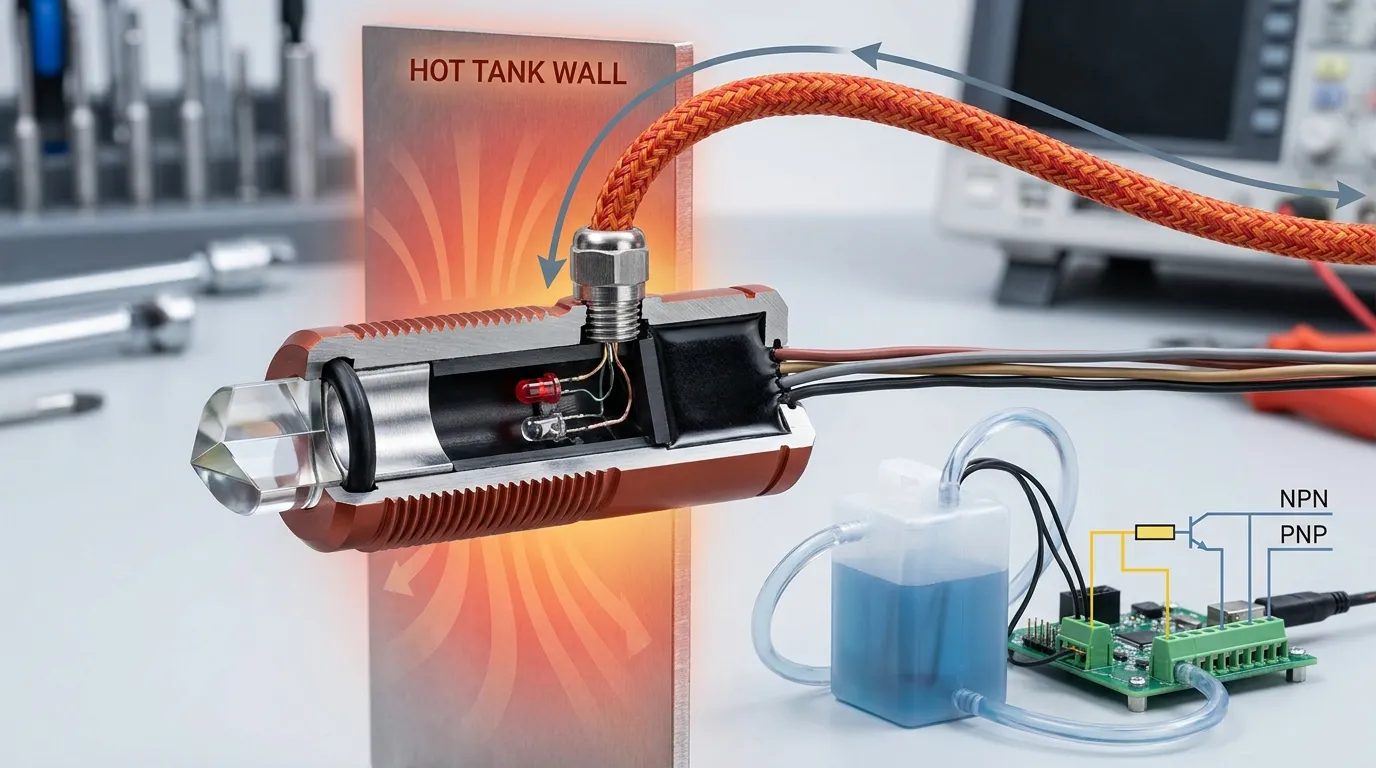
In hot tanks, the sensor tip is not the only exposed part. Cable routing can decide whether the project succeeds.
A cable rated for normal ambient conditions may fail if it touches a hot metal tank, runs beside a heater, or exits through a hot enclosure. The cable may need higher-temperature insulation, extra strain relief, a cooler routing path, or a metal body design that reduces direct heat transfer to the cable entry.
Connector selection also matters. M8, M12, plug-in connectors, flying leads, and custom harnesses have different heat limits. If the connector sits outside the hot zone, the design may be easier. If the connector is close to the tank wall, the connector material and sealing must be checked together.
For high-temperature applications, buyers should confirm:
- Cable jacket material and heat exposure area
- Distance from hot tank wall to connector
- Whether the cable is fixed, flexing, or exposed to vibration
- Whether oil, coolant, or cleaning chemical contacts the cable
- Whether output wiring uses NPN, PNP, or another control interface
- Whether the control board needs normally open, normally closed, high-in-liquid, or low-in-liquid logic
Hot-Media Application Checklist
Use this checklist before requesting a quote or sample:
| RFQ Item | What to Provide |
|---|---|
| Liquid type | Water, coolant, oil, detergent, chemical solution, or mixed media |
| Continuous temperature | Normal long-term operating temperature of the liquid |
| Peak temperature | Highest expected temperature and exposure duration |
| Mounting position | Side mount, bottom mount, top entry, or custom tank wall design |
| Wetted material preference | PSU, 316 stainless steel, glass, PTFE, or factory recommendation |
| Seal requirement | Media compatibility, pressure condition, and cleaning cycle |
| Cable exposure | Hot-zone length, connector distance, and routing environment |
| Output type | NPN, PNP, switch output, or transmitter discussion |
| Power supply | Control board voltage confirmed at RFQ stage |
| Application goal | High-level alarm, low-level alarm, dry-run protection, leak detection, or OEM tank control |
| Sample validation | Bench test, hot-liquid soak test, and installation test before production |
For hot coolant and reservoir projects, the coolant tank sensor page gives application context for compact tank monitoring.
5-Step OEM/ODM Supply Process
1. Enquiry
Send the liquid, temperature profile, mounting position, output requirement, drawing, photo, or existing part sample. Our team reviews whether a standard optical switch, stainless version, glass version, or customized structure is more suitable.
2. Spec and Customization
We confirm the practical sensor configuration: wetted material, thread, cable, output logic, connector, seal, and whether the temperature ceiling must be validated by sample testing.
3. Sample
Samples are prepared for electrical testing, immersion testing, and installation checks. For hot-media projects, we recommend testing under real liquid temperature and duty-cycle conditions.
4. Production and QC
After sample approval, production follows the confirmed drawing and specification. QC can include appearance inspection, wiring check, output function check, sealing check, and application-specific testing agreed before production.
5. Shipping
HojellyTek exports sensor products to the US, EU, India, and other markets. Shipping, packaging, labeling, and documentation can be discussed based on the buyer’s order and destination.
Requirements and Specs to Confirm Before Ordering
A reliable high-temperature optical sensor order should confirm more than the sensor body. At minimum, define:
- Sensor type: point level optical switch or continuous level project
- Wetted material: PSU, 316 stainless steel, glass, PTFE, or custom
- Output: NPN, PNP, digital switch output, or 4–20 mA discussion
- Output logic: active in liquid or active in air
- Mounting: thread, flange, side wall, bottom mount, or compact OEM structure
- Cable: length, jacket material, connector, and heat exposure
- Seal: compatibility with liquid and temperature cycle
- Electrical integration: supply voltage, load, controller, PLC, or PCB input
- Media behavior: foam, bubbles, coating, oil film, residue, color, or viscosity
- Validation plan: sample test conditions before batch production
Material and Application Comparison
| Application Situation | Better Starting Option | Why |
|---|---|---|
| Compact plastic tank with warm liquid | PSU optical sensor if confirmed suitable | Cost-effective and compact, but must stay inside the real material and seal rating |
| Hot coolant reservoir | 316 stainless or glass-tip design | Better choice where heat, additives, and vibration are concerns |
| Hot oil tank | Stainless housing with suitable optical tip and cable | Oil compatibility, cable jacket, and seal material must be checked carefully |
| Corrosive hot chemical | Glass/PTFE discussion | Chemical resistance and temperature must both be validated |
| Buyer only knows “hot liquid” | RFQ-based material selection | The factory needs media, continuous temperature, peak temperature, and mounting details before quoting safely |
Why Choose HojellyTek
HojellyTek is a Shenzhen manufacturer and exporter focused on photoelectric optical liquid level sensing. We support in-house R&D, OEM/ODM customization, compact sensor structures, industrial material selection, and application-based sample validation.
Buyers work with us when they need a practical factory-direct sensor partner rather than a catalog-only supplier. We can help compare PSU, 316 stainless steel, glass, and PTFE options, adjust cable and output details, and support OEM integration for tanks, appliances, industrial equipment, coolant systems, and smart liquid monitoring products. Tuya and Smart Life integration can also be discussed where the project requires connected liquid monitoring instead of a simple wired switch.
FAQ
What is the real maximum temperature of a high temperature optical liquid level sensor?
The real maximum temperature depends on the complete assembly: prism, housing, seal, cable, connector, potting, and liquid compatibility. We do not recommend choosing by one headline number. Send your continuous and peak temperature requirements so the correct ceiling can be confirmed.
Is continuous temperature different from peak temperature?
Yes. Continuous temperature is long-term normal exposure. Peak temperature is a short event. A sensor may survive a short peak but fail in continuous immersion if the prism, seal, or cable is not rated for that duty cycle.
Which material is best for hot liquid: PSU, 316 stainless steel, glass, or PTFE?
PSU can suit compact OEM applications when confirmed within rating. 316 stainless steel improves mechanical durability. Glass is often preferred when plastic compatibility is a concern. PTFE is useful for chemical compatibility, but temperature and sealing still need confirmation.
Can optical level sensors work in hot coolant tanks?
Yes, optical sensors can be used for coolant level detection when the material, seal, cable, and output are selected correctly. Coolant additives, temperature cycle, vibration, and mounting position should be shared before sample selection.
Are optical sensors continuous level sensors?
Most optical prism sensors are point level switches. They detect whether the tip is dry or wetted. If your project needs continuous measurement or 4–20 mA output, discuss a separate continuous level or transmitter-based solution.
What should I send before requesting a quote?
Send liquid type, continuous temperature, peak temperature, mounting method, tank material, thread requirement, cable length, connector type, output type, and target order quantity. Photos, drawings, or an existing sensor sample are also helpful.
Request a Quote
For a high-temperature optical liquid level sensor, the safest first step is to confirm the real ceiling of the complete sensor assembly before ordering. Send your hot-media checklist, tank drawing, and wiring requirement to HojellyTek by WhatsApp or email, and our team will recommend a suitable material, output, cable, and sample plan.


