
5V Optiese Infrarooi Watervlaksensor (Laestroommodule)
Die 15ma 5V optiese infrarooi watervloeistofvlaksensor is 'n lae-stroom foto-elektriese puntvlaksensormodule vir watertenks, Klein reservoirs, Toestelle, Toetstoerusting, en MCU-gebaseerde vloeistofopsporingsisteme. Kopers verifieer gewoonlik eers vier items: 5V GS-toevoer, ongeveer 15mA stroomverbruik, NPN oopversamelaar-uitset, en direkte MCU-insetversoenbaarheid. HojellyTek voorsien optiese watervlaksensors van Shenzhen met OEM/ODM-ondersteuning vir behuisingsmateriaal, Kabel, Konnektor, Montering, en uitsetkonfigurasie.
Lae-stroom 5V optiese watervlaksensorvermoëns
Hierdie 5V infrarooi optiese watervlaksensor is ontwerp vir enkelpunt-vloeistofteenwoordigheidsopsporing. Dit meet nie die aaneenlopende tenkhoogte nie; Dit bevestig of vloeistof die sensorpuntposisie bereik het. Vir kopers wat 'n standaard vergelyk optiese vlaksensor met 'n kompakte PCB-vriendelike module, Die sleutelwaarde is vinnig, Kontaklose optiese skakeling by 'n gedefinieerde vlakpunt.
Tipiese projekgebruiksgevalle sluit in:
- Watertenk laevlak- of hoëvlakopsporing
- Beskerming van klein toestelreservoirs
- Slim dispenser- en humidifiseerdervloeistofopsporing
- Laboratoriumtoestel vloeistofteenwoordigheidswaarneming
- Pomp-droogloopbeskermingsinset
- Ingebedde MCU-wateropsporingsmodules
- OEM slim tenkprodukte wat gateway gebruik., Wifi, Tuya/Slim Lewe, of plaaslike beheerderlogika
Die module is geskik wanneer die beheerbord reeds op 5V-logika werk en die koper 'n lae-stroom sensorinset wil hê sonder om 'n relais by te voeg, Vlotarm, of meganiese bewegende deel.
Elektriese spesifikasies wat kopers eers verifieer
Vir hierdie produktipe, Die belangrikste koopbesluit is nie die voorkoms van die sensor nie; dit gaan daaroor of die elektriese uitset ooreenstem met die beheerder. 'n Lae-stroom 5V optiese infrarooi sensor word gewoonlik gekies omdat dit van dieselfde gereguleerde 5V-rail as die MCU-bord aangedryf kan word.
| Elektriese Item | Spesifikasie / Koper Tjek |
|---|---|
| Toevoerspanning | 5V GS |
| Huidige trekking | Ongeveer 15mA |
| Waarnemingsmetode | Infrarooi foto-elektriese optiese sensing |
| Uitsettipe | NPN oopversamelaar-uitset |
| Beheerderversoenbaarheid | Direkte MCU-invoer is versoenbaar wanneer pull-up en logikavlak korrek ontwerp is |
| Opsporingsmodus | Puntvlak-nat/droog deteksie |
| Seingebruik | Digitale vlakinvoer vir alarm, Pompbeheer, Tenkstatus, of ingebedde logika |
| Bedradingkontrole | Bevestig VCC, GND, en seinlyn voordat die sensor van krag voorsien word |
Die NPN oopversamelaar-uitset is veral belangrik. Dit is nie dieselfde as 'n stoot-trek uitset nie. In baie MCU-kringe, Die uitsetlyn benodig 'n trek-op na die beheerder se logika-spanning. Wanneer die sensor skakel, Die uitsettransistor trek die seinlyn laag of laat dit vry, afhangend van die nat/droë toestand en stroombaanontwerp. Voor bestelling, Kopers moet die verwagte uitsetlogika met die beheerbord se firmware bevestig.
Vir 'n praktiese verduideliking van mikrobeheerderbedrading, Gebruik ons Arduino optiese sensorgids. Hierdie produkbladsy fokus op spesifikasie-keuse, nie Arduino-programmering nie.
Hoe die infrarooi optiese punt water opspoor
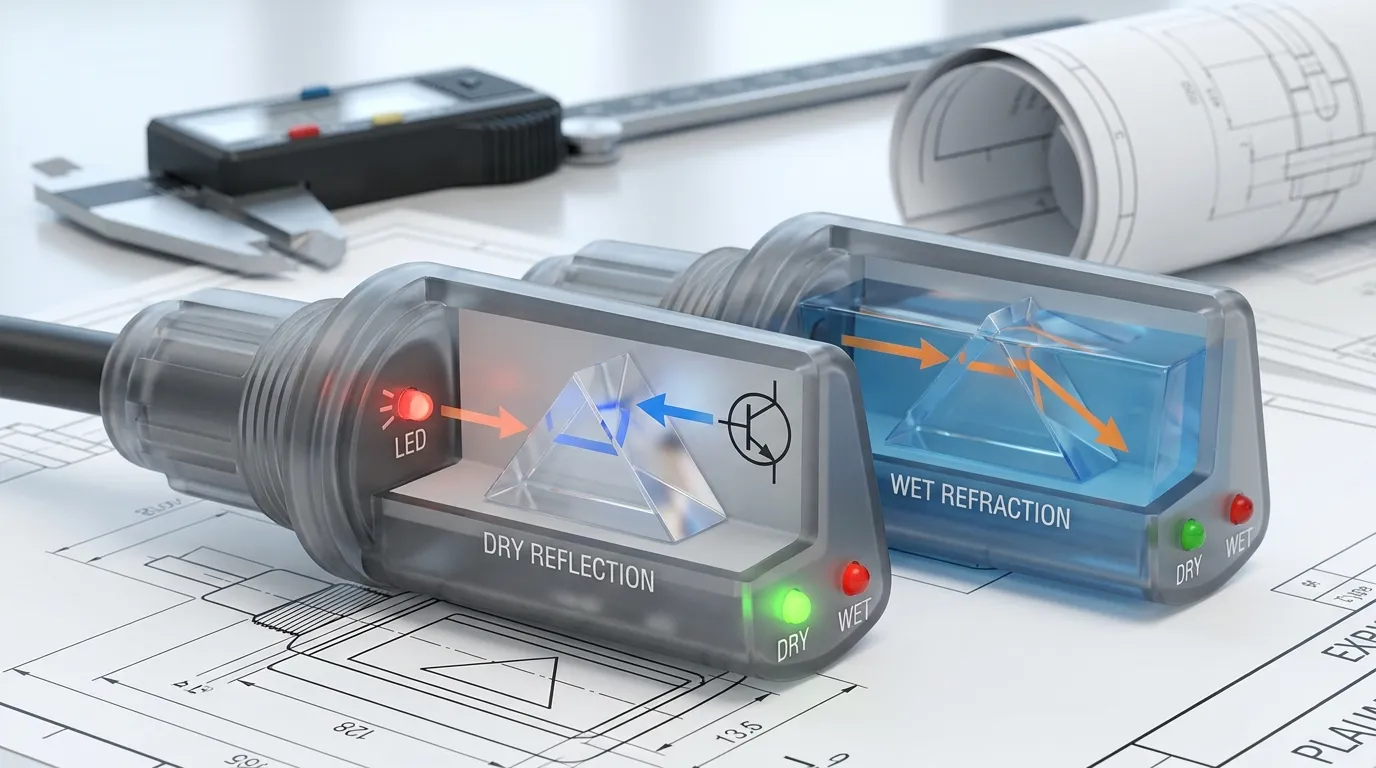
Die sensorbeginsel gebruik 'n infrarooi LED, 'n fototransistorontvanger, en 'n deursigtige optiese prismapunt. In die droë toestand, Infrarooi lig weerkaats intern binne die prisma en keer terug na die ontvanger. Wanneer die prisma deur vloeistof bevochtig word, Die brekingstoestand verander, dus keer minder lig terug na die ontvanger. Die stroombaan omskakel daardie optiese verandering in 'n elektriese uitset.
Dit is hoekom optiese sensors verskil van vlotskakelaars. Daar is geen magneet nie, Reed-skakelaar, Skarnier, of bewegende drywer. Die sensor reageer op die optiese toestand aan die punt. Dit maak dit nuttig in kompakte tenks, Nou ruimtes, en toerusting waar 'n bewegende vlot kon vassteek, Stok, of lawaaierig raak.
Nietemin, Die koper moet die opsporingsvloeistof nagaan. Skoon water is die mees algemene teiken vir hierdie 5V-module, Maar vloeistowwe in die regte wêreld kan anders optree. Skuim, Borrels, Swaar skaal, Dikke oliefilms, kondensasie, of klewerige residu op die optiese punt kan die opsporing vertraag of versteur. As die vloeistof nie skoon water is nie, Deel die medium naam, Temperatuurtoestand, Skoonmaakmetode, en of residu verwag word.
Dimensies, Huismateriaal en Monteringskeuses
Kompakte 5V optiese watervlakmodules word dikwels gebruik waar ruimte beperk is. Afmetings moet bevestig word uit die produktekening voor aankoop omdat die tenk se wanddikte is, Draadlengte, Kabeluitgangsrigting, en die seëlarea beïnvloed almal die installasie.
HojellyTek kan optiese sensorstrukture vir verskillende OEM-projekte ondersteun, insluitend plastiek-lyfmodules, Kompakte sensorkoppe, en pasgemaakte kabelsamestellings. Vir baie stywe toerustinguitlegte, Kopers kan ook ons hersien Mikro-optiese sensor Opsies.
Algemene keuses van natgemaakte materiaal sluit in:
- PSU-behuising vir algemene water- en toesteltoepassings
- PTFE-liggaam vir chemies aggressiewe vloeistofomgewings
- 316 Vlekvrye staal behuising vir sterker meganiese beskerming of industriële tenks
- Glassensorpunt vir gekose hoë-netheid of spesiale mediavereistes
Materiaalkeuse moet die vloeistof volg, Skoonmaakchemikalie, Temperatuurblootstelling, Meganiese spanning, en seëlmetode. 'n Laestroom 5V elektriese ontwerp beteken nie outomaties dat dieselfde behuizing vir elke vloeistof werk nie.
Paneel- en inlynmonteringsnotas
Paneelmontering is die mees algemene benadering. Die sensorpunt gaan deur 'n tenkmuur of paneelopening, en die optiese punt is op die vereiste vlakpunt geplaas. Die koper moet bevestig:
- Sensorpuntrigting
- Tenkwanddikte
- Draad- of sluitmoer-vereiste
- Seëlposisie
- Kabeluitgangsrigting
- Of die sensor van binne of buite die tenk geïnstalleer is
- Of die vloeistofvlak stadig styg, Spatsels, of skep skuim naby die senseringspunt
Inline-montering is anders. In plaas daarvan om direk in 'n tenkmuur gemonteer te word, Die sensor kan in 'n klein vloeistofpad geplaas word, Buis, Kamer, of deursigtige/ondeursigtige vloei-afdeling. Vir inlyngebruik, Die koper moet 'n tekening van die vloeistofpad voorsien sodat die fabriek kan hersien of die optiese punt ten volle aan die vloeistof blootgestel sal wees en of vasgevangde lugborrels die opsporing kan beïnvloed.
Vinnige Toetslys Voor Produksiegebruik
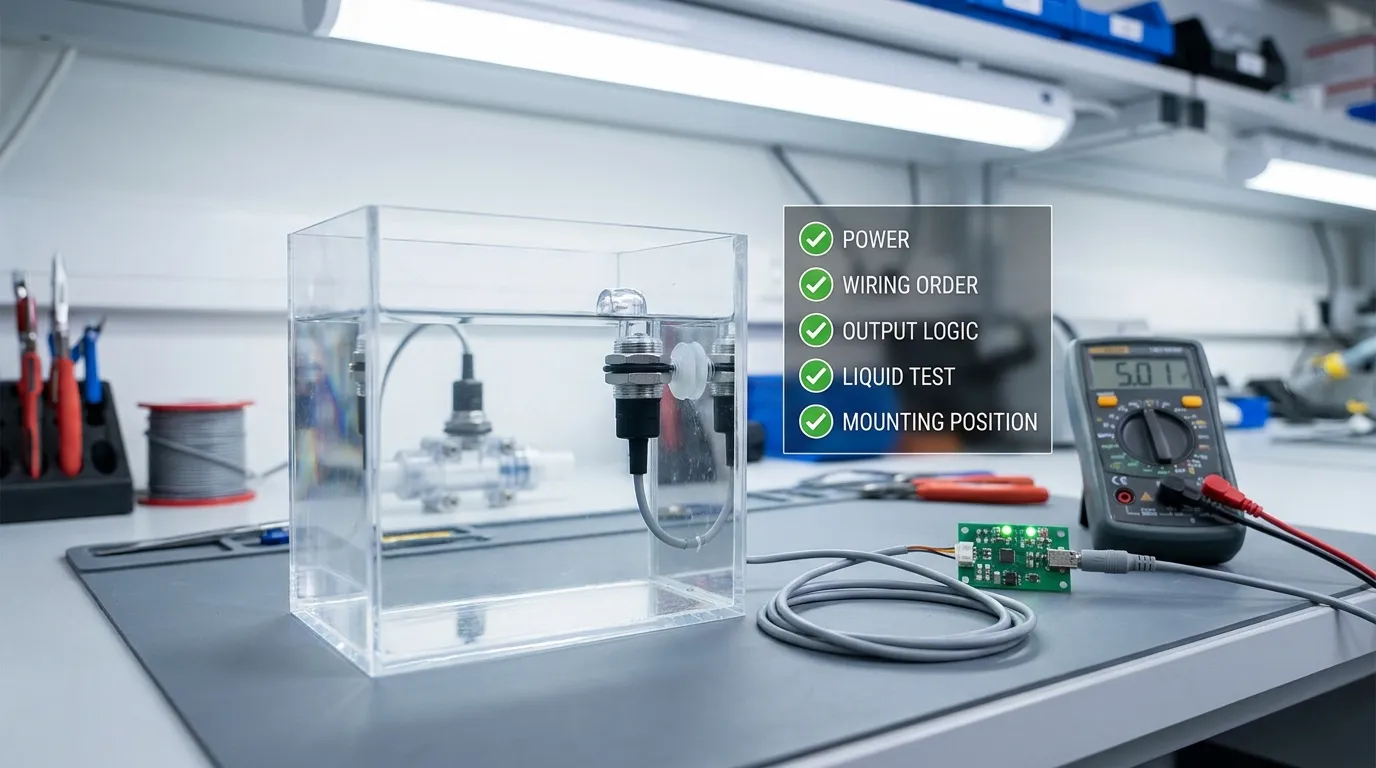
Voor oorgang na bondelproduksie, Toets die module met die regte beheerbord en die regte vloeistoftoestand.
- Bevestig eers krag
Voorsien die sensor van stabiele 5V gelykstroom en verifieer dat die stroomverbruik geskik is vir die beheerder se kragbegroting. - Kontroleer die bedradingvolgorde
Bevestig VCC, GND, en NPN-seinuitset voor aansluiting. Verkeerde bedrading kan die module beskadig of verkeerde uitset veroorsaak. - Verifieer uitsetlogika
Toets droë toestand en nattoestand met 'n multimeter of MCU-inset. Bevestig of die firmware aktief-laag of aktief-hoog gedrag verwag. - Toets die werklike vloeistof
Moet nie net op skoon water staatmaak as die finale produk wasmiddel gebruik nie, Koelmiddel, Olie-water mengsel, Chemiese oplossing, of vloeistof met residu. - Toetsmonteringsposisie
Installeer die sensor in die werklike tenkmuur of kamerposisie. Kontroleer spat, Borrels, kondensasie, en of die optiese punt ten volle blootgestel is. - Herhaalde nat/droog siklusse laat loop
Siklus die vloeistofvlak verskeie kere om herhaalbaarheid te bevestig voordat die sensor vir produksie goedgekeur word.
5-Stap OEM-voorsieningsproses
- Navraag
Stuur die teikenvloeistof, Toevoerspanning, Uitsettipe, Monteringsmetode, Voorkeur vir kabellengte, en toepassingsfoto's of tekeninge. - Spesifikasie- en aanpassingsresensie
Ons span bevestig die 5V, ongeveer 15mA, NPN se oopversamelaarvereiste en hersien behuisingsmateriaal, Konnektor, Seël, en installasiebeperkings. - Steekproefbevestiging
Monster-eenhede kan vir elektriese voorberei word, Vloeibare, en meganiese pastoetsing voor bondelgoedkeuring. - Produksie en kwaliteitsbeheer
Die fabriek kontroleer die elektriese funksie, optiese reaksie, Bedrading, Behuisingstoestand, en kliënt-spesifieke konfigurasie. - Uitvoer- en skeepsondersteuning
HojellyTek voer optiese vloeistofvlaksensors na die VSA uit, ONS, Indië, en ander markte met ondersteuning deur WhatsApp en e-pos.
Bestellingsvereistes om met die fabriek te deel
Om die korrekte weergawe aan te haal, Stuur hierdie besonderhede:
| Vereiste | Waarom dit saak maak |
|---|---|
| Vloeistoftipe | Bevestig die betroubaarheid van optiese opsporing en natgemaakte materiaal |
| Toevoerspanning | Hierdie bladsy fokus op 5V GS-modules |
| Huidige begroting | Bevestig geskiktheid vir ongeveer 15mA sensortrek |
| Uitsetvereiste | NPN oop versamelaar is standaard vir hierdie keuse; PNP of 4–20 mA kan vir ander projekte hersien word |
| Monteringsstyl | Paneel, Tenkmuur, Kamer, of inlyninstallasie |
| Behuisingsmateriaal | PSU, PTFE, 316 Vlekvrye staal, of glasopsies hang af van die vloeistof |
| Kabel / Konnektor | Benodig vir OEM-samestelling en diensbaarheid |
| Beheerdertipe | MCU, PLC-insetbord, IoT-module, of toestelbeheer-PCB |
5V vs 12V vs Mikro Optiese Sensor Opsies
| Opsie | Beste vir | Kopernota |
|---|---|---|
| 5V lae-stroom optiese module | MCU-borde, Toestelle, Kompakte waterdeteksie | Kies wanneer 5V-toevoer en direkte digitale inset verkies word |
| 12V-optiese sensor | Industriële beheer en 12V-stelsels | Beter as die beheerkas of masjien reeds 12V krag gebruik |
| Mikro-optiese sensor | Baie klein reservoirs en stywe OEM-uitlegte | Hersien die teken- en monteerdiepte sorgvuldig |
| 316 Vlekvrye vlekvrye / PTFE-weergawes | Industriële of chemiese vloeistofprojekte | Kies gebaseer op vloeistofversoenbaarheid en meganiese omgewing |
Hoekom HojellyTek kies
HojellyTek is 'n vervaardiger en uitvoerder in Shenzhen wat fokus op foto-elektriese optiese vloeistofvlakwaarneming. Ons interne R&D-span ondersteun die keuse van sensorstruktuur., OEM/ODM-aanpassing, Kabel- en konnektor-ooreenkoms, en aansoekhersiening vir water, Toestel, Tenk, en industriële vloeistofdeteksieprojekte.
Kopers werk saam met ons wanneer hulle fabriek-direkte ondersteuning benodig, in plaas van net 'n generiese modulelys. Ons help om die elektriese koppelvlak te bevestig, Vloeistofkompatibiliteit, Monteringsbenadering, en produksietoetsvereistes voordat die bestelling gefinaliseer word.
Vrae
Is die 15ma 5V optiese infrarooi watervloeistofvlaksensor 'n deurlopende vlaksensor?
Nee. Dit is 'n puntvlaksensor. Dit detecteer of vloeistof by die optiese puntposisie teenwoordig is. Vir deurlopende tenkhoogtemeting, 'n Ander sensorstruktuur is nodig.
Kan die 5V optiese watervlaksensor direk aan 'n MCU koppel?
Ja, wanneer die MCU-insetkring ontwerp is vir 'n NPN oopversamelaarssein met die korrekte pull-up en logiese verwagting. Toets altyd nat en droë uitsettoestande voor produksie.
Watter vloeistof kan hierdie optiese infrarooi sensor opspoor?
Skoon water is die mees algemene teiken. Ander vloeistowwe moet getoets word omdat skuim is, residu, Oliefilm, Borrels, of swaar besoedeling kan die optiese puntreaksie beïnvloed.
Het die sensor 'n relais nodig??
Nie vir die meeste MCU-invoerontwerpe nie. Die NPN oopkollektor-uitset word normaalweg as 'n digitale seininset gebruik. 'n Relê is slegs nodig as die breër beheerstelsel een vereis.
Kan ek 'n ander uitsettipe bestel?
Ja. Hierdie bladsy fokus op die 5V, ongeveer 15mA, NPN oopversamelaarmodule. Vir PNP, analoog, 4–20 mA, of ander koppelvlakbehoeftes, Stuur jou kontroleerderspesifikasie vir hersiening.
Kan hierdie sensor vir inlynmontering gebruik word??
Ja, Inline gebruik kan hersien word as die vloeistofpad toelaat dat die optiese punt behoorlik met die vloeistof kontak maak. Stuur die kamer, Buis, of vloei-pad tekening voordat georden word.
Versoek 'n Kwotasie
Stuur jou vloeistoftipe, 5V-beheerder besonderhede, Uitsetlogika-vereiste, Monteringstekening, Voorkeur vir kabel of koppelaar, en geskatte bestelhoeveelheid. HojellyTek kan die spesifikasie hersien en 'n geskikte lae-stroom 5V optiese infrarooi watervlaksensor-kwotasie per WhatsApp of e-pos verskaf.


