
Optiese vlaksensor vir pomp-droogloopbeskerming
Optiese vlaksensorpomp droogloopbeskerming help om 'n pomp te stop voordat die vloeistof onder die veilige suigpunt val en brandseëls veroorsaak, beskadigde impellers, Oorverhitting, of luginlaat. HojellyTek voorsien foto-elektriese optiese vlaksensors vir kompakte, Vinnig-reaksie laevlak-afsnykringe in tenks, Reservoirs, Koelmiddelsisteme, Oliehouers, en OEM-pompsamestellings.
Gebruik hierdie bladsy om die sensor te spesifiseer, Bedradinglogika, Monteringspunt, en herstel gedrag vir 'n betroubare droogloopvoorkomingskring.
Optiese Pomp Droogloopbeskermingsvermoëns
Vir pompbeskerming, Die sensor is nie net 'n vlak-aanwyser nie. Dit word die laevlak-besluitpunt in die beheerkring: wanneer die vloeistof onder die afsnyhoogte daal, Die uitset verander toestand en die beheerder stop die pomp.
HojellyTek ondersteun droë-beskermingsprojekte wat kan insluit:
- Optiese puntvlakdeteksie by die minimum veilige vloeistofvlak
- Laevlak-afsny-uitset vir PLC, Relaisbord, Pompbeheerder, of VFD-inset
- NPN, PNP, of analoogseinopsies afhangende van die beheerstelsel
- NO/NC-logika-keuse gebaseer op foutveilige vereistes
- Kompakte prisma-punt sensors vir klein tenks en OEM-pompmodules
- Natgemaakte materiaalkeuse soos PSU, PTFE, 316 Vlekvrye staal, of glas
- Draad- of pasgemaakte montering vir tenkmuur, Reservoir-kant, of kamerinstallasie
- OEM/ODM-aanpassing vir behuising, Kabel, Konnektor, gare, en uitsetlogika
Vir 'n algemene produk-oorsig, sien ons optiese vlaksensor omvang. Vir 'n gereed produkverwysing, Hersien die Foto-elektriese vloeistofvlakskakelaar.
Hoekom die droogloop-afsluiting moet plaasvind voordat die pomp leeg loop
'n Pomp hoef nie lank droog te loop voordat skade begin nie. Wanneer vloeistof nie meer aan die suigkant teenwoordig is nie, Die pomp kan verkoeling verloor, Smeermiddel, en hidrouliese las. Die resultaat kan verbrande meganiese seëls wees, beskadigde impellers, Oorverhitte natgemaakte dele, Kavitasie, Vibrasie, of totale pompfout.
'n Droogloop-beskermingskring moet dus een praktiese vraag beantwoord:
By watter presiese vloeistofvlak moet die pomp afgedwing word?
'n Optiese vlaksensor is by daardie afsnypunt gemonteer. Wanneer vloeistof die prismapunt bedek, Die sensor sien die "nat" toestand. Wanneer vloeistof onder die punt daal, Die optiese pad verander en die uitset skakel vinnig oor. Die beheerkring verwyder dan die pompsein, Maak 'n relais oop, deaktiveer 'n VFD-inset, of stuur 'n stop-opdrag na die pompbeheerder.
Dit verskil van algemene tenkmonitering. In droogloopbeskerming, Die sensorposisie, Uitsetlogika, en herlaaigedrag moet ontwerp word rondom pompveiligheid.
Hoe die optiese sensor nat en droë toestande opspoor
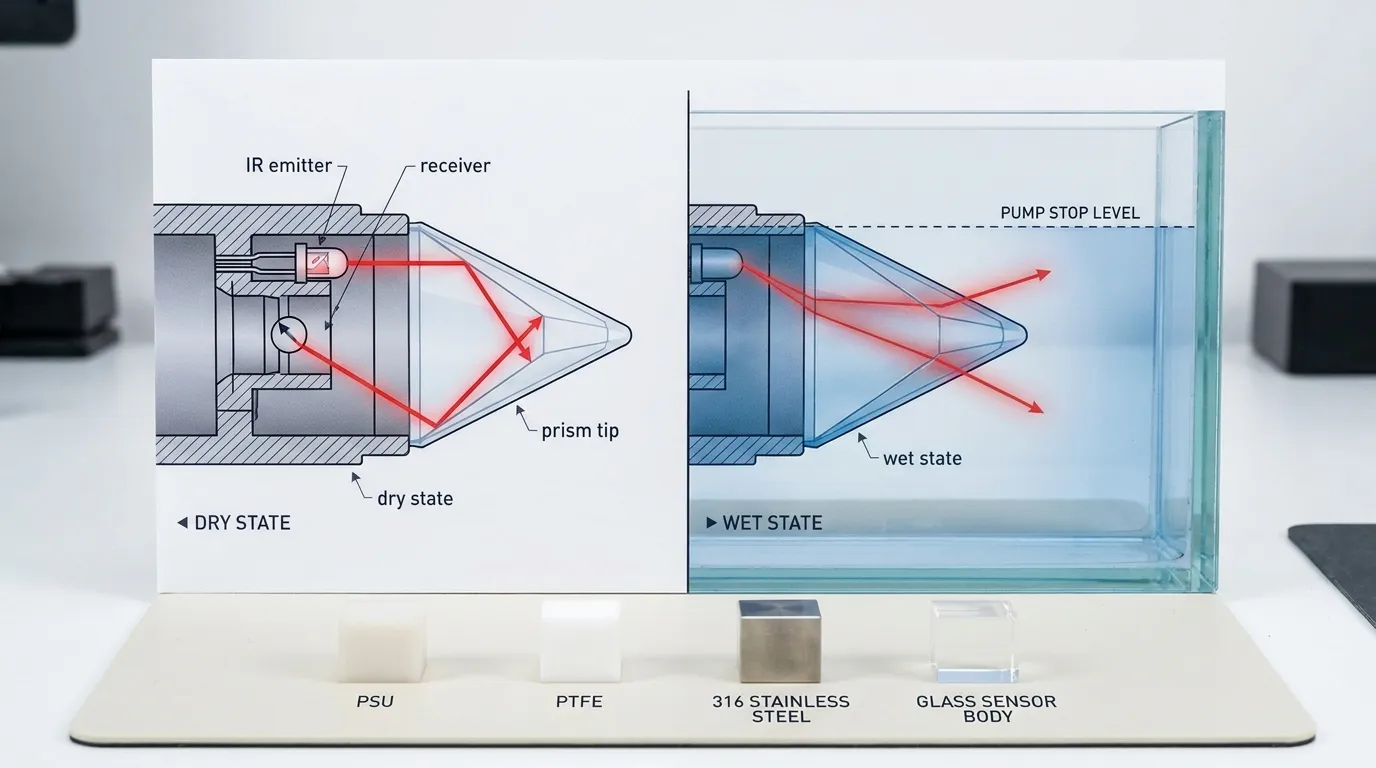
'n Foto-elektriese vlaksensor gebruik 'n infrarooi LED, 'n fototransistor, en 'n gevormde optiese prisma by die sensorpunt. In die lug, Infrarooi lig weerkaats intern binne die prisma en bereik die ontvanger. Wanneer die prisma deur vloeistof bedek is, Die brekingstoestand verander en minder lig keer terug na die ontvanger. Die elektronika omskakel hierdie optiese verandering in 'n digitale uitset.
Hierdie ontwerp het geen vlotterarm nie, magneet, Skarnier, of bewegende meganiese deel binne die vloeistof. Dit is belangrik vir pomp-afsnytoepassings waar 'n stadige, Vasgevang, of 'n gekantelde vlot kan die stopsein vertraag. Optiese sensing is veral nuttig vir kompakte reservoirs, Nou kamers, OEM-toerusting, Koelmiddeltenks, Doseringstelsels, Waterhouers, en verseëlde pompmodules waar meganiese skakelaars dalk te groot is.
'n Droogloopkring gebruik die sensor normaalweg as 'n puntvlakskakelaar. Vir verwante puntopsporingstoepassings, sien ons Puntvlakskakelaar Bladsy.
Laevlak-afsnybedrading vir pompbeheer
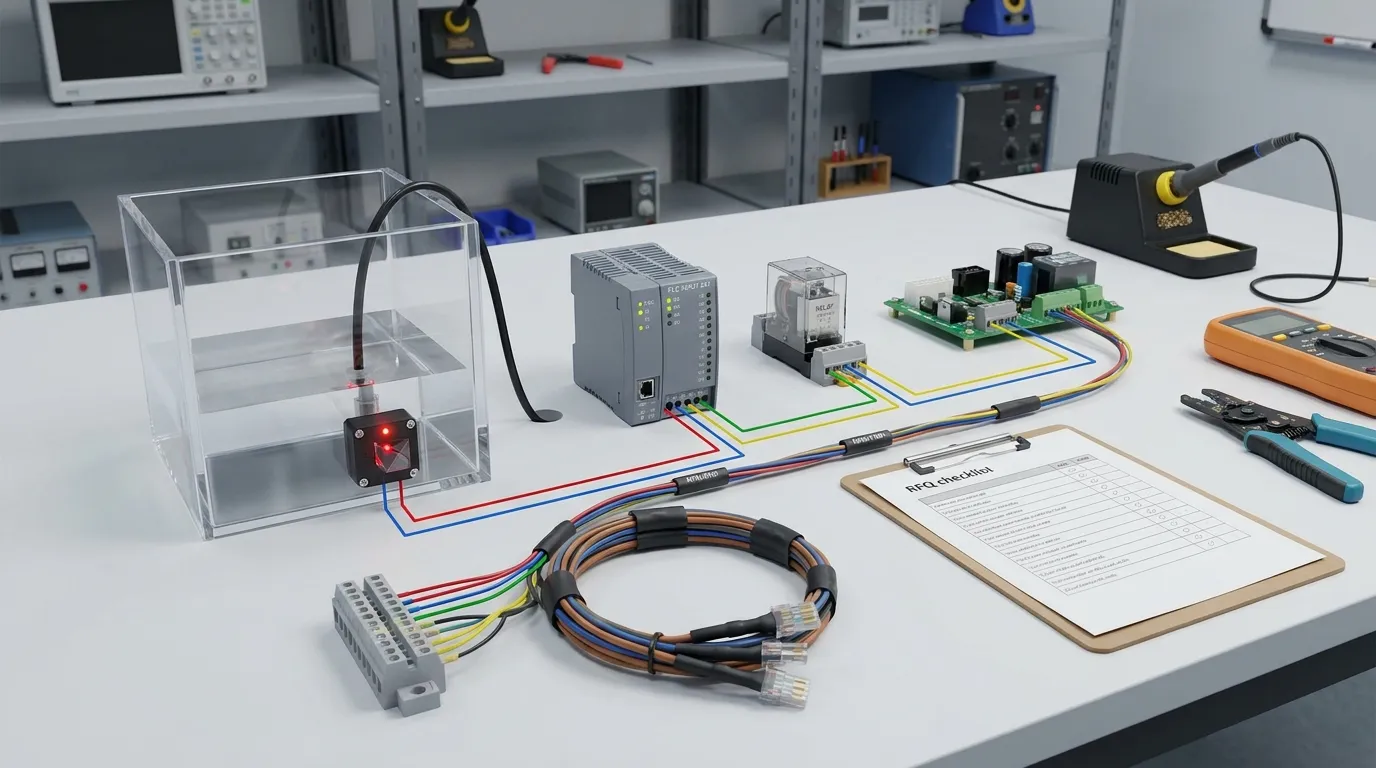
Die sensoruitset moet by die beheerinset aangepas word, nie net deur sensorvorm gekies nie. Voor bestelling, Bevestig of jou pompstelsel 'n relaisspoel gebruik, PLC digitale inset, VFD droë kontak-invoer, Transistor-inset, of pasgemaakte PCB.
Algemene beheerreëlings sluit in:
- Sensor na PLC-inset: die PLC lees die nat/droë toestand en beheer die pompkontaktor of VFD.
- Sensor na relaismodule: Die sensor dryf 'n relê aan wat die pomp-aktiveringskring oopmaak.
- Sensor na pompbeheerder: die beheerder ontvang 'n laevlak-alarm of looppermitsein.
- Sensor na VFD-inset: Die droogloopsein deaktiveer die werking van die dryf of aktiveer 'n foutinset.
- Sensor na OEM-PCB: Die sein word direk deur die produkbeheerbord gelees..
Die veiligste ontwerp is gewoonlik 'n "run permit"-logika. Die pomp mag slegs loop wanneer die sensor bevestig dat vloeistof teenwoordig is. Wanneer die sensor droog raak, Die hardlooppermit word verwyder.
Bedradinglogika-tabel vir droogloopbeskerming
| Vloeibare toestand by sensorpunt | Sensor-uitsetlogika | Beheerderinterpretasie | Pompaksie | Beste gebruiksgeval |
|---|---|---|---|---|
| Nat / vloeibare teenwoordigheid | Looppermitsein aktief | Veilige vloeistofvlak beskikbaar | Pomp toegelaat om te loop | Standaard laevlakbeskerming |
| Droog / Vloeistof onder die punt | Permitsein verwyder | Drooglooprisiko opgespoor | Pomp stop of kan nie begin nie | Fail-safe pomp-afsnypunt |
| Nat na hervulling | Sein weer aktief | Vloeistof herstel | Outo-herstel of handmatige herstel afhangende van logika | Eenvoudige reservoirs of beheerde hervulstelsels |
| Droog met grendel geaktiveer | Trip bly aktief | Skuld moet erken word | Pomp bly AF | Hoëwaarde-pompe, Chemiese dosering, Onbewaakte stelsels |
| Nat/droë onstabiele naby golflyn | Sein kan herhaaldelik verander | Chatter-risiko | Gebruiksvertraging, Hysterese, Of stilhoubuis | Opgewonde tenks of klein kamers |
| Sensor-/kabelfout | Die sein hang af van die bedradingontwerp | Fout of geen ritpermit nie | Die pomp moet stop in 'n foutveilige ontwerp | Kritieke pompbeskermingskringe |
Vir die meeste droogloop-toepassings, Spesifiseer die verlangde nat/droë uitsettoestand duidelik. Die fabriek kan help om NPN te ewenaar, PNP, NEE / NC, of analooguitset na jou kontroleerderontwerp.
Vinnige optiese reaksie vs stadige vlotskakelaars
Vlotskakelaars is algemeen, Maar hulle is nie altyd ideaal vir pomp-droogloopbeskerming nie. 'n Vlot het fisiese beweging nodig, Ruimte om te swaai, en korrekte oriëntasie. In klein tenks, olierige vloeistof, Nou pompkamers, of toerusting met vibrasie, Die drywer kan stadig reageer of vassteek.
'n Optiese sensor reageer direk by die sensorpunt. Wanneer die vloeistof die prisma ontbloot, Die optiese toestand verander sonder om te wag dat 'n dryfarm val. Dit maak die afsnypunt meer herhaalbaar en kompakt.
Optiese droogloop-sensing is nuttig wanneer die koper dit nodig het:
- 'n Presiese laevlak-afsnyhoogte
- Kompakte montering binne 'n klein reservoir
- Vinnige skakeling op die minimum veilige vlak
- Geen bewegende dele in die vloeistof nie
- OEM-vriendelike behuising en kabelaanpassing
- Skoner seinintegrasie met 'n PCB, PLC, of pompbeheerder
Nietemin, Die sensor moet steeds korrek gekies wees. Skuimende vloeistof, Swaar laag, Kristallisasie, of dik residu mag materiaalkeuse vereis, Puntplasing, Skoonmaaktoegang, of 'n bykomende beskermingsmetode.
Grendel, Vertraging, en Outo-Reset Logic
Die sensoruitset is slegs een deel van die beskermingstelsel. Die beheerlogika bepaal wat gebeur nadat 'n droë toestand opgespoor is.
Outo-herstellogika laat die pomp toe om te herbegin nadat vloeistof bo die sensorpunt teruggekeer het. Dit kan werk vir eenvoudige watertenks, Hervulreservoirs, of stelsels waar herbegin veilig en verwag word.
Sluitlogika hou die pomp AF na 'n droë rit totdat 'n operateur of beheerder die fout herstel. Dit is beter vir duur pompe, Chemiese stelsels, Industriële dosering, Onbewaakte toerusting, of stelsels waar herhaalde droë aanvang skade kan veroorsaak.
Vertraginglogika Voorkom hinderlike uitslae van golwe, gespat, Borrels, of oombliklike vloeistofbeweging rondom die sensor. 'n Kort beheerdervertraging kan bevestig dat die sensor werklik droog is voordat die pomp gestop word. 'n Herbeginvertraging kan ook kort siklusse na hervul voorkom.
Die bladsy se onderwerp is nie pomponderhoud nie; Die sleutelpunt is beheerontwerp: bepaal of die droë uitset die pomp onmiddellik moet stop, Stop na 'n geverifieerde vertraging, Sluit tot handmatige herstel, of outomaties terugstel nadat die nat sein terugkeer.
Montering van die sensor by die afsnypunt
Die sensor moet by die minimum veilige vloeistofvlak geïnstalleer word, nie net naby die bodem van die tenk nie. Die korrekte hoogte hang af van die suigpoort, Pompinlaatgeometrie, Vorteksrisiko, Vereiste reserwevolume, en of die tenkoppervlak beweeg tydens werking.
Montering van leiding:
- Plaas die prismapunt op die vloeistofhoogte waar die pomp moet stop.
- Hou die punt vry van tenkmure, Hoeke, Sedimentsones, en dooie areas.
- Vermy plekke waar borrels of spatsels herhaaldelik blootstel en bedek die punt.
- Vir geagiteerde tenks, Oorweeg 'n stilhoubuis of 'n beskermde sensorkamer.
- Vir sywandinstallasie, Bevestig draadtipe, Seëlmetode, en kabelrigting.
- Vir chemies aggressiewe vloeistowwe, Kies versoenbare natgemaakte materiale.
- Vir olie- of brandstoftoepassings, bevestig optiese respons en materiaalversoenbaarheid voor massaproduksie.
Vir oorloop en hoëvlakbeskerming met soortgelyke optiese sensorbeginsels, sien ons Oorloopbeskermingsensor Bladsy.
Droë-Toets Beskermingskontrolelys voor RFQ
| Item om te bevestig | Hoekom dit saak maak vir die afsnykring |
|---|---|
| Vloeistoftipe | Water, Koelmiddel, Olie, Brandstof, Chemiese, of gemengde vloeistof beïnvloed materiaal- en optiese gedrag |
| Minimum veilige vlak | Bepaal die presiese sensormonteringshoogte |
| Tenk- of kamermateriaal | Beïnvloed draad, Verseëling, en monteermetode |
| Beheerinvoertipe | PLC, Aflos, VFD, Pompbeheerder, of PCB vereis 'n ander uitsetpassing |
| Uitsetvoorkeur | NPN, PNP, NEE / NC, of analooguitset moet ooreenstem met die stroombaan |
| Herstellogika | Outo-herstel of sluit-herstel verander pompherbegingedrag |
| Vertragingvereiste | Voorkom vals uitskakelings van golwe, Vibrasie, Borrels, of spat |
| Nat materiaal | PSU, PTFE, 316 Vlekvrye staal, of glas moet by vloeistof en omgewing pas |
| Kabel en konnektor | Belangrik vir OEM-samestelling, Toegang tot diens, en waterdigte roetering |
| Installasieoriëntasie | Symontering, Vertikale montering, Kamermontering, of die pasgemaakte houer beïnvloed betroubaarheid |
5-Stapdiensproses
1. Navraag
Stuur jou pomptipe, Tenktekening, Vloeibare tipe, Beheerinvoer, en vereis die afsnyvlak per WhatsApp of e-pos. Foto's, Bedradingdiagramme, of PCB-invoerbesonderhede help ons ingenieurs om vinniger te reageer.
2. Spesifikasie en Aanpassing
Ons span bevestig die optiese sensortipe, natgemaakte materiaal, Uitsetlogika, gare, Kabel, Konnektor, en monteringsrigting. Vir OEM/ODM-projekte, Huis- en harnasbesonderhede kan aangepas word om by die toerustingontwerp te pas.
3. Voorbeeld
'n Monster kan voorberei word vir nat/droë seintoetsing in jou werklike vloeistof- en beheerstroombaan. Hierdie stap is belangrik om die herbegingedrag na te gaan, Laevlak-stoptydsberekening, en monteerposisie.
4. Produksie en kwaliteitsbeheer
Na die goedkeuring van die monster, Produksie volg die bevestigde spesifikasie. QC fokus op optiese skakelfunksie, Uitsetgedrag, Bedrading, Verseëling, en voorkoms gebaseer op die ooreengekome konfigurasie.
5. Skeepsvaart
HojellyTek voer optiese vloeistofvlaksensorprodukte uit Shenzhen na kliënte in die VSA uit, ONS, Indië, en ander markte. Verpakking en dokumentasie word volgens die projekvereistes gereël.
Vereistes en Spesifikasies om te bevestig
Vir 'n pomp-droogloopbeskermingsprojek, Bevestig hierdie besonderhede voordat jy bestel:
- Vloeistofnaam en konsentrasie
- Normale en minimum vloeistofvlak
- Tenkwanddikte en monteerruimte
- Vereiste draad of installasiestruktuur
- Sensorliggaamsmateriaal en prisma/punt-materiaal
- Voorsieningsspanning wat deur die beheerpaneel benodig word
- Uitsettipe: NPN, PNP, 4–20 mA, of ander koppelvlak
- Nattoestand- en droëtoestand-uitsetvoorkeur
- Kabellengte, Konnektor, en draadkleurvereiste
- Of die pomp outomaties moet herstel of AF gesluit moet bly
- Of die toepassing Tuya/Smart Life-integrasie vir afstandstenkmonitering benodig
Moet nie die bedradinglogika raai tydens installasie nie. Die afsnykring moet voor produksie gespesifiseer word sodat die sensoruitset en beheerder-inset korrek ooreenstem.
Optiese sensor vs Ander Droogloopbeskermingsmetodes
| Metode | Sterkte | Beperking | Beste pasvorm |
|---|---|---|---|
| Optiese vlak sensor | Vinnige puntvlak-reaksie, Kompakte, Geen bewegende dryf nie | Benodig korrekte materiaal en skoon sensing tip | OEM-tenks, Reservoirs, Kompakte pompstelsels |
| Vlotskakelaar | Eenvoudig en bekend | Dit kan stadig wees, Bulky, gekantel, of vasgevang is | Groter tenks met genoeg dryfruimte |
| Druk skakelaar | Kan lae suiging of ontladingstoestand aflei | Mag dalk nie die werklike tenkvlak direk opspoor nie | Pompstelsels wat drukgebaseerde rugsteun benodig |
| Vloei-skakelaar | Detecteer werklike vloeiverlies | Kan reageer nadat die vloei reeds misluk het | Pyplynbeskerming en sekondêre bevestiging |
| Stroomwaarneming | Detecteer abnormale motorlas | Dit vereis afstelling en kan per pomp verskil | Motorbeskermingslaag, nie 'n presiese vlakafsnypunt nie |
Vir baie kompakte stelsels, Die optiese sensor is die mees direkte laevlak-afsnytoestel. Vir komplekse industriële stelsels, Dit kan ook met druk gekombineer word, Vloei, of stroommonitering vir gelaagde beskerming.
Hoekom Werk Met HoJellyTek
HojellyTek is 'n vervaardiger en uitvoerder in Shenzhen wat fokus op foto-elektriese optiese sensing en die ontwikkeling van vloeistofvlaksensors.. Met in-huis R&D en OEM/ODM-vermoë, Ons help kopers om die sensorliggaam te pas, Uitsetkring, Kabel, en monteerontwerp vir die pompbeskermingstoepassing.
Ons span ondersteun praktiese ingenieursvrae: nat/droë logika, NPN/PNP-keuse, Draadopsies, Materiaalversoenbaarheid, en monstertoetsing. In plaas daarvan om een generiese skakelaar vir elke pomp aan te bied, Ons help om die afsnypunt te definieer en beheer gedrag voor produksie.
Vrae
Kan 'n optiese vlaksensor die pomp droogloop voorkom?
Ja. Wanneer dit op die minimum veilige vloeistofvlak gemonteer is, die sensor bespeur wanneer vloeistof onder die prismapunt val en stuur 'n droë-toestand sein om die pomp deur 'n PLC te stop, Aflos, VFD, of pompbeheerder.
Wat beteken die beskerming van die optiese vlaksensorpomp vir droë loop.?
Dit beteken om 'n optiese puntvlaksensor as die laevlak-afsnytoestel in die pompbeheerkring te gebruik. Die pomp werk slegs wanneer die sensor bevestig dat vloeistof teenwoordig is en stop wanneer die sensor 'n droë toestand opspoor.
Moet die pomp outomaties herbegin nadat die tenk weer vol is?
Dit hang van die risiko af. Outo-herstel is geskik vir eenvoudige hervultenks. Sluiting/handmatige herstel is veiliger vir duur pompe, Chemikalieë, Onbewaakte stelsels, of toepassings waar herhaalde droë aanvang die toerusting kan beskadig.
Is 'n optiese sensor vinniger as 'n vlotskakelaar?
In baie kompakte tenks, Ja. 'n Optiese sensor verander toestand by die prismapunt sonder om te wag dat 'n dryfarm beweeg. Dit gee 'n meer direkte afsnysein by die gekose vloeistofvlak.
Waar moet die sensor geïnstalleer word vir droogloopbeskerming?
Installeer dit op die minimum veilige afsnyhoogte bo die pomp se suigrisikopunt. Vermy borrels, Sediment, Turbulensie, en plekke waar die sensorpunt herhaaldelik natgespat kan word in plaas daarvan om dit stadig nat te maak.
Watter uitset moet ek kies vir 'n pompbeheerder?
Kies die uitset gebaseer op die beheerinset. PLC's gebruik dikwels NPN- of PNP-digitale insette, relaismodules mag NO/NC-logika benodig, en sommige stelsels vereis analoog of pasgemaakte PCB-invoer. Bevestig dit tydens die RFQ.
Versoek 'n kwotasie vir pomp-droogloop-sensorbeskerming
Stuur jou tenktekening, Vloeibare tipe, Pompbeheermetode, Bedrading-inset, en vereiste afsnyvlak na HojellyTek per WhatsApp of e-pos. Ons sal 'n optiese vlaksensor-konfigurasie aanbeveel vir jou droogloop-beskermingskring, insluitend uitsetlogika, Materiaal, gare, Kabel, en monstertoetsopsies.


