
Keyence Optical Liquid Level Sensor Alternative
Für Käufer, die suchen Keyence optischer Flüssigkeitssensorpegel, HojellyTek bietet eine werkseitig direkte optische Flüssigkeitsniveau-Sensor-Alternative für OEMs, die eine zuverlässige Punktpeilerkennung benötigen, ohne für jedes Gerät einen Premium-Markenpreis zahlen zu müssen..
Keyence ist bekannt für hochwertige Automatisierungssensoren, Starke Dokumentation, und schneller technischer Support. Wenn die Anwendung jedoch eine klare Punktebene ist – also zu erkennen, ob an einer Stelle Flüssigkeit vorhanden ist oder fehlt – kann ein kostengünstigerer optischer Sensor eines Shenzhener Hersteller die klügere Wahl für budgetsensitive OEM-Volumen sein.
Fähigkeiten optischer Pegelsensoren für OEM-Geräte
Unsere optischen Sensorlösungen sind für kompakte Tanks konzipiert, Wassersysteme, Gerätereservoirs, Brennstoff- und Ölüberwachung, Medizinische oder Laborausrüstung, Reinigungsmaschinen, Verkaufsautomaten, HLK-Kondensatdetektion, und industrielle Prozessgeräte, bei denen ein einfaches Nass-/Trockensignal erforderlich ist.
Ein typisches Optischer Pegelsensor kann nach dem mechanischen und elektrischen Design des Kunden konfiguriert werden, einschließlich:
- Photoelektrische Flüssigkeitspräsenzerkennung
- Kompakte Prisma-Spitze-Punktpegelschaltung
- Trockenlaufschutz, Überlaufalarm, Niedrig-Pegel-Alarm, und Panzerpräsenzerkennung
- Horizontale oder vertikale Montage, abhängig vom Design der Panzerwand,
- Kunststoff, Metall, oder glasbenetzte Teile, je nach Flüssigkeit
- NPN, PNP, Normalerweise offen, normalerweise geschlossen, oder angepasste Signallogik
- Kabel, Steckverbinder, Faden, Karosserieform, und Ausgabeanpassung für OEM/ODM-Builds
Das Ziel ist nicht, jede Keyence-Produktkategorie zu kopieren. Keyence deckt eine breite Palette von Sensortechnologien ab, einschließlich Glasfaser, Radar, Ultraschall, und kontinuierliche Levelsysteme. Unser Angebot konzentriert sich auf optische/photoelektrische Punktniveau-Erkennung, wobei eine praktikable OEM-Alternative Kosten senken und dennoch die tatsächlichen Anwendungsanforderungen erfüllen kann..
Wenn eine HojellyTek-Alternative mehr Sinn macht als ein Premium-Keyence-Sensor
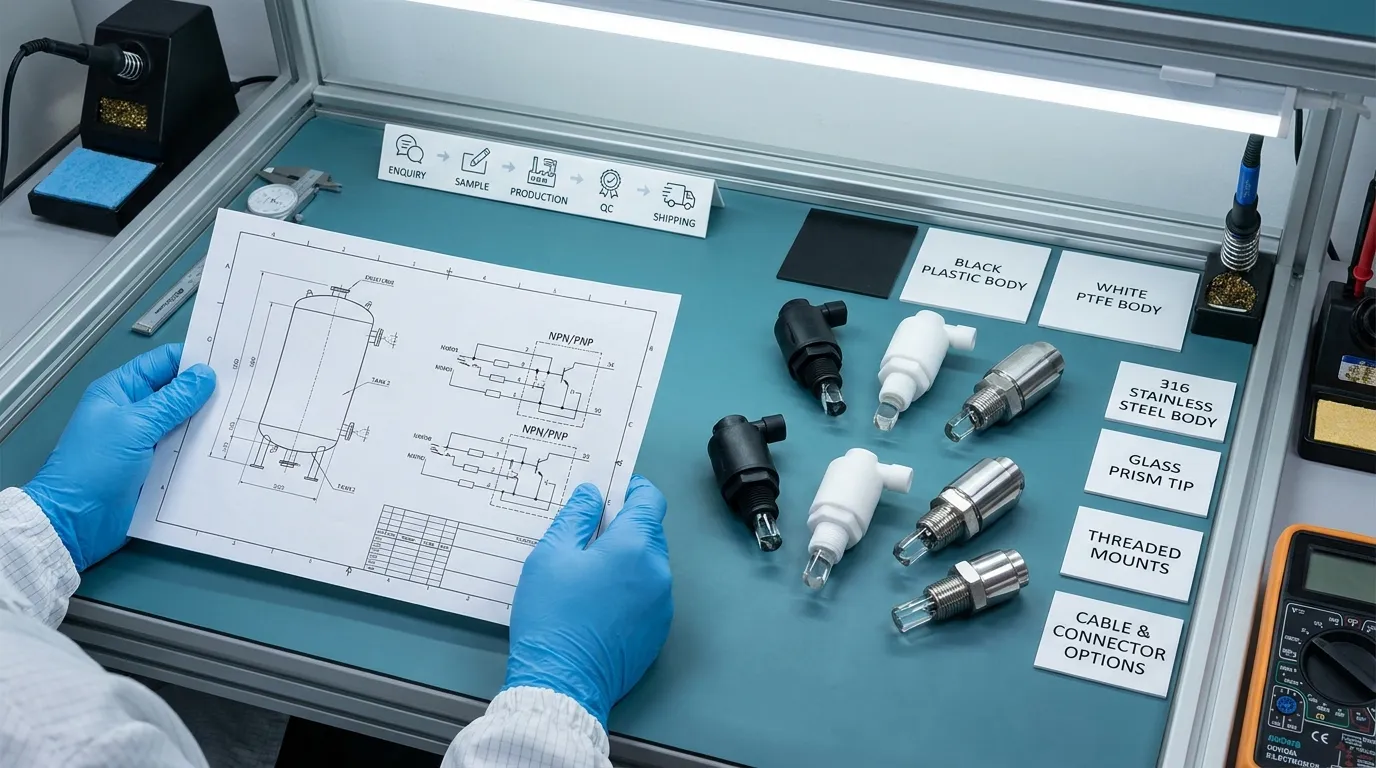
Keyence wird häufig ausgewählt, wenn eine Pflanze schnelle lokale Unterstützung benötigt, Ein breites Automatisierungsökosystem, oder ein fertiges Sensorpaket mit detaillierter Dokumentation. Das macht Sinn für hochwertige Automatisierungslinien, Dringende Fehlersuche, oder Einrichtungen, die um Keyence-Controller und -Verstärker standardisiert wurden.
Aber viele OEM-Käufer versuchen nicht, ein komplexes Automatisierungsproblem zu lösen. Sie benötigen Tausende kompakter Flüssigkeitspegelschalter in wiederholbaren Produkten: Luftbefeuchter, tankt, Pumps, Wasseraufbereitungsanlagen, Spender, Reinigungsgeräte, Kleine Stauseen, und Fluidmodule. In diesen Projekten, Die Hauptsorge des Käufers ist die stabile Erkennung, Wiederholbare Build-Qualität, Maßgeschneiderte Passform, und Gesamtkosten pro Stück.
Hier wird ein werksdirekter optischer Sensor attraktiv. Wenn die Anwendung nur "Flüssigkeit vorhanden" oder "Flüssigkeit fehlt" auf einem festen Niveau bestätigen muss, Ein photoelektrischer Prismensensor kann oft die erforderliche Funktion mit einer einfacheren Kostenstruktur liefern. Anstatt für ein Premium-Ökosystem auf jedem Gerät zu bezahlen, OEMs können das genaue Karosseriematerial angeben, Faden, Kabel, Signaltyp, und den Produktionsteststandard, den sie benötigen.
Das Sensorprinzip ist unkompliziert. Im Inneren des Sensors, eine Infrarot-LED strahlt Licht in eine transparente Prismenspitze ein. Im trockenen Zustand, Licht reflektiert intern im Prisma und kehrt zu einem Fototransistor oder -empfänger zurück. Wenn das Prisma durch Flüssigkeit benetzt wird, der brechungsbedingte Zustand ändert sich, daher kehrt weniger Licht zum Empfänger zurück. Die Elektronik wandelt diese optische Änderung in ein Schaltsignal für die Steuerplatine oder SPS um.
Dieses Design funktioniert besonders gut, wenn die Flüssigkeit mit optischer Erkennung kompatibel ist und die Sensorspitze sauber bleibt. Klares Wasser, viele Öle, und kompatible chemische Flüssigkeiten können effektiv nachgewiesen werden. Aber, Käufer sollten die tatsächliche Liquidität überprüfen, weil milchige Flüssigkeiten, Schwerer Schaum, Kristallisierende Flüssigkeiten, Klebrige Rückstände, oder schwebende Festkörper können den optischen Kontrast verringern oder das Prisma beschichten.. Ein fairer Vergleich muss diese realen Bedingungen einschließen, Nicht nur ein Katalog-Checkbox.
Auch die Materialwahl spielt eine Rolle. Netzteile und andere technische Kunststoffe können sich für kostenempfindliche Wasser- oder Geräteanwendungen eignen. PTFE wird bevorzugt, wo chemische Beständigkeit wichtig ist. 316 Edelstahl wird verwendet, wenn ein stärkeres Gehäuse oder eine bessere Korrosionsbeständigkeit erforderlich ist. Glasspitzen können bestimmte hochklare optische Designs und chemische Umgebungen unterstützen, Aber die vollständige Flüssigkeitsverträglichkeit sollte immer vor der Bestellung überprüft werden.
Die elektrische Leistung ist eine weitere entscheidende Entscheidung. Viele OEM-Systeme verwenden NPN- oder PNP-Schalterausgänge für eine direkte Verbindung zu einem Controller-Eingang. Einige Konstruktionen erfordern eine normal offene oder normal geschlossene Logik, je nachdem, ob der Alarm im trockenen oder nassen Zustand ausgelöst werden soll. Wenn Ihr Steuerungssystem 4–20 mA benötigt, Bestätigen Sie, ob Sie einen Pegelstufensensor oder ein analoges Ausgangsdesign benötigen; Ein einfacher optischer Punktschalter sollte nicht als kontinuierliche Messung angenommen werden..
Die Montage muss als Teil des Sensordesigns behandelt werden, Kein nachträglicher Gedanke. Gewindetyp, Dichtungsverfahren, Wanddicke, Tankkrümmung, Dichtungsmaterial, Drehmomentregelung, Kabelrichtung, und Prismenposition beeinflussen alle die Feldzuverlässigkeit. Ein Sensor, der auf einer Testbank arbeitet, kann in der Produktion ausfallen, wenn die Spitze in einer Blasenzone platziert wird, Zu nah an einer Fülleinlass installiert, ausgesetzt für Sedimentansammlungen, oder so montiert, dass die Flüssigkeit zu langsam vom Prisma abläuft.
Für OEMs, die Keyence mit einem vergleichen Hersteller optischer Sensoren, die wichtigste Frage ist nicht: "Welche Marke ist berühmt?" Es ist "Welches Sensorpaket liefert die erforderliche Detektionsleistung, Anpassung, und Einheitsökonomie für dieses Produkt?”
Häufige Fehlermodi, die Käufer vor dem Wechsel überprüfen sollten
Eine kostengünstigere Alternative kann gut funktionieren, aber nur, wenn die Anwendung korrekt angegeben ist. Vor dem Austausch oder der Konstruktion eines alternativen optischen Flüssigkeitspegelsensors, Überprüfen Sie diese Risikopunkte:
- Flüssigkeit hinterlässt den Film, Öl, Maßstab, oder Kristalle auf der Prismaspitze
- Schaum oder Blasen berühren das Prisma, bevor der eigentliche Flüssigkeitsspiegel es erreicht
- Die Flüssigkeit ist undurchsichtig, Milchig, stark gefärbt, oder gefüllt mit Partikeln
- Die Beckenwand ist zu dünn, zu dick, gekrümmt, oder flexibel für den gewählten Faden
- Die Austrittsrichtung des Kabels steht im Konflikt mit dem Gehäuse oder der Platinenanordnung
- NPN/PNP- oder NO/NC-Logik passt nicht zum Controller-Eingang
- Das Material des Sensorgehäuses ist nicht kompatibel mit der Flüssigkeit oder dem Reinigungsmittel
- Kondensation, Waschbecken, oder schlechte Kabeldichtung führt zu Feuchtigkeitseintritt
- Der Sensor ist in Turbulenznähe installiert, Fülldüsen, oder Pumpenvibration
- Der Käufer vergleicht einen optischen Punktschalter mit einer Keyence-Stufentechnologie und erwartet die falsche Funktion
Eine geeignete alternative Auswahl sollte auf der Sensorarbeit basieren, Nicht nur der Konkurrenten-Markennamen.
Wie unser OEM-Alternative-Prozess funktioniert
- Untersuchung — Senden Sie die Zielflüssigkeit, Panzerzeichnung, Erwartete Funktion, Verdrahtungsanforderungen, und die Referenz des Stromsensors, falls verfügbar..
- Spezifikations- und Anpassungsbewertung — Unser Ingenieurteam überprüft das Karosseriematerial, Prismendesign, Kabel, Faden, Ausgangslogik, und Installationsposition.
- Probenbestätigung — Eine Probe kann für die Passformprüfung vorbereitet werden, Flüssigkeitstests, Controller-Eingangstests, und Überprüfung der Versammlung.
- Produktion und Qualitätskontrolle — Nach der Bestätigung, Die Produktion folgt dem vereinbarten elektrischen, mechanisch, und Inspektionsanforderungen für die OEM-Bestellung.
- Versand- und Exportunterstützung — Als Hersteller und Exporteur aus Shenzhen, wir unterstützen Lieferungen für Kunden in den USA, WIR, Indien, und andere Märkte.
Voraussetzungen zum Bestätigen vor der Bestellung
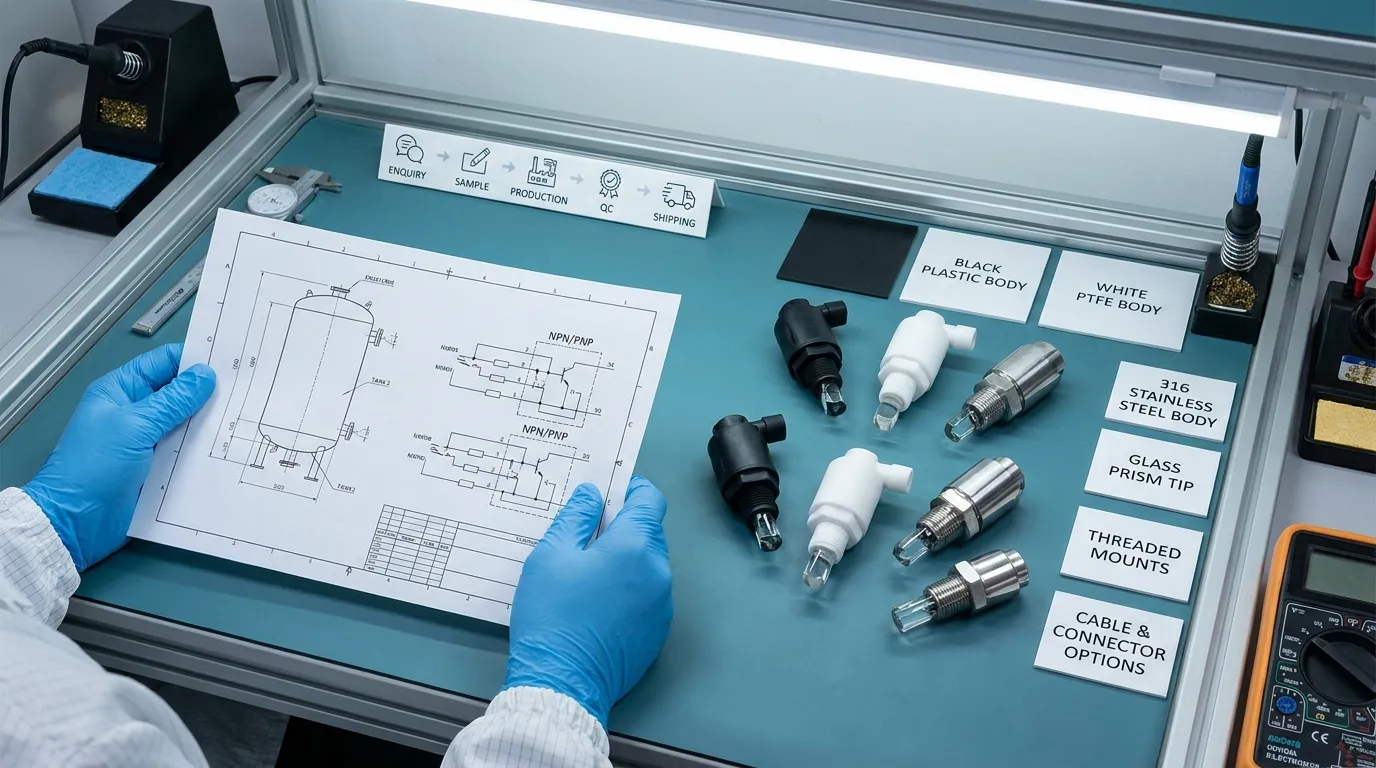
Um das richtige auszuwählen OEM optischer Pegelschalter, Bereiten Sie diese Details vor, bevor Sie ein Angebot anfordern:
- Flüssiger Typ, Konzentration, Farbe, Viskosität, und ob Schaum oder Rückstände erwartet werden
- Tankmaterial, Wanddicke, Montageorientierung, und Versiegelungsverfahren
- Erforderliche Ausgabe: NPN, PNP, NEIN, NC, oder andere Controller-Eingangslogik
- Ob die Anwendung Punkterkennung oder kontinuierliche Pegelmessung benötigt
- Kabellänge, Steckertyp, Drahtfarbe, und Dehnentlastungsanforderung
- Präferenz für benetztes Material: Netzteil, PTFE, 316 Edelstahl, Glas, oder andere Optionen
- Betriebsumgebung: Schwingung, Waschbecken, Kondensation, Temperaturexposition, und Reinigungsmethode
- Erwartetes jährliches Volumen, Stichprobenmenge, Verpackungsbedarf, und Kennzeichnungsanforderungen
Für intelligente Geräte oder IoT-gebundene Fluidsysteme, Die Integration von Tuya/Smart Life kann auf Geräteebene relevant sein, Die Sensorspezifikation sollte jedoch weiterhin mit der physischen Flüssigkeitserkennungsanforderung beginnen.
Keyence vs HojellyTek optischer Flüssigkeitspegelsensor Alternative
| Vergleichsgebiet | Keyence Optical / Optionen für Flüssigkeitsniveausensoren | HojellyTek Factory-Direct Alternative |
|---|---|---|
| Positionierung | Premium-Automatisierungsmarke mit starkem Support und einem breiten Produktökosystem | Shenzhen OEM/ODM-Hersteller mit Fokus auf optische Flüssigkeitssensorlösungen |
| Beste Passform | Pflanzen, die schnelle Unterstützung benötigen, Dokumentation, Demos, und Integration mit bestehenden Keyence-Systemen | OEMs, die maßgeschneiderte Punktpegelsensoren zu geringeren Einheitskosten benötigen |
| Technologiebereich | Beinhaltet mehrere Stufen-Sensorkategorien, abhängig von der ausgewählten Produktfamilie. | Fokussiert auf photoelektrische optische Punktniveau-Detektion |
| Erkennungsrolle | Kann optisch abdecken, Faser, und andere Technologien auf Ebene, abhängig vom Modell | Am besten zur Erkennung von Nass-/Trockenflüssigkeitspräsenz an einem festen Punkt |
| Anpassung | Starkes Ökosystem für Standardprodukte; Die Anpassung hängt vom Projekt und Kanal ab | Karosserie, Faden, Kabel, Ausgabe, Material, und die Verpackung kann für OEM-Bauten diskutiert werden |
| Preisstruktur | Premium-Markenpreise sind oft akzeptabel für hochwertige Automatisierungsprojekte | Besser geeignet für budgetsensible Volumeneinkäufe |
| Wo es gewinnt | Schnelle lokale Unterstützung, Umfassende Dokumentation, Etablierter Automatisierungstrust | Kostenkontrolle, Fabrikkommunikation, OEM-Flexibilität, und anwendungsspezifisches Sensordesign |
| Wichtige Lagerstätte | Gehen Sie nicht davon aus, dass alle Keyence-Level-Produkte optische Punktschalter sind | Verwenden Sie keinen Punktschalter, bei dem kontinuierliche Messung erforderlich ist |
Warum mit HojellyTek zusammenarbeiten
HojellyTek stellt in Shenzhen optische und photoelektrische Flüssigkeitsstandsensoren mit hausinternem R her&D- und OEM/ODM-Unterstützung. Unser Team arbeitet mit Geräteherstellern zusammen, die praktische Lösungen zur Flüssigkeitserkennung benötigen, Nicht nur Austausch von Katalogteilen.
Käufer können mit Unser optischer Pegelsensor und dann Änderungen am mechanischen Design anfordern, Elektrische Ausgabe, Kabel, Steckverbinder, Material, oder Verpackung. Dies ist nützlich, wenn der Sensor in einen bestehenden Tank passen muss, PCB, Gehege, oder Exportproduktlinie.
FAQ
Ist HojellyTek ein direkter Keyence-Ersatz??
Wir bieten kompatible Alternativen zu optischen Flüssigkeitsniveausensoren für geeignete Punktniveauanwendungen an, aber wir werden nicht von Keyence unterstützt und behaupten nicht, jede Keyence-Level-Sensortechnologie zu ersetzen. Die richtige Wahl hängt von der Flüssigkeit ab, Installation, Ausgabe, und ob die Aufgabe Punkterkennung oder kontinuierliche Messung ist.
Was sollte ich vergleichen für Projekte, in denen ich den Pegel von Keyence optische Flüssigkeitssensoren habe??
Vergleich der Sensormethode, Flüssigkeitskompatibilität, Montageposition, Benetzte Materialien, Ausgabetyp, Kabel oder Stecker, Steuerungslogik, und erforderliche Detektionsfunktion. Vergleichen Sie nicht nur das Erscheinungsbild von Markennamen oder Sensoren.
Wann sollte ich noch Keyence wählen??
Wählen Sie Keyence, wenn Ihre Anlage erstklassige lokale Unterstützung benötigt, Schnelle Fehlersuche, Fortschrittliche Automatisierungsintegration, oder eine bestimmte Keyence-Technologie, die bereits in deinem System genehmigt wurde,. Es könnte auch für komplexe Anwendungen über die einfache optische Punkterkennung hinaus besser geeignet sein.
Können optische Sensoren Öl und Wasser erkennen?
Ja, Optische Punktpegelsensoren werden häufig für Wasser eingesetzt, Öl, und kompatible Flüssigkeiten, Aber die eigentliche Flüssigkeit muss getestet oder überprüft werden. Schaum, Beschichtung, Opazität, Schwebende Teilchen, und chemische Kompatibilität kann die Leistung beeinflussen.
Kannst du das NPN anpassen?, PNP, NEIN, oder NC-Ausgabe?
Ja. Die Ausgangslogik kann je nach Eingang der Steuerplatine oder SPS überprüft werden. Der Käufer sollte bestätigen, ob das System ein Absinken erwartet, Herkunft, Normalerweise offen, normalerweise geschlossen, oder ein anderes Signalverhalten.
Wie beantrage ich ein Angebot?
Schick deinen flüssigen Typ, Panzerzeichnung, Fotoinstallation, Ausgangsanforderungen, Materialpräferenz, Kabeldetails, und das erwartete Bestellvolumen per WhatsApp oder E-Mail. Unser Team prüft die Anwendung und empfiehlt eine geeignete Option zum optischen Flüssigkeitsstandsensor..
Fordern Sie ein Angebot für einen Keyence-alternativen optischen Pegelsensor an
Wenn Sie Keyence optische Flüssigkeits- oder Flüssigkeitspegelsensoren für ein OEM-Produkt vergleichen, Kontaktieren Sie HojellyTek mit Ihren Bewerbungsdaten. Wir helfen Ihnen zu überprüfen, ob ein kostengünstigerer werks-direkter optischer Sensor die Erkennungsanforderung erfüllt, Senke die Stückkosten, und unterstützen Sie Ihren Produktionsplan durch individuelles Design, Stichprobe, und OEM-Lieferung.


