
Alternative au capteur de niveau optique IFM
HojellyTek n’est pas positionné comme un remplaçant complet de l’écosystème IO-Link. Nous sommes un fabricant direct d’usine de Shenzhen spécialisé dans la détection optique photoélectrique des niveaux liquides, Personnalisation OEM/ODM, et une offre rentable pour les projets en volume où la commutation discrète de niveau liquide est la véritable exigence.
Capacités de capteurs de niveau optique directs en usine
Pour les acheteurs comparant les capteurs de niveau optique IFM avec une option directe d’usine, la question principale n’est pas seulement « Peut-il remplacer la marque?« mais « La méthode de détection est-elle, Sortie, matériel, et l’installation correspond à ma machine?”
Nos capteurs optiques de niveau liquide sont conçus pour la détection ponctuelle dans les cuves, appareils, Systèmes de dosage, Équipement d’eau, Systèmes liés au pétrole, Machines de nettoyage, et des assemblages OEM compacts. Le principe de détection de base utilise une LED infrarouge, un phototransistor, et une pointe optique à prisme. Dans les airs, la lumière infrarouge se réfléchit à l’intérieur du prisme. Lorsque le liquide entre en contact avec la surface du prisme, Changements de la condition réfractive, La lumière s’échappe dans le liquide, et le signal du récepteur change. L’électronique convertit cet état humide/sec en une sortie commutatrice.
Cela rend le capteur adapté lorsque vous avez besoin d’un « liquide présent » compact / signal liquide absent » plutôt que mesure de distance longue portée. Les acheteurs peuvent consulter notre avis général Capteur de niveau optique Guide pour des exemples d’applications plus larges, Ou vérifie Notre capteur de niveau optique Page produit pour la direction produit standard.
Les options de projet courantes incluent:
- Pointe optique de détection de prisme optique compacte
- Sortie commutatrice NPN ou PNP
- Logique normalement ouverte ou normalement fermée, selon la conception des commandes
- Montage fileté pour parois de réservoir, Petits navires, et des boîtiers d’équipement
- Câble, Connecteur, et la personnalisation du câblage par projet
- Sélection des matériaux de logement basée sur la compatibilité des liquides
- Support OEM/ODM pour le corps du capteur, Longueur du câble, Logique de sortie, et structure d’installation
Là où l’IFM l’emporte toujours — et où une alternative directe à l’usine s’intègre
IFM occupe une position forte dans l’automatisation industrielle car de nombreux acheteurs ont besoin de produits standardisés pour catalogue, Distribution mondiale, Intégration compatible avec les API, Communication IO-Link, Outils de configuration avancés, et une documentation industrielle détaillée. Pour les usines utilisant déjà des plateformes d’automatisation IFM, rester avec IFM peut réduire les risques d’ingénierie.
C’est particulièrement vrai lorsque l’application nécessite un capteur optique IO-Link, Sortie analogique, Mesure basée sur la distance, Paramètres avancés, ou intégration dans un écosystème d’automatisation IFM plus large. Si la conception de votre machine dépend du diagnostic IO-Link, paramètres configurables, ou un profil de communication IFM spécifique, nous ne devrions pas décrire un commutateur optique HojellyTek standard comme un remplacement direct.
L’alternative directe à l’usine convient mieux à une situation d’achat différente: Volume OEM, Conception mécanique personnalisée, Commandes de production répétées, et des équipements sensibles au coût où le signal de niveau n’a besoin que d’indiquer au contrôleur si du liquide est présent à un point fixe. Dans ces cas, Payer pour une plateforme d’automatisation plus large n’est peut-être pas nécessaire..
Par exemple, Un fabricant d’appareils électroménagers, Fournisseur de modules de réservoir, Fabricant d’équipements de dosage, ou bien le fabricant d’eau peut n’avoir besoin que d’un système d’eau:
- Un point de commutation humide/sec fiable
- Un corps compact qui s’adapte à une paroi de char sur mesure
- Un fil de discussion spécifique, Phoque, ou sortie de câble
- Sortie NPN ou PNP correspondant à la carte de contrôle
- Compatibilité des matériaux avec l’eau, Détergent, Liquide de refroidissement, huile, ou d’autres liquides
- Un approvisionnement stable auprès d’un fabricant au lieu d’acheter par plusieurs niveaux de distribution
C’est là que notre modèle d’usine de Shenzhen devient utile. Nous pouvons soutenir des projets OEM/ODM via une R interne&D, Conception de détection photoélectrique, Sélection des matériaux, Essais par échantillon, et l’offre d’exportation vers des marchés comme les États-Unis, EU, et l’Inde.
IO-Link, Analogique, et Sortie discrète: La différence honnête
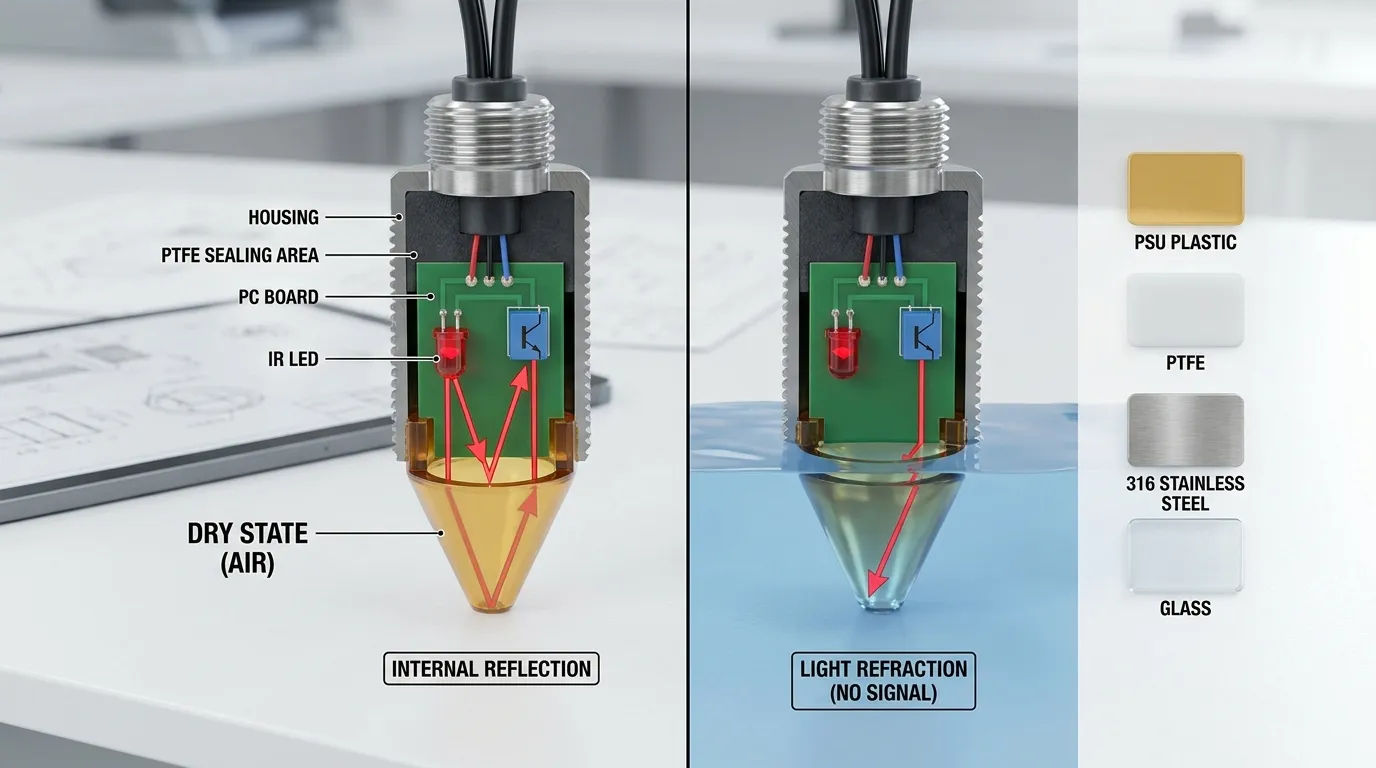
La plus grande comparaison technique concerne le type de sortie.
De nombreux acheteurs de capteurs de niveau optique IFM connaissent des sorties de qualité automatisée telles que IO-Link, Commutation programmable, et dans certaines familles de produits, des signaux analogiques tels que 4–20 mA ou une tension de sortie. Ces fonctionnalités sont utiles lorsqu’un système a besoin de diagnostics de dispositifs, Définition des paramètres, Mesure continue, ou une surveillance au niveau PLC au-delà d’un simple état humide/sec.
La direction standard de notre capteur optique de niveau liquide est différente. Il s’agit principalement d’un commutateur ponctuel discret. La discussion habituelle sur la sortie est NPN vs PNP, et si la logique doit être normalement ouverte ou normalement fermée. Vous pouvez en apprendre davantage sur ces choix de câblage sur notre Options de sortie NPN/PNP Page.
Clairement dit: un commutateur optique optique standard HojellyTek ne doit pas être vendu comme équivalent IO-Link. Si votre spécification nécessite IO-Link, Confirmez cette exigence avant de faire un devis. Si votre application nécessite une sortie continue de 4 à 20 mA, Cela devrait également être discuté comme un projet séparé de niveau continu, non supposé pour un commutateur optique ponctuel standard.
Pour de nombreux produits OEM, une sortie discrète suffit. Le capteur n’a qu’à en informer le contrôleur:
- Réservoir vide ou rempli à un moment donné
- Le liquide a atteint le niveau de sécurité
- La pompe doit s’arrêter avant la répétition à blanc
- Point de dépassement a été atteint
- Cartouche, réservoir, ou un petit réservoir est installé et humide
Quand c’est la véritable exigence, Un capteur optique discret personnalisé peut être plus pratique que de spécifier un capteur de qualité automatisation avec des fonctionnalités que la machine n’utilisera jamais.
Matériel, Montage, et Vérifications de l’application avant commande
Les capteurs de niveau optique sont sensibles à l’environnement réel de l’installation. Une comparaison alternative équitable doit inclure plus que le type de sortie.
La première vérification concerne la compatibilité liquide. Le plastique des PSU peut convenir à de nombreuses applications à base d’eau. Le PTFE peut être nécessaire pour des liquides plus chimiquement agressifs. 316 L’acier inoxydable peut aider en cas de résistance mécanique, résistance à la corrosion, ou l’apparence industrielle. Une pointe prisme en verre peut être utile pour la stabilité optique et la compatibilité chimique, Mais la sélection finale dépend du liquide, pression, Méthode de nettoyage, et conception de l’installation.
La deuxième vérification concerne le comportement optique du liquide. Les capteurs optiques à prisme ponctuel fonctionnent mieux lorsque le liquide peut modifier la condition de réflexion à la surface du prisme. Écume, résidu collant, Revêtement, bulles lourdes, Cristallisation, ou une contamination épaisse peut provoquer de fausses commutations ou un retard de récupération. Liquides transparents, Huiles, Détergents, et les liquides de refroidissement doivent être examinés au cas par cas car l’indice de réfraction et le comportement des résidus sont importants.
Le troisième contrôle est de monter. Taille du filetage, Épaisseur du mur, Méthode d’étanchéité, Direction du câble, et la position des pointes du capteur affectent toutes les performances. Un capteur monté trop près de la paroi d’un réservoir, à une entrée turbulente, ou à l’intérieur d’une zone très dense en bulles peut se comporter différemment d’un test de laboratoire propre. Pour les projets OEM, Nous recommandons généralement de tester les échantillons dans le réservoir réel avant l’approbation de la production.
Le quatrième test concerne la correspondance électrique. Les sorties NPN et PNP ne sont pas interchangeables. L’acheteur doit confirmer le type d’entrée de la manette, Conception des fournitures, Exigence de courant de charge, Préférence de couleur du câblage, Logique de sortie, et si le signal doit être actif lorsqu’il est humide ou actif quand il est sec.
5-Processus de projet OEM par étapes
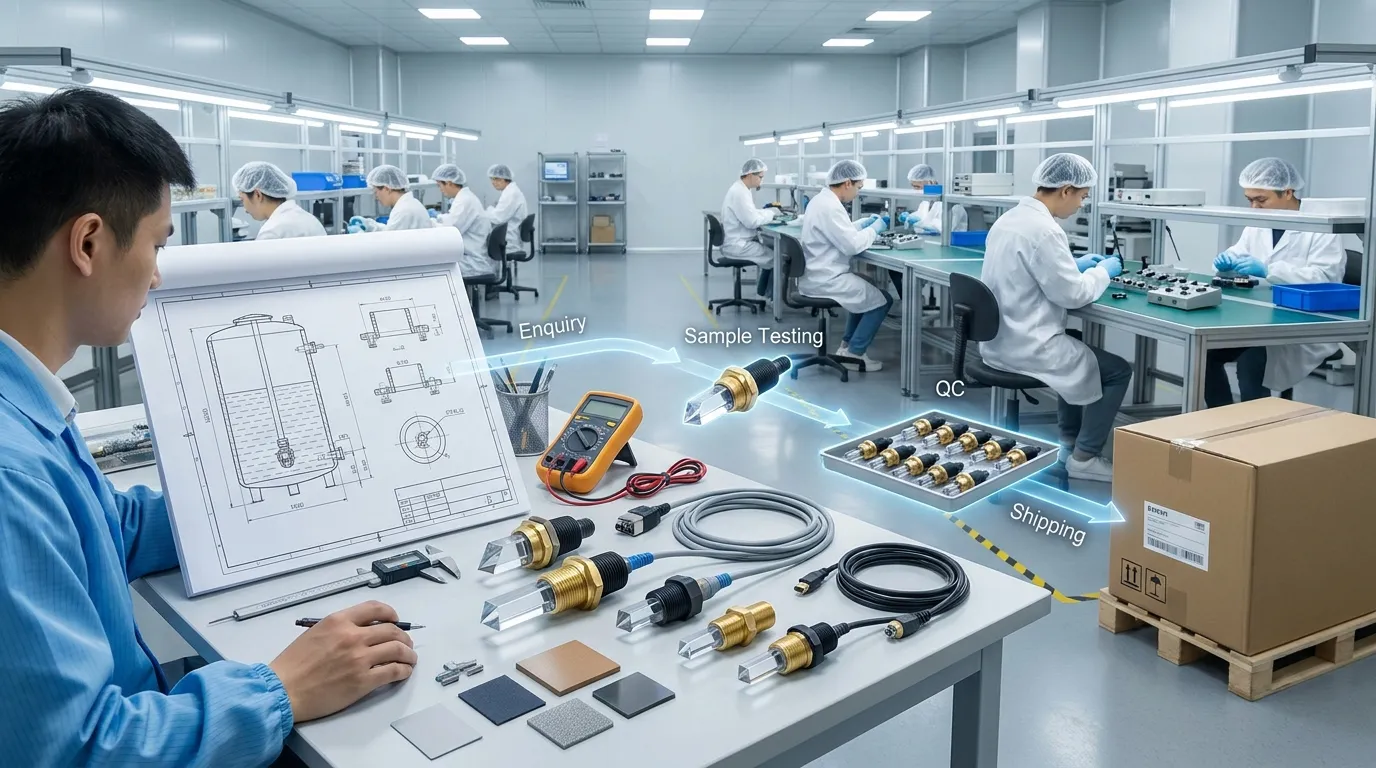
- Enquête: Envoyez votre exigence de référence IFM, Dessin de candidature, Type liquide, Matériau du réservoir, et fonction attendue. Nous vérifions si un commutateur optique discret convient ou si votre projet nécessite IO-Link, analogique, ou la mesure continue à la place.
- Spécification et personnalisation: Notre équipe évalue le type de production, Matériau de logement, fil, Méthode d’étanchéité, Câble, Connecteur, et l’espace d’installation. Pour les projets OEM/ODM, Nous pouvons discuter de la structure des capteurs personnalisés et des exigences de production.
- Tests d’échantillons: Les échantillons sont préparés pour validation dans la conception réelle de votre liquide et de votre cuve. Cette étape est importante car les capteurs optiques peuvent être affectés par des bulles, Revêtement, écume, et angle d’installation.
- Production et contrôle qualité: Après approbation de l’échantillon, La production suit le dessin et le cahier des charges confirmés. Les contrôles qualité se concentrent sur la réponse optique, câblage, Scellement, Apparence, et fonction de sortie.
- Soutien à l’expédition et à l’exportation: Nous soutenons les commandes d’exportation pour les acheteurs et distributeurs OEM. Le délai d’exécution est confirmé après la spécification finale, matériel, Statut de l’exemple, et la quantité de commande sont examinées.
Exigences et spécifications de la RFQ à confirmer
Avant de demander un devis, Préparez ces détails:
- Application cible et type de machine
- Nom liquide, Concentration, Conditions de température, et procédé de nettoyage
- Sortie requise: NPN, PNP, normalement ouvert, ou normalement fermé
- Que la sortie IO-Link ou analogique soit obligatoire
- Matériau de paroi du réservoir et épaisseur du mur
- Filetage ou méthode de montage
- Longueur du câble, Type de connecteur, et définition du câblage
- Préférence pour les matériaux de logement: Alimentation, PTFE, 316 Acier inoxydable, Embout en verre, ou structure personnalisée
- Quantité de commande attendue et exigence d’échantillons
- Des dessins, Photos, ou des notes de remplacement provenant de l’installation IFM existante
Pour les acheteurs qui ont besoin d’un fournisseur à long terme plutôt qu’un remplaçant ponctuel, notre Fabricant de capteurs optiques Page explique la capacité plus large de l’usine.
Comparaison équitable: Capteur de niveau optique IFM vs Alternative HojellyTek
| Critères d’achat | IFM / Capteur de niveau optique de l’effecteur ifm | HojellyTek Factory-Direct Alternative |
|---|---|---|
| Position de la marque | Marque mondiale d’automatisation établie | Fabricant/exportateur de capteurs optiques de niveau liquide de Shenzhen |
| Meilleur choix | Automatisation industrielle, Systèmes PLC, Achat par catalogue standardisé | Volume OEM, Conception de chars sur mesure, Équipements sensibles au coût |
| Type de capteur | Souvent sélectionné pour la détection optique de niveau automatisé et l’intégration avancée | Détection ponctuelle photoélectrique de liquide basée sur prismes |
| Style de mesure | Peut supporter des mesures avancées selon la famille de modèles | Commutation de niveau point humide/sec |
| IO-Link | IFM est solide dans les produits d’automatisation IO-Link | Non proposé de série pour notre commutateur optique à niveau prisme; doit être confirmé séparément |
| Sortie analogique | Disponible dans certaines configurations de capteurs de qualité automatisée | Ce n’est pas supposé pour les modèles ponctuels standards; Discutez-en séparément si besoin |
| Sortie discrète | Courant dans les capteurs d’automatisation | La commutation NPN/PNP est la principale option |
| Personnalisation | Généralement piloté par le catalogue | Personnalisation OEM/ODM pour le boîtier, fil, Câble, matériel, et logique |
| Structure des coûts | Valeur de la marque et de la distribution incluse | Option directe en usine pour des projets en volume adapté |
| Là où ils gagnent encore | Écosystème IO-Link, Catalogue mondial, Documentation avancée d’automatisation | Détection de liquide discrète personnalisée pour la production OEM |
Pourquoi les acheteurs choisissent HojellyTek
HojellyTek se concentre sur la détection optique photoélectrique pour les applications de niveau liquide, Pas des catalogues d’automatisation générale. Cette concentration est utile lorsque les acheteurs ont besoin d’un capteur compact conçu pour un réservoir, réservoir, ou une machine OEM plutôt qu’une pièce standard prête à l’emploi.
Les points clés de confiance incluent:
- Soutien à la fabrication et à l’exportation basé à Shenzhen
- R interne&D pour détection optique des liquides
- Personnalisation OEM/ODM pour les projets en volume
- Expérience avec l’optique, photoélectrique, et des capteurs compacts de niveau liquide
- Soutien aux États-Unis, EU, Inde, et d’autres marchés d’exportation
- À toi / Expérience d’intégration Smart Life où la surveillance sans fil des réservoirs est pertinente pour le périmètre du projet
FAQ
HojellyTek est-il un remplacement direct du capteur de niveau optique IFM?
Pas toujours. Si votre capteur IFM nécessite un IO-Link, Sortie analogique, ou fonctions d’automatisation avancées, Notre commutateur optique standard à niveau point n’est pas un équivalent direct. Si votre application nécessite uniquement une détection de liquide humide/sec avec une sortie NPN ou PNP, Nous pouvons tester une alternative compatible en usine directe.
Proposez-vous des capteurs optiques IO-Link?
Notre commutateur optique standard de niveau liquide à prisme ne doit pas être supposé inclure IO-Link. Si IO-Link est obligatoire, énoncer-le clairement dans la RFQ afin que nous puissions confirmer si une option appropriée existe ou conseiller que le capteur d’automatisation de type IFM reste le mieux adapté.
Puis-je utiliser une sortie NPN ou PNP au lieu d’un capteur IFM IO-Link?
Seulement si votre contrôleur ne nécessite pas de données IO-Link, Diagnostic, ou réglage des paramètres. Beaucoup de machines OEM n’ont besoin que d’un signal de commutation simple, mais les systèmes PLC conçus autour de IO-Link ne devraient pas être modifiés sans l’approbation technique.
Quels liquides un capteur de niveau optique peut-il détecter?
Les capteurs optiques de niveau ponctuel sont couramment utilisés pour les liquides à base d’eau et de nombreux fluides industriels, Mais chaque liquide doit être vérifié. Écume, Résidu, bulles, Revêtement, Haute viscosité, et les différences d’indice de réfraction peuvent affecter la performance.
Pouvez-vous personnaliser le boîtier du capteur ou le filetage de montage?
Oui. Pour les projets OEM/ODM, Nous pourrons discuter du matériel de logement, fil, Longueur du câble, Connecteur, Logique de sortie, et structure mécanique. La faisabilité finale dépend de la revue du dessin, Compatibilité liquide, et tests d’échantillons.
Que dois-je envoyer pour un devis ??
Envoyez le besoin existant de capteurs, Photo ou dessin de candidature, Type liquide, Exigence de production, Méthode de montage, Préférence en matière, Détails du câble, Estimation de la quantité, et si la sortie IO-Link ou analogique est obligatoire.
Demandez un devis alternatif Factory-Direct
Si votre projet a besoin d’une automatisation IO-Link au niveau IFM, L’IFM pourrait encore être le meilleur choix. Si votre véritable besoin est un capteur optique compact au niveau point liquide avec commutation NPN/PNP, Montage personnalisé, et prise en charge des volumes OEM, HojellyTek peut vous aider à évaluer une alternative économique.
Envoyez votre dessin, Informations liquides, Exigence de production, et cibler la quantité par WhatsApp ou email pour demander un devis, Exemple de critique, ou discussion sur la personnalisation OEM.


