
Capteur optique de niveau continu
HojellyTek prend en compte les projets optiques de détection de niveau liquide pour les acheteurs qui ont besoin d’un retour d’information plus clair, Installation compacte, et une personnalisation au-delà de la détection on/off standard.
Capacités continues de détection de niveau optique
La plupart des capteurs optiques de niveau liquide utilisent un principe photoélectrique: une LED infrarouge envoie de la lumière dans la pointe d’un prisme, et un phototransistor ou un récepteur détecte la lumière réfléchie. Dans les airs, Le prisme réfléchit la lumière différemment que lorsqu’il est humidifié par un liquide. Le circuit capteur convertit ensuite ce changement optique sec/humide en un signal utilisable.
Pour une simple alarme de char, Ce signal peut être une sortie marche/arrêt. Pour la surveillance continue ou quasi-continue de niveau, La conception peut utiliser une structure de détection plus longue, Points optiques multiples, ou une conception de conversion de signal qui rapporte les changements de niveau à un contrôleur.
Notre support de détection de niveau optique peut inclure:
- Commutateurs optiques sur mesure pour hauts, faible, vide, déborder, et détection de fuite
- Réseaux de niveaux optiques multipoints pour l’indication de niveau en palier
- Projets de niveau continu où le signal doit supporter le contrôle du processus ou la rétroaction de dosage
- Configuration de sortie pour les cartes de contrôle, Automates, Pompes, Alarmes, ou des appareils IoT
- Choix des matériaux pour l’eau, huile, combustible, chimique, et applications dans les fluides de nettoyage
- Corps de capteur OEM/ODM, fil, Câble, Connecteur, et personnalisation du logement
Pour les acheteurs comparant des solutions générales, voir notre Capteur de niveau optique Guide.
Commutateur optique ponctuel vs mesure continue du niveau optique
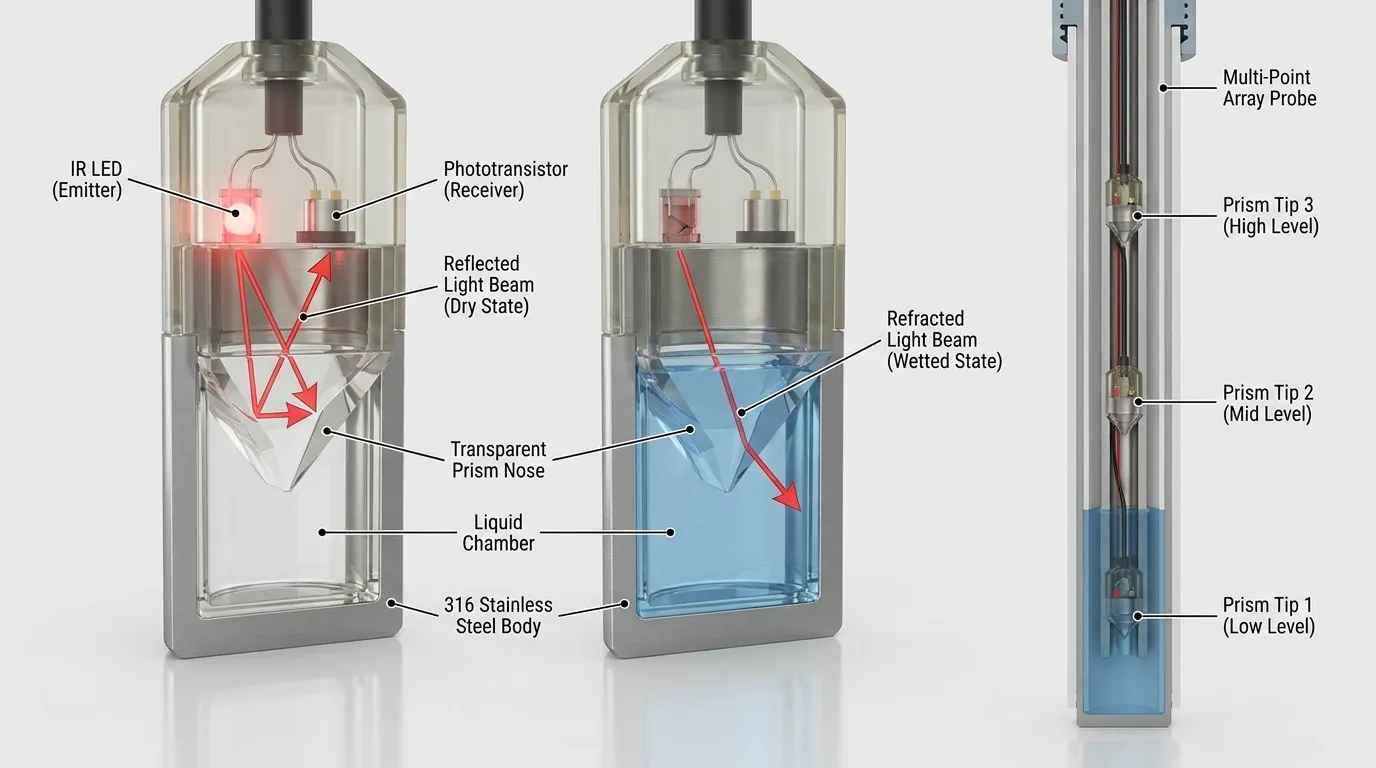
Un interrupteur de niveau point photoélectrique répond à une question: « Y a-t-il du liquide à cet endroit?« C’est idéal lorsque le système n’a besoin que d’un état clair sec/humide. Par exemple, Une machine à café peut nécessiter une alerte de basse quantité d’eau, Un dispositif médical peut avoir besoin d’un signal réactif présent, Ou un petit réservoir peut nécessiter une protection contre les débordements.
La mesure continue répond à une autre question: « Combien de liquide y a-t-il dans le réservoir maintenant?« Cela compte lorsqu’un contrôleur doit suivre le changement de niveau lors du remplissage, Drainage, Dosage, Dosage, ou fonctionnement de procédé.
Dans de nombreux projets, Les acheteurs demandent d’abord un capteur optique de niveau continu, Mais après révision, Le bon design peut être l’une des trois options suivantes:
- Commutateur unique à point optique pour l’alarme haute/basse
- Réseau optique multipoint pour plusieurs étapes de niveau fixe
- Conception de sortie continue où le contrôleur reçoit un signal analogique ou numérique variable
Si votre exigence est seulement « réservoir plein » ou « réservoir vide »,« Un dispositif ponctuel est généralement plus simple. Si vous avez besoin de tendance de niveau, Minutage du remplissage, Quantité de dosage, ou retour d’information sur les processus, La détection continue ou multipoint est plus adaptée.
Pour les projets de détection de point fixe, Comparez notre capteur de niveau ponctuel électro-optique.
Plage de mesure, Résolution, et Conception du signal
Pour les projets de niveau optique continu, La plage de mesure n’est pas sélectionnée comme un commutateur de catalogue générique. Il doit correspondre à la profondeur du réservoir, Zone de détection, Position d’installation, Comportement liquide, et la précision requise dans les commandes.
Un réservoir court peut n’avoir besoin que de plusieurs points de détection optique. Un réservoir plus haut peut nécessiter une sonde plus longue ou une structure de détection personnalisée. Une chambre de dosage peut nécessiter une résolution plus élevée sur une section étroite plutôt qu’une longue plage de réservoir complet.
La résolution dépend de la méthode de détection. Avec un tableau multipoint, La résolution est basée sur l’espacement entre chaque point optique. Un espacement plus serré donne plus de pas de niveau, Mais cela affecte aussi la conception des sondes, câblage, coût, et les exigences d’entrée des contrôleurs. Avec sortie continue analogique ou numérique, La résolution utilisable dépend de la conception de détection optique, Traitement du signal, Stabilité des liquides, et méthode d’étalonnage.
Les acheteurs doivent définir:
- Profondeur totale du réservoir ou hauteur de détection de la cible
- Niveaux de liquide minimum et maximal à surveiller
- Précision requise de niveau ou de contrôle
- Que le système ait besoin d’une sortie fluide ou de zones de niveau fixes
- Type liquide, clarté, viscosité, écume, bulles, et risque de revêtement
- Type d’entrée de contrôleur: NPN, PNP, Tension, 4–20 mA, Impulsion, RS485, ou un signal numérique personnalisé
Options de sortie: NPN, PNP, 4–20 mA, et Signaux numériques
La sélection de la sortie est l’une des décisions d’achat les plus importantes. Un commutateur ponctuel utilise normalement une sortie discrète telle que NPN, PNP, pousse-tira-pousse, ou logique de type relais selon le circuit de contrôle. C’est adapté aux alarmes, Démarrage/arrêt de la pompe, Déclencheurs de recharge, et des signaux d’interverrouillage.
Pour une rétroaction continue ou au niveau du processus, Les acheteurs demandent souvent une sortie analogique. Un signal de 4 à 20 mA est courant dans le contrôle industriel car il peut représenter un niveau variable sur une plage définie et convient mieux aux longs câbles qu’aux simples signaux de tension. La sortie numérique peut être utilisée lorsque le capteur doit communiquer avec un microcontrôleur, Appareil intelligent, ou passerelle industrielle.
HojellyTek peut examiner les exigences du contrôleur lors des appels d’offres et aider à faire correspondre la logique de sortie à votre système. Tension d’alimentation, Mode de câblage, Longueur du câble, Connecteur, et le comportement du signal sont confirmés avant la production de l’échantillon.
Réseaux optiques multipoints comme alternative continue
Toutes les applications à apparence continue n’ont pas besoin d’un véritable émetteur continu. Dans de nombreux systèmes compacts OEM, Un réseau optique multipoint est une alternative pratique.
Une conception multipoint place plusieurs positions de détection optique le long d’une sonde ou d’un ensemble. Chaque point détecte si le liquide a atteint cette hauteur. Le contrôleur interprète alors le résultat comme vide, faible, Médium, haut, ou complet. Pour de nombreux appareils, C’est suffisant pour contrôler le recharge, Prévention du fonctionnement à sec, Arrêter le débordement, ou estimer le liquide restant.
Cette approche est utile lorsque:
- Le bassin est petit ou irrégulier
- Une mesure exacte au niveau du millimètre n’est pas requise
- Le contrôleur dispose de multiples entrées numériques
- L’acheteur souhaite une fiabilité optique sans flotteur mobile
- L’application nécessite des zones de niveau simples pour le dosage ou le contrôle du procédé
Les réseaux multipoints sont souvent utilisés dans les réservoirs de réactifs, Réservoirs d’eau, Cartouches de liquide de nettoyage, Réservoirs de pétrole, Modules de surveillance du carburant, Appareils connectés, Équipement de laboratoire, et dispositifs industriels compacts.
Pour les projets d’interface huile-eau ou liquide, voir notre Capteur de niveau d’interface optique.
Comparaison entre capteurs de niveau optique ponctuel et continu
| Exigence | Commutateur de point photoélectrique | Réseau optique multipoint | Détection optique continue |
|---|---|---|---|
| Objectif principal | Détecter un liquide à une position fixe | Détecter plusieurs zones de niveau fixe | Changement de niveau de voie sur une plage définie |
| Sortie typique | NPN, PNP, Marche/arrêt numérique | Signaux numériques multiples ou sorties encodées | 4–20 mA, Tension, Numérique, ou un signal personnalisé |
| Meilleur choix | Plein, vide, déborder, fuite, Alarme haute/basse | Indication faible/moyenne/élevée, Contrôle du remplissage par échelons | Dosage, Retour d’information sur le processus, Surveillance des tendances des réservoirs |
| Résolution | Un point de détection | Basé sur l’espacement ponctuel | Basé sur la conception de détection et le traitement du signal |
| Complexité de conception | Le plus bas | Douleur moyenne | Maximum |
| L’acheteur doit le choisir quand | Seul le statut sec/humide est nécessaire | Plusieurs niveaux suffisent | Le contrôleur a besoin d’un retour de retour variable |
Utilisations applicatives pour la détection continue ou multipoint des niveaux optiques
La détection optique continue et multipoint est utile lorsque les flotteurs mécaniques sont trop grands, Ça peut coller, ou ne correspondent pas au design du produit. Parce que la pointe de détection n’a pas de bras flotteur mobile, Il convient aux équipements compacts où l’espace est limité.
Les usages courants incluent:
- Réservoirs de dosage nécessitant un timing de remplissage ou un retour en volume
- Équipements de procédé où le niveau de liquide affecte le contrôle de la pompe ou de la vanne
- Appareils connectés qui surveillent l’eau, Détergent, Ou du liquide nettoyant
- Équipements médicaux et de laboratoire avec réservoirs de réactifs ou de déchets
- Huile, Liquide de refroidissement, ou des réservoirs de carburant nécessitant une indication de faible à élevé
- Systèmes OEM connectés à une carte de contrôle, montrer, ou module IoT
Pour des designs de produits intelligents, L’intégration Tuya/Smart Life peut être discutée lorsque le capteur fait partie d’un système de surveillance connecté plus large.
Liste de contrôle de sélection avant commande
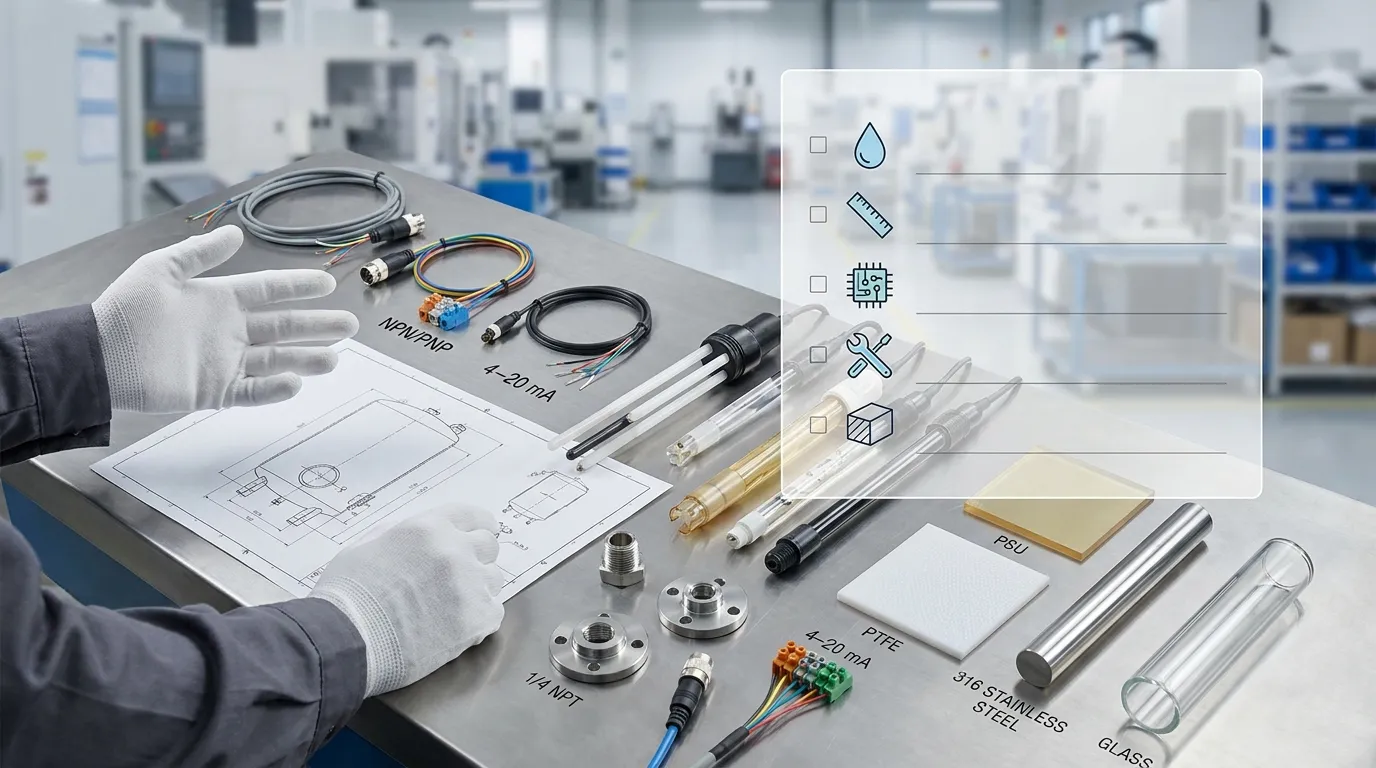
Avant de demander un devis, préparez les détails suivants:
- Fonction de niveau: Alarme de point, Indication multipoint, ou sortie continue
- Dessin de char: Taille, Épaisseur du mur, installation angle, et l’espace de montage disponible
- Zone de mesure: Portée complète ou seulement la section de contrôle actif
- Détails liquides: eau, huile, combustible, chimique, Risque de mousse, bulles, viscosité, Revêtement, et transparence
- Matériau mouillé: Alimentation, PTFE, 316 Acier inoxydable, verre, ou d’autres matériaux basés sur le contact chimique
- Style de montage: Corps fileté, Support de panneau, Montage latéral, Montage supérieur, 1/4 NPT, Bride, ou un boîtier sur mesure
- Exigence de production: NPN, PNP, 4–20 mA, Tension, Impulsion, RS485, ou une sortie numérique personnalisée
- Détails électriques: Tension d’alimentation, Longueur du câble, Connecteur, Couleurs des fils, et l’entrée de la manette
- Environnement d’exploitation: Méthode de nettoyage, vibration, condensation, éclaboussures, et conditions de température
- Phase de projet: Prototype, remplacement, Nouveau design OEM, ou l’approvisionnement en production
5-Processus de service personnalisé par étapes
- Examen de la demande
Tirages de partage, Détails sur le liquide, Portée au niveau de la cible, Besoins en production, et méthode d’installation. - Spécifications et personnalisation
Notre équipe d’ingénierie confirme la structure de détection, Matériau humide, Montage, Câble, Connecteur, et type de signal. - Préparation de l’échantillon
Un échantillon peut être préparé pour l’ajustement, câblage, et les essais liquides avant la production de masse. - Production et contrôle qualité
L’usine vérifie la réponse optique, câblage, Qualité d’assemblage, et la cohérence basée sur l’échantillon approuvé. - Soutien au transport
Nous soutenons les acheteurs à l’exportation aux États-Unis, EU, Inde, et d’autres marchés offrant une coordination d’emballage et d’expédition.
Pourquoi choisir HojellyTek
HojellyTek est un fabricant de capteurs optiques et de niveau liquide de Shenzhen disposant d’un système R interne&D, Expérience de détection photoélectrique, et support de la personnalisation OEM/ODM. Au lieu de forcer chaque acheteur à un changement de point standard, Nous aidons à évaluer si votre produit a besoin d’un capteur ponctuel, Réseau multipoint, ou conception de signaux de niveau continu.
Les acheteurs peuvent également consulter notre Produit capteur de niveau optique page avant d’envoyer les dessins ou les détails de la candidature.
FAQ
Un capteur optique de niveau continu est le même qu’un commutateur optique de point?
Non. Un commutateur optique détecte le liquide à une position fixe. Un capteur optique de niveau continu ou un design multipoint fournit un retour de niveau sur une plage ou plusieurs zones de hauteur.
La détection de niveau optique peut-elle fournir une sortie de 4 à 20 mA?
Oui, 4–20 mA peut être spécifié pour les projets nécessitant un retour d’information de niveau variable. La portée de détection, Mise à l’échelle du signal, câblage, et l’entrée du contrôleur doit être confirmée lors de la RFQ.
Quand devrais-je utiliser un réseau optique multipoint?
Utilisez un tableau multipoint lorsque vous avez besoin de plusieurs niveaux fixes, comme faible, Médium, et haut, mais n’ont pas besoin d’un signal d’émetteur entièrement lisse et continu.
Quel matériau humide devrais-je choisir?
L’alimentation est courante pour de nombreux usages à base d’eau. PTFE, 316 Acier inoxydable, Ou le verre peut être envisagé pour des produits chimiques, Huiles, Carburants, exigences élevées en propreté, ou un contact liquide plus exigeant.
Qu’est-ce qui peut causer des problèmes de détection du niveau optique?
Les risques courants incluent des embouts prismaticaux sales, Liquide de revêtement, écume, bulles, condensation, Mauvaise position de montage, Matériau incompatible, Câblage incorrect, ou choisir un commutateur de point lorsque le processus nécessite un retour continu.
Comment puis-je demander un devis personnalisé pour capteur de niveau optique?
Envoyez votre dessin de char, Type liquide, Plage de mesure, signal de sortie, Méthode de montage, Tension, Exigence du câble, et application attendue. Vous pouvez demander un devis par WhatsApp ou par e-mail.
Demandez un devis
Besoin de retour de niveau continu au lieu d’un simple signal marche/arrêt? Envoyez votre dessin, Détails sur le liquide, Sortie requise, et le plan d’installation d’HojellyTek. Notre équipe peut vous aider à choisir entre un commutateur optique ponctuel, Réseau optique multipoint, ou une solution continue de détection optique pour votre projet OEM ou industriel.
