
Capteur de niveau d’interface optique (Huile-Eau)
Un capteur de niveau d’interface optique permet de détecter la frontière entre le pétrole et l’eau lorsque deux liquides non miscibles se séparent à l’intérieur d’un réservoir, séparateur, Sump, ou récipient de procédé. Pour les acheteurs, Le défi n’est pas simplement de détecter « liquide présent » ou « liquide absent »; il s’agit de trouver le point d’interface où la condition d’indice de réfraction autour du prisme optique change d’une phase liquide à une autre.
HojellyTek fabrique des solutions de détection optique photoélectrique à Shenzhen pour des projets OEM/ODM, Constructeurs d’équipements industriels, Fournisseurs de surveillance des réservoirs, et intégrateurs de systèmes. Nous aidons les acheteurs à configurer des capteurs d’interface huile-eau avec une conception prismaticale adaptée, Matériaux humides, Montage, signal de sortie, et des options câble/connecteur.
Capacités de détection d’interface optique
Pour les applications huile-eau, Le capteur doit être sélectionné en fonction de la condition réelle du média, Pas seulement la taille de l’aquarium. Une frontière claire entre l’huile et l’eau est plus facile à détecter qu’un puisard sale avec des boues, écume, Solides en suspension, ou une couche d’émulsion. Le capteur de niveau d’interface optique est généralement utilisé lorsque le système nécessite un point de commutation ou un changement de signal lorsque le prisme est exposé à une phase liquide différente.
Les capacités typiques des projets incluent:
- Détection de la frontière huile-eau dans les séparateurs, Réservoirs de collecte, Puisards, et équipements de procédé compacts
- Détection photoélectrique du prisme à l’aide d’une LED IR, Phototransistor, et la réponse par réfraction optique
- Conception personnalisée d’un commutateur d’interface ponctuelle pour équipements OEM
- Une revue optionnelle continue ou multipoint lorsque la position de l’interface s’étend sur une plage plus large
- Options de sortie telles que NPN, PNP, Signal compatible relais, Sortie numérique personnalisée, ou 4 à 20 mA lorsque la conception du système l’exige
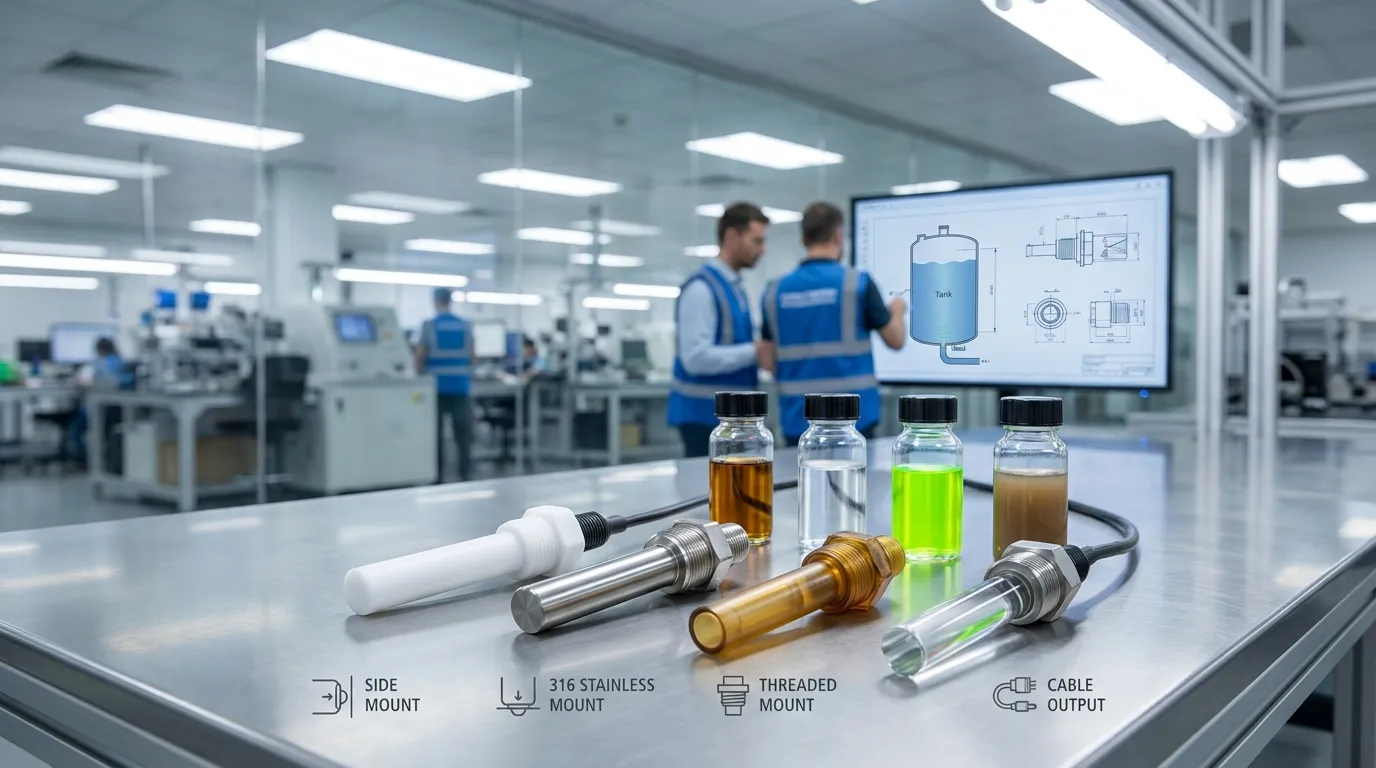
- Sélection des matériaux humides, y compris l’alimentation, PTFE, 316 Acier inoxydable, Prisme en verre, et des choix de joints et de câbles spécifiques à l’application
- Fileté, Panel, Mur latéral, Bottom, ou des formats montés sur cuve selon l’installation
Pour une explication plus large des principes standards de détection optique, voir notre Capteur de niveau optique Guide. Cette page se concentre spécifiquement sur la sélection des services d’interface deux liquides huile-eau.
Détection de la frontière huile-eau par variation de l’indice de réfraction
Dans de nombreux séparateurs et puisards, L’huile et l’eau forment deux couches car elles ne se mélangent pas uniformément. Le problème de l’acheteur est de localiser la frontière entre ces couches afin que le système puisse drainer l’eau, déclenche une alarme, Arrêter une pompe, Protéger les équipements en aval, ou confirmer la séparation.
Un capteur d’interface optique photoélectrique utilise une source lumineuse et un récepteur à l’intérieur du corps du capteur. La pointe de détection comprend normalement un prisme. Lorsque le prisme est exposé à l’air, huile, eau, ou un autre liquide, Le chemin de la lumière change car chaque milieu environnant présente une condition optique différente. À l’intérieur du capteur, une LED IR émet de la lumière vers le prisme, et un phototransistor reçoit la lumière retournée ou réfractée. L’électronique convertit cette réponse optique en signal de sortie.
Pour le service pétrole-eau, Le point important est que l’huile et l’eau ne produisent pas toujours la même réponse prismaticale. Le capteur peut être configuré pour que la sortie change lorsque le prisme passe d’une phase à une autre. C’est pourquoi il est fortement recommandé de tester avec de l’huile réelle et de l’eau réelle. Diesel, lubrifiant, Huile hydraulique, eaux usées, Liquide de refroidissement, Eau émulsifiée, et les produits chimiques de procédé peuvent se comporter différemment.
Comment le prisme réagit à l’huile, Eau, et Air
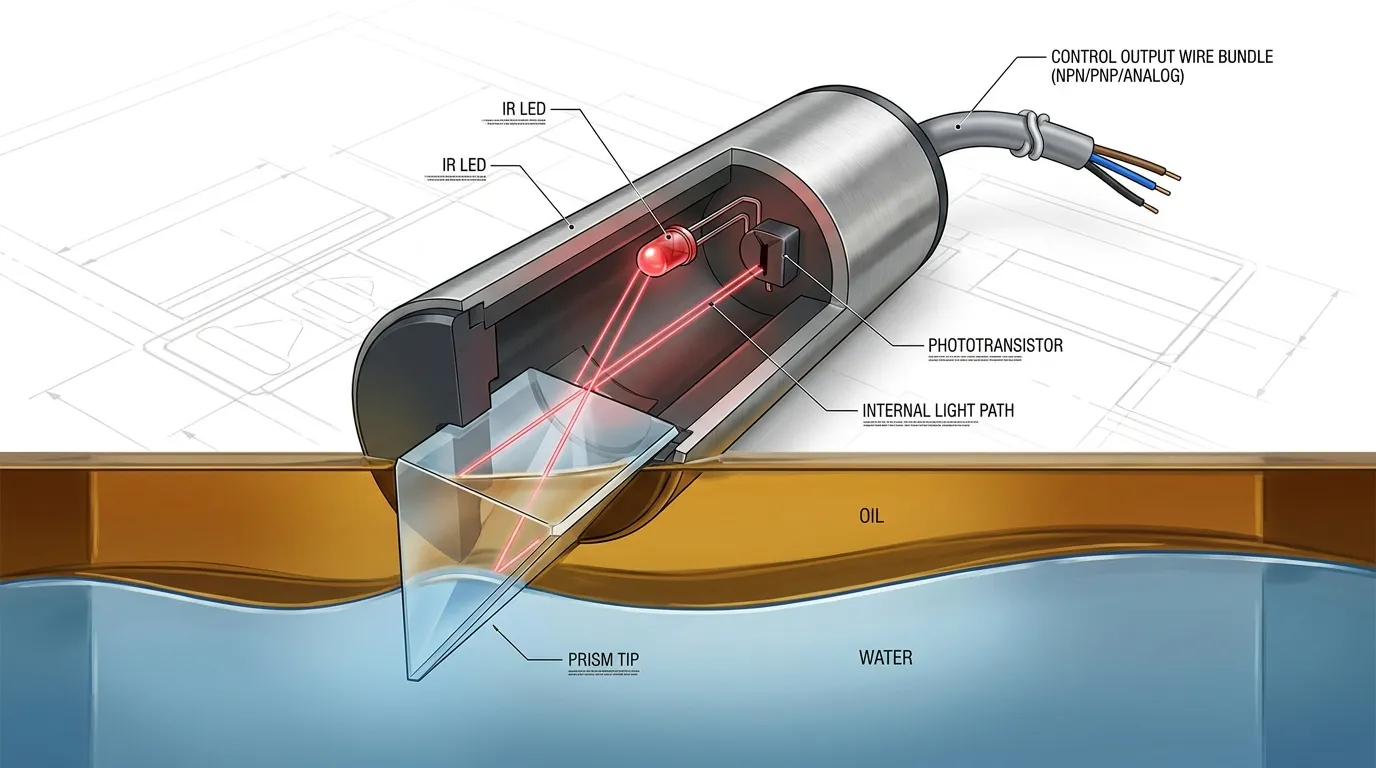
Dans un interrupteur optique sec/humide standard, La réponse du prisme change lorsque le liquide recouvre la pointe sensorielle. Dans la détection de l’interface huile-eau, L’exigence est plus spécifique: Le capteur peut devoir identifier si le prisme se trouve dans la couche pétrolière, Couche d’eau, ou parfois dans l’air au-dessus du liquide.
Le comportement pratique dépend de:
- La différence d’indice de réfraction entre les deux liquides
- Clarté du liquide autour du prisme
- Si l’huile recouvre le prisme après exposition
- Savoir si l’eau contient des solides en suspension, Détergent, Liquide de refroidissement, ou additifs chimiques
- Que la couche d’interface soit nette ou émulsionnée
- Orientation du capteur et profondeur d’installation
Pour un séparateur propre, Un capteur monté sur le côté peut être positionné à la hauteur de l’interface cible. Quand l’eau monte ou que le pétrole descend à ce niveau, la réponse optique change et le contrôleur reçoit un signal de commutation. Pour un puisard, Le capteur peut être utilisé pour détecter la présence d’hydrocarbures, Accumulation d’eau, ou une couche spécifique selon la conception du réservoir et la cible de calibration.
Si le projet nécessite un suivi de niveau sur une plage plutôt qu’un seul point de commutation, Examinez notre Capteur optique de niveau continu Options.
Compatibilité des applications et des médias
| Application | Media Pair | Condition de l’interface | Approche recommandée par capteurs | Notes sur le matériel |
|---|---|---|---|---|
| Séparateur huile-eau | Couche pétrolière / Couche d’eau | Frontière généralement plus nette, peut inclure une émulsion légère | Capteur d’interface ponctuelle monté latéralement à hauteur de limite de cible | 316 Corps en acier inoxydable ou PTFE selon l’exposition chimique |
| Puisard industriel | Hydrocarbures / eau / Aérien | Liquide sale, boue, Risque de revêtement | Commutateur optique compact avec position de nettoyage accessible | Confirmez la gaine du câble, Phoque, et la résistance aux prismes au combustible ou aux eaux usées |
| Réservoir d’huile usée | Huile usagée / Couche de fond d’eau | Huile foncée, sédiments, Viscosité variable | Position prismaticale personnalisée ou conception de pointe protégée | Le PTFE ou le corps en inox peuvent être préférés pour les supports durs |
| Réservoir de récupération du liquide de refroidissement | Film à huile / Liquide de refroidissement à base d’eau | Couche fine d’huile, Additifs, Tensioactifs | Test d’application recommandé avant production | Vérifiez la compatibilité avec la chimie du liquide de refroidissement et le liquide de nettoyage |
| Système de support de stockage de carburant | Carburant / Accumulation d’eau | Couche d’eau sous le carburant | Détection d’interface inférieure ou basse | Un joint et un matériau de câble compatibles carburant doivent être choisis |
| Glissement de procédé OEM | Huile de procédé / rinçez l’eau | Séparation contrôlée, Processus répétable | Capteur d’interface optique sur mesure fileté ou monté sur panneau | La sortie et le connecteur doivent correspondre à la conception de l’API ou de la carte de contrôle |
Séparateur, Sump, et utilisations de l’intégration des équipements
Les séparateurs huile-eau ont souvent besoin d’un signal fiable lorsque la limite atteint un point de drainage, Niveau de démarrage de la pompe, ou niveau d’alarme. Un capteur d’interface optique peut aider à éviter de pomper la mauvaise phase, Réduire les vérifications manuelles, et soutenir le contrôle automatisé des refoulements.
Dans les puisards de confinement, Le capteur peut être utilisé pour la discrimination hydrocarbures/eau ou pour la détection de liquides anormaux. L’installation devrait permettre un nettoyage car les liquides de puisard contiennent souvent de la saleté, Biofilm, Résidus d’huile, ou sédiments. Si l’huile recouvre le prisme, Le capteur peut continuer à voir l’état de revêtement après que l’interface réelle ait bougé, Donc, le nettoyage de l’accès et la validation des tests sont importants.
Pour l’équipement OEM, L’exigence la plus courante n’est pas un seul capteur de catalogue. Les acheteurs ont généralement besoin de la longueur du corps du capteur, fil, Sortie du câble, Logique de sortie, Connecteur, et l’ensemble de matériaux ajusté selon la conception de l’équipement. HojellyTek prend en charge les projets de détection optique OEM/ODM pour les clients exportateurs aux États-Unis, EU, Inde, et autres marchés.
Options de sortie et compatibilité des commandes
La sortie doit correspondre au système de contrôle de l’acheteur dès le départ. Pour un contrôle simple d’alarme ou de pompe, Les sorties de commutation NPN ou PNP sont couramment demandées. Pour les systèmes PLC, L’acheteur doit confirmer le type d’entrée, Tension d’alimentation, Logique de source/suppression, Longueur du câble, et que la logique normalement ouverte ou normalement fermée soit requise.
Pour les systèmes de surveillance nécessitant un retour proportionnel ou une intégration avec une entrée analogique, 4–20 mA peuvent être examinés lorsque la configuration du capteur supporte ce cas d’utilisation. Pour les projets de surveillance des réservoirs IoT, L’intégration de passerelle sans fil ou de systèmes liés à Tuya/Smart Life peut être discutée lorsque cela est pertinent pour la conception complète du produit, Mais la détection de l’interface du cœur dépend toujours de la condition de détection optique au niveau du prisme.
Pour les applications de commutation de points, le capteur de niveau ponctuel électro-optique Page est utile lors de la comparaison des formats standard au niveau du point.
Liste de contrôle de sélection pour les projets d’interface huile-eau
Avant de commander, Confirmez ces détails:
- Identifier les deux liquides: Type d’huile, Type d’eau, Additifs, Tensioactifs, combustible, Liquide de refroidissement, eaux usées, ou la teneur chimique.
- Confirmez si la frontière est dégagée, nuageux, mousseux, sale, ou émulsionné.
- Définir la fonction requise: Détection de pétrole, Eau détectée, interface atteinte, Alarme haute/basse, Contrôle de la pompe, ou le contrôle du drain séparateur.
- Choisissez la détection ponctuelle ou le suivi continu selon qu’un niveau ou une plage d’interface mobile doit être surveillée.
- Confirmez les matériaux humides: Alimentation, PTFE, 316 Acier inoxydable, Prisme en verre, Sceaux, Chemise de câble, et connecteur.
- Fixation spécifique: Mur latéral, Bottom, Sonde verticale, Monture filetée, Montage à bride, Support de panneau, ou boîtiers personnalisés OEM.
- Confirmer la sortie: NPN, PNP, Signal compatible relais, Sortie numérique personnalisée, ou 4–20 mA.
- Tirage de réservoir partagé, Profondeur d’installation, Température liquide, Condition de pression, Longueur du câble, et type d’entrée de contrôleur.
- Prévoyez un nettoyage du prisme en cas de résidus d’huile, boue, Échelle, ou des solides peuvent s’accumuler autour de la pointe sensorielle.
- Demandez un test d’échantillon lorsque le comportement de contraste ou de revêtement de l’indice de réfraction est incertain.
Exigences et révision des spécifications
Pour la détection d’interface, La « spécification » la plus importante n’est pas un seul numéro de catalogue. C’est la correspondance entre la réponse optique, Comportement des médias, et position d’installation. Pendant le RFQ, Notre équipe examine la cible de détection, Paire liquide, Méthode de montage, Matériau humide, Logique de sortie, et exigences du système de contrôle.
L’usine peut examiner la forme de carrosserie personnalisée, Exposition au prisme, Type de filetage, Câble/connecteur, et configuration du signal pour les équipements OEM. Caractéristiques électriques spécifiques, Plage de température, Condition de pression, et la compatibilité des matériaux doit être confirmée par rapport à l’application réelle avant l’approbation de l’échantillon.
Capteur d’interface optique vs autres options de niveau
| Option | Meilleur pour | Limitation | Quand choisir |
|---|---|---|---|
| Capteur de point d’interface optique | Détection d’un niveau limite pétrole-eau cible | Nécessite une validation du milieu si une émulsion ou un revêtement est présent | Alarmes séparatrices, Détection des puisards, Contrôle de point OEM |
| Interrupteur optique liquide standard | Détection de liquide présent/absent | Pas toujours configuré pour la discrimination entre deux liquides | Détection simple de char à haute et basse altitude |
| Capteur de niveau optique continu | Suivi du niveau sur une plage | Plus de travail de configuration qu’un commutateur à point unique | Interface mobile ou surveillance multipoint |
| Interrupteur à flotteur | Contrôle de base du niveau liquide | Pièces mobiles, Dépendance à la densité, Risque de blocage mécanique | Applications à faible coût avec des liquides propres |
| Capteur de conductivité | Détection de l’eau | L’huile est généralement non conductrice, La contamination peut affecter la réponse | Détection de la présence d’eau lorsque la conductivité est fiable |
Pour un produit de commutation optique de type catalogue standard, voir notre Interrupteur photoélectrique de niveau liquide.
5-Processus de projet en étapes
- Enquête
Envoyez la paire liquide, Photo de candidature, Dessin de char, Position de montage, et les exigences d’entrée du système de contrôle par WhatsApp ou par e-mail. - Analyse des spécifications et de la personnalisation
Nous vérifions la cible de réponse prismatique, Sélection des matériaux, Conception du filetage ou du boîtier, Type de sortie, Câble, Connecteur, et contraintes d’installation. - Exemple de confirmation
Un échantillon peut être préparé pour des tests en médias réels, Surtout lorsqu’il s’agit de type huile, Chimie de l’eau, ou le comportement de l’émulsion est incertain. - Production et contrôle qualité
Après approbation de l’échantillon, La production suit les spécifications confirmées. Réponse optique, câblage, Logement, et le comportement de sortie sont vérifiés selon le plan convenu. - Transport maritime et support
Les capteurs sont emballés pour l’exportation, et notre équipe prend en charge les questions d’installation, Confirmation du câblage, et ajustements futurs de l’OEM.
Pourquoi choisir HojellyTek
HojellyTek est un fabricant et exportateur de Shenzhen spécialisé dans la détection optique photoélectrique pour des applications de niveau liquide. Avec R interne&Support D et OEM/ODM, Nous aidons les fabricants d’équipements à configurer les capteurs en fonction des besoins réels d’installation au lieu de forcer une pièce de catalogue universelle.
Les acheteurs collaborent avec nous pour des conceptions personnalisées de prismes optiques, Sélection des matériaux, Correspondance de signal, Structures de capteurs compactes, et un soutien prêt à l’exportation pour les marchés industriels et OEM.
FAQ
Un capteur de niveau d’interface optique peut-il distinguer l’huile de l’eau ??
Oui, lorsque l’huile et l’eau créent une différence utilisable de réponse optique au niveau du prisme. Le design final doit être testé avec les liquides réels car les additifs, contamination, Émulsion, et le revêtement peut affecter la détection.
Ce capteur convient-il aux séparateurs huile-eau?
Oui. Un capteur d’interface optique monté latéralement ou positionné sur mesure peut être utilisé pour détecter lorsque la frontière pétrole-eau atteint un niveau cible dans un séparateur, Système de drainage, ou cuve de procédé.
Que se passe-t-il s’il y a de la mousse, boue, ou une couche d’émulsion?
Écume, boue, et l’émulsion peut réduire la fiabilité de la détection car le prisme peut ne pas voir un changement de phase propre. Le point d’installation, Accès de nettoyage, et les tests d’échantillons doivent être examinés avant la production.
Quels matériaux sont disponibles pour les parties humides?
Les options courantes incluent l’alimentation, PTFE, 316 Acier inoxydable, et des conceptions de prismes en verre. Le bon choix dépend du type d’huile, Chimie de l’eau, température, Méthode de nettoyage, et exposition à long terme.
Puis-je avoir un NPN, PNP, ou une sortie de 4 à 20 mA?
Oui, La configuration de sortie peut être examinée lors de la RFQ. NPN et PNP sont courants pour les applications de commutation, tandis que 4 à 20 mA peuvent être envisagés lorsque le système nécessite une intégration de type analogique.
Ai-je besoin d’un capteur ponctuel ou d’un capteur continu pour la détection de l’interface huile-eau?
Utilisez un capteur ponctuel lorsque vous n’avez besoin de détecter qu’un seul niveau de frontière cible. Utilisez une solution continue ou multipoint lorsque l’interface s’étend sur une plus grande plage et nécessite une surveillance continue de la position.
Demandez un devis
Envoyez vos coordonnées médias huile-eau, Dessin de char, Position de montage, Sortie préférée, et les besoins matériels pour HojellyTek par WhatsApp ou email. Notre équipe examinera l’application et recommandera une configuration adaptée du capteur au niveau de l’interface optique pour l’échantillonnage, Intégration OEM, ou l’approvisionnement en production.
