
Capteur de niveau optique pour la protection contre le débordement
La protection contre le débordement du capteur de niveau optique aide à prévenir le débordement du réservoir avant qu’il n’endommage les pompes, Armoires, Plancher, Équipement de production, ou panneaux électriques. HojellyTek fournit des interrupteurs optiques de haut niveau pour les circuits d’alarme de trop-plein, Circuits de coupure de pompe, Systèmes d’arrêt de vannes, et la détection de haut niveau sur un top, où une réponse rapide à l’état solide est préférée à un flotteur mécanique qui peut rester coincé, Inclinaison, faute, ou ne pas se déplacer librement.
Pour les constructeurs d’équipements OEM, Intégrateurs de systèmes de chars, et les acheteurs industriels, Nous configurons des capteurs optiques photoélectriques pour qu’ils correspondent au liquide, Position de montage, Circuit de contrôle, et logique d’alarme.
Capacités de protection contre les débordements
Notre service de protection optique contre les débordements se concentre sur le circuit d’alarme, Pas une surveillance générique des réservoirs. L’objectif est simple: Détectez rapidement le point de haut niveau et envoyez un signal fiable au contrôleur avant que le liquide n’atteigne le point de déversement.
Les configurations typiques incluent:
- Interrupteur optique de haut niveau pour alarme de débordement de réservoir
- Interrupteur optique monté sur le débordeur pour prévenir les débordements
- Signal d’arrêt de pompe lorsque le liquide atteint le point culminant
- Signal de fermeture de la vanne électrolénoïde pour l’arrêt d’entrée
- Entrée API pour la logique d’alarme de haut niveau
- Buzzer local, balise, ou sortie indicateur de panneau
- Capteur high-high redondant pour la sécurité de secours
- Boîtier OEM/ODM, fil, Câble, Connecteur, et la personnalisation des sorties
Pour la détection standard au niveau ponctuel, Les acheteurs peuvent également consulter notre Capteur de niveau optique Portée et notre Commutateur de niveau ponctuel Options.
Pourquoi les dégâts de débordement nécessitent une détection rapide et de haut niveau
Un débordement de réservoir est rarement un problème de perte de liquide. Dans les systèmes industriels et OEM, Le débordement peut endommager les moteurs à proximité, Bornes de câblage, Armoires pompes, Compartiments à piles, capteurs, Machines d’emballage, Cartes de contrôle, et du matériel monté au sol. En chimie, huile, Réactif, Liquide de refroidissement, ou systèmes d’alimentation, Le débordement peut également entraîner des coûts de nettoyage, Dangers de glissement, contamination, et les temps d’arrêt des processus.
Le circuit d’alarme de haut niveau doit donc réagir avant que la ligne de trop-plein ne soit atteinte. Un flotteur mécanique peut bien fonctionner dans de nombreux réservoirs basiques, Mais cela dépend de la libre circulation. Si le bras flotteur reste coincé, La charnière se dégrade, Le flotteur frotte contre la paroi du réservoir, ou un liquide visqueux laisse des résidus, L’interrupteur peut ne pas changer d’état au bon niveau.
Un commutateur optique de haut niveau n’a pas de bras flottant. La pointe de détection est fixée au point d’alarme. Lorsque le liquide touche la pointe du prisme, Le capteur change d’état de sortie et envoie un signal à l’alarme, PLC, Démarreur de pompe, ou circuit à pistons. Cela le rend adapté aux chars compacts, Espaces étroits, Petits réservoirs, Cartouches OEM, et les systèmes où les pièces mobiles présentent un risque de défaillance.
Comment fonctionne le commutateur optique de haut niveau
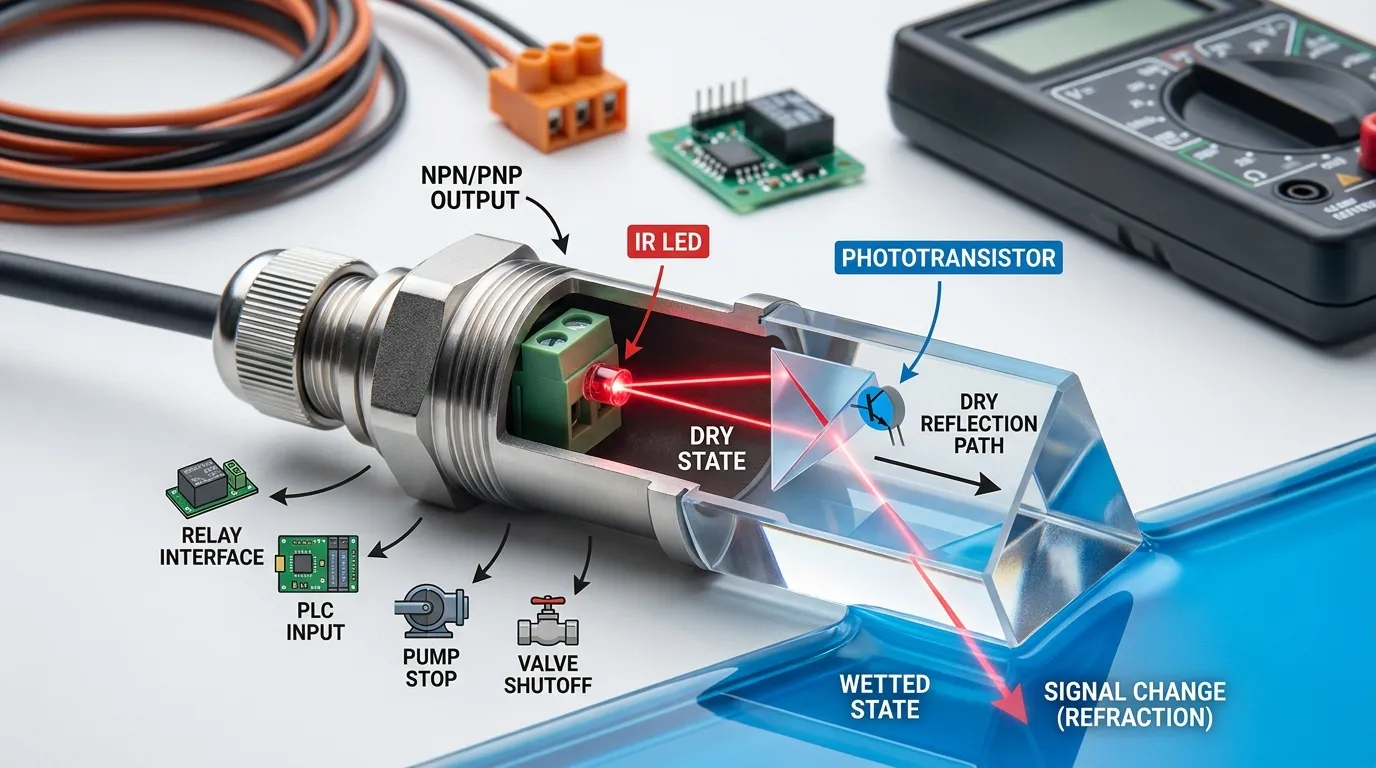
À l’intérieur de la pointe du capteur, une LED infrarouge envoie de la lumière dans un prisme. Un phototransistor reçoit la lumière réfléchie. Dans les airs, Le prisme réfléchit le faisceau infrarouge vers le récepteur. Lorsque le liquide recouvre le prisme, Changements de la condition réfractive, moins de lumière revient au récepteur, et l’état de sortie des interrupteurs électroniques.
Ce principe de détection sec contre humide est utile pour la protection contre le débordement car le capteur n’a pas besoin d’une longue distance de course. Le point de commutation est proche de la pointe physique du capteur, Ainsi, la position en hauteur peut être placée près du sommet du réservoir, Sous le port de trop-plein ou la marge de sécurité.
Selon le système de contrôle de l’acheteur, la sortie peut être configurée pour une entrée directe de l’API, Panneaux d’alarme basse tension, Circuits à interface relais, ou de l’électronique OEM personnalisée. Les sorties NPN et PNP sont courantes pour les systèmes de contrôle numériques. Pour les systèmes de niveaux continus, 4–20 mA peut être utilisé, Mais la protection contre les débordements utilise généralement un interrupteur ponctuel car le circuit n’a besoin que d’une alarme de haut niveau ou d’un signal de coupure.
Alarme de haut niveau vs arrêt automatique
La protection contre le débordement doit être conçue en fonction de ce qui doit se passer lorsque le point haut est atteint.
Un Circuit d’alarme uniquement avertit l’opérateur à l’aide d’un buzzer, Tour de lumière, montrer, Alarme d’API, ou signal à distance. Cela convient lorsque la confirmation humaine est requise avant d’arrêter un processus, ou lorsque le réservoir fait partie d’une station de remplissage manuelle.
Un Circuit d’arrêt automatique arrête l’entrée sans attendre un opérateur. Le signal du capteur peut arrêter une pompe de remplissage, Fermez une vanne d’admission, désactiver une pompe doseuse, ou déclencher un verrouillage de manette. C’est préféré lorsque le débordement pourrait rapidement endommager les équipements ou lorsque le remplissage peut se faire sans surveillance.
De nombreux systèmes industriels utilisent les deux: Le premier capteur de haut niveau déclenche une alarme et cesse de se remplir, tandis qu’un second capteur haut-haut agit comme une sauvegarde redondante. Le capteur de secours doit être câblé sur une alarme indépendante ou une logique de sécurité lorsque cela est possible, pas seulement dans le même état logiciel.
Pour les systèmes où le mode de défaillance opposé est également important, Comme empêcher une pompe de fonctionner sans liquide, voir notre Protection contre la pompe contre le fonctionnement à sec application.
Options de câblage de coupure de haut niveau
La conception du câblage dépend du fait que le signal capteur soit envoyé à un API, Module relais, Contrôleur de pompe, Haut-parleur de soupapes, ou panneau d’alarme. À l’étape RFQ, Notre équipe confirme la tension d’alimentation, Type de sortie, État normal, Longueur du câble, Connecteur, et si le signal doit être actif lorsqu’il est sec ou actif lorsqu’il est mouillé.
| Fonction de haut niveau | Chemin typique du signal | Choix de sortie commun | Circuit Action |
|---|---|---|---|
| Alarme locale de débordement | Panneau d’alarme capteur → → sonnette/balise | NPN, PNP, ou interface relais | Active une alarme visuelle ou sonore lorsque la pointe est mouillée |
| Entrée de haut niveau des PLC | Entrée numérique capteur → PLC | NPN ou PNP | L’API enregistre l’état de haut niveau et exécute une logique d’alarme |
| Coupure de la pompe | Relais/contrôleurs → capteur → démarreur de pompe | NPN/PNP avec interface relais | Arrête la pompe de remplissage lorsque le liquide atteint le point culminant |
| Coupure de vanne | Capteur → contrôleur/conducteur → électrovanne | NPN/PNP ou interface relais | Fermeture de la vanne d’admission pour éviter un remplissage supplémentaire |
| Alarme redondante à haute fréquence | Le second capteur → une entrée ou une alarme indépendante | Sortie numérique séparée | Avertissement de secours si le premier étage de contrôle échoue |
| Carte de contrôle OEM | Capteur → entrée PCB personnalisée | Sortie ou connecteur de transistor personnalisé | Intègre la protection contre les débordements dans l’électronique des équipements |
Pour les systèmes critiques pour la sécurité, Le capteur ne doit pas être considéré comme un dispositif de sécurité autonome à moins que l’architecture de contrôle complète ne soit conçue et validée à cet effet. Le rôle pratique de l’interrupteur optique est de fournir une vitesse, détection répétable à haut niveau sur l’alarme ou le circuit de coupure.
Redondance avec un second capteur haut-haut
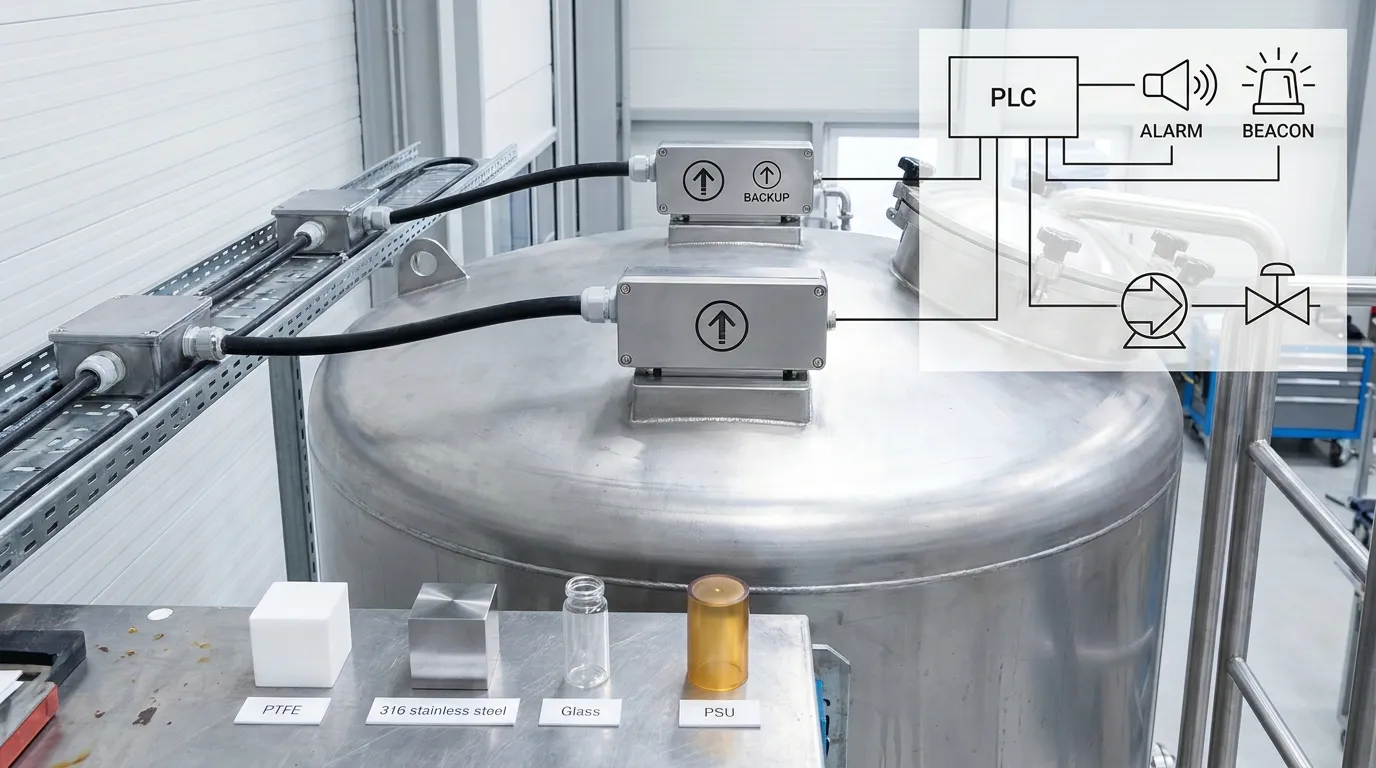
Un seul capteur optique de haut niveau suffit souvent pour une protection simple de l’équipement. Cependant, Un second capteur est recommandé lorsque le débordement pourrait endommager des équipements coûteux, contaminer une zone de production, ou provoquer une marée noire dangereuse.
Le premier capteur peut être placé au niveau normal de l’alarme de haut niveau ou au point d’arrêt de remplissage. Le second capteur doit être monté légèrement plus haut, En dessous du véritable point de dépassement, comme signal d’urgence haut-élevé. Ce second signal peut activer une balise séparée, envoyer une erreur de contrôleur, désactiver la commande de remplissage, ou nécessitent une réinitialisation manuelle.
La redondance aide à protéger contre les défauts de câblage, Erreurs de programmation du contrôleur, Bouchons d’entrée, Vannes défaillantes, Paramètres incorrects de l’opérateur, ou un câble principal de capteur endommagé. Cela permet également aux équipes de maintenance un diagnostic plus clair des défauts: si le capteur haut-haut se déclenche, L’arrêt normal en haut niveau n’a pas contrôlé l’événement de remplissage comme prévu.
Montage sur le débordement pour la protection contre les débordements
Les capteurs de trop-plein sont généralement installés depuis le dessus du réservoir ou la paroi latérale supérieure. Le montage sur le débardeur maintient la pointe de détection au point haut tandis que le câble sort au-dessus de la zone liquide. Il convient souvent aux réservoirs en plastique, Réservoirs de refroidissement, Réservoirs de dosage, réservoirs d’eau, Réservoirs à réactifs, et des contenants liquides OEM.
Les choix de montage clés incluent un montage fileté, Montage des panneaux, Installation de type compression, ou un fitting OEM personnalisé. La taille du filetage et la méthode d’étanchéité devraient correspondre à l’épaisseur de la paroi du réservoir, Conception du capuchon, et environnement de service. Pour de nombreuses applications, Un capteur optique compact peut être monté là où un interrupteur à flotteur n’aurait pas assez d’espace pour se déplacer.
La pointe de détection doit être positionnée sous le point de déversement avec une marge suffisante pour un délai d’arrêt de pompe, Temps de fermeture des soupapes, Turbulence liquide, mousse, ou mouvement des vagues. Si l’aquarium a de fortes éclaboussures, un tube de calme, Emplacement protégé, Délai logiciel, ou un filtrage logique peut être envisagé, mais le délai ne doit pas être si long qu’il annule la protection contre les débordements.
Pour les applications en cuves sur le marché indien, Nous le soutenons également capteur de trop-plein pour réservoirs projets avec support de configuration et d’exportation OEM.
Matériaux et spécifications à confirmer
Le corps du capteur et les parties mouillées doivent correspondre au liquide. HojellyTek peut discuter d’options comme l’alimentation, PTFE, 316 Acier inoxydable, ou en verre selon la compatibilité des supports, Conditions de nettoyage, et exigences mécaniques.
Avant de commander, confirmer:
- Type liquide: eau, Liquide de refroidissement, huile, combustible, chimique, Réactif, Détergent, ou liquide mixte
- Que le liquide soit clair, Coloré, mousse, collant, Revêtement, ou turbulente
- Matériau du réservoir et épaisseur des parois
- Style de montage: débardeur, Mur latéral, fileté, Bride, ou un ajustement personnalisé
- Sortie requise: NPN, PNP, Interface de relais, analogique, ou signal de carte OEM
- Tension d’alimentation requise par le contrôleur ou la carte d’alarme
- État normal: alarme quand elle est mouillée ou alarme quand elle est sèche
- Longueur du câble, Type de connecteur, Exigences en matière de couleur des fils, et besoins en protection de la propriété intellectuelle
- Est-ce qu’un second capteur haut-haut est nécessaire
- Exigences de destination d’exportation et de documentation
Pour des médias agressifs, Zones à haute température, ou des projets à zones dangereuses, La sélection des matériaux et des enclos doit être examinée attentivement avant l’approbation de l’échantillon.
Optique vs flotteur pour circuits d’alarme de débordement
| Point de sélection | Commutateur optique de haut niveau | Interrupteur à flotteur mécanique |
|---|---|---|
| Pièces mobiles | Pas de bras flotteur ni de charnière | Nécessite un mouvement de flotteur |
| Point de réponse | Interrupteurs lorsque le liquide atteint la pointe du prisme | Cela dépend de la course et de l’angle du flotteur |
| Ajustement compact du réservoir | Idéal pour les espaces OEM étroits | Nécessite une dégagement de dégagement |
| Risque de liquide collant | Pas de flotteur pour coller, Mais le revêtement doit être pris en compte | Le flotteur peut coller, faute, ou confiture |
| Flexibilité de montage | Adapté pour un débardeur ou un montage latéral | L’orientation et le chemin de déplacement sont importants |
| Utilisation des circuits d’alarme | Un ajustement solide pour une alarme numérique de haut niveau | Courant dans les aquariums simples |
| Maintenance concern | Vérifiez la propreté des prismes et l’intégrité des câbles | Vérifiez le mouvement des flotteurs, Charnière, et montée en puissance |
Liste de contrôle contre la protection contre le débordement
Utilisez cette liste de contrôle lors de l’envoi d’une demande de renseignements pour un projet de protection contre le débordement du capteur de niveau optique:
- Définissez le point d’alarme exact de haut niveau à l’intérieur du réservoir.
- Confirmez la distance entre le point d’alarme et le véritable point de dépassement.
- Décidez si le capteur ne doit déclencher qu’une alarme ou arrêter de se remplir.
- Spécifier si la sortie va vers un API, Relais, Contrôleur de pompe, Haut-parleur de soupapes, ou panneau d’alarme.
- Confirmer NPN, PNP, Interface de relais, ou une exigence de sortie personnalisée.
- Décidez si un second capteur de secours haut-haut est nécessaire.
- Confirmez la compatibilité liquide avec l’alimentation, PTFE, 316 Acier inoxydable, verre, ou d’autres matériaux mouillés.
- Fournir une direction de montage: débardeur, Mur latéral, Fixé sur le capuchon, fileté, ou sur mesure OEM.
- Vérifiez s’il éclabousse, écume, Revêtement, ou la turbulence peut affecter le point de haut niveau.
- Confirmez la longueur du câble, Connecteur, Direction de sortie du fil, et exigences de scellement.
- Confirmer la quantité de l’échantillon, Besoins en dessin, et les attentes de production.
5-Processus de Service en étapes
1. Enquête
Envoyez le dessin du char, Type liquide, Circuit de contrôle, Poste de haut niveau, et la sortie cible. Les photos de la zone du débardeur sont utiles lorsque l’espace est limité.
2. Spécifications et personnalisation
Notre équipe d’ingénierie confirme la structure de détection, Matériau humide, Type de sortie, Filetage de montage, Câble, Connecteur, et logique d’alarme.
3. Exemple
Un échantillon peut être préparé pour un test d’ajustement, Vérification de commutation humide/sec, et les contrôles de compatibilité des manettes.
4. Production et contrôle qualité
Après confirmation de l’échantillon, La production suit la configuration approuvée. Les tests clés se concentrent sur l’apparence, câblage, Fonction de commutation, et exigences spécifiques à chaque client.
5. Transport maritime
En tant que fabricant et exportateur de Shenzhen, HojellyTek soutient les acheteurs étrangers aux États-Unis, EU, Inde, et d’autres marchés offrant une coordination de communication et de documentation prête à l’exportation.
Pourquoi travailler avec HojellyTek
HojellyTek se concentre sur la détection optique photoélectrique et la détection des niveaux liquides, avec R interne&Prise en charge de D et OEM/ODM pour la structure des capteurs, matériel, Câble, Connecteur, et la personnalisation des sorties. Nous soutenons les acheteurs qui ont besoin d’une discussion pratique sur l’ingénierie avant la production, Pas seulement un numéro de pièce de catalogue.
Pour des projets de réservoirs intelligents ou d’équipements connectés, notre équipe peut également discuter de l’intégration liée à Tuya et Smart Life lorsque cela est pertinent pour la conception complète de l’appareil.
FAQ
Comment fonctionne la protection contre les débordements des capteurs de niveau optique?
La protection contre le débordement du capteur de niveau optique utilise une LED infrarouge, Phototransistor, et la pointe prismatice pour détecter quand un liquide atteint le point de haut niveau. Lorsque la pointe passe de sèche à humide, la sortie commute et peut déclencher une alarme, Arrêt de pompe, Fermeture de la valve, ou un signal de haut niveau PLC.
Un interrupteur optique est-il meilleur qu’un interrupteur à flotteur pour les alarmes de débordement?
Pour les réservoirs compacts ou le risque de flotteur collant, Un interrupteur optique est souvent préférable car il n’a pas de bras flotteur mobile. Il commute à la pointe du prisme au lieu de dépendre du déplacement mécanique. Revêtement liquide, Compatibilité chimique, et la position de montage doit encore être vérifiée.
Le capteur peut-il arrêter automatiquement une pompe?
Oui, si le circuit de contrôle est conçu pour cela. La sortie du capteur optique peut aller vers un API, Module relais, Contrôleur de pompe, ou un circuit d’interverrouillage qui arrête la pompe de remplissage lorsque le point de niveau élevé est atteint.
Dois-je utiliser un capteur ou deux capteurs?
Utilisez un capteur de haut niveau pour l’alarme de débordement basique ou l’arrêt de remplissage. Ajoutez un second capteur haut-haut lorsque le débordement pourrait endommager des équipements coûteux, créer des problèmes de sécurité, ou nécessitent une logique d’alarme de secours.
Où le capteur doit-il être monté?
La plupart des applications de débordement utilisent un montage sur le dessus du réservoir ou sur la paroi latérale supérieure. La pointe du prisme doit se situer sous le point de trop-plein réel avec une marge suffisante pour le délai de la pompe, Temps de fermeture des soupapes, éclaboussures, et le mouvement liquide.
Quelles informations devrais-je envoyer pour obtenir un devis?
Envoyez le type liquide, Dessins ou photos du char, Position de montage, Tension d’alimentation, Type de sortie, État d’alarme normal, Besoins en câble ou connecteur, et si le capteur contrôle une alarme, pompe, soupape, PLC, ou circuit high-high de secours.
Demandez un devis
Envoyez votre dessin de protection contre le débordement, Type liquide, Circuit de contrôle, et méthode de montage cible sur HojellyTek via WhatsApp ou e-mail. Notre équipe peut recommander une configuration optique d’interrupteur haut niveau pour alarme uniquement, Arrêt automatique, ou une protection redondante de débordement haut-haut.


