
Capteur de niveau optique pour la protection contre la pompe contre la course à sec
Protection de la pompe à sec par capteur de niveau optique Aide à arrêter une pompe avant que le liquide ne tombe sous le point d’aspiration sûr et ne provoque des joints brûlés, Hélices endommagées, Surchauffe, ou prise d’air. HojellyTek fournit des capteurs optiques photoélectriques pour les compacts, Circuits de coupure à faible altitude à réponse rapide dans les réservoirs, Réservoirs, Systèmes de refroidissement, Conteneurs d’huile, et ensembles pompes OEM.
Utilisez cette page pour spécifier le capteur, Logique de câblage, Point de montage, et réinitialiser le comportement pour un circuit de prévention à sec fiable.
Capacités de protection contre la pompe optique contre la manœuvre à sec
Pour la protection de la pompe, Le capteur n’est pas qu’un simple indicateur de niveau. Il devient le point de décision de bas niveau dans le circuit de commande: lorsque le liquide descend en dessous de la hauteur de coupure, La sortie change d’état et le contrôleur arrête la pompe.
HojellyTek soutient des projets de protection à répétition à sec qui peuvent inclure:
- Détection optique au niveau ponctuel au niveau minimum sûr du liquide
- Sortie de coupure de bas niveau pour les API, Carte relais, Contrôleur de pompe, ou entrée VFD
- NPN, PNP, ou des options de signaux analogiques selon le système de contrôle
- Sélection logique NO/NC basée sur des exigences de sécurité
- Capteurs compacts à pointe prismatice pour petits réservoirs et modules de pompe OEM
- Sélection de matériaux humides tels que l’alimentation, PTFE, 316 Acier inoxydable, ou verre
- Montage fileté ou sur mesure pour mur de réservoir, Côté réservoir, ou installation en chambre
- Personnalisation OEM/ODM pour le boîtier, Câble, Connecteur, fil, et logique de sortie
Pour un aperçu général du produit, voir notre Capteur de niveau optique gamme. Pour un produit de référence prêt à l’emploi, Examiner le Interrupteur photoélectrique de niveau liquide.
Pourquoi la coupure à blanc doit-elle se faire avant que la pompe ne soit vide
Une pompe n’a pas besoin de rester à sec longtemps avant que les dégâts ne commencent. Lorsque le liquide n’est plus présent du côté aspiration, La pompe peut perdre le refroidissement, Lubrification, et la charge hydraulique. Le résultat peut être des joints mécaniques brûlés, Hélices endommagées, Parties humides surchauffées, Cavitation, vibration, ou défaillance totale de la pompe.
Un circuit de protection à sec doit donc répondre à une question pratique:
À quel niveau exact de liquide la pompe doit-elle être forcée à l’arrêt?
Un capteur de niveau optique est monté à ce point de coupure. Lorsque le liquide recouvre la pointe du prisme, Le capteur détecte l’état « humide ». Quand le liquide tombe sous la pointe, le chemin optique change et la sortie change rapidement. Le circuit de contrôle supprime alors le signal de fonctionnement de la pompe, ouvre un relais, désactive une entrée VFD, ou envoie une commande d’arrêt au contrôleur de la pompe.
C’est différent de la surveillance générale des réservoirs. Dans la protection contre les essais à sec, La position du capteur, Logique de sortie, et le comportement de réinitialisation doit être conçu autour de la sécurité de la pompe.
Comment le capteur optique détecte les états humides et secs
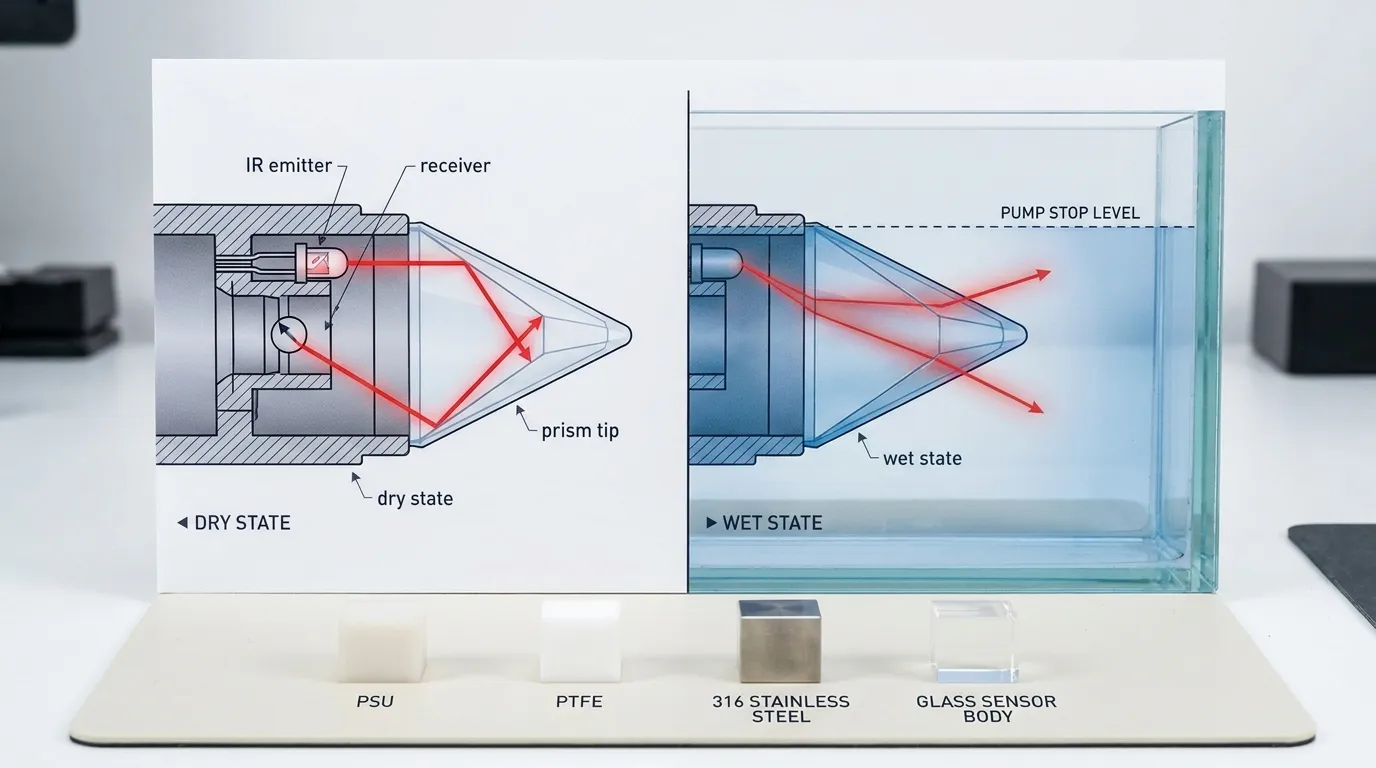
Un capteur de niveau photoélectrique utilise une LED infrarouge, un phototransistor, et un prisme optique façonné à la pointe de détection. Dans les airs, La lumière infrarouge se réfléchit à l’intérieur du prisme et atteint le récepteur. Lorsque le prisme est recouvert de liquide, La condition de réfraction change et moins de lumière revient au récepteur. L’électronique convertit ce changement optique en sortie numérique.
Ce design n’a pas de bras flottant, aimant, Charnière, ou une partie mécanique mobile à l’intérieur du liquide. C’est important pour les applications de coupure de pompe où une coupure lente, Coincé, ou un flotteur incliné peut retarder le signal d’arrêt. La détection optique est particulièrement utile pour les réservoirs compacts, Chambres étroites, Équipements OEM, Réservoirs de liquide de refroidissement, Systèmes de dosage, Récipients d’eau, et des modules de pompe scellés où les interrupteurs mécaniques peuvent être trop grands.
Un circuit à sec utilise normalement le capteur comme interrupteur ponctuel. Pour des applications connexes de détection ponctuelle, voir notre Commutateur de niveau ponctuel Page.
Câblage de coupure de bas niveau pour le contrôle de la pompe
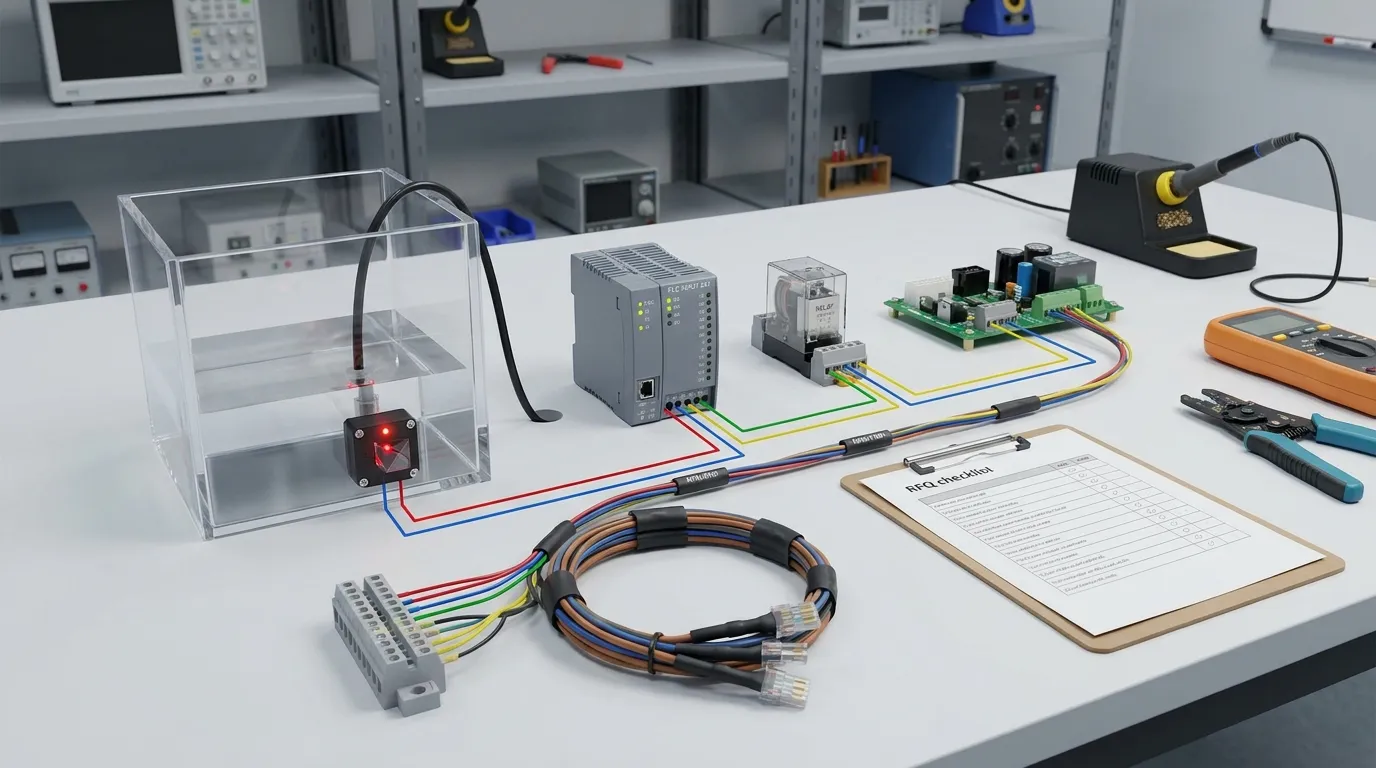
La sortie du capteur doit être adaptée à l’entrée de contrôle, pas choisi uniquement par la forme du capteur. Avant de commander, Vérifiez si votre système de pompe utilise une bobine relais, Entrée numérique API, Entrée à contact sec VFD, Entrée transistor, ou un circuit imprimé personnalisé.
Les dispositifs de contrôle courants incluent:
- Entrée capteur vers API: l’API indique l’état humide/sec et contrôle le contacteur de pompe ou le VFD.
- Capteur vers module relais: Le capteur entraîne un relais qui ouvre le circuit d’activation de la pompe.
- Capteur vers contrôleur de pompe: Le contrôleur reçoit une alarme de faible niveau ou un signal de permis d’exécution.
- Capteur vers entrée VFD: Le signal de passage à sec désactive le fonctionnement du pilotage ou déclenche une entrée de panne.
- Capteur vers circuit imprimé OEM: Le signal est lu directement par la carte de contrôle produit.
La conception la plus sûre est généralement une logique de « permis de fonctionnement ». La pompe n’est autorisée à fonctionner que lorsque le capteur confirme la présence d’un liquide. Quand le capteur devient sec, Le permis de passage est retiré.
Table logique de câblage pour la protection contre les manœuvres à sec
| État liquide à la pointe du capteur | Logique de sortie du capteur | Interprétation du contrôleur | Fonctionnement de la pompe | Meilleur cas d’utilisation |
|---|---|---|---|---|
| Mouillé / liquide présent | Signal de permis de passage actif | Niveau de liquide sûr disponible | Pompe autorisée à fonctionner | Protection standard à basse altitude |
| Sec / liquide sous la pointe | Signal de permis de passage supprimé | Risque de manœuvre détecté | La pompe s’arrête ou ne peut pas démarrer | Coupure de pompe de sécurité |
| Humide après recharge | Signal de nouveau actif | Liquide restauré | Réinitialisation automatique ou réinitialisation manuelle selon la logique | Réservoirs simples ou systèmes de remplissage contrôlé |
| Sèche avec le loquet activé | Le Trip reste actif | La faute doit être reconnue | La pompe reste ÉTEINTE | Pompes à forte valeur, Dosage chimique, Systèmes non surveillés |
| Humidité/sec instable près de la ligne d’onde | Le signal peut changer à plusieurs reprises | Risque de bavardage | Utiliser le délai, hystérésis, ou tube de calme | Réservoirs agités ou petites chambres |
| Défaillance capteur/câble | Le signal dépend de la conception du câblage | Faute ou absence de permis de circulation | La pompe doit s’arrêter en conception de sécurité | Circuits critiques de protection de la pompe |
Pour la plupart des applications à sec, Spécifiez clairement l’état de sortie humide/sec souhaité. L’usine peut aider à faire correspondre NPN, PNP, NO/NC, ou sortie analogique vers la conception de votre manette.
Réponse optique rapide vs interrupteurs à flotteur lents
Les interrupteurs à flotteur sont courants, Mais ils ne sont pas toujours idéaux pour la protection contre les pompes. Un char a besoin d’un mouvement physique, Espace pour balancer, et orientation correcte. Dans les petits réservoirs, liquide huileux, Chambres de pompe étroites, ou un équipement à vibration, Le flotteur peut réagir lentement ou rester coincé.
Un capteur optique répond directement à la pointe de détection. Lorsque le liquide découvre le prisme, L’état optique change sans attendre qu’un bras flotteur se détache. Cela rend le point de coupure plus répétable et compact.
La détection optique à sec est utile lorsque l’acheteur en a besoin:
- Une hauteur de coupure précise à bas niveau
- Montage compact à l’intérieur d’un petit réservoir
- Commutation rapide au niveau minimum de sécurité
- Aucune pièce mobile dans le liquide
- Boîtier et personnalisation des câbles adaptés aux OEM
- Intégration du signal plus propre avec un PCB, PLC, ou contrôleur de pompe
Cependant, Le capteur doit toujours être correctement sélectionné. Liquide moussant, Revêtement épais, Cristallisation, ou un résidu épais peut nécessiter un choix de matériau, Placement des pointes, Accès de nettoyage, ou une méthode de protection supplémentaire.
Loquet, Retard, et la logique à réinitialisation automatique
La sortie du capteur n’est qu’une partie du système de protection. La logique de contrôle détermine ce qui se passe après la détection d’une condition sèche.
Logique de réinitialisation automatique permet à la pompe de redémarrer après que le liquide soit revenu au-dessus de la pointe du capteur. Cela peut fonctionner pour des réservoirs d’eau simples, Réservoirs de remplissage, ou des systèmes où le redémarrage est sûr et attendu.
Logique de verrouillage maintient la pompe ÉTEINTE après un déclenchement à sec jusqu’à ce qu’un opérateur ou contrôleur réinitialise la panne. C’est mieux pour les pompes coûteuses, Systèmes chimiques, Dosage industriel, Matériel non surveillé, ou des systèmes où des démarrages à sec répétés pourraient causer des dommages.
Logique de délai Empêche les trips gênants causés par les vagues, éclaboussures, bulles, ou un mouvement momentané du liquide autour du capteur. Un court délai de contrôle peut confirmer que le capteur est vraiment sec avant d’arrêter la pompe. Un délai de redémarrage peut également éviter un court cycle après le remplissage.
Le sujet de la page n’est pas l’entretien de la pompe; Le point clé est la conception des commandes: Définissez si la sortie sèche doit arrêter immédiatement la pompe, Arrêter après un délai vérifié, verrouiller jusqu’à la réinitialisation manuelle, ou réinitialiser automatiquement après le retour du signal humide.
Montage du capteur au point de coupure
Le capteur doit être installé au niveau minimum sûr de liquide, pas simplement près du fond de l’aquarium. La hauteur correcte dépend du port d’aspiration, Géométrie de l’admission de la pompe, Risque de vortex, Volume de réserve requis, et si la surface du réservoir bouge pendant le fonctionnement.
Guidage de montage:
- Placez la pointe du prisme à la hauteur du liquide où la pompe doit s’arrêter.
- Garde la pointe éloignée des parois de l’aquarium, Angles, Zones sédimentaires, et zones mortes.
- Évitez les endroits où les bulles ou les éclaboussures exposent et couvrez la pointe à plusieurs reprises.
- Pour les chars agités, Envisagez un tube de calme ou une chambre de détection protégée.
- Pour l’installation sur les murs latéraux, Confirmer le type de thread, Méthode d’étanchéité, et direction du câble.
- Pour les liquides chimiquement agressifs, Choisir des matériaux humides compatibles.
- Pour les applications au pétrole ou au carburant, confirmer la réponse optique et la compatibilité des matériaux avant la production de masse.
Pour la protection contre le débordement et le haut niveau en utilisant des principes similaires de détection optique, voir notre capteur de protection contre les débordements Page.
Liste de contrôle de la protection contre les essais à blanc avant la RFQ
| Point à confirmer | Pourquoi c’est important pour le circuit de coupure |
|---|---|
| Type liquide | Eau, Liquide de refroidissement, huile, combustible, chimique, ou un liquide mixte affecte le comportement du matériau et optique |
| Niveau minimum de sécurité | Détermine la hauteur de montage exacte du capteur |
| Matériau de réservoir ou de chambre | Affecte le fil, Scellement, et méthode de montage |
| Type d’entrée de commande | PLC, Relais, VFD, Contrôleur de pompe, ou bien le PCB nécessite un autre appariement de sortie |
| Préférence de sortie | NPN, PNP, NO/NC, ou la sortie analogique doit correspondre au circuit |
| Logique de réinitialisation | Le réinitialisation automatique ou le loquet modifie le comportement de redémarrage de la pompe |
| Exigence de délai | Empêche les faux déclenchements des ondes, vibration, bulles, ou éclaboussures |
| Matériau mouillé | Alimentation, PTFE, 316 Acier inoxydable, Ou le verre devrait correspondre au liquide et à l’environnement |
| Câble et connecteur | Important pour l’assemblage OEM, service access, et le rouage étanche |
| Orientation de l’installation | Montage latéral, Montage vertical, Monture de chambre, ou le support personnalisé affecte la fiabilité |
5-Processus de Service en étapes
1. Enquête
Envoyez votre type de pompe, Dessin de char, Type liquide, Entrée de contrôle, et un niveau de coupure exigé par WhatsApp ou par e-mail. Photos, Schémas de câblage, ou les détails d’entrée du PCB aident nos ingénieurs à répondre plus rapidement.
2. Spécification et personnalisation
Notre équipe confirme le type de capteur optique, Matériau humide, Logique de sortie, fil, Câble, Connecteur, et direction de montage. Pour les projets OEM/ODM, Les détails du boîtier et du harnais peuvent être ajustés pour s’adapter à la conception de l’équipement.
3. Exemple
Un échantillon peut être préparé pour un test de signal humide/sec dans votre liquide et votre circuit de contrôle. Cette étape est importante pour vérifier le comportement de réinitialisation, Synchronisation d’arrêt à basse altitude, et position de montage.
4. Production et contrôle qualité
Après approbation de l’échantillon, La production suit les spécifications confirmées. La QC se concentre sur la fonction de commutation optique, Comportement de sortie, câblage, Scellement, et l’apparence basée sur la configuration convenue.
5. Transport maritime
HojellyTek exporte des produits optiques de capteurs de niveau liquide depuis Shenzhen vers des clients aux États-Unis, EU, Inde, et autres marchés. L’emballage et la documentation sont organisés selon les exigences du projet.
Exigences et spécifications à confirmer
Pour un projet de protection contre la pompe à sec, Confirmez ces détails avant de commander:
- Nom et concentration liquides
- Niveau normal et minimum de liquide
- Épaisseur de la paroi du réservoir et espace de montage
- Filetage ou structure d’installation requise
- Matériau du corps du capteur et matériau du prisme/extrémité
- Tension d’alimentation requise par la carte de contrôle
- Type de sortie: NPN, PNP, 4–20 mA, ou une autre interface
- Préférence de sortie en état humide et sec
- Longueur du câble, Connecteur, et l’exigence de couleur des fils
- Savoir si la pompe doit se réinitialiser automatiquement ou rester verrouillée ÉTEINTE
- Si l’application nécessite une intégration Tuya/Smart Life pour la surveillance à distance des réservoirs
Ne devine pas la logique du câblage au moment de l’installation. Le circuit de coupure doit être spécifié avant la production afin que la sortie du capteur et l’entrée du contrôleur correspondent correctement.
Capteur optique vs autres méthodes de protection à sec
| Méthode | Force | Limitation | Meilleur choix |
|---|---|---|---|
| Capteur de niveau optique | Réponse rapide au niveau ponctuel, compact, Pas de flotteur en mouvement | Il faut un matériau correct et une pointe de détection propre | Réservoirs OEM, Réservoirs, Systèmes de pompes compacts |
| Interrupteur à flotteur | Simple et familier | Ça peut être lent, encombrant, incliné, Ou coincé | Des réservoirs plus grands avec suffisamment d’espace pour les déplacements des flotteurs |
| Pressostat | Peut déduire une faible succion ou une condition de débit | Peut ne pas détecter directement le niveau réel du réservoir | Systèmes de pompe nécessitant une remise en secours basée sur la pression |
| Interrupteur de débit | Détecte la perte de débit réelle | Peut réagir après que le flux ait déjà échoué | Protection du pipeline et confirmation secondaire |
| Détection de courant | Détecte une charge motrice anormale | Nécessite une réglage et peut varier selon la pompe | Couche de protection motrice, Coupure de niveau pas précise |
Pour de nombreux systèmes compacts, Le capteur optique est le dispositif de coupure de bas niveau le plus direct. Pour les systèmes industriels complexes, il peut aussi être combiné à la pression, couler, ou la surveillance du courant pour la protection en couches.
Pourquoi travailler avec HojellyTek
HojellyTek est un fabricant et exportateur de Shenzhen spécialisé dans la détection optique photoélectrique et le développement de capteurs de niveau liquide. Avec R interne&D et capacités OEM/ODM, Nous aidons les acheteurs à adapter le corps du capteur, Circuit de sortie, Câble, et la conception de montage à l’application de protection de la pompe.
Notre équipe soutient les questions pratiques d’ingénierie: Logique humide/sèche, Sélection NPN/PNP, Options de filetage, Compatibilité des matériaux, et tests d’échantillons. Au lieu d’offrir un seul interrupteur générique pour chaque pompe, Nous aidons à définir le point de coupure et le comportement de contrôle avant la production.
FAQ
Un capteur de niveau optique peut-il empêcher le fonctionnement à sec de la pompe?
Oui. Lorsqu’elle est montée au niveau liquide minimum sûr, le capteur détecte lorsque du liquide tombe sous la pointe du prisme et envoie un signal à l’état sec pour arrêter la pompe via un PLC, Relais, VFD, ou contrôleur de pompe.
Que signifie la protection contre la pompe à sec par capteur de niveau optique?
Cela signifie utiliser un capteur optique de niveau ponctuel comme dispositif de coupure de bas niveau dans le circuit de contrôle de la pompe. La pompe ne fonctionne que lorsque le capteur confirme la présence d’un liquide et s’arrête lorsqu’il détecte un état sec.
La pompe doit-elle redémarrer automatiquement après le remplissage du réservoir?
Cela dépend du risque. L’auto-réinitialisation convient aux réservoirs de remplissage simples. Le loquet/réinitialisation manuelle est plus sûr pour les pompes coûteuses, Produits chimiques, Systèmes non surveillés, ou des applications où des démarrages à sec répétés pourraient endommager l’équipement.
Un capteur optique est-il plus rapide qu’un interrupteur à flotteur?
Dans de nombreux chars compacts, oui. Un capteur optique change d’état à la pointe du prisme sans attendre qu’un bras flotteur bouge. Cela fournit un signal de coupure plus direct au niveau de liquide sélectionné.
Où le capteur doit-il être installé pour la protection contre les manœuvres à sec?
Installez-le à la hauteur de coupure minimale sûre au-dessus du point de risque d’aspiration de la pompe. Évitez les bulles, sédiments, Turbulence, et des endroits où la pointe du capteur peut être éclaboussée à plusieurs reprises au lieu d’être mouillée de façon continue.
Quelle sortie devrais-je choisir pour un contrôleur de pompe?
Choisissez la sortie en fonction de l’entrée de contrôle. Les API utilisent souvent des entrées numériques NPN ou PNP, Les modules relais peuvent nécessiter une logique NO/NC, et certains systèmes nécessitent une entrée analogique ou personnalisée sur PCB. Confirmez cela lors du RFQ.
Demandez un devis pour la protection des capteurs de test à sec de la pompe
Envoyez votre dessin de char, Type liquide, Méthode de contrôle de la pompe, Entrée du câblage, et un niveau de coupure requis pour HojellyTek via WhatsApp ou email. Nous recommanderons une configuration de capteur de niveau optique pour votre circuit de protection à sec, y compris la logique de sortie, matériel, fil, Câble, et options d’essai par exemple.


