
Capteurs de niveau liquide à fibre optique (Grillage à longue période) Expliqué
Un capteur de niveau liquide à fibre optique utilisant un réseau à longue période détecte le niveau de liquide en mesurant comment la transmission de la lumière change à l’intérieur d’une fibre optique lorsque une partie du réseau est entourée de liquide. Contrairement aux capteurs optiques photoélectriques de niveau d’HojellyTek, cette technologie n’utilise pas de pointe prismatice avec un émetteur et un récepteur IR. Cela dépend de la perte optique, Interaction avec l’indice de réfraction, et la longueur de la fibre exposée au liquide.
Cet article explique comment fonctionnent les capteurs de fibres à grillage à longue période, là où ils sont utiles, où ils peuvent être trop complexes, et quand un plus simple Capteur de niveau optique est le meilleur choix pour l’équipement OEM, Réservoirs, Alarmes, et des panneaux de contrôle industriels.
Comment fonctionne la détection de niveau à fibre optique à longue période
Un réseau de longue période, souvent appelé un LPG, est une section de fibre optique où la structure de la fibre est modifiée à intervalles répétés. Ce réseau couple la lumière du noyau en fibre en modes de revêtement. En termes simples, Une partie de la lumière qui traverse la fibre est intentionnellement rendue sensible à l’environnement autour de la fibre.
Quand la grille est dans l’air, L’indice de réfraction environnant diffère de celui lorsqu’il est immergé dans un liquide. À mesure que le liquide recouvre davantage le réseau, La quantité de pertes de lumière change. En mesurant le spectre de transmission ou le motif d’atténuation, Le système peut estimer le niveau de liquide le long de la longueur du réseau.
Le principe de détection est différent d’un interrupteur électrique à flotteur typique, Sonde capacitive, Émetteur ultrasonore, ou un commutateur de niveau ponctuel photoélectrique. Un capteur à fibre de grillage à longue période peut nécessiter:
- Une fibre optique avec la section de détection du GPL
- Une source lumineuse
- Équipement de détection ou d’interrogatoire optique
- Traitement du signal pour convertir la perte de lumière en informations de niveau
- Calibration du liquide cible et géométrie d’installation
Pour la recherche, Surveillance spécialisée, Environnements dangereux, et la détection à longue distance, Cette approche peut être très puissante. Pour une détection simple de haut et bas niveau, toutefois, Cela peut être plus que ce que la demande demande.
Pourquoi l’indice de réfraction est important
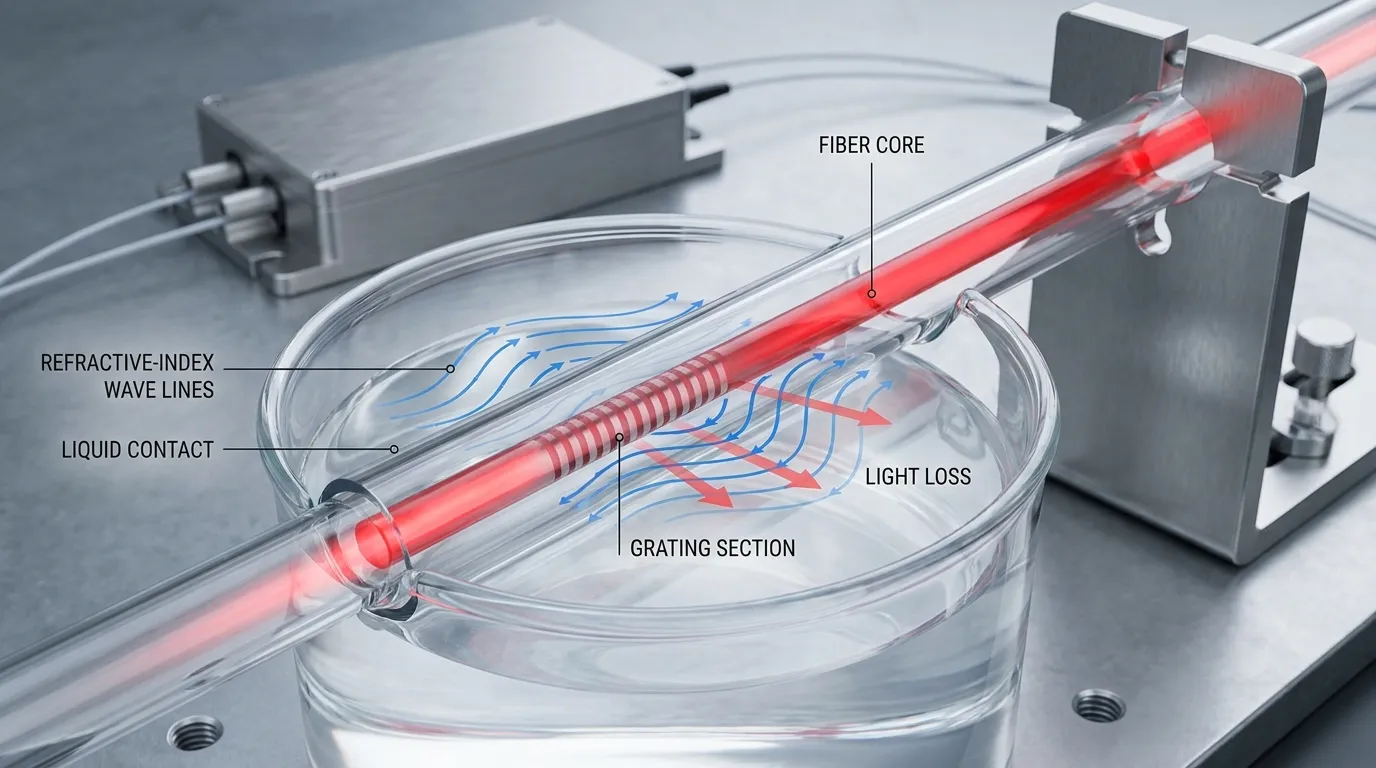
L’idée clé derrière la détection de niveau de réseau à longue période est que le liquide modifie les conditions optiques autour de la fibre. Chaque milieu possède un indice de réfraction. Air, eau, huile, combustible, Solvants, et les liquides cryogéniques n’interagissent pas exactement de la même manière avec la lumière.
Quand le liquide touche la zone du râpeau, Les modes de revêtement sont affectés par le milieu environnant. Le résultat est un changement mesurable dans la transmission de la lumière. Si seulement une petite section du réseau est submergée, Le changement de signal est plus faible. Si une plus grande partie du réseau est submergée, le changement de signal devient plus important.
C’est pourquoi les capteurs à fibre GPL sont souvent évoqués comme des dispositifs de détection de niveau continus ou quasi-continus, Pas seulement les commutateurs ponctuels. La réponse du capteur est liée à la longueur immergée du réseau et aux propriétés optiques du liquide.
Cela explique aussi une limitation importante: Le même design de fibre peut ne pas répondre de la même manière dans tous les liquides. Une application d’eau, Application de l’huile, Réservoir chimique, ou une application à interface mixte peut nécessiter des calibrations et des tests différents.
Les capteurs de niveau à fibre optique ne sont pas les mêmes que les capteurs optiques photoélectriques
Le mot « optique » peut prêter à confusion car il est utilisé pour plusieurs familles de capteurs différentes. Un capteur à réseau à fibre optique à longue période et un capteur de niveau optique photoélectrique utilisent tous deux la lumière, Mais les principes de fonctionnement, Structure des coûts, et les cas d’usage sont différents.
Un interrupteur de niveau optique photoélectrique courant utilise une LED infrarouge, un phototransistor, et une pointe prismatice transparente. À l’état sec, La lumière IR se réfléchit à l’intérieur du prisme et revient au récepteur. Lorsque le liquide recouvre le prisme, Changements de la condition réfractive, Moins de lumière revient, et la sortie des capteurs commute.
Ce genre de Capteur de point photoélectrique est compact, presque, et pratique pour détecter la présence d’un liquide à un niveau fixe. Il est couramment utilisé pour la protection contre les débordements, Détection à basse altitude, Prévention des essais à sec par pompe, Surveillance des petits réservoirs, Systèmes de refroidissement, distributeurs d’eau, Dispositifs médicaux, et des contenants liquides OEM.
Un capteur à fibre optique de GPL, en revanche, est généralement sélectionné lorsque la fibre elle-même doit servir d’élément de détection, lorsque la transmission optique longue distance est précieuse, ou lorsque l’environnement est trop bruyant électriquement ou dangereux pour les appareils électroniques conventionnels près du réservoir.
Là où l’emportent les capteurs de grillage à longue période en fibre optique
Les capteurs de niveau à fibre optique ne sont pas le moyen le moins cher de détecter le liquide. Ils gagnent lorsque l’environnement justifie la complexité supplémentaire.
Sites à forte pression et bruit électrique
Parce que le chemin de détection est optique, Les capteurs à fibre optique peuvent être attrayants autour des moteurs, Équipements haute tension, Transformateurs, Systèmes RF, Équipement de soudure, et d’autres sites où les interférences électromagnétiques peuvent perturber les signaux des capteurs électriques.
Un interrupteur optique photoélectrique nécessite encore l’alimentation et le câblage électrique de sortie au niveau du capteur. Un système à fibre optique peut déplacer plus loin l’électronique sensible, en fonction de la conception.
Surveillance longue distance
La fibre optique peut transmettre des signaux sur de longues distances avec une faible perte de signal. Cela rend la détection de fibres utile à l’endroit de l’aquarium, Navire, ou le point surveillé est loin de la salle de contrôle.
Dans certains projets, Cela peut réduire le besoin de conditionnement du signal électrique près du point de détection. Toutefois, L’ensemble du système a encore besoin d’un véritable interrogateur optique, Plan d’itinéraire, Tubulure de protection, et méthode d’installation.
Potentiel de sécurité intrinsèque
La fibre elle-même ne transporte pas de courant électrique au point de détection, ce qui peut être utile dans des environnements dangereux ou explosifs. C’est pourquoi la détection par fibre optique est souvent discutée parallèlement à l’instrumentation intrinsèquement sûre.
Toutefois, « intrinsèquement sûr » n’est pas quelque chose à supposer uniquement avec le mot fibre. Le système complet, y compris la source lumineuse, Interrogateur, installation, Enceinte, et classification des zones, doit être évalué. Pour les acheteurs comparant des options pratiques, notre page sur Détection intrinsèquement sûre explique comment les exigences de zones dangereuses affectent la sélection des capteurs de niveau optique.
Températures difficiles ou environnements liquides spécialisés
La détection par fibre optique peut être précieuse dans des environnements particuliers où les composants électriques proches du liquide sont indésirables. Selon le matériau de la fibre, Revêtement, emballage, et installation, Il peut être envisagé pour les réservoirs cryogéniques, Processus chimiques, et des points de surveillance à distance.
Pour les applications ponctuelles dans les liquides à basse température, Une conception photoélectrique plus simple peut également être possible lorsque le corps du capteur, scellement, et la pointe optique sont conçues pour ce support. Consultez notre guide pour Détection de niveau cryogénique pour un cas d’usage optique au niveau ponctuel connexe.
Compromis: Pourquoi la fibre optique n’est pas toujours le meilleur choix
Le principal inconvénient d’un capteur de niveau de fibre à réseau à longue période n’est pas le principe de détection. C’est la complexité totale du système.
Un capteur GPL pratique peut nécessiter un équipement d’interrogatoire optique, étalonnage, Routage à fibre protégée, Installation formée, et une interprétation attentive des changements de signaux. Pour un acheteur OEM qui n’a besoin que d’une détection « réservoir plein » ou « réservoir vide », Cela peut être coûteux et inutile.
Les compromis courants incluent:
- Coût système plus élevé que les commutateurs ponctuels simples
- Un interrogateur optique ou un équipement de mesure requis
- Étalonnage affecté par l’indice de réfraction liquide
- Sensibilité possible au revêtement, contamination, bulles, et gisements
- Manipulation des fibres plus délicate que les boîtiers de capteurs moulés
- Installation et dépannage plus complexes
- Moins adapté aux appareils électroménagers à bas coût ou aux constructions compactes OEM
Les capteurs à fibre nécessitent également une protection mécanique réaliste. Une fibre nue n’est pas une sonde industrielle robuste à elle seule. L’emballage, tube, Tête de montage, Conception de l’étanchéité, et la protection des câbles compte autant que le principe optique.
Quand un simple capteur optique photoélectrique suffit
Pour de nombreux produits réels, L’acheteur n’a pas besoin d’un système de grillage à longue durée en fibre optique. Un capteur optique photoélectrique compact suffit lorsque la détection de la présence de liquide en point fixe est nécessaire.
Un capteur à prisme photoélectrique est souvent le choix pratique quand on en a besoin:
- Détection de débordement de haut niveau
- Détection de vide de bas niveau
- Protection contre la pompe contre le fonctionnement à sec
- Détection des liquides en réservoir de petits réservoirs
- Eau, huile, Liquide de refroidissement, ou détection de présence de carburant
- Réponse rapide dans un espace compact
- Simple NPN, PNP, ou sortie numérique vers une carte de contrôle
- Taille adaptée aux fabricants, câblage, et montage
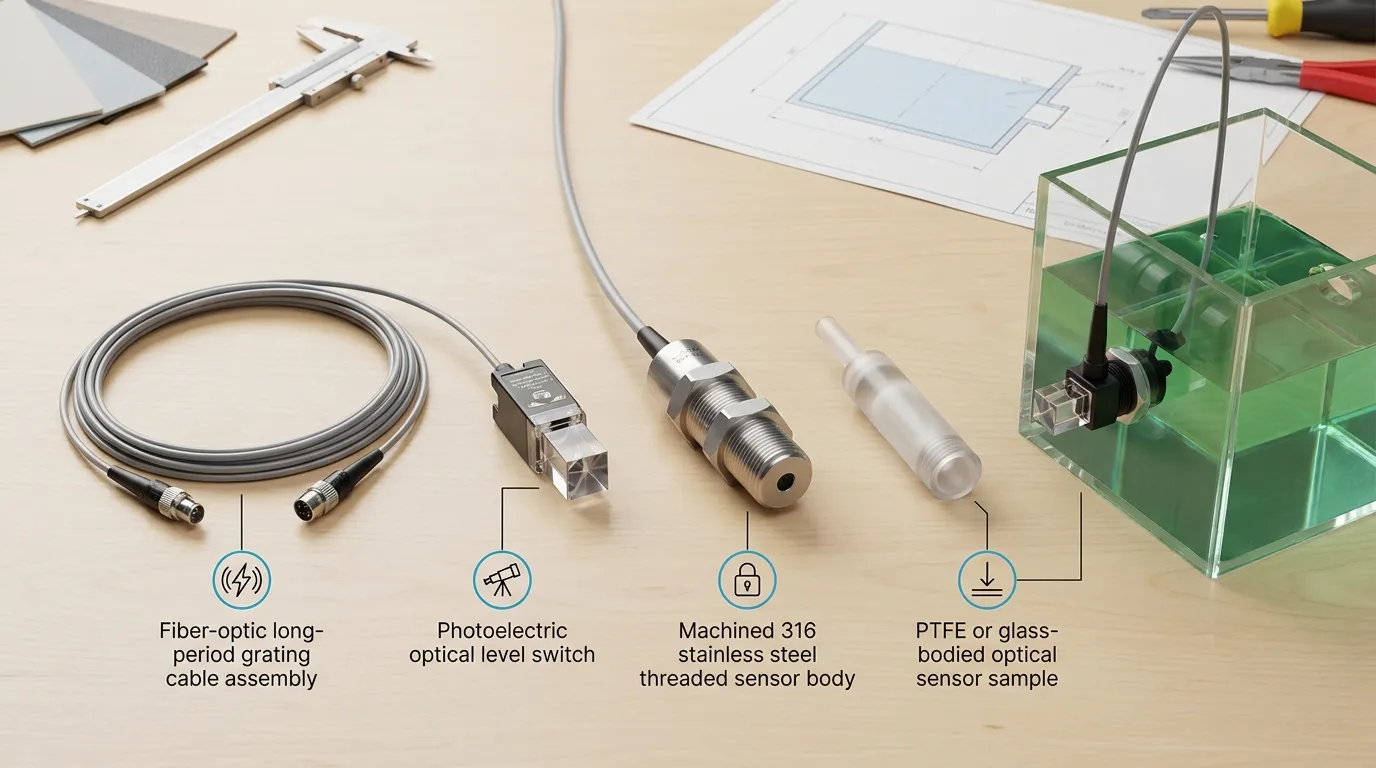
HojellyTek se concentre sur la détection optique photoélectrique des niveaux liquides pour les applications OEM/ODM et industrielles. Ces capteurs utilisent généralement une LED IR et un phototransistor à l’intérieur d’un boîtier scellé, avec une pointe prismaticale exposée au liquide. Lorsque la pointe passe de sèche à humide, la réflexion interne change et les sorties commutent.
Selon le projet, Les acheteurs peuvent devoir confirmer les matériaux humides comme l’alimentation, PTFE, 316 Acier inoxydable, ou verre. Ils devraient aussi vérifier le type de fil, Méthode d’étanchéité, Logique de sortie, Tension d’alimentation, Longueur du câble, Connecteur, liquide de fonctionnement, Conditions de nettoyage, et si le capteur est monté sur le côté, Retour au début, ou au fond de l’aquarium.
Capteurs de niveau à fibre optique vs photoélectriques
| Point de comparaison | Capteur de grillage à longue période à fibre optique | Capteur de niveau optique photoélectrique |
|---|---|---|
| Principe fondamental | Mesure la perte de transmission de la lumière ou le changement spectral causé par l’indice de réfraction du liquide autour du réseau de fibres | Utilise une LED IR, Phototransistor, et changement de réflexion prismale entre les états secs et humides |
| Type de niveau | Peut supporter des mesures continues ou distribuées selon la conception | Généralement une détection ponctuelle à une hauteur fixe |
| Meilleur cas d’utilisation | Sites à haute EMI, Détection longue distance, Recherche spécialisée, Surveillance dangereuse ou à distance | Réservoirs OEM, Alarmes de débordement, Protection de la pompe, Équipement compact, Détection d’eau/huile/liquide de refroidissement |
| Électronique près du liquide | Cela peut être minimisé selon l’architecture système | Le capteur possède un câblage électrique et une sortie au point d’installation |
| Niveau de coût | Généralement plus élevé à cause de la préparation des fibres, Interrogateur, et étalonnage | Généralement plus bas et plus simple pour la production de masse |
| Installation | Nécessite un routage soigneux de la fibre, Protection, et installation optique | Fileté, bridé, ou une installation montée sur panneau est plus simple |
| Production | Signal optique interprété par un équipement externe | NPN, PNP, Sortie transistor, Interface de relais, ou option analogique selon le modèle |
| Risques de défaillance | Rupture de fibres, Perte en flexion, Fouling, Dérive d’étalonnage, Variation de l’indice de réfraction liquide | Encrassement prismatical, bulles, Revêtement, Mauvais choix de matériau, Câblage incorrect, Erreurs de montage |
| Ajustement acheteur | Instrumentation avancée ou équipes d’ingénierie sur sites hostiles | Ingénieurs OEM, Fabricants de chars, Constructeurs d’équipements, et les acheteurs industriels nécessitant des changements simples |
Chèques d’achat pratiques avant de choisir l’une ou l’autre technologie
Avant de choisir la détection de niveau par fibre optique ou photoélectrique, Définissez clairement le poste réel.
D'abord, décidez si vous avez besoin d’une mesure de niveau continue ou d’une détection ponctuelle. Si vous avez seulement besoin de savoir si le liquide a atteint une hauteur fixe, Un capteur de point photoélectrique est généralement plus simple. Si vous avez besoin de mesurer sur une longueur de fibre, La détection du GPL pourrait être plus pertinente.
Deuxième, Vérifie le liquide. Eau, huile, combustible, Produits chimiques, écume, Liquides collants, et les liquides cryogéniques se comportent différemment. Pour les capteurs photoélectriques, Le prisme doit rester suffisamment propre pour un changement de réflexion fiable. Pour les capteurs à fibre, L’indice de réfraction et l’état du revêtement peuvent influencer l’étalonnage.
Troisième, Examinez l’installation. Un capteur photoélectrique peut utiliser un support fileté, Montage à bride, ou une structure OEM personnalisée. Épaisseur de la paroi du réservoir, Joint d’étanchéité, Orientation, et la direction de sortie du câble comptent tous. Un capteur à fibre a besoin d’un chemin protégé et d’un positionnement stable donc en flexion, vibration, ou les tirages accidentels ne créent pas de faux signaux.
Quatrième, Confirmez l’interface du signal. Les capteurs photoélectriques peuvent être sélectionnés avec NPN, PNP, normalement ouvert, normalement fermé, ou d’autres configurations de sortie correspondant à l’API ou à la carte de contrôle. Certains projets peuvent nécessiter 4 à 20 mA pour la surveillance liée au niveau, mais cela doit être confirmé lors du RFQ car tous les types de capteurs ne supportent pas la même sortie.
Finalement, Pensez à l’entretien. Toute surface de détection optique peut être affectée par des dépôts lourds, Cristallisation, bulles d’air, écume, ou résidus collants. Le meilleur capteur n’est pas seulement celui qui fonctionne dès le premier jour, mais celui qui reste stable après des mois de véritable fonctionnement.
Où s’intègre HojellyTek
HojellyTek est un fabricant et exportateur de Shenzhen spécialisé dans la détection optique photoélectrique, Détection des niveaux liquides, et la personnalisation des capteurs OEM/ODM. Notre R interne&L’équipe D travaille avec les acheteurs qui ont besoin de commutateurs optiques pratiques pour le matériel, Réservoirs, Systèmes d’automatisation, et applications spécialisées dans les liquides.
Nous ne présentons pas les capteurs à fibre à grillage longue période comme le même produit que nos commutateurs optiques de niveau à prisme. Ce sont des technologies différentes. Si votre projet a vraiment besoin d’une détection de niveau par fibre optique, Vous devriez évaluer l’interrogatoire optique, Emballage en fibre, étalonnage, et les exigences en zone dangereuse avec soin.
Si votre projet nécessite une détection ponctuelle compacte, Notre équipe peut aider à examiner le matériel humide, Filetage de montage, câblage, Type de sortie, Structure du réservoir, et besoins en tests d’échantillons. Nous soutenons des projets d’exportation pour des marchés, y compris les États-Unis, EU, et l’Inde, avec des discussions OEM/ODM disponibles sur WhatsApp ou par e-mail.
FAQ
Qu’est-ce qu’un capteur de niveau liquide à fibre optique utilisant un réseau à longue période?
Un capteur de niveau liquide à fibre optique utilisant un réseau à longue période mesure le niveau liquide en détectant les changements de transmission de la lumière lorsque le liquide entoure une partie de la section du réseau. L’indice de réfraction du liquide modifie la façon dont la lumière est couplée ou perdue dans la fibre, permettant au système d’estimer le niveau.
En quoi un capteur à réseau à longue période diffère-t-il d’un capteur de niveau optique photoélectrique?
Un capteur à réseau à longue période utilise une fibre optique comme élément de détection et mesure la transmission ou les changements spectraux. Un capteur optique photoélectrique utilise une LED IR, Phototransistor, et la pointe prismatice pour détecter si la pointe est sèche ou humide à un moment donné.
Les capteurs de niveau liquide à fibre optique sont-ils intrinsèquement sûrs?
Ils peuvent soutenir la conception de systèmes intrinsèquement sûrs car la fibre de détection n’a pas besoin de courant électrique au point de détection. Toutefois, La sécurité intrinsèque dépend de la conception complète du système, installation, Électronique, Enceinte, et les exigences applicables pour les zones dangereuses.
Quand devrais-je choisir la détection de niveau par fibre optique?
Considérons la détection par fibre optique lorsque le site présente une forte EMI, Longues distances de transmission, Contraintes de zone dangereuse, ou des besoins de mesure spécialisés qui justifient l’équipement d’interrogatoire optique et l’étalonnage. Il est généralement choisi pour l’instrumentation avancée plutôt que pour la détection ponctuelle à faible coût.
Quels sont les principaux modes de défaillance des capteurs optiques de niveau liquide?
Les systèmes de fibres peuvent souffrir de ruptures de fibres, Perte en flexion, Fouling, Dérive d’étalonnage, et variation de l’indice de réfraction. Les capteurs à prismes photoélectriques peuvent être affectés par un revêtement, bulles, liquide collant, Montage incorrect, Matériaux mouillés incompatibles, ou un câblage NPN/PNP incorrect.
Quand un simple capteur optique photoélectrique suffit?
Un simple capteur photoélectrique suffit lorsque vous avez besoin d’une détection ponctuelle fiable, comme le réservoir plein, Réservoir vide, Protection contre les débordements, ou prévention des essais à sec par pompe. C’est généralement plus facile à installer, Plus facile à câbler, et plus rentable pour les équipements OEM et les réservoirs compacts.
Besoin d’aide pour choisir le bon capteur de niveau optique?
Si vous comparez la détection par fibre optique à un commutateur de niveau photoélectrique pratique, Envoyez votre type liquide, Dessin de char, Position de montage, Exigence de production, et application cible à HojellyTek. Notre équipe peut vous aider à décider si un simple capteur optique suffit ou si votre projet nécessite une approche de détection plus spécialisée. Demandez un devis ou une discussion technique via WhatsApp ou email.


