
Capteur optique de niveau liquide de qualité alimentaire
En tant que fabricant et exportateur à Shenzhen avec un R interne&D, nous supportons la configuration de capteurs OEM/ODM pour l’alimentation, PTFE et 316 Conceptions humides en acier inoxydable, avec la documentation de contact alimentaire confirmée à l’étape de la RFQ.
Capacités de détection des niveaux alimentaires et des boissons
Nos capteurs optiques de niveau liquide sont utilisés pour la détection ponctuelle dans les cuves, Petits réservoirs, Systèmes de distribution et équipements de procédé. Selon l’installation, Le capteur peut permettre de prévenir le débordement, Alarme de bas niveau, Protection de la pompe, Confirmation de remplissage ou surveillance du réservoir de dosage.
Les capacités typiques incluent:
- Détection optique photoélectrique utilisant un émetteur IR, Récepteur et pointe de détection de prisme
- Corps de capteurs compacts pour l’intégration d’appareils OEM
- Alimentation, PTFE, 316 Options en acier inoxydable ou en verre selon les conditions de liquide et de nettoyage
- NPN, PNP, commutateur numérique ou options de sortie 4–20 mA selon les exigences du système de contrôle
- Fileté, Structures mécaniques montées sur char ou personnalisées
- Câble, Personnalisation des connecteurs et boîtiers pour la production OEM
- Soutien à l’alimentation, Boisson, Laitiers, eau, café, Applications de sirop et de dosage après validation de l’échantillon
Pour les acheteurs comparant le principe général de détection, voir notre Capteur de niveau optique Page.
La compliance commence avec la surface mouillée
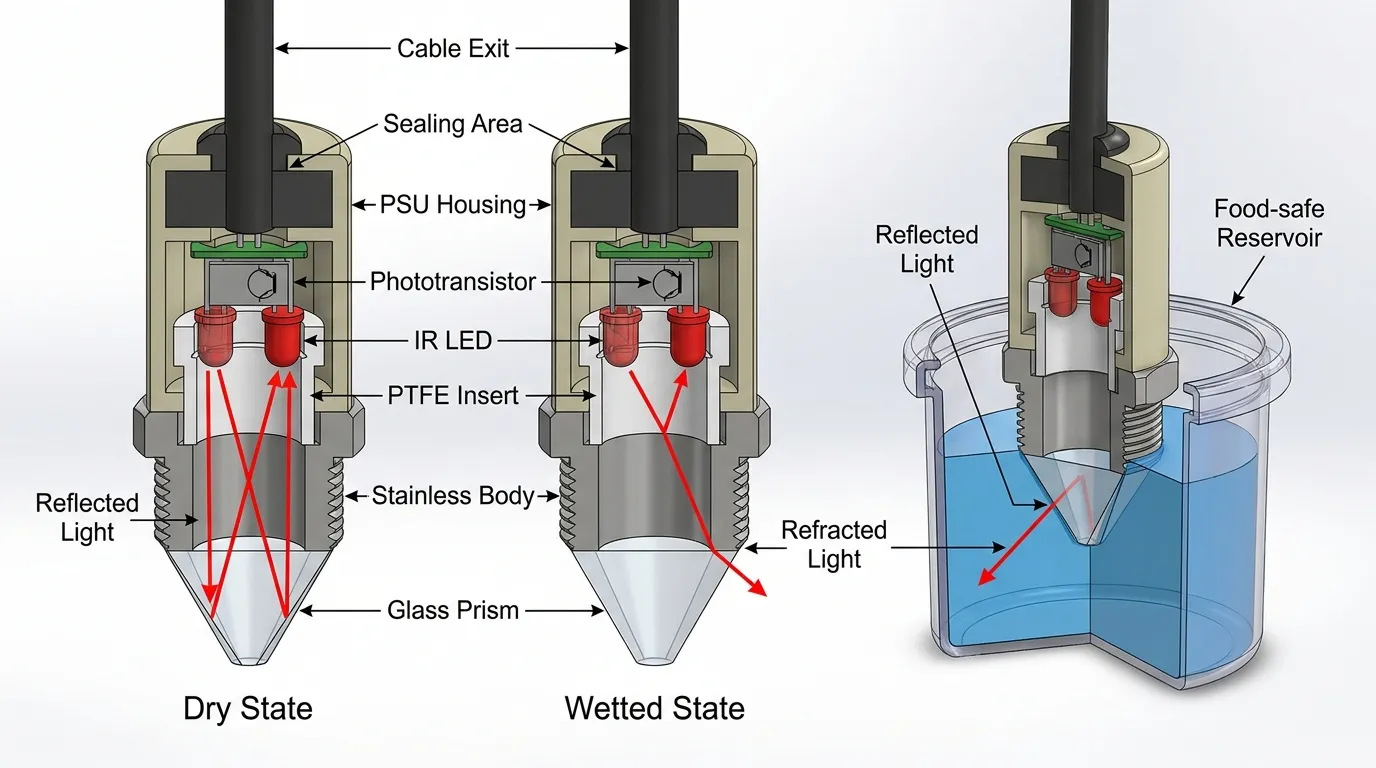
Dans les projets alimentaires et de boissons, La question clé n’est pas simplement « le capteur détecte-t-il le liquide?« La première question est de savoir si chaque partie mouillée est adaptée au procédé. Le corps du capteur, Prisme, Phoque, joint, fil, L’exposition des adhésifs et l’entrée du câble doivent être examinées avant que la pièce ne soit approuvée pour un équipement de contact alimentaire.
Les capteurs de niveau optique fonctionnent en envoyant de la lumière infrarouge à travers la pointe d’un prisme. À l’état sec, La lumière se réfléchit à l’intérieur du prisme et revient au récepteur. Quand le liquide recouvre la pointe, Changements de la condition réfractive, donc moins de lumière revient au récepteur. L’électronique convertit ce changement en signal de niveau.
Cette méthode est utile car il n’y a pas de flotteurs en mouvement, Pas d’anches magnétiques ni de points de charnière mécaniques dans la zone de détection. Pour le matériel alimentaire et de boissons, cela peut réduire l’usure des pièces mobiles et simplifier le montage compact. Cependant, La performance hygiénique dépend toujours du matériau humidifié, Géométrie du capteur et procédé de nettoyage.
Documents de conformité aux contacts alimentaires tels que la FDA, EC 1935/2004, LFGB, 3-A ou EHEDG doit être confirmé avec HojellyTek avant utilisation dans des équipements de contact alimentaire réglementés. Nous ne recommandons pas de publier des revendications de certification tant que les déclarations matérielles pertinentes ou les documents de test n’ont pas été vérifiés pour le modèle exact du capteur et de la configuration.
Options de matériaux de contact alimentaire
Différentes applications alimentaires et de boissons nécessitent des matériaux humides variés. Un réservoir de machine à café, Bac de lait, Le système de dosage du sirop et le réservoir de liquide de nettoyage peuvent tous nécessiter des corps capteurs différents.
| Matériau mouillé | Utilisation typique des aliments et boissons | Forces | Confirmez avant de commander |
|---|---|---|---|
| Alimentation / Plastique d’ingénierie de type PPSU | Machines à café, Réservoirs d’eau potable, Distributeurs de boissons, petits réservoirs OEM | Léger, compact, adapté aux structures de capteurs moulés, Bon pour l’intégration des appareils | Déclaration de contact alimentaire, Exposition à l’eau chaude, Compatibilité des détergents, Résistance au montage |
| PTFE | Réservoirs de dosage, Liquides de nettoyage, liquides acides/alcalins, Ingrédients collants, Zones de contact chimique | Forte résistance chimique, Faible adhérence de surface, utile lorsque des liquides agressifs peuvent entrer en contact avec le capteur | Montage mécanique, Méthode d’étanchéité, Preuves de contact alimentaire, Température de nettoyage |
| 316 Acier inoxydable | Cuves de procédé, Gammes de boissons, Matériel laitier, Zones de lavage | Logement durable, Forte protection mécanique, Adapté à la conception d’équipements alimentaires industriels | Finition de surface, Matériau du joint, Soudure ou hygiène du filetage, Documentation réelle des notes |
| Prisme en verre / Interface optique | Embout de détection optique ou interface de détection transparente | Surface optique stable, Point de détection propre, Bonne transmission optique | Risque de casse, Comportement des résidus, Procédé de nettoyage, Protection d’installation |
| Phoque / Matériau du joint | Connexion au procédé, Prévention des fuites, Frontière de contact alimentaire | Essentiels pour l’hygiène, Nettoyage de survie et étanchéité sous pression | Adéquation EPDM/FKM/PTFE, Exposition à la température, Compatibilité détergent et vapeur |
Pour les ingrédients agressifs, Liquides de nettoyage ou surfaces humides à faible adhérence, un Capteur optique PTFE peut être plus adapté qu’une option à carrosserie en plastique. Pour les cuves industrielles, zones de lavage ou protection mécanique renforcée, un 316 capteur en inox Peut-être que c’est un meilleur point de départ.
CIP, SIP, Remplissage à chaud et survie à l’eau
Les capteurs alimentaires et de boissons tombent souvent en panne car la spécification de commande ne décrit que le liquide, Pas le cycle de nettoyage. Un capteur fonctionnant dans de l’eau à température ambiante peut ne pas survivre à un remplissage à chaud répété, Lavage caustique, Rinçage acide, Exposition à la vapeur ou nettoyage haute pression.
Avant de choisir un capteur optique de niveau liquide de qualité alimentaire, confirmer:
- Température normale du produit pendant le fonctionnement
- Exposition maximale à chaud ou pasteurisation près du capteur
- Température et durée de nettoyage CIP ou SIP
- Que la vapeur touche la pointe de détection ou seulement la paroi du réservoir
- Produits chimiques de nettoyage, Séquence de concentration et de rinçage
- Pression de lavage près de la sortie du câble et du connecteur
- Que le capteur soit immergé en continu ou seulement pendant le remplissage
- Si le résidu sèche sur le prisme après l’évacuation
La détection optique dépend d’une interface optique propre. Si les solides laitiers, sirop, Film à l’huile, Pulpe de fruit, du sucre cristallisé ou un résidu de nettoyage recouvre le prisme, Le capteur peut mal lire. Cela ne signifie pas que la détection optique est inadaptée, Mais cela signifie que le liquide doit être testé dans de vraies conditions de nettoyage et de séchage.
Conception hygiénique de montage et d’installation
Une installation de capteurs hygiénique doit éviter les liquides emprisonnés, Coins morts et bords difficiles à nettoyer. Dans les petits appareils électroménagers, La priorité peut être un montage compact sur les murs latéraux. Dans les cuves de procédé, La priorité peut être la drainabilité, Compression du joint et finition de surface autour de la connexion du procédé.
Les choix de montage courants incluent l’installation d’un cuve fileté, Montage latéral compact, montage de style bride ou boîtier OEM personnalisé. La meilleure conception dépend de l’épaisseur de la paroi du réservoir, Accès au nettoyage interne, Orientation du capteur et si le côté câble nécessite une protection contre le délavage.
Pour les machines à café, distributeurs d’eau et équipements pour boissons chaudes, Le capteur doit s’adapter à des réservoirs compacts tout en tolérant l’eau chaude, Zones adjacentes à la vapeur et remplissage répété. Voir notre Capteur de machine à café page pour un exemple plus axé sur les appareils électroménagers.
Laitier, Applications de boissons et de dosage
Les fabricants alimentaires et de boissons utilisent des capteurs optiques de niveau ponctuel lorsque les compacts, Un signal liquide/non-liquide rapide est plus utile que la mesure continue de niveau.
Les applications typiques incluent:
- Alarme de bas niveau dans le lait, Réservoirs d’eau ou de boissons
- Protection contre les débordements dans les équipements de remplissage
- Détection du réservoir vide avant le fonctionnement de la pompe
- Confirmation du bac de dosage pour le goût, Systèmes de sirop ou d’additifs
- Détection du niveau d’eau par machine à café et distributeur
- Surveillance des réservoirs de liquide de nettoyage dans les équipements alimentaires
- Petits réservoirs OEM où les flotteurs sont trop gros ou peu fiables
Pour les produits laitiers et les boissons, Le test d’échantillons est important car la mousse, Gros, Protéine, pulp, Le sucre et les résidus de nettoyage peuvent affecter la détection optique. Pour les systèmes de dosage, La compatibilité chimique est généralement la première préoccupation. Pour le café et l’équipement d’eau chaude, température, L’échelle et le montage compact sont généralement plus importants.
Liste de contrôle hygiène avant la demande de propositions
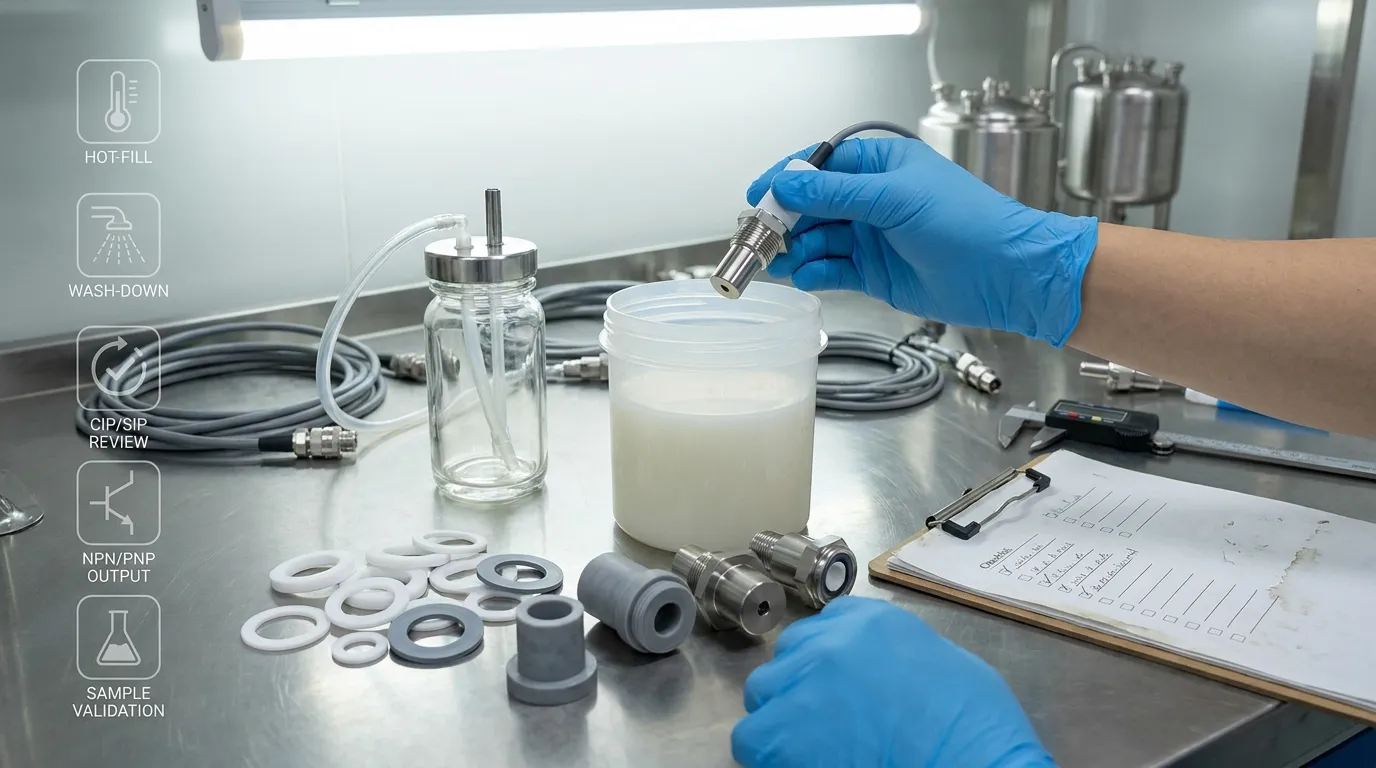
Utilisez cette liste de contrôle avant de demander un échantillon:
- Listez chaque liquide touchant le capteur, y compris les produits chimiques de nettoyage.
- Confirmez toutes les parties mouillées: Carrosserie, Prisme, Phoque, Joint et filetage.
- Précisez si la documentation de contact alimentaire est requise pour le produit final.
- Partagez les détails du cycle de nettoyage: eau chaude, Détergent, acide, Alcalin, Vapeur ou rinçage.
- Confirmez si le capteur doit survivre à la CIP, SIP ou lavage externe.
- Vérifiez si le liquide peut mousser, Manteau, cristalliser, Fermenter ou laisser des solides.
- Définir la position de montage: Mur latéral, Bottom, Retour au début, Tuyau, Réservoir ou réservoir.
- Vérifiez si la zone de détection doit être drainable après nettoyage.
- Choisir le type de sortie: NPN, PNP, commutateur numérique ou 4–20 mA.
- Demande de validation de l’échantillon en utilisant le liquide réel et le procédé de nettoyage.
5-Processus de support des applications en étapes
- Enquête
Envoyez le type liquide, Dessin de char, Méthode de nettoyage, Exposition à la température, Position de montage et sortie requise. - Revue des spécifications et de la personnalisation
Notre équipe d’ingénierie vérifie les matériaux humides, Logement, Phoque, Câble, fil, Sortie et compatibilité carte de contrôle. - Exemple de confirmation
Les échantillons peuvent être préparés pour validation avec la nourriture réelle, Boisson, Liquide de dosage ou cycle de nettoyage. - Production et contrôle qualité
Après confirmation, L’usine suit le modèle convenu, câblage, Exigences de matériaux et d’inspection pour la production OEM/ODM. - Soutien à l’expédition et à l’exportation
Nous soutenons des projets d’exportation pour des clients aux États-Unis, EU, L’Inde et d’autres marchés, avec un emballage et une documentation alignés sur les exigences de commande.
Exigences à confirmer avant de commander
| Exigence | Pourquoi cela compte |
|---|---|
| Matériau mouillé | Détermine l’adéquation au contact alimentaire, Résistance chimique et hygiène à long terme |
| Processus de nettoyage | CIP/SIP, eau chaude, Le détergent ou la vapeur peut changer le choix du matériau |
| Comportement des liquides | Écume, film, pulp, La graisse ou les cristaux peuvent affecter la détection optique |
| Conception de montage | Une mauvaise installation peut créer des crevasses, Trappeurs à fuite ou résidus |
| Signal de sortie | NPN, PNP, numérique ou 4–20 mA doivent correspondre au contrôleur |
| Câble et connecteur | Les conditions de lavage et d’assemblage d’origine influencent la conception des sorties de câble |
| Documentation | Les affirmations concernant le contact alimentaire doivent être confirmées par des preuves spécifiques au modèle |
Détection optique vs flotteur vs détection de niveau conducteur
| Type de capteur | Meilleur choix | Principal avantage | Problème alimentaire/boissons |
|---|---|---|---|
| Capteur optique de niveau ponctuel | Chars compacts, appareils, Dosage, Détection de débordement/vide | Pas de flotteur en mouvement, signal rapide au niveau du point, Conception compacte | Le prisme doit rester propre et le matériau doit être validé |
| Interrupteur à flotteur | Des réservoirs simples avec assez d’espace | Commutation mécanique à faible coût | Pièces mobiles, Stuck, Difficulté de nettoyage |
| Sonde conductrice | Liquides conducteurs | Détection simple de niveau | Inadapté aux liquides non conducteurs et nécessitant peut-être des électrodes exposées |
| Capteur capacitif | Certains liquides traversant les parois ou les sondes | Peut détecter sans pièces mobiles | Nécessite un réglage et peut être affecté par l’accumulation |
Pourquoi travailler avec HojellyTek
HojellyTek combine la détection optique photoélectrique, R interne&Fabrication D et OEM/ODM pour les projets de capteurs de niveau liquide. Au lieu de vendre un modèle fixe pour chaque application alimentaire, Nous aidons les acheteurs à évaluer les matériaux humides, Montage, Sortie, Structure du câble et tests d’échantillons avant production en volume.
Pour les projets d’appareils électroménagers intelligents, L’intégration de Tuya ou Smart Life peut être discutée lorsque le capteur fait partie d’un réservoir d’eau connecté, distributeur ou dispositif de surveillance.
FAQ
Qu’est-ce qui rend un capteur optique de niveau liquide de qualité alimentaire adapté aux équipements de boissons?
Il doit utiliser des matériaux humides appropriés, une structure de détection nettoyable et un système de montage adapté au processus de nettoyage. La documentation de contact alimentaire doit être confirmée pour le matériau et le modèle exacts avant que les revendications de certification ne soient utilisées.
Les capteurs optiques peuvent-ils être utilisés dans des cuves de lait ou de produits laitiers?
Oui, ils peuvent être envisagés pour la détection ponctuelle des produits laitiers, Mais la graisse du lait, Film protéique, La mousse et les résidus de nettoyage doivent être testés. Le prisme doit rester suffisamment propre pour une détection stable de la zone sèche/humide.
Le PTFE est-il meilleur que 316 Acier inoxydable pour applications alimentaires?
Pas toujours. Le PTFE est utile pour la résistance chimique et une faible adhérence, tandis que 316 L’acier inoxydable est plus résistant pour les réservoirs industriels et les environnements de lavage. Le bon choix dépend du liquide, Méthode de nettoyage et conception de montage.
Le capteur peut-il survivre au nettoyage CIP ou SIP?
Cela dépend du matériel choisi, Phoque, Sortie du câble et cycle de nettoyage. Température CIP/SIP, Exposition à la vapeur, les produits chimiques et la durée doivent être partagés lors du RFQ afin que la configuration correcte puisse être examinée.
Will syrup, La mousse ou le liquide cristallisé provoquent de fausses lectures?
Ça peut. Les capteurs optiques dépendent de la surface du prisme. Sirop collant, mousse épaisse, Le sucre séché ou les résidus cristallisés peuvent affecter la détection, Il est donc recommandé de tester en liquide réel avant l’approbation de la production.
Que dois-je envoyer pour demander un devis?
Envoie le nom du liquide, Dessin de char, Position de montage, Préférence pour les matériaux humides, Procédé de nettoyage, Exposition à la température, Type de sortie, Besoins en câble/connecteur, Quantité de commande et toute obligation de documentation concernant les contacts alimentaires.
Demandez un devis pour capteur alimentaire et de boissons
Spécifier une solution de détection de niveau optique de qualité alimentaire, envoyez vos coordonnées de candidature par WhatsApp ou email. Partagez le liquide, Structure du réservoir, Méthode de nettoyage, Préférence en matière, Dessin de montage et sortie requise, et notre équipe recommandera une configuration de capteurs adaptée pour les tests d’échantillons et la production OEM.


