
Capteur optique de niveau d’eau pour machines à café
Un capteur optique de niveau d’eau pour les fabricants de machines à café aide les fabricants d’appareils à détecter le basse niveau d’eau, Haute Mer, déborder, et le risque de répétition à sec sans dépendre de sondes conductrices qui peuvent s’élever à cause de l’étarchage. Pour les machines à espresso, Distributeurs automatiques, Cafetiers, et des équipements de boissons intelligents, HojellyTek fournit des capteurs de niveau photoélectriques compacts conçus pour les réservoirs, adjacent à la chaudière, Plateau goutte-à-goutte, et intégration interne des réservoirs.
Notre priorité n’est pas l’utilisation de barista. C’est un design en OEM: petit facteur de forme, Sortie logique stable, Matériaux humides adaptés, Commutation répétable, Options de câblage, et support de logement sur mesure pour les fabricants d’appareils électroménagers.
Capacités optiques de capteurs de niveau d’eau pour les fabricants d’appareils électroménagers
HojellyTek développe et exporte des solutions photoélectriques de détection de niveau liquide depuis Shenzhen pour les fabricants ayant besoin de compactité, Détection fiable de l’eau à l’intérieur des appareils finis. Pour le café et le matériel de distribution, Le capteur peut être configuré comme un commutateur de bas niveau, Commutateur de haut niveau, Détecteur de débordement, Capteur de réservoir amovible, ou une entrée de protection de la pompe.
Le support typique des fabricants comprend:
- Structure compacte de capteur optique pour des espaces d’appareils restreints
- 5Conception de sortie logique en V ou 12V pour correspondre aux cartes de contrôle des appareils
- NPN, PNP, NON, NC, et des options de logique de signaux personnalisées
- Sélection des matériaux en contact alimentaire basée sur le réservoir, Chemin d’eau, et conditions de nettoyage
- Réservoir, adjacent à la chaudière, Plateau goutte-à-goutte, et soutien au placement des réservoirs distributeurs
- Câble, Connecteur, fil, Logement, et personnalisation du montage
- Développement OEM/ODM pour les marques d’appareils et intégrateurs système
- Évaluation de l’échantillon avant confirmation de production
Pour un contexte général produit, voir notre Capteur de niveau optique gamme. Pour les conceptions à contact avec l’eau des appareils, notre capteur optique de qualité alimentaire Page est également pertinente.
Pourquoi les cafetières remplacent les sondes conductrices
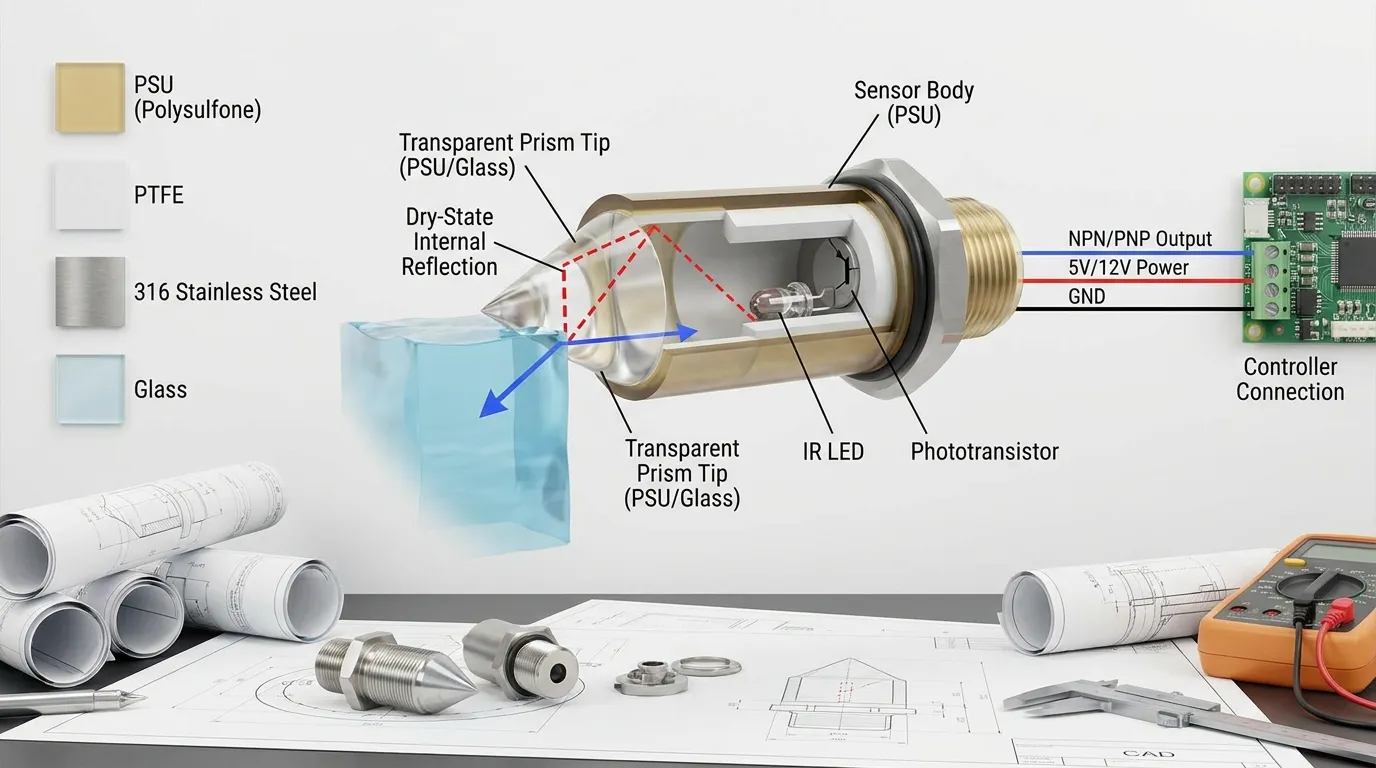
Les sondes conductrices sont courantes dans les réservoirs d’eau car elles sont simples, Mais ils dépendent du contact électrique avec le liquide. Dans le café et le matériel de distribution, Cette zone de contact peut devenir moins fiable lorsque l’eau utilise des minéraux, Échelle, Résidus de café, Film à agent nettoyant, ou de condensation de vapeur autour de l’électrode.
Un capteur optique utilise plutôt la détection photoélectrique. À l’intérieur du capteur, une LED infrarouge envoie la lumière vers une pointe de prisme transparent. Un phototransistor reçoit la lumière réfléchie. Quand le prisme est sec, La lumière se reflète à l’intérieur de manière prévisible. Lorsque l’eau touche la surface du prisme, le chemin optique change car la condition de réfraction change. L’électronique convertit ce changement en un signal de commutation.
Pour les fabricants d’appareils électroménagers, Cela crée plusieurs avantages de conception:
- Aucune paire d’électrodes conductrices exposées n’est requise pour la détection.
- Le capteur peut fournir un signal clair haut/bas au contrôleur.
- Le point de détection peut être rendu très petit pour des réservoirs compacts.
- Il peut détecter la présence d’eau à un point fixe sans bras flotteur.
- Cela réduit la défaillance des pièces mobiles comparé aux interrupteurs à flotteur.
- Il convient mieux aux configurations d’appareils scellés ou semi-étanches.
Cela ne signifie pas que le capteur ignore toute contamination. La face du prisme a encore besoin d’un environnement de conception réaliste. Revêtement épais à tartre, bulles d’air piégées, Résidu opaque, Ou un mauvais angle de montage peut affecter n’importe quel capteur ponctuel. La différence est que la méthode optique évite le problème courant de la sonde conductrice, qui est le contact électrique devenu instable parce que la surface de la sonde s’est retrouvée.
Café, Espresso, et points d’intégration des distributeurs automatiques
La meilleure valeur de conception vient du choix de la bonne position de détection. Une machine à café peut nécessiter un seul capteur, mais une plateforme de boissons OEM peut nécessiter plusieurs capteurs ponctuels avec différents états logiques.
Détection de basse altitude dans un réservoir d’eau
Un interrupteur optique de bas niveau peut être installé près de la conduite d’eau sûre inférieure du réservoir. Lorsque le niveau de l’eau descend sous le prisme, Le contrôleur peut arrêter la pompe, afficher une alerte de recharge, ou empêcher le fonctionnement du chauffage. C’est utile pour les machines à espresso compactes, Cafetières de plan de travail, et les distributeurs automatiques où le fonctionnement à sec peut endommager les pompes ou réduire la fiabilité des clients.
Détection de haute intensité et de débordement
Un capteur optique de haut niveau peut être positionné près de la ligne de remplissage supérieure. Il peut prendre en charge les systèmes de remplissage automatique, Réservoirs de distribution, distributeurs d’eau, ou des machines reliées à une vanne d’entrée d’eau. Lorsque le capteur détecte de l’eau au point supérieur, Le contrôleur peut arrêter de se remplir ou déclencher une routine de protection contre le débordement.
Protection adjacente à la chaudière
Dans le placement lié à la chaudière, La conception du capteur doit être examinée plus attentivement. Les fabricants doivent confirmer la température de l’eau, Exposition à la vapeur, Isolation de pression, Compatibilité des matériaux, et si le capteur est directement humidifié ou installé dans une chambre voisine. Pour de nombreux appareils électroménagers, Le capteur est mieux placé dans le réservoir ou le chemin d’eau auxiliaire plutôt que dans un corps de chaudière à forte contrainte.
Détection des plateaux goutte-à-goutte et des eaux usées
Un capteur ponctuel optique peut également être utilisé dans un bac goutte-à-goutte ou un récipient d’eaux usées. Ici, l’accent de la conception passe de l’eau potable à la tolérance aux résidus, Accès de nettoyage, et prévention des fausses déclencheurs. La position de montage doit éviter les zones d’éclaboussures directes autant que possible.
Détection interne des réservoirs des distributeurs automatiques
Pour les distributeurs automatiques et les distributeurs de boissons, Les capteurs optiques peuvent prendre en charge le contrôle des recharges, Détection de réservoir vide, Coupure de niveau élevé, et des alarmes de maintenance. Lorsque le distributeur dispose de fonctions IoT ou connectées à une application, La sortie du capteur peut alimenter la carte de contrôle principale, et le système peut transmettre les alertes de statut via la plateforme appliance. Lorsque cela est pertinent, notre équipe peut discuter des besoins produits connectés Tuya ou Smart Life au niveau de l’appareil et du système.
Table d’intégration des appareils
| Zone d’appareils électroménagers | Rôle des capteurs | Orientation de conception suggérée | Besoins en production |
|---|---|---|---|
| Réservoir d’eau amovible | Alerte de basse eau, Protection de la pompe | Montage compact latéral ou en bas, Exposition au prisme propre, Cycle de recharge utilisateur | 5Sortie logique V ou 12V |
| Point supérieur du réservoir | Coupure de niveau élevé, Prévention des débordements | Positionnement stable en ligne de remplissage, Contrôle des éclaboussures, Logique de commutation définie | NO/NC, NPN/PNP |
| Chemin d’eau de la machine à espresso | Verrouillage de basse altitude ou de sécurité | Compatibilité des matériaux, Critique de la vapeur/chauffage, Sortie à fil scellé | Logique personnalisée confirmée par RFQ |
| Chambre adjacente à la chaudière | Soutien à la prévention des essais à blanc | Évitez le surstress direct; Confirmer la température, Montage, et état de mouillage | Sortie adaptée au contrôleur |
| Réservoir de distribution | Statut vide/plein, Contrôle du remplissage | Acheminement de câbles longs, Verrouillage des connecteurs, service access | NPN/PNP ou signal personnalisé |
| Gouttière goutte / Réservoir à déchets | Alerte plateau plein | Tolérance aux résidus, Accès de nettoyage, Placement anti-éclaboussures | Sortie numérique à commutateur |
Format compact et choix de montage
Les machines à café ont souvent un espace limité derrière la paroi du réservoir, Sous le réservoir, ou près du cadre de l’appareil. Un interrupteur à flotteur encombrant peut gêner les pièces en plastique moulé, Retrait des réservoirs, ou accès aux services. Une conception optique compacte permet de placer le point de détection à un niveau fixe avec une petite pointe prismatice.
Pour des plans serrés, notre Micro capteur optique Les options sont des points de départ adaptés pour la discussion. Le design final peut utiliser un montage fileté, Un corps scellé, Une installation latérale, ou un support sur mesure selon la structure de l’appareil.
Les décisions croissantes à confirmer incluent:
- Mur latéral, Bottom, ou installation en angle
- Épaisseur de la paroi du réservoir et surface d’étanchéité disponible
- Exigence de montage filetage ou non filetage
- Joint torique, joint, ou concept d’intégration soudée/scellée
- Direction de sortie du câble et soulagement de la contrainte
- Type de connecteur et longueur du faisceau
- Que le réservoir soit fixe ou amovible
- Si les utilisateurs peuvent nettoyer autour de la zone de détection
Pour les projets OEM, Le capteur ne doit pas être sélectionné uniquement par la taille extérieure. La vraie question de conception est de savoir si la pointe du prisme reste correctement exposée à l’eau au point de commutation requis pendant tout le cycle d’utilisation de l’appareil.
Matériaux pour l’eau, Vapeur, Échelle, et Conditions de nettoyage
Le choix du matériau dépend de l’endroit où le capteur touche l’eau et de ce que le fabricant d’appareils attend lors du nettoyage et de l’exploitation. Les options courantes incluent le plastique ingénieur, Alimentation, PTFE, 316 Acier inoxydable, et des structures en verre. Chacun a un équilibre de coûts différent, Résistance chimique, Comportement thermique, et résistance mécanique.
Pour le café et les vendeurs, Les acheteurs devraient vérifier:
- Si la partie mouillée entre en contact avec l’eau potable
- Si le capteur détecte l’eau chaude, vapeur, ou seulement de l’eau de réservoir à température ambiante
- Qu’il s’agisse d’un liquide détartragique ou d’agents nettoyants qui entrent en contact avec le prisme
- Transparence du matériau du réservoir, translucide, ou opaque
- S’il s’agit d’une accumulation de minéraux des marchés de l’eau dure
- Si le point de détection est accessible pour un nettoyage périodique
Aucun matériau ne doit être choisi uniquement à partir d’une photo de catalogue. La solution la plus sûre est de fournir le plan de l’appareil, Emplacement du chemin d’eau, Méthode de nettoyage, et l’état de fonctionnement attendu afin que l’usine puisse recommander une structure adaptée en matériau humide.
Sortie électrique: 5V, 12V, NPN, PNP, et 4–20 mA
Les cartes de contrôle des machines à café préfèrent souvent un statut numérique simple: Eau présente ou absente. Pour cette raison, de nombreux projets d’appareils utilisent une sortie logique 5V ou 12V. Le contrôleur lit le signal et décide s’il doit arrêter la pompe, Afficher une alerte, ouvre une vanne, ou autoriser le chauffage.
Les discussions sur l’électricité disponibles peuvent inclure:
- 5Sortie logique V pour cartes d’appareils basse tension
- 12Sortie logique V pour les distributeurs automatiques ou systèmes de contrôle interne
- Sortie NPN ou PNP selon la conception des entrées du contrôleur
- Logique normalement ouverte ou normalement fermée pour préférence de sécurité
- Personnalisation des câbles et connecteurs pour les faisceaux d’appareils électroménagers
- 4–20 mA de sortie où un système nécessite une signalisation de niveau de boucle de courant plutôt qu’un simple commutateur de point
Pour la plupart des machines à café, la détection d’eau basse ou élevée, Un commutateur optique au niveau ponctuel suffit. Pour les applications nécessitant une surveillance à tendance de niveau ou une surveillance industrielle à distance, Le type de sortie doit être examiné à l’étape RFQ.
Personnalisation OEM et support de conception
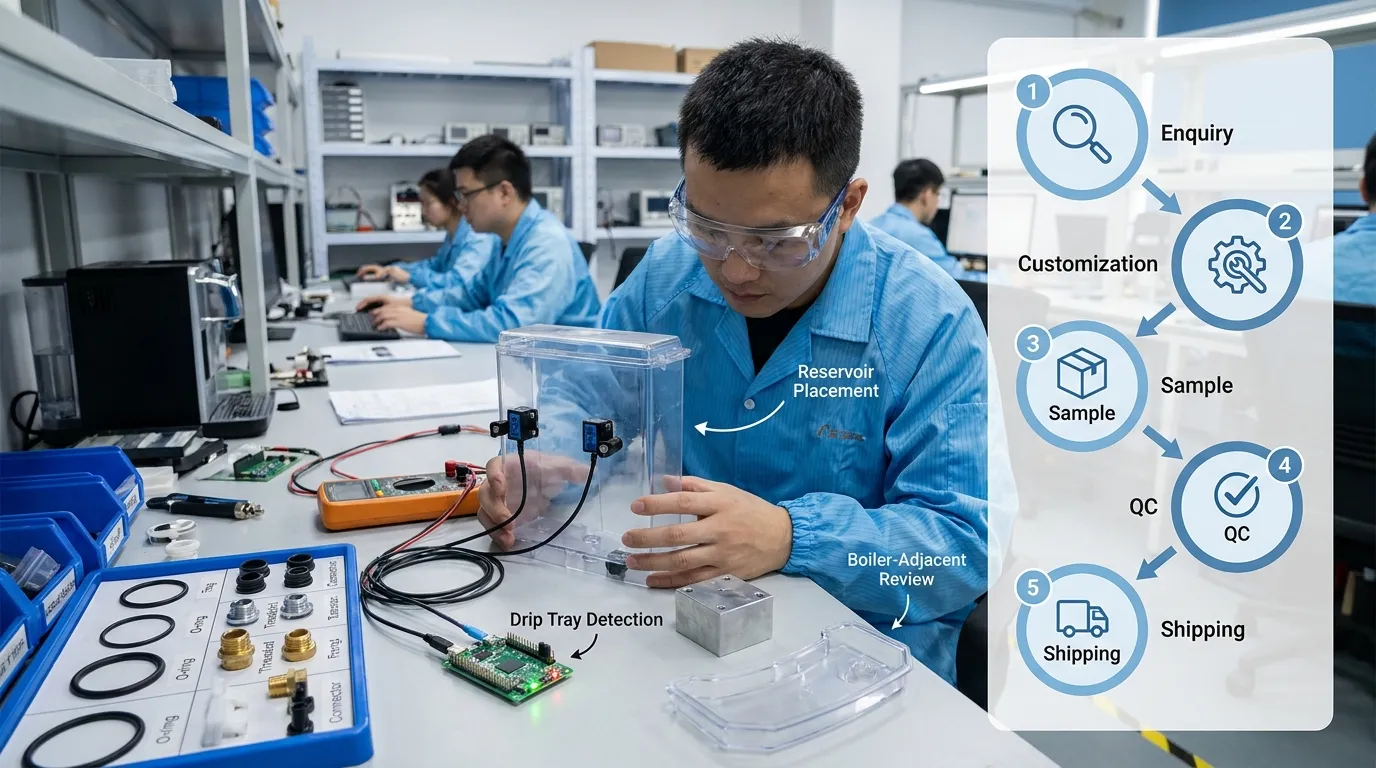
En tant que fabricant/exportateur de Shenzhen avec un R interne&D, HojellyTek prend en compte les projets OEM/ODM où les capteurs de catalogue standard ne correspondent pas à la conception de l’appareil. Notre Commutateur de niveau optique OEM Le service peut soutenir les changements dans le logement, Ensembles de câbles, Correspondance de connecteurs, Exigences du logo ou de l’emballage, et la logique électrique spécifique à chaque projet.
La conception OEM peut inclure:
- Analyse de la forme du prisme et du point de détection
- Sélection du matériau du corps du capteur
- Personnalisation du filetage et de la structure de montage
- Longueur de fil et connexion de borne
- Réglage logique de sortie
- Préparation de l’échantillon pour les essais d’appareils
- Plan de contrôle qualité de production après approbation de l’échantillon
Nous exportons des produits de capteurs pour des clients aux États-Unis, EU, Inde, et autres marchés, la communication technique étant axée sur les dessins, Échantillons, et intégration pratique des appareils.
5-Processus OEM par étapes
- Enquête
Envoyez le type d’appareil, Emplacement du capteur, Condition de l’eau, Fonction cible, Tension, Type de sortie, et le dessin si disponible. - Revue des spécifications et de la personnalisation
Notre équipe vérifie le matériel, Logement, Câble, Connecteur, Montage, et exigences de sortie logique. - Exemple de confirmation
Les échantillons sont préparés pour le réservoir, adjacent à la chaudière, Plateau goutte-à-goutte, ou tests en cuve distributrice. - Production et contrôle qualité
Après approbation de l’échantillon, La production suit les spécifications confirmées, câblage, et exigences d’inspection. - Transport maritime et soutien
Nous préparons l’expédition à l’exportation et soutenons les questions de suivi pour l’installation, câblage, et répéter les ordres.
Liste de contrôle de conception avant commande
Avant de demander un devis, Préparez ces détails:
- Type d’appareil: Cafetière, Machine à espresso, Distributeur automatique, distributeur d’eau, ou système de boissons
- Fonction du capteur: Niveau d’eau basse, Haute Mer, déborder, Protection contre les essais à sec, Gouttière pleine, ou présence de chars
- Point d’installation: Mur du réservoir, Réservoir de fond, Zone adjacente à la chaudière, Réservoir de distribution, ou contenant à déchets
- État de l’eau: eau propre, eau chaude, Exposition à la vapeur, Risque d’échelle, Exposition au liquide nettoyant
- Tension d’alimentation: 5V, 12V, ou une autre exigence de contrôle pour confirmer
- Type de sortie: NPN, PNP, NON, NC, 4–20 mA, ou logique personnalisée
- Exigences en matière: Alimentation, PTFE, 316 Inox, verre, ou une autre préférence pour les matériaux humides
- Montage: fil, joint, Joint torique, Tableau, Interface de cuve moulée, ou un boîtier sur mesure
- Câble et connecteur: Longueur, Terminal, Étanchéité, Soulagement de la déformation, et direction de routage
- Logique de sécurité: Ce que le contrôleur doit faire en cas d’absence d’eau, Aujourd’hui, ou que le câblage du capteur ne tombe pas
- Quantité d’échantillon et plan de test pour la validation des appareils
Détection optique vs conductrice vs Détection de flotteurs
| Option | Force | Limitation dans le café/distributeurs automatiques | Meilleure utilisation |
|---|---|---|---|
| Capteur ponctuel optique | Compact, Pas de flotteur en mouvement, Pas de paire de sondes conductrices exposées, Signal numérique stable de présence d’eau | La face prismatique doit être positionnée et maintenue adaptée à la détection optique | Détection des basses/hautes eaux OEM |
| Sonde conductrice | Simple et à faible coût | Peut se former avec les écailles, nécessite une conductivité liquide, peut être affecté par un film minéral | Détection de contact de base avec l’eau |
| Interrupteur à flotteur mécanique | Facile à comprendre, Commutation directe | Pièce mobile, Espace plus grand, Éventuellement collé ou usure mécanique | Des chars plus grands avec suffisamment de dégagement |
| Détection basée sur la pression | Peut supporter l’estimation du niveau | Plus de complexité de conception système | Réservoirs plus grands ou mesures diffuses |
| 4Sortie au niveau de –20 mA | Bon pour la transmission du signal au niveau du système | Généralement plus que nécessaire pour la détection basique des points de réservoir de café | Systèmes industriels ou connectés |
Pourquoi travailler avec HojellyTek
HojellyTek combine une expérience en détection optique photoélectrique avec un support de fabrication OEM pour des applications de niveau liquide. Pour les fabricants d’appareils électroménagers, Cela signifie que vous pouvez discuter du problème d’installation réel au lieu de ne choisir qu’un numéro de pièce dans une liste.
Les principaux signaux de confiance incluent:
- Fabricant et exportateur basé à Shenzhen
- R interne&D pour la détection photoélectrique du niveau de liquide
- Personnalisation OEM/ODM pour les marques d’appareils électroménagers et d’équipements
- Prise en charge de la conception compacte de commutateurs optiques de niveau
- Câblage, Connecteur, Sortie, et des discussions croissantes
- Expérience à l’exportation avec les États-Unis, EU, Inde, et autres marchés
- Citations et exemples de communication via WhatsApp ou e-mail
FAQ
Un capteur optique de niveau d’eau pour les projets de machines à café peut-il remplacer les sondes conductrices?
Oui. Un capteur optique de niveau d’eau pour les machines à café peut remplacer les sondes conductrices lorsque l’appareil nécessite une détection compacte de la présence d’eau, sans dépendre de la conductivité liquide. Il est particulièrement utile lorsque l’accumulation de minéraux ou le fourrure de la sonde peut réduire la fiabilité des sondes conductrices.
Le même capteur peut-il détecter à la fois le niveau d’eau bas et le niveau d’eau élevé?
Le capteur à un point détecte un niveau fixe. Pour la protection des pompes de bas niveau et le contrôle de trop-plein de haut niveau, Les OEM installent généralement deux points de détection ou conçoivent un ensemble personnalisé avec plusieurs positions de détection.
Un capteur optique convient-il à l’installation d’eau chaude ou de chaudière?
Cela dépend de l’emplacement exact. L’utilisation du réservoir est généralement plus simple. Le placement adjacent à la chaudière ou à l’eau chaude nécessite un examen du matériau, Exposition à la température, vapeur, Scellement, Isolation de pression, et conditions de nettoyage avant confirmation de l’échantillon.
Quelle tension devrions-nous choisir: 5V ou 12V?
Choisissez la tension qui correspond à la carte de contrôle de votre appareil. De nombreux projets de machines à café évoquent la sortie logique 5V, tandis que les systèmes de distribution automatique ou de contrôle interne peuvent utiliser du 12V. La logique finale d’alimentation et de sortie doit être confirmée lors de la révision des RFQ.
Est-ce que des écailles ou des bulles provoquent des faux déclenchements?
Revêtement épais à tartre, bulles piégées, Éclaboussures directes, ou le résidu peut affecter la détection. Placement correct du prisme, Choix des matériaux, Accès de nettoyage, et l’angle d’installation aide à réduire les faux signaux lors de l’utilisation d’appareils réels.
HojellyTek peut-il personnaliser le câble, Connecteur, fil, ou le logement?
Oui. Pour les projets OEM/ODM, HojellyTek peut examiner la longueur des câbles, Type de connecteur, Filetage ou structure de montage, Matériau de logement, Logique de sortie, et des exigences d’exemple basées sur votre plan d’appareil.
Demandez un devis pour la conception de capteurs de machine à café
Envoyez votre machine à café, Machine à espresso, ou l’exigence du niveau d’eau du distributeur automatique pour HojellyTek via WhatsApp ou email. Partagez la position du capteur, Tension, Type de sortie, Préférence en matière, Dessin de montage, et l’état attendu de l’eau, et notre équipe recommandera un capteur de niveau optique adapté pour les tests d’échantillons.


