
Capteur optique de niveau d’eau pour aquariums (ACTE)
Un système ATO d’aquarium à capteur optique de niveau d’eau fournit des conservateurs de récifs, Installateurs, et l’équipement d’aquarium marque une méthode sans flotteur pour contrôler le remplissage de l’eau sans dépendre d’un flotteur mécanique qui peut coller, Jam, ou échouer dans le fluissement du sel. HojellyTek fournit des capteurs optiques photoélectriques de niveau liquide pour les projets de remplissage automatique en aquarium, Produits de recharge intelligents, et automatisation des puisards compatibles avec le contrôleur.
Pour les applications ATO en aquarium, L’objectif est simple: Détecter avec précision la conduite d’eau du puisard, Recharge uniquement si nécessaire, Arrêter avant le débordement, et protéger la pompe de l’épuisement.
Capacités optiques de capteurs ATO pour les systèmes d’aquarium
HojellyTek prend en charge les solutions de capteurs optiques pour les produits ATO d’aquarium, Systèmes de remplissage des puisards récifaux, Modules de remplissage d’aquarium intelligent, et des projets de contrôleurs OEM/ODM. Au lieu d’un bras flottant mobile, Le capteur utilise une détection optique infrarouge à la pointe, Donc il n’y a pas de charnière, Flotteur à aimant, ou la partie glissante vers le bloquage.
Le soutien typique aux projets comprend:
- Détection optique des niveaux humides/secs pour le contrôle ATO du puisard
- Capteur unique, Double capteur, ou configurations ATO multi-capteurs
- Options de capteurs pour le puisard récifal, Chambre arrière, et détection de réservoir
- Planification de compatibilité pour les cartes contrôleurs, Ports de style Apex, Boîtes de contrôle Tuya/Smart Life, et des circuits imprimés personnalisés
- Choix des matériaux pour les zones de contact avec l’eau de l’aquarium
- Câble, Connecteur, Montage, et la personnalisation de la sortie pour les acheteurs OEM/ODM
Pour les références de détection optique standard, voir notre Capteur de niveau optique Page. Pour les applications complètes des produits de recharge, voir le Système de remplissage automatique de l’aquarium et Remplissage intelligent de l’aquarium solutions.
Contrôle ATO sans flotteur pour le trop-plein et la protection contre le sèchement de la pompe
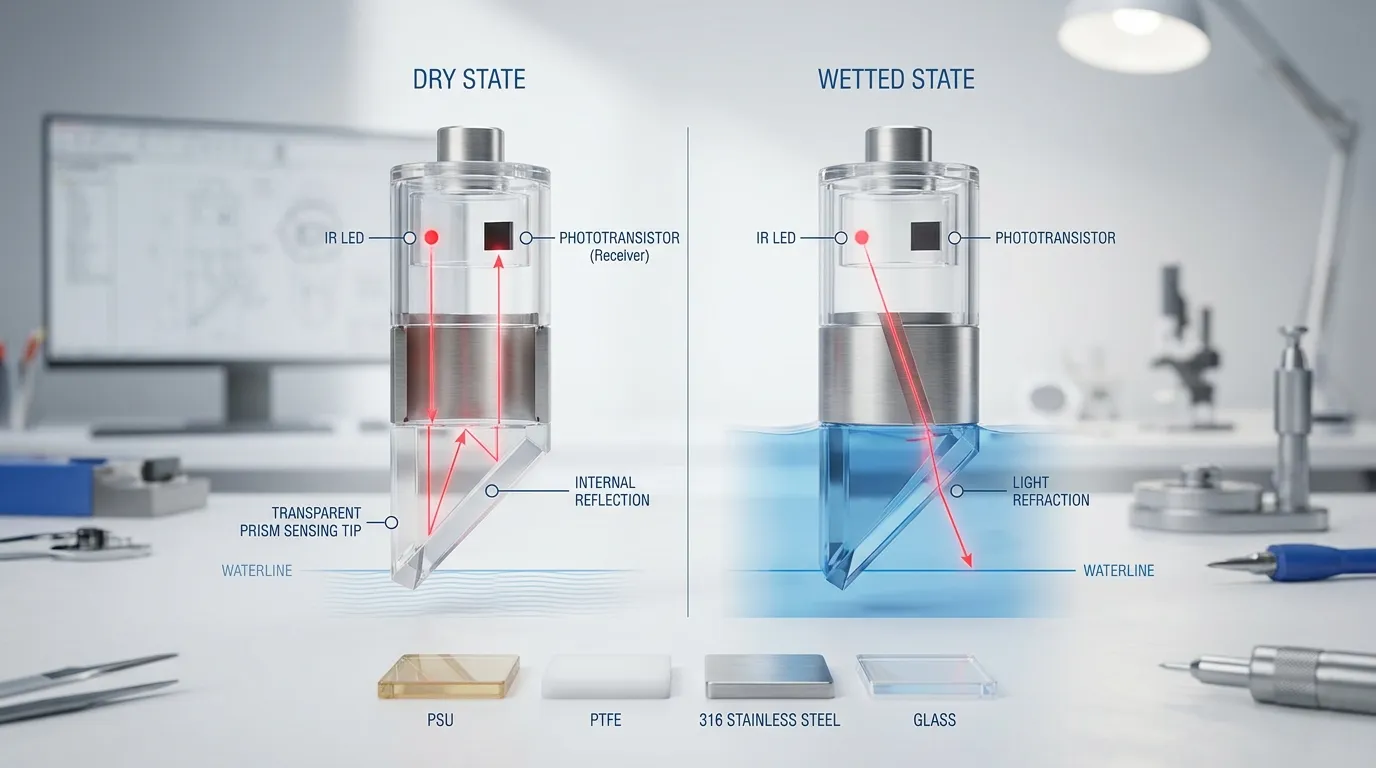
Un interrupteur à flotteur mécanique peut bien fonctionner dans des conditions propres, mais les installations ATO en aquarium ne sont pas toujours propres. Dérive du sel, Biofilm, Escargots, Tension des câbles, Turbulence, et un espace de puisard étroit peut affecter les pièces mobiles. Dans l’automatisation des puisards récifaux, Un signal « basse eau » bloqué peut maintenir la pompe de remplissage en fonctionnement et provoquer un débordement. Un signal « plein » bloqué peut arrêter le remplissage et permettre à la chambre de la pompe de retour de chuter trop bas.
Un capteur optique de niveau d’eau réduit ce risque car la pointe de détection n’a pas de déplacement mécanique. La structure courante utilise une LED infrarouge, un phototransistor ou un récepteur, et une pointe sensorielle en forme de prisme. Quand le prisme est sec, La lumière infrarouge se réfléchit à l’intérieur de la pointe et atteint le récepteur. Lorsque l’eau recouvre le prisme, Changements de la condition réfractive, donc moins de lumière revient au récepteur. L’électronique du capteur convertit ce changement optique sec/humide en une sortie électrique pour le contrôleur.
Pour les systèmes ATO, Ce signal humide/sec peut être utilisé de trois manières principales:
- Contrôle du recharge primaire: Le mode sec démarre la pompe de remplissage; L’état humide arrête la pompe.
- Coupure de sécurité de haut niveau: Le capteur supérieur détecte une montée anormale et arrête la pompe ou déclenche une alarme.
- Protection basse réservoir: Un capteur dans le réservoir d’eau douce aide à éviter le fonctionnement à sec de la pompe.
La meilleure conception d’ATO ne dépend pas d’un seul signal. Il combine un placement correct des capteurs, Logique d’attente du contrôleur, Tracage anti-tube à siphon, et la redondance à double capteur.
Montage sur puisard pour récif et aquarium ATO
Le capteur doit être installé dans la chambre de puisard où le niveau d’eau change par évaporation, généralement la chambre de la pompe de retour ou une chambre arrière stable dans un aquarium AIO. Il ne doit pas être placé là où les vagues, bulles, Éclaboussures de drain, ou un flux de remplissage direct frappe constamment la pointe.
Pour l’ATO monté sur carter, Les acheteurs doivent définir:
- Conduite d’eau en fonctionnement normal: La hauteur du capteur primaire doit correspondre au niveau de recharge de la cible.
- Conduite d’eau de sécurité: Le capteur de secours de haut niveau doit se situer au-dessus du niveau normal mais en dessous du point de risque de débordement.
- Surface de montage: verre, acrylique, Tableau, Port threadé, Monture magnétique, ou porte-douane.
- Épaisseur des parois et espace de la chambre: Important pour les chambres arrière compactes et les nano-chars.
- Itinéraire du câble: Évitez la tension du câble qui pourrait déplacer le capteur.
- Position du tube de remplissage: La sortie du tube doit être conçue pour éviter le siphonnage et ne doit pas se décharger directement sur la face du capteur.
HojellyTek peut prendre en charge différents formats mécaniques selon le projet: Sondes optiques compactes, Corps filetés, Styles de montage sur panneau, Conceptions montées sur support, et des ensembles de câbles personnalisés. Le filetage et le style de montage sont confirmés lors de la phase de RFQ car les marques d’aquarium et les fabricants de contrôleurs utilisent souvent des dispositions d’enceinte différentes.
Compatibilité du câblage et des manettes
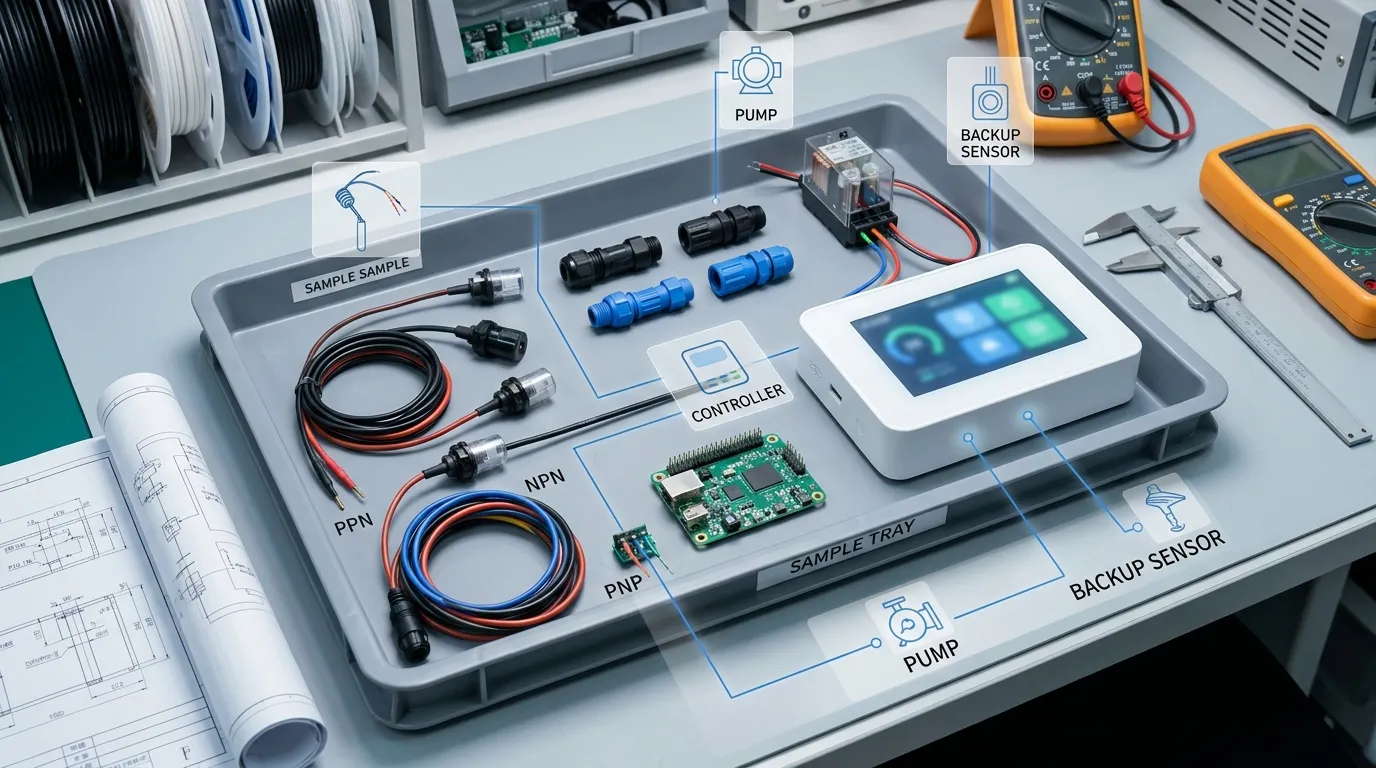
La compatibilité des contrôleurs ATO dépend de la sortie du capteur, Tension, Logique de câblage, et style de connecteur. Certains acheteurs ont besoin d’un simple signal numérique wet/dry. D’autres ont besoin d’une sortie NPN ou PNP pour une carte contrôleur. Les acheteurs OEM peuvent demander un harnais personnalisé pour un contrôleur de recharge Tuya/Smart Life ou un module de contrôle d’aquarium.
| Demande ATO | Exigence de signal commun | Type typique de contrôleur | L’acheteur doit confirmer |
|---|---|---|---|
| Contrôle ATO DIY de base | Sortie numérique humide/sèche | Carte relais, Petit circuit imprimé ATO, Microcontrôleur | Tension d’alimentation, Logique du signal, Entrée du relais de pompe |
| Entrée du contrôleur d’aquarium | Signal état humide/sec | Ports de style Apex ou de style Cerebra | Type de port, Connecteur, Logique de détection, besoins d’isolement |
| Produit de recharge intelligent | Signal du capteur vers la carte de contrôle | À toi / Contrôleur de recharge Smart Life | Tension du contrôleur d’application, Entrée carte, Connecteur de câble |
| Système ATO OEM | NPN personnalisé / PNP / Sortie numérique | Boîtier de contrôle ATO de marque | Couleur des fils, Connecteur étanche, Longueur du câble |
| Surveillance de style industriel | 4–20 mA ou une sortie continue lorsque nécessaire | Contrôleur de surveillance ou électronique personnalisée | Que la détection ponctuelle ou la mesure continue soit nécessaire |
| ATO de sécurité à double capteur | Primaire + Coupure de niveau élevé | Circuit imprimé ATO dédié ou contrôleur d’aquarium | Quel capteur a la priorité et comment les alarmes sont gérées |
Pour des projets d’aquarium orientés contrôleur, voir notre Capteur d’aquarium Apex/Cerebra Page de candidature.
Redondance à double capteur pour une conception ATO plus sûre
Un seul capteur optique peut contrôler la recharge, mais l’ATO à double capteur est la disposition la plus sûre pour les systèmes récifs haut de gamme et les produits OEM. Le premier capteur contrôle la conduite d’eau normale. Le second capteur est monté légèrement plus haut comme point de coupure de sécurité. Si le capteur principal se bloque, sale, débranché, ou mal lu par le contrôleur, Le capteur de haut niveau donne au contrôleur une autre condition pour arrêter la pompe.
Pour une meilleure protection, de nombreux designs ATO ajoutent également une limite de temps. Si la pompe fonctionne plus longtemps que prévu, Le contrôleur l’arrête et déclenche une alarme. Cela protège contre un tube déconnecté, Réservoir vide, Mauvaise position du capteur, ou état anormal du puisard.
Les modes de défaillance réels à planifier incluent:
- Fluage salé ou algues recouvrant la pointe du prisme
- Les micro-bulles provoquant une détection instable
- Interférence directe de lumière dans des chambres exposées
- Remplissez l’eau qui éclabousse directement le capteur
- Logique humide/sèche incorrecte dans le contrôleur
- Siphon du réservoir de remplissage vers le puisard
- Pompe fonctionnant avec un réservoir vide
- Mouvement du câble ou du support après maintenance
Un produit ATO fiable est conçu autour de ces cas avant la production, Pas après les plaintes des clients.
Matériaux sûrs pour aquarium et options de corps capteurs
Les matériaux humidifiés sont des matières dans les systèmes d’eau salée et récifaux. La pointe du capteur et le corps doivent être compatibles avec l’eau douce, Eau salée, et des additifs d’aquarium normaux. Selon la conception, HojellyTek peut discuter de l’alimentation, PTFE, 316 Acier inoxydable, et des options de pointe sensorielle en verre pour les zones de contact liquide.
Le choix des matériaux doit correspondre au projet:
- Corps d’alimentation: utile pour les structures de capteurs en plastique compact où la résistance chimique et le moulage sont importants.
- Corps en PTFE: sélectionné pour une résistance chimique plus forte et de faibles exigences d’adhérence en surface.
- 316 Caisse en acier inoxydable: utilisé là où un boîtier métallique, Installation filetée, ou une structure mécanique robuste est nécessaire.
- Embout prisme en verre: utile lorsque la clarté optique et la performance de détection propre sont prioritaires.
Le choix final du matériau dépend de la chimie de l’eau du client, Conception de l’enceinte, Objectif de coût, et méthode de montage. Nous ne recommandons pas de choisir un capteur uniquement par apparence; L’acheteur doit confirmer le matériau humidifié, Méthode d’étanchéité, Chemise de câble, Connecteur, et conditions de nettoyage avant commande.
5-Processus de projet en étapes
Demande d’information et examen des cas d’utilisation: Envoyez votre disposition ATO, Type de contrôleur, Conception de la chambre de puisard, Nombre de capteurs désiré, et marché cible. Notre équipe vérifie si le projet nécessite un seul capteur optique, Redondance à double capteur, Détection de basses réservoirs, ou un module de recharge intelligent.
Spécifications et personnalisation: Nous confirmons la tension d’alimentation, Type de sortie, Logique humide/sèche, Couleurs des fils, Longueur du câble, Connecteur, Style de monture, Matériau de la carrosserie, et interface de contrôleur. Pour les projets OEM/ODM, Les exigences en matière de logement et de brackets peuvent également être examinées.
Tests d’échantillons: Des échantillons peuvent être préparés pour des essais de laboratoire et des simulations de puisard. Les acheteurs devraient tester la réponse sèche/humide, Logique d’arrêt de pompe, Coupure de niveau élevé, Détection de basses réservoirs, et comportement de nettoyage.
Production et contrôle qualité: En tant que fabricant et exportateur à Shenzhen avec un R interne&D, HojellyTek prend en charge la personnalisation de la détection optique photoélectrique, Contrôles d’assemblage, et contrôle qualité de la production pour les projets d’exportation.
Transport maritime et support: Nous soutenons les acheteurs exportant vers les États-Unis, EU, Inde, et autres marchés. Après les essais, vous pouvez demander des devis via WhatsApp ou par e-mail pour les commandes en série, Ensembles OEM, ou modules capteurs ATO complets.
Exigences à confirmer avant de commander
Pour une sélection précise, Préparez les informations suivantes:
| Exigence | Pourquoi cela compte |
|---|---|
| Type de cuve ou de puisard | Définit l’espace de la chambre, Mouvement de l’eau, et style de brackets |
| Modèle de contrôleur | Détermine le câblage, Connecteur, et la compatibilité du signal |
| Tension d’alimentation | Doit correspondre à l’entrée de la carte de contrôle ou du contrôleur d’aquarium |
| Type de sortie | NPN, PNP, Commutateur numérique, ou un autre format de signal doit être sélectionné correctement |
| Logique humide/sèche | Le contrôleur doit savoir si mouillé signifie ALLUMÉ, OFF, haut, ou bas |
| Quantité du capteur | Simple, dual, ou la disposition à basse réserve modifie le câblage et la logique du firmware |
| Méthode de montage | Fil, Tableau, Panel, ou un support personnalisé influence le choix du corps du capteur |
| Matériau mouillé | Indispensable pour l’eau salée, eau douce, et conditions de nettoyage |
| Câble et connecteur | Important pour l’étanchéité, Disponibilité opérationnelle, et assemblage OEM |
| Méthode de contrôle de la pompe | Relais, MOSFET, Port contrôleur, ou le module intelligent doit être adapté en toute sécurité |
Capteur optique vs interrupteur à flotteur mécanique pour l’ATO d’aquarium
| Fonctionnalité | Capteur optique de niveau d’eau | Interrupteur à flotteur mécanique |
|---|---|---|
| Pièces mobiles | Pas de flotteur ou de charnière en mouvement | Utilise le mouvement des flotteurs |
| Principal avantage de l’ATO | Compact, Détection rapide de mouillés/sec, Moins de risque de coller | Simple et à faible coût |
| Risque principal | Prisme sale, bulles, lumière, Mauvais emplacement | Collage, Jam, Sel creep, Usure mécanique |
| Meilleure utilisation | ATO du carter récifal, Recharge intelligente, Systèmes compacts OEM | Commutation simple et peu coûteuse du niveau d’eau |
| Option de redondance | Primaire facile à combiner + Capteurs de haut niveau | Possible, mais nécessite un dégagement physique sur les flotteurs |
| Intégration des contrôleurs | Bon pour le numérique, NPN/PNP, et des conceptions de contrôleurs intelligents | Cela dépend de la capacité de l’interrupteur et du câblage |
Pourquoi choisir HojellyTek pour des projets de capteurs ATO en aquarium
HojellyTek se concentre sur la fabrication de capteurs de niveau liquide optiques et photoélectriques, Pas des accessoires génériques pour aquarium. Cela compte quand l’acheteur a besoin de personnalisation de la sortie, Choix des matériaux, Petits corps capteurs, Appariement des manettes, et une alimentation OEM stable.
Nos avantages incluent:
- Fabrication et support à l’exportation de capteurs basés à Shenzhen
- R interne&D pour la détection optique du niveau liquide
- Support OEM/ODM pour les marques ATO d’aquarium et les produits de recharge intelligente
- Discussion sur la compatibilité Tuya/Smart Life pour les projets de manettes intelligentes
- Personnalisation du capteur pour câble, Connecteur, Sortie, Carrosserie, et montage
- Expérience à l’exportation pour les acheteurs aux États-Unis, EU, Inde, et d’autres régions
FAQ
Un ATO d’aquarium à capteur optique de niveau d’eau est-il plus sûr qu’un interrupteur à flotteur?
Cela peut réduire le risque de blocage mécanique car il n’y a pas de flotteur en mouvement. Cependant, La sécurité dépend toujours d’un montage correct, Logique de contrôle, Redondance à double capteur, Protection contre le temps mort, et nettoyage régulier de la pointe optique.
Puis-je utiliser un capteur optique pour le remplissage automatique de l’aquarium ??
Oui, Un capteur peut contrôler le point de remplissage normal. Pour les systèmes récifaux, produits ATO premium, ou équipements orientés clients, Un second capteur de haut niveau est fortement recommandé pour la protection contre les débordements.
Le capteur fonctionnera-t-il avec les ports de contrôleur d’aquarium de style Apex ??
Il peut être conçu pour répondre aux exigences d’entrée de manette de type Apex ou similaires, mais la compatibilité doit être vérifiée par type de port, Tension, Connecteur, et logique du signal humide/sec avant commande.
Les capteurs optiques ATO peuvent-ils fonctionner avec des contrôleurs Tuya ou Smart Life?
Oui, Les capteurs optiques peuvent être intégrés aux contrôleurs de recharge Tuya ou Smart Life lorsque la carte de contrôle entre, Tension, Connecteur, et la logique sont correctement adaptées lors de la conception du produit.
Quels matériaux sont adaptés aux capteurs ATO d’aquarium d’eau salée?
Les choix courants incluent l’alimentation, PTFE, 316 Acier inoxydable, et des structures à pointe sensorielle en verre. La meilleure option dépend du design du corps du capteur, Chimie de l’eau, Méthode de nettoyage, et environnement de montée.
Qu’est-ce qui cause un faux déclenchement ATO avec un capteur optique?
Les causes courantes incluent les bulles, Sel creep, Algues, Lumière directe, éclaboussures, hauteur de montage incorrecte, Mauvaise logique de contrôleur, ou remplir l’eau qui coule directement sur la pointe de détection.
Demandez un devis pour les capteurs optiques ATO d’aquarium
Envoie ton modèle de manette, Tension d’alimentation, Type de sortie, Quantité du capteur, Méthode de montage par carter, Longueur du câble, Exigence du connecteur, et plan d’ordre des cibles. HojellyTek peut vous aider à sélectionner ou personnaliser une solution optique de capteur ATO pour les puisards récifaux, Contrôleurs de recharge intelligents, et systèmes d’aquarium à remplissage automatique OEM. Contactez-nous par WhatsApp ou par e-mail pour demander un devis, Exemple, ou revue de compatibilité.


