
Capteur de niveau optique pour réservoirs de liquide de refroidissement
Une solution de réservoir de liquide de refroidissement par capteur de niveau optique aide à prévenir la surchauffe à faible niveau de liquide de refroidissement, Pompe à sec, Cavitation, et un arrêt inattendu de la machine avant que le réservoir n’atteigne un niveau dangereux. Pour les machines-outils, moteur, refroidisseurs, Patins de refroidissement, et réservoirs industriels, HojellyTek fournit des capteurs photoélectriques compacts pour la détection d’alarmes de bas niveau, coolant presence confirmation, et intégration du réservoir de refroidissement OEM.
L’objectif est simple: détecter si le liquide de refroidissement est présent au niveau minimum sûr, puis envoie un signal fiable à un API, Carte de contrôle, Relais, buzzer, Feu d’avertissement, ou circuit d’arrêt.
Capacités de détection du niveau des réservoirs de liquide de refroidissement
Les capteurs optiques HojellyTek sont conçus pour la détection ponctuelle dans des réservoirs compacts et des réservoirs industriels où les interrupteurs à flotteur peuvent être trop encombrants, mécaniquement peu fiable, ou sensible aux vibrations.
Pour les applications dans les réservoirs de refroidissement, Nous pouvons soutenir:
- Détection d’alarme de faible liquide de refroidissement dans les réservoirs de refroidissement des machines-outils CNC
- Protection de l’entrée de la pompe pour les pompes de circulation du liquide de refroidissement
- Surveillance du niveau du réservoir de liquide de refroidissement moteur pour les équipements industriels
- Détection d’alarme de basse altitude dans le réservoir de refroidissement
- Surveillance du niveau de refroidissement du lubrifiant dans les systèmes de travail des métaux
- Personnalisation des capteurs OEM/ODM pour les constructeurs de chars et les fabricants d’équipements
- Modules de détection photoélectrique avec câble personnalisé, Connecteur, Sortie, et options de logement
- Sélection des capteurs basée sur le type de liquide de refroidissement, Matériau du réservoir, Position de montage, et logique de contrôle
Si votre application a besoin d’une plateforme générale de capteurs ponctuels, voir notre Capteur de niveau optique Options pour les projets standards de détection des liquides.
Prévenir la surchauffe à faible liquide de refroidissement et les dommages à la pompe
Dans les systèmes de refroidissement, Le capteur de niveau n’est pas seulement un accessoire de surveillance. C’est un dispositif de protection. Lorsque le liquide de refroidissement descend en dessous du niveau sûr, Le système peut perdre sa capacité de refroidissement, La pompe peut aspirer de l’air, et la machine peut continuer à fonctionner sans assez de liquide pour retirer la chaleur.
Les défaillances courantes qu’un capteur optique de bas niveau aide à prévenir incluent:
- Pompez à sec lorsque le niveau du réservoir de refroidissement descend en dessous du point d’aspiration
- Surchauffe dans les machines-outils, moteur, ou des refroidisseurs
- Mauvaise circulation du liquide de refroidissement causée par l’admission d’air ou la cavitation
- Usure de l’outil ou instabilité du procédé due à un débit de refroidissement insuffisant
- Pannes de faible intensité des refroidisseurs et arrêts d’urgence
- Interruptions imprévues causées par un retard dans l’inspection manuelle
- Dommages au joint de la pompe dus à des opérations répétées sans assez de liquide
Pour les applications axées sur la pompe, Nos liens Protection contre la pompe contre le fonctionnement à sec Page explique comment la détection ponctuelle peut être utilisée comme verrouillage avant que la pompe ne fonctionne dans des conditions dangereuses.
Comment le capteur optique détecte le niveau de liquide de refroidissement
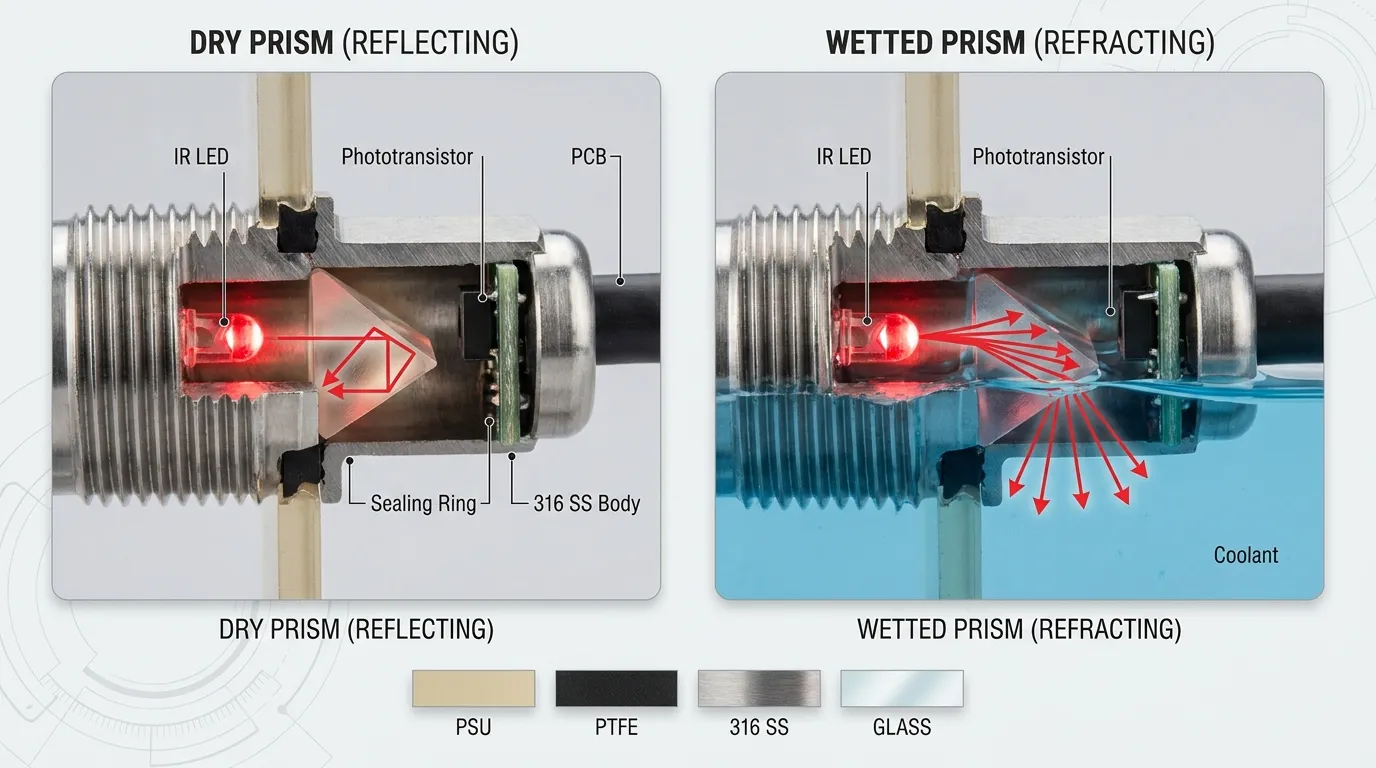
Un capteur de niveau de liquide de refroidissement photoélectrique utilise généralement une LED infrarouge, un phototransistor, et une pointe sensorielle en forme de prisme. La pointe de détection est installée au niveau d’alarme cible, à l’intérieur ou à travers la paroi du réservoir de refroidissement.
Quand la pointe du prisme est dans l’air, La lumière infrarouge se réfléchit à l’intérieur du prisme et revient au récepteur. Quand le liquide de refroidissement recouvre le prisme, La lumière se réfracte dans le liquide au lieu de se refléter. L’électronique des capteurs détecte ce changement et change l’état de sortie.
Cette méthode de détection sèche versus humidifiée présente plusieurs avantages dans les réservoirs de liquide de refroidissement:
- Aucun bras de flotteur mobile pour se bloquer, Bâton, ou s’user
- Embout de détection compact pour petits réservoirs
- Réponse rapide au niveau ponctuel à la hauteur de montage fixée
- Détection stable pour de nombreux produits aquatiques, à base de glycol, et les liquides à base d’huile
- Intégration facile d’alarmes de bas niveau avec des systèmes de contrôle électroniques
- Adapté au montage horizontal sur le côté ou à l’intégration de réservoirs personnalisés
Le capteur n’analyse pas la qualité du liquide de refroidissement ni la formule chimique. Son rôle est la détection de niveau: que la pointe de détection soit sèche ou humide au point d’alarme.
Compatibilité des liquides de refroidissement et sélection des températures
La compatibilité du liquide de refroidissement dépend du type de liquide, Concentration, Additifs, température, pression, Procédé de nettoyage, et matériau humidifié. Pour cette raison, Le corps du capteur et le matériau du prisme doivent être sélectionnés en fonction du liquide de refroidissement réel utilisé dans le réservoir, Pas seulement le nom de l’application.
Les options courantes pour les matériaux humides incluent le plastique de l’alimentation, PTFE, 316 Acier inoxydable, et verre. Pour les réservoirs à haute température, Circuits de liquide de refroidissement chauffé, ou des fluides industriels agressifs, Le modèle et le matériel du câble doivent être examinés avant l’échantillonnage. Pour les applications à haute température, voir notre capteur optique haute température Page de sélection.
| Liquide de refroidissement / Type de liquide | Cas d’usage typique | Direction suggérée du matériau du capteur | Considération de la température | Vérification de l’acheteur avant de commander |
|---|---|---|---|---|
| Liquide de refroidissement à base d’eau | Machines-outils CNC, Centres d’usinage, Réservoirs de refroidissement généraux | Alimentation ou inox/verre selon les additifs et la conception du réservoir | Confirmez la température normale de fonctionnement et de nettoyage | Vérifiez la mousse, Puces, Concentration additive, et la hauteur de l’alarme |
| Liquide de refroidissement à base de glycol | Refroidisseurs, Patins de refroidissement, Réservoirs industriels liés aux moteurs | Alimentation, PTFE, ou en inox/verre après révision de compatibilité | Confirmez la plage de fonctionnement basse et haute température | Partagez la concentration de glycol et la plage de température du réservoir |
| Liquide de refroidissement à base d’huile / Huile de coupe | Travail des métaux, Systèmes de lubrification et de refroidissement | PTFE ou 316 l’inox/verre est souvent préféré pour les fluides plus agressifs | Confirmer la variation de viscosité à la température de fonctionnement | Tester avec un échantillon d’huile/liquide de refroidissement avant la commande en gros |
| Émulsion lubrifiante de refroidissement | Réservoirs de refroidissement pour machines-outils | Le choix du matériau dépend de la chimie de l’émulsion et du niveau de contamination | Confirmez si le réservoir chauffe pendant un fonctionnement continu | Vérifier la boue, écume, Puces, et méthode de nettoyage |
| Eau de refroidissement / Liquide de refroidissement du procédé | Refroidisseurs industriels et réservoirs de refroidissement des procédés | Alimentation ou inox/verre selon le fluide et l’installation | Confirmez le cycle de température du refroidisseur et la réponse à l’alarme | Vérifiez la logique d’alarme de bas niveau et le câblage d’interverrouillage de la pompe |
| Liquide de refroidissement agressif ou inconnu | Machines OEM, Équipements spéciaux de procédé | PTFE, 316 Inox, Ou le verre devrait être examiné en premier | La plage de température doit être confirmée à l’étape RFQ | Envoyez les détails du liquide de refroidissement ou demandez une validation d’échantillon |
Pour corrosif, haute température, ou applications en cuve métallique, un 316 capteur en inox peut être plus adapté qu’un capteur à corps plastique.
Câblage d’alarme de basse intensité pour les réservoirs de liquide de refroidissement
La plupart des projets de réservoir de refroidissement utilisent le capteur optique comme interrupteur de bas niveau. La sortie peut être configurée pour correspondre au système de contrôle de la machine, Tableau d’alarme, PLC, ou interface relais.
Les choix courants de sortie incluent:
- Sortie NPN pour les circuits d’entrée enfoncés
- Sortie PNP pour la fourniture des circuits d’entrée
- Logique NO ou NC selon que l’alarme doit se déclencher lorsque la pointe est sèche ou humide
- Interface relais lorsque la machine a besoin d’une commutation isolée
- Sortie de la lampe d’avertissement ou du buzzer à travers un circuit de contrôle
- Verrouillage de butée de pompe pour éviter le manœuvre à sec
- 4Sortie de –20 mA lorsqu’un capteur de niveau continu est sélectionné au lieu d’un commutateur de niveau ponctuel
Pour une faible protection contre le liquide de refroidissement, Beaucoup d’acheteurs préfèrent la logique de sécurité: lorsque le capteur est déconnecté, endommagé, ou détecte une pointe sèche, La machine doit passer en mode alarme ou arrêt au lieu de continuer silencieusement. Cette logique doit être confirmée avec votre ingénieur de contrôle avant la production.
Montage du capteur dans un réservoir de liquide de refroidissement
La position de montage détermine l’utilité de l’alarme. Un capteur installé trop bas peut détecter le problème seulement après que la pompe a déjà commencé à aspirer de l’air. Un capteur installé trop haut peut déclencher des alarmes nuisibles fréquentes même lorsque le système dispose encore de suffisamment de liquide de refroidissement utilisable.
Pour la plupart des réservoirs de refroidissement, Le capteur doit être monté au niveau minimum sûr au-dessus de l’entrée de la pompe ou du point d’aspiration. La hauteur exacte dépend de la géométrie de l’aquarium, Emplacement de la pompe, Mouvement fluide, et combien de volume de réserve est nécessaire avant l’arrêt.
Parmi les points de montage importants figurent:
- Installez la pointe de détection à la vraie hauteur d’alarme basse
- Éloignez la pointe des zones de découpage et de boue
- Évitez de monter là où de la mousse ou une forte turbulence frappe constamment le prisme
- Utilisez une méthode d’étanchéité adaptée au type paroi du réservoir et de liquide de refroidissement
- Confirmer la taille du fil, Direction du câble, et dégagement d’installation
- Protégez le câble des surfaces chaudes, pièces mobiles, Copeaux de découpe, et pulvérisation de liquide de refroidissement
- Pour les réservoirs métalliques, Confirmer la mise à la terre, Bruit électrique, et protection des connecteurs
- Pour les réservoirs en plastique, Confirmez l’épaisseur de la paroi et la résistance du filetage
Les options de montage typiques incluent un montage fileté sur les côtés, Installation personnalisée du boss de char, Montage interne compact, ou intégration de réservoir OEM. Fil, Longueur du câble, Style de connecteur, et le matériau du boîtier peut être personnalisé pendant la phase de RFQ.
Liste de contrôle pour les alarmes de bas niveau avant commande
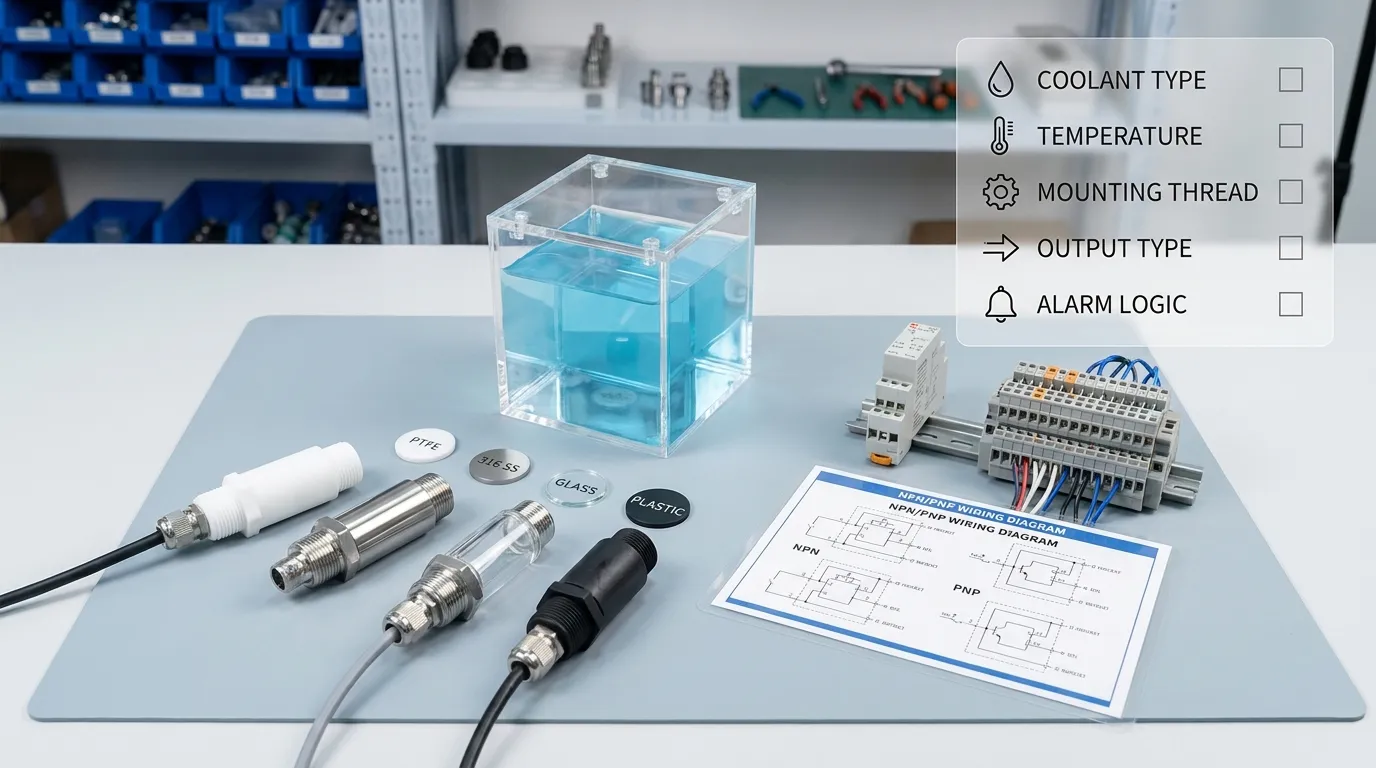
Avant de sélectionner un capteur optique pour la surveillance du réservoir de liquide de refroidissement, Préparez les informations suivantes:
- Type de liquide de refroidissement: À base d’eau, à base de glycol, à base d’huile, Émulsion, Eau de refroidissement, ou autre
- Marque ou échantillon de liquide de refroidissement si la compatibilité est incertaine
- Température normale de fonctionnement et température maximale de nettoyage ou de procédé
- Matériau du réservoir et épaisseur des parois
- Style de montage: Mur latéral, Boss fileté, Bride, ou porte-douane
- Niveau d’alarme requis mesuré au fond du réservoir ou à l’entrée de la pompe
- Type de sortie: NPN, PNP, Relais, ou signal analogique continu
- Logique d’alarme: normalement ouvert ou normalement fermé
- Tension d’alimentation requise par la carte de contrôle de la machine
- Cible de connexion: PLC, Relais, buzzer, Feu d’avertissement, ou interverrouillage à pompe
- Longueur du câble, Type de connecteur, et l’exigence de la gaine de câble
- Exposition aux vibrations, Copeaux de découpe, écume, Brume huileuse, ou spray de liquide de refroidissement
- Matériau du corps du capteur requis: Alimentation, PTFE, 316 Acier inoxydable, ou verre
- Quantité d’échantillonnage et plan d’essai avant commande de production
5-Processus de Service en étapes
1. Enquête
Envoyez-nous votre application pour réservoir de liquide de refroidissement, Type liquide, Dessin ou photo du char, Hauteur de l’alarme, et l’obligation de câble via WhatsApp ou e-mail.
2. Spécification et personnalisation
Notre équipe d’ingénierie examine les matériaux humides, Filetage de montage, Type de sortie, Câble, Connecteur, et logique d’alarme. Pour les projets OEM/ODM, Nous pouvons prendre en charge la structure et le câblage personnalisés des capteurs.
3. Tests d’échantillons
Les échantillons peuvent être préparés pour validation avec votre vrai liquide de refroidissement, réservoir, Carte de contrôle, et circuit d’alarme. Cette étape est importante pour les aliments à base de glycol, à base d’huile, haute température, ou des liquides de refroidissement riches en additifs.
4. Production et contrôle qualité
Après confirmation de l’échantillon, L’usine produit selon la configuration convenue. La QC se concentre sur la fonction des capteurs, État de sortie, Scellement, Qualité des câbles, et apparence.
5. Transport maritime et soutien
Nous exportons des capteurs pour des clients aux États-Unis, EU, Inde, et autres marchés. Le support peut inclure la confirmation du câblage, Suggestions d’installation, et la sélection de modèles pour les projets futurs.
Exigences et points de spécification à confirmer
| Exigence | Pourquoi ça compte |
|---|---|
| Type de liquide de refroidissement | Détermine les matériaux humidifiés et les besoins en tests d’échantillons |
| Plage de température | Affecte le corps du capteur, Prisme, Scellement, et le choix des câbles |
| Filetage ou structure de montage | Garantit que le capteur s’adapte au réservoir sans fuite |
| Hauteur du point d’alarme | Évite la surchauffe et la pompe fonctionne à sec avant d’être endommagée |
| Type de sortie | Indispensable pour un API, Relais, Tableau d’alarme, ou une entrée contrôleur |
| Logique NO/NC | Détermine quand l’alarme de faible niveau est déclenchée |
| Câble et connecteur | Doit s’adapter à la disposition de la machine et à l’environnement de service |
| Environnement de bassin | Puces, écume, vibration, boue, et les pulvérisations peuvent affecter la conception de l’installation |
Capteur optique vs interrupteur à flotteur pour réservoirs de liquide de refroidissement
| Objet | Capteur de niveau optique | Interrupteur à flotteur |
|---|---|---|
| Méthode de détection | Le prisme photoélectrique IR détecte l’état sec ou humide | Le flotteur mécanique se déplace avec le niveau liquide |
| Pièces mobiles | Aucun mécanisme de détection mobile | Un flotteur en mouvement peut rester collé ou s’user |
| Taille | Compact, adaptés aux petits réservoirs et aux réservoirs OEM | Il faut souvent plus d’espace interne |
| Coolant contamination | Nécessite un montage correct, loin des boues ou des éclats lourds | Le flotteur peut se bloquer avec les puces, saleté, ou résidus collants |
| Câblage | NPN, PNP, Interface de relais, ou une entrée contrôleur | Généralement une sortie simple à commutateur |
| Meilleure utilisation | Alarme électronique de faible niveau, Réservoirs compacts, Conceptions OEM | Des chars simples où le mouvement mécanique est acceptable |
Pourquoi choisir HojellyTek
HojellyTek est un fabricant de capteurs optiques et de niveau liquide de Shenzhen disposant d’un système R interne&Expérience en D et détection photoélectrique. Nous supportons la personnalisation OEM/ODM pour la surveillance des réservoirs de liquide de refroidissement, Réservoirs d’équipements compacts, Systèmes de contrôle industriel, et des intégrations d’appareils intelligents lorsque cela est pertinent.
Les acheteurs travaillent avec nous pour:
- Développement direct de capteurs en usine et support à l’exportation
- Conception du commutateur de niveau optique pour réservoirs compacts
- Câble personnalisé, Connecteur, fil, et configuration de sortie
- Options de matériaux incluant l’alimentation, PTFE, 316 Acier inoxydable, et verre
- Support applicatif pour machines-outils, moteur, refroidisseurs, et protection de la pompe
- Expérience d’exportation avec des clients aux États-Unis, EU, Inde, et autres marchés
FAQ
Une solution de réservoir de refroidissement par capteur de niveau optique peut-elle détecter un faible liquide de refroidissement avant d’être endommagé par la pompe?
Oui. Le capteur est monté au niveau minimum sûr de liquide de refroidissement. Lorsque la pointe du prisme devient sèche, La sortie change d’état et peut déclencher une alarme, Entrée API, Relais, buzzer, Feu d’avertissement, ou interverrouillage d’arrêt de pompe.
Un capteur de niveau optique fonctionnera-t-il avec un liquide de refroidissement à base de glycol ??
Il peut être utilisé dans de nombreuses applications de liquide de refroidissement à base de glycol, Mais la compatibilité doit être confirmée par la concentration du liquide de refroidissement, température, Additifs, et matériau humidifié. Pour les projets OEM, Il est recommandé de tester avec le liquide de refroidissement lui-même.
Le capteur peut-il détecter le liquide de refroidissement à base d’huile ou l’huile de coupure?
Oui, La détection optique de niveau peut être utilisée avec du liquide de refroidissement à base d’huile ou de l’huile de coupe lorsque le matériau et la position de montage appropriés sont sélectionnés. PTFE, Acier inoxydable, ou des options en verre peuvent être envisagées pour des fluides plus agressifs.
Où le capteur doit-il être monté dans un réservoir de liquide de refroidissement?
Installez-le à la hauteur d’alarme basse requise, généralement au-dessus de l’entrée de la pompe ou du point d’aspiration. Évitez les zones de boue, Zones d’accumulation de puces, Turbulence forte, et des positions où la mousse peut provoquer des alarmes nuisibles.
Dois-je choisir la sortie NPN ou PNP pour un capteur de réservoir de refroidissement?
Choisissez la sortie qui correspond à votre API, Carte de contrôle, ou circuit d’alarme. NPN et PNP sont tous deux courants. La logique NO/NC doit également être confirmée afin que la machine réagisse correctement lorsque le liquide de refroidissement est bas.
Est-ce qu’il faut 4 à 20 mA pour la surveillance du niveau du réservoir de refroidissement?
Pas toujours. Pour une simple alarme de faible niveau, un commutateur optique de niveau point avec NPN, PNP, ou une interface relais suffit généralement. Utilisez 4 à 20 mA uniquement lorsque votre système nécessite une mesure continue du niveau au lieu d’un seul point d’alarme.
Demandez un devis pour le capteur de réservoir de liquide de refroidissement
Envoyez votre type de liquide de refroidissement, Photo ou dessin du char, Hauteur de l’alarme, Filetage de montage, Type de sortie, Exigence de tension, et la préférence câble/connecteur à HojellyTek via WhatsApp ou e-mail. Notre équipe vous aidera à sélectionner ou personnaliser un capteur de niveau de liquide de refroidissement optique pour machines-outils, moteur, refroidisseurs, et systèmes de réservoir OEM.


