
Capteur optique de niveau liquide haute température
HojellyTek fabrique des solutions photoélectriques de détection de niveau liquide à Shenzhen pour les acheteurs OEM/ODM et industriels qui ont besoin d’un accompagnement matériel avant de commander des échantillons ou des lots de production.
Capacités de détection de niveau optique haute température
Notre service de capteur optique haute température couvre la détection ponctuelle pour les applications de milieu chaud où les interrupteurs à flotteur peuvent se bloquer, absorber les résidus, ou s’user mécaniquement. Le capteur utilise une LED infrarouge, Phototransistor, et la pointe du prisme optique pour détecter si le prisme est sec ou recouvert d’un liquide.
À l’état sec, La lumière infrarouge se réfléchit à l’intérieur du prisme et revient au récepteur. Lorsque le liquide recouvre le prisme, Changements de la condition réfractive, La lumière est redirigée dans le liquide, et la sortie change d’état. Cela rend la détection optique utile pour les alarmes de haut niveau, Alarme de bas niveau, Protection contre les essais à sec, Détection du niveau du réservoir de liquide de refroidissement, Surveillance des réservoirs de pétrole, et intégration compacte de réservoirs OEM.
Selon le projet, Nous le soutenons:
- Détection photoélectrique du niveau ponctuel pour la détection de liquides chauds
- Alimentation, 316 Acier inoxydable, verre, PTFE, et structures à matériaux mixtes
- NPN, PNP, et options de sortie numérique
- 4–20 mA discussion pour des projets de niveau continu ou basés sur émetteurs
- Fileté, compact, Montage latéral, Fixation inférieure, et des structures de montage personnalisées
- Longueur du câble OEM, Connecteur, Logique de sortie, et conception de logements
- Essais d’échantillons avant production de masse pour des applications en médias chauds
Pour la sélection générale du niveau optique du point, voir notre Capteur de niveau optique gamme.
Le véritable risque de défaillance: Prismes et joints en plastique au-dessus de la classification
Les acheteurs à haute température demandent généralement la température maximale en premier. C’est compréhensible, Mais un seul chiffre de « température maximale » peut être trompeur s’il ne décrit qu’une partie du capteur.
Un prisme en plastique peut survivre à un court éclaboussure chaude mais se déformer lors d’une immersion continue. Un sceau peut durcir, Swell, ou perdre la compression avant que le boîtier métallique ne lâche. Une gaine de câble peut se fissurer près de la paroi d’un réservoir chaud même si la pointe du capteur est encore fonctionnelle. Composé de rempotage, adhésif, Plastique du connecteur, et l’électronique interne peut aussi devenir la véritable limite.
Pour cette raison, HojellyTek ne recommande pas de sélectionner un capteur liquide chaud uniquement par le matériau corporel. Un corps en acier inoxydable ne signifie pas automatiquement le câble, Phoque, Fenêtre optique, et l’électronique partagent le même plafond. Une embout en verre peut supporter des supports plus agressifs que de nombreux plastiques, Mais l’assemblage a encore besoin d’un joint et d’un design de câble confirmés.
La manière sûre de spécifier un capteur optique à média chaud est de confirmer:
- Température normale continue d’un liquide
- Température maximale maximale
- Combien de temps dure la température de pointe
- Que la pointe du capteur soit, fil, Câble, ou le connecteur est exposé à la chaleur
- Si le liquide est de l’eau, Liquide de refroidissement, huile, Solution chimique, ou techniques mixtes
- Que la pression, vibration, écume, bulles, ou des cycles de nettoyage sont présents
Plafond de température par matériau: Alimentation vs 316SS vs Verre/PTFE
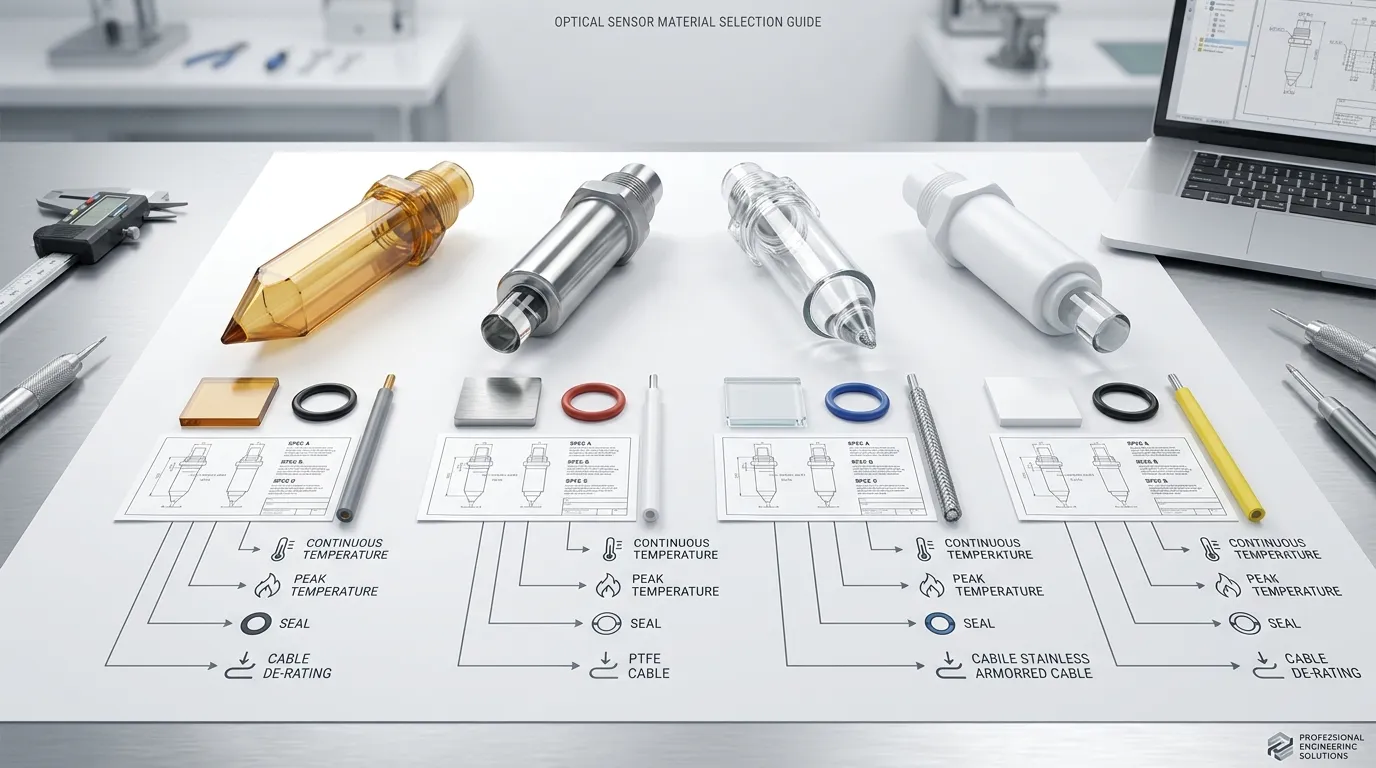
Pour les projets de capteurs optiques de niveau liquide à haute température, Le « plafond réel » doit être confirmé à partir de la configuration complète du capteur, non supposée à partir d’une seule matière première. Le tableau ci-dessous est conçu pour la sélection des acheteurs, Pas comme une affirmation de température publiée.
| Matériau des capteurs / Construction | Meilleur choix | Guidage de classification de température | Principal risque à vérifier |
|---|---|---|---|
| Prisme optique ou corps en plastique de l’alimentation | Réservoirs OEM compacts, Liquides à base d’eau, Projets à moindre coût | Convenable uniquement lorsque la note continue et maximale confirmée de la pièce exacte correspond à l’application. Ne supposez pas que « plastique d’ingénierie » signifie sûr pour tous les réservoirs chauds. | Adoucissement du prisme, craquelement, Gonflement, Contrainte de joint, Déformation à long terme |
| 316 Boîtier en acier inoxydable avec embout optique | Liquide de refroidissement chaud, huile, Réservoirs industriels, Protection mécanique renforcée | La durabilité de la carrosserie est supérieure à celle du plastique, Mais le plafond réel dépend de la pointe optique, Phoque, Câble, et l’assemblage interne. | Vieillissement du joint, Réduction de la classification des câbles, Transfert de chaleur vers l’électronique |
| Embout optique en verre | Eau chaude, Huiles, Produits chimiques, et des applications où la compatibilité des prismes plastiques est un problème | Souvent choisi lorsque les acheteurs ont besoin d’une interface optique plus stable que le plastique. Le plafond réel doit encore être confirmé par la conception complète de l’assemblage. | Étanchéité verre-métal, choc, Contrainte d’installation, Exposition des câbles |
| Parties humidifiées en PTFE avec une zone de détection de verre | Médias chimiques, liquides corrosifs, Applications nécessitant une faible adhérence de surface | Le PTFE peut améliorer la compatibilité chimique, Mais la résistance chimique et la température doivent être vérifiées séparément. | Compatibilité des joints, Rigidité mécanique, Permétation du milieu, Limite de câble |
| Montage mixte sur mesure | Réservoirs OEM avec espace strict, câblage, et exigences en médias | Mieux géré comme une conception basée sur la RFQ où le matériau, Phoque, Câble, Sortie, et le montage sont spécifiés ensemble. | Un composant de l’assemblage devient le point de limite |
Pour les acheteurs qui ont besoin d’un visage sans détection plastique, notre Capteur optique en verre Page est une référence utile. Pour des logements industriels plus durs, Examiner le 316 Capteur optique en inox option.
Température continue vs Température de pointe
La température continue est la température que le capteur doit supporter pendant un fonctionnement normal pendant de longues périodes. La température de pointe est un événement court, comme la chaleur de démarrage, nettoyage, Chasse d’eau, ou une surchauffe temporaire.
Cette distinction est importante car de nombreuses défaillances ne surviennent pas instantanément. Un prisme en plastique peut passer un court test de laboratoire mais devenir un peu fou après des semaines dans le liquide de refroidissement chaud. Un joint peut passer le test de fuite à température ambiante mais perdre son élasticité après plusieurs séances de chauffage et de refroidissement répétés. L’isolation des câbles peut rester flexible au début, puis durcir et se fissurer après une longue exposition près d’une paroi d’un aquarium.
Lors de l’envoi d’une RFQ, N’écrivez pas seulement « haute température ». Envoyez la température de fonctionnement continue, Température maximale maximale, Durée de pointe, et si le capteur est immergé en continu ou seulement exposé lors du remplissage. Si l’application inclut un nettoyage CIP, vapeur, Détergent chaud, Additifs à huile, ou du liquide de refroidissement au glycol, Incluez ces informations avant la sélection de l’échantillon.
Classification du câble, Réduction de la cote des connecteurs, et Chauffage d’installation
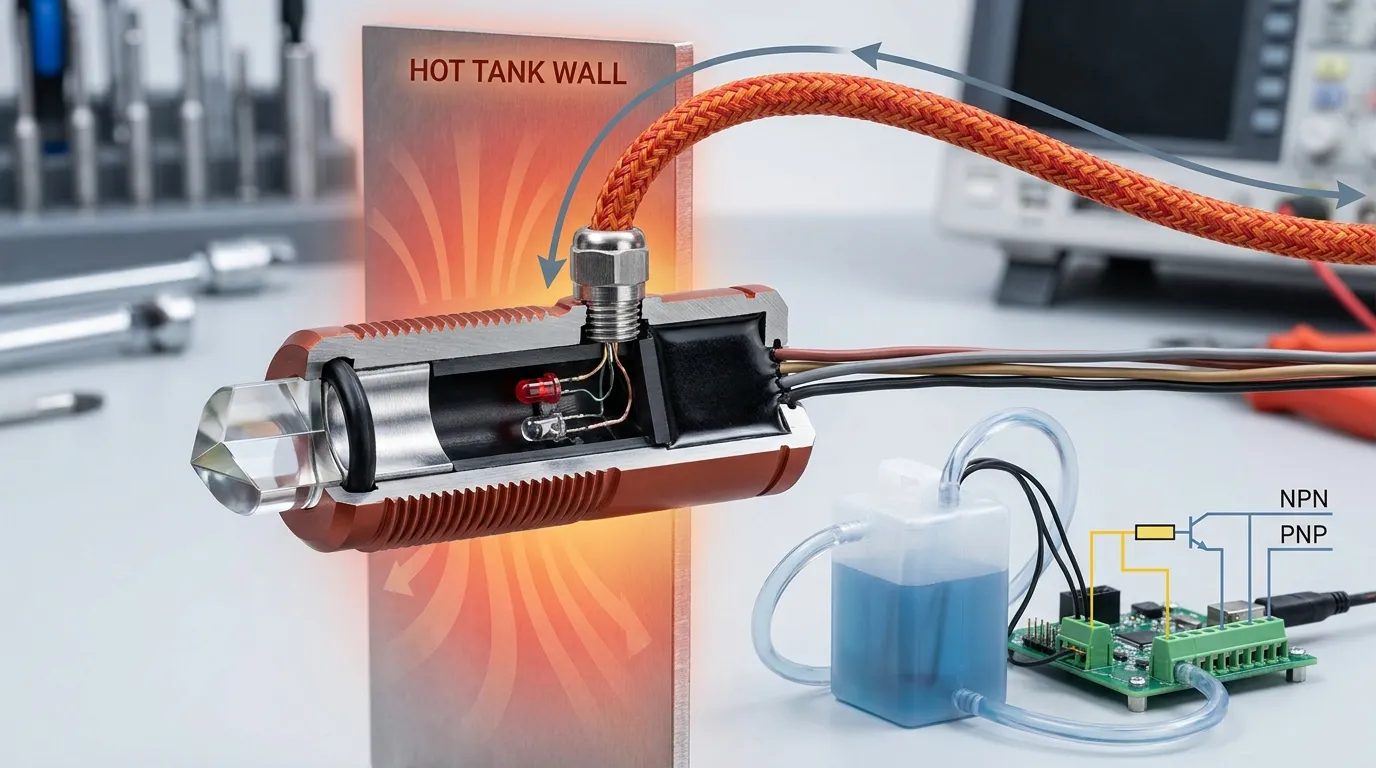
Dans des réservoirs chauds, La pointe du capteur n’est pas la seule pièce exposée. Le routage des câbles peut décider si le projet réussit.
Un câble homologué pour des conditions ambiantes normales peut lâcher s’il touche un réservoir métallique chaud, Il fonctionne à côté d’un chauffage, ou des sorties par un enclos chaud. Le câble peut nécessiter une isolation à haute température, Soulagement supplémentaire de la contrainte, Un chemin de routage plus frais, ou un boîtier métallique qui réduit le transfert direct de chaleur à l’entrée du câble.
Le choix du connecteur est aussi important. M8, M12, Connecteurs à brancher, Plombs volants, et les harnais sur mesure ont des limites de chaleur différentes. Si le connecteur se trouve en dehors de la zone chaude, La conception peut être plus simple. Si le connecteur est proche de la paroi du réservoir, Le matériau du connecteur et l’étanchéité doivent être vérifiés ensemble.
Pour les applications à haute température, Les acheteurs doivent confirmer:
- Matériau de la gaine de câble et zone d’exposition à la chaleur
- Distance entre la paroi du réservoir chaud et le connecteur
- Que le câble soit fixé, Flexion, ou exposés à la vibration
- Que ce soit du pétrole, Liquide de refroidissement, ou le produit de nettoyage entre en contact avec le câble
- Si le câblage de sortie utilise NPN, PNP, ou une autre interface de contrôle
- Est-ce que la carte de contrôle doit être normalement ouverte, normalement fermé, Riche en liquide, ou logique à faible teneur en liquide
Liste de contrôle des applications Hot-Media
Utilisez cette liste de contrôle avant de demander un devis ou un échantillon:
| RFQ Item | Que fournir |
|---|---|
| Type liquide | Eau, Liquide de refroidissement, huile, Détergent, Solution chimique, ou techniques mixtes |
| Température continue | Température normale de fonctionnement à long terme du liquide |
| Température de pointe | Température et durée d’exposition les plus élevées attendues |
| Position de montage | Montage latéral, Fixation inférieure, Entrée principale, ou conception personnalisée des murs de réservoir |
| Préférence pour les matériaux humidifiés | Alimentation, 316 Acier inoxydable, verre, PTFE, ou recommandation d’usine |
| Exigence de scellement | Compatibilité média, Condition de pression, et cycle de nettoyage |
| Exposition des câbles | Longueur de zone chaude, Distance du connecteur, et environnement de routage |
| Type de sortie | NPN, PNP, Sortie à commutateur, ou discussion sur l’émetteur |
| Alimentation | Tension de la carte de contrôle confirmée à l’étape RFQ |
| Objectif de la candidature | Alarme de haut niveau, Alarme de bas niveau, Protection contre les essais à sec, Détection des fuites, ou contrôle de réservoir OEM |
| Validation par exemple | Test de laboratoire, Test de trempage à liquide chaud, et test d’installation avant production |
Pour les projets de refroidissement chaud et de réservoir, le Capteur de réservoir de liquide de refroidissement Page fournit le contexte applicatif pour la surveillance des réservoirs compacts.
5-Processus d’alimentation OEM/ODM par étapes
1. Enquête
Envoyez le liquide, Profil thermique, Position de montage, Exigence de production, Dessin, Photo, ou un échantillon de pièce existant. Notre équipe examine si un commutateur optique standard est, Version en inox, Version en verre, ou une structure personnalisée est plus adaptée.
2. Spécifications et personnalisation
Nous confirmons la configuration pratique des capteurs: Matériau humide, fil, Câble, Logique de sortie, Connecteur, Phoque, et si le plafond de température doit être validé par test d’échantillon.
3. Exemple
Les échantillons sont préparés pour des tests électriques, Essais en immersion, et contrôles d’installation. Pour des projets médiatiques en vue, Nous recommandons de tester dans des conditions réelles de température liquide et de cycle de travail.
4. Production et contrôle qualité
Après approbation de l’échantillon, La production suit le dessin et le cahier des charges confirmés. Le contrôle qualité peut inclure l’inspection de l’apparence, Vérification du câblage, Vérification de la fonction de sortie, Contrôle du scellement, et des tests spécifiques à l’application convenus avant la production.
5. Transport maritime
HojellyTek exporte des produits de capteurs vers les États-Unis, EU, Inde, et autres marchés. Transport maritime, emballage, étiquetage, et la documentation peut être discutée en fonction de la commande et de la destination de l’acheteur.
Exigences et spécifications à confirmer avant de commander
Une commande fiable d’un capteur optique haute température devrait confirmer plus que le corps du capteur. Au minimum, Définissez:
- Type de capteur: Commutateur optique au niveau ponctuel ou projet de niveau continu
- Matériau mouillé: Alimentation, 316 Acier inoxydable, verre, PTFE, ou coutumier
- Production: NPN, PNP, Sortie numérique à commutateur, ou une discussion de 4 à 20 mA
- Logique de sortie: Actif dans le liquide ou actif dans l’air
- Montage: fil, Bride, Mur latéral, Fixation inférieure, ou une structure OEM compacte
- Câble: Longueur, Matériau de la veste, Connecteur, et l’exposition à la chaleur
- Phoque: Compatibilité avec le cycle liquide et thermique
- Intégration électrique: Tension d’alimentation, Charge, Contrôleur, PLC, ou entrée PCB
- Comportement des médias: écume, bulles, Revêtement, Film à l’huile, Résidu, Couleur, ou viscosité
- Plan de validation: Conditions d’essai d’échantillons avant production en série
Comparaison des matériaux et des applications
| Situation des applications | Meilleure option de départ | Pourquoi |
|---|---|---|
| Réservoir compact en plastique avec un liquide chaud | Capteur optique d’alimentation si jugé approprié | Économique et compact, mais il faut rester à l’intérieur du matériau réel et de la capacité d’étanchéité |
| Réservoir de refroidissement chaud | 316 Conception en inox ou à pointe en verre | Meilleur choix pour chauffer, Additifs, et les vibrations sont des préoccupations |
| Réservoir d’huile chaude | Boîtier en inox avec embout optique et câble adaptés | Compatibilité pétrolière, Chemise de câble, et le matériau des joints doit être vérifié avec soin |
| Produit chimique chaud et corrosif | Discussion sur le verre et le PTFE | La résistance chimique et la température doivent toutes deux être validées |
| L’acheteur ne connaît que le « liquide chaud » | Sélection des matériaux basée sur la RFQ | L’usine a besoin de supports, température continue, Température de pointe, et les détails de montage avant de faire un devis en toute sécurité |
Pourquoi choisir HojellyTek
HojellyTek est un fabricant et exportateur de Shenzhen spécialisé dans la détection optique photoélectrique du niveau liquide. Nous soutenons la R interne&D, Personnalisation OEM/ODM, Structures de capteurs compactes, Sélection des matériaux industriels, et la validation d’échantillons basée sur l’application.
Les acheteurs travaillent avec nous lorsqu’ils ont besoin d’un partenaire capteur pratique direct à l’usine plutôt que d’un fournisseur uniquement au catalogue. Nous pouvons vous aider à comparer les alimentations, 316 Acier inoxydable, verre, et options PTFE, ajuster les détails du câble et de la sortie, et support de l’intégration OEM pour les chars, appareils, Équipements industriels, Systèmes de refroidissement, et des produits intelligents de surveillance des liquides. L’intégration entre Tuya et Smart Life peut également être discutée lorsque le projet nécessite une surveillance liquide connectée plutôt qu’un simple interrupteur filaire.
FAQ
Quelle est la température maximale réelle d’un capteur optique de niveau liquide à haute température?
La température maximale réelle dépend de l’ensemble complet: Prisme, Logement, Phoque, Câble, Connecteur, Rempotage, et la compatibilité des liquides. Nous ne recommandons pas de choisir selon un seul numéro de titre. Envoyez vos exigences de température continue et de pointe afin de vérifier le plafond correct.
Est-ce que la température continue diffère de la température de pointe?
Oui. La température continue correspond à une exposition normale à long terme. La température de pointe est un événement court. Un capteur peut survivre à un pic court mais échouer en immersion continue si le prisme, Phoque, ou le câble n’est pas homologué pour ce cycle de travail.
Quel matériau est le meilleur pour le liquide chaud: Alimentation, 316 Acier inoxydable, verre, ou PTFE?
L’alimentation peut convenir aux applications compactes d’origine lorsqu’elle est confirmée dans la classification. 316 L’acier inoxydable améliore la durabilité mécanique. Le verre est souvent préféré lorsque la compatibilité plastique est un problème. Le PTFE est utile pour la compatibilité chimique, Mais la température et le scellement doivent encore être confirmés.
Les capteurs de niveau optique peuvent-ils fonctionner dans des réservoirs de refroidissement chaud?
Oui, Les capteurs optiques peuvent être utilisés pour la détection du niveau de liquide de refroidissement lorsque le matériau, Phoque, Câble, et la sortie sont correctement sélectionnées. Additifs de liquide de refroidissement, Cycle de température, vibration, et la position de montage doit être partagée avant la sélection de l’échantillon.
Les capteurs optiques sont-ils des capteurs de niveau continu?
La plupart des capteurs optiques à prismes sont des commutateurs de niveau ponctuel. Ils détectent si la pointe est sèche ou humide. Si votre projet nécessite une mesure continue ou une sortie de 4 à 20 mA, discutez d’une solution séparée à niveau continu ou basée sur un émetteur.
Que dois-je envoyer avant de demander un devis?
Type liquide à envoyer, température continue, Température de pointe, Méthode de montage, Matériau du réservoir, Exigence de thread, Longueur du câble, Type de connecteur, Type de sortie, et la quantité ciblée d’ordre. Photos, Dessins, ou un échantillon de capteur existant est également utile.
Demandez un devis
Pour un capteur optique de niveau liquide haute température, La première étape la plus sûre est de confirmer le plafond réel de l’ensemble complet du capteur avant de commander. Envoyez votre checklist des médias en vue, Dessin de char, et l’obligation de câbler vers HojellyTek via WhatsApp ou e-mail, et notre équipe recommandera un matériau adapté, Sortie, Câble, et plan d’échantillonnage.


