
Capteur optique de niveau liquide en verre
Pour les acheteurs comparant le verre, plastique, PTFE, et des conceptions de capteurs optiques en inox, Cette page explique le choix du matériau, Parties mouillées, Scellement, Considérations de température, Limites de choc thermique, nettoyage, Options de sortie, et les détails de la RFQ nécessaires avant la commande.
Capacités des capteurs optiques en verre
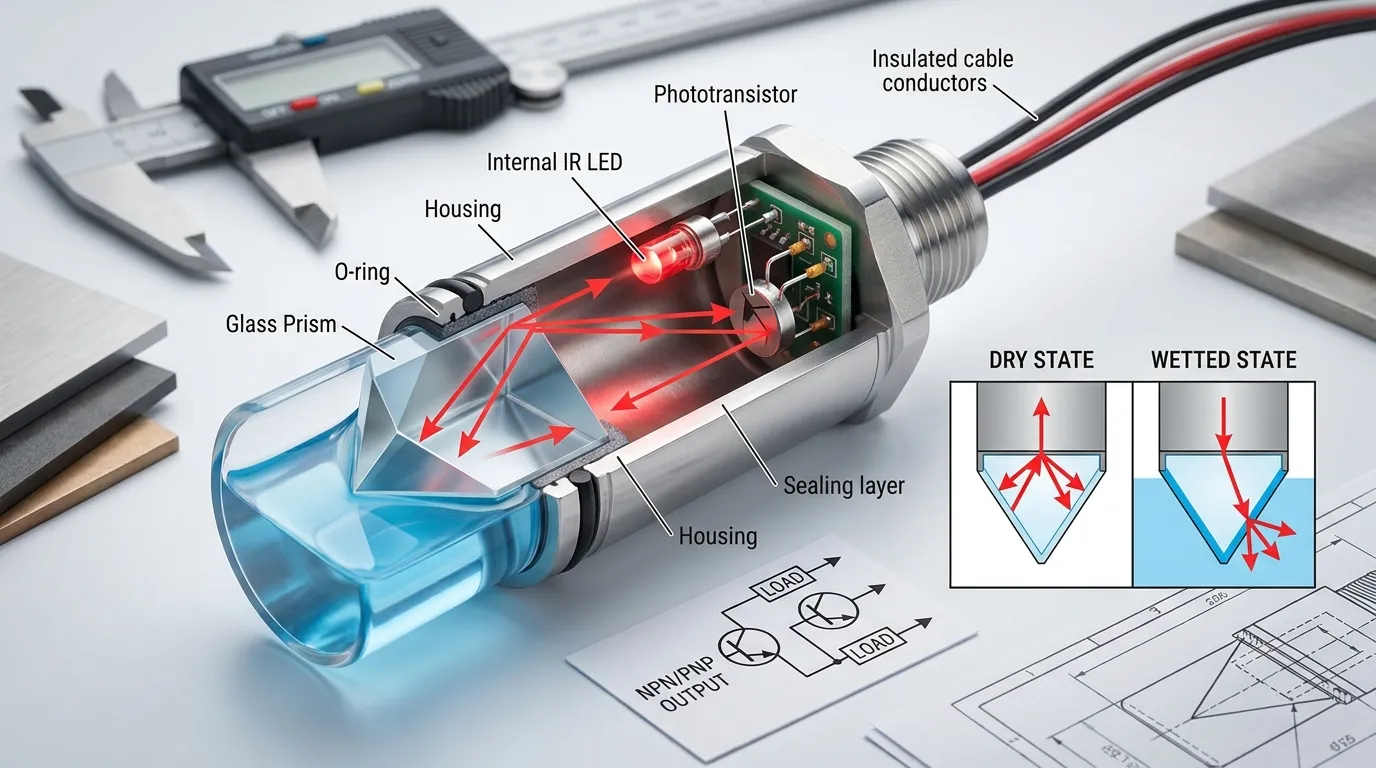
Nos capteurs optiques en verre-prisme utilisent la détection photoélectrique pour détecter si la pointe du prisme est dans l’air ou immergée dans un liquide. À l’intérieur du capteur, une LED infrarouge envoie de la lumière dans le prisme. Dans un état sec, La lumière se réfléchit à l’intérieur et revient au phototransistor. Lorsque le liquide recouvre le prisme, Changements de la condition réfractive, donc moins de lumière revient au récepteur. Le circuit commute ensuite la sortie.
Selon le projet, Le capteur peut être configuré pour:
- Détection ponctuelle pour un niveau de liquide élevé ou bas
- Logique de commutation sec-à-humide ou humide-à-sec
- Structures à pointe de verre ou à prise de verre
- Inox, PTFE, Alimentation, ou d’autres options de matériaux de logement
- NPN, PNP, ou d’autres exigences de sortie de la carte de contrôle
- Discussion sur la sortie numérique à commutateur ou analogique pour les projets de niveau continu
- Fileté, Montant sur char, Monté sur le côté, ou une installation OEM personnalisée
- Câble, Connecteur, ou terminaison fil de plomb poté
- Personnalisation OEM/ODM pour les fabricants d’équipements
Si vous avez besoin d’une référence générale avant de choisir la version en verre, voir notre Capteur de niveau optique Aperçu.
Pourquoi le verre est utilisé pour des milieux durs et à haute température
Le verre est choisi lorsque la pointe de détection doit rester optiquement stable dans un liquide qui peut être trop agressif, trop chaud, Ou trop abrasif pour un prisme en plastique standard. La valeur ne réside pas seulement dans la résistance chimique. Le véritable avantage réside dans la combinaison de la clarté optique, Dureté de surface, Stabilité dimensionnelle, et la facilité de nettoyage.
Résistance chimique dans les liquides agressifs
Dans les cuves chimiques, systèmes de nettoyage, Manipulation des solvants, Équipement de placage, et conteneurs de procédés industriels, La pointe du capteur est directement exposée au fluide. Les prismes plastiques peuvent absorber, Swell, adoucir, Décoloré, ou de folie lorsqu’il est exposé à certains solvants ou à des produits chimiques agressifs. Une pointe sensorielle en verre offre une surface optique plus stable pour de nombreux liquides agressifs.
Cependant, Le verre n’est pas universel. L’acheteur doit tout de même confirmer le liquide exact, Concentration, température, agent nettoyant, et temps d’exposition. Certains produits chimiques peuvent attaquer le verre, et le système d’étanchéité autour du verre peut devenir le véritable point faible s’il n’est pas adapté au liquide.
Résistance à l’abrasion et stabilité de surface
Un capteur à prisme en verre est utile lorsque le liquide contient des particules, Poudres, Traces de boue, Résidus de nettoyage, ou un liquide en mouvement qui peut rayer des plastiques plus tendres. Un prisme rayé peut diffuser la lumière et provoquer des commutations instables, Surtout dans les petits réservoirs où le niveau traverse à plusieurs reprises le point de détection.
Le verre a une meilleure dureté de surface que les embouts optiques en plastique courants, il peut ainsi maintenir un chemin optique plus propre plus longtemps dans des environnements abrasifs ou fréquemment nettoyés. Encore, Le verre peut s’ébrécher ou se fissurer s’il est touché par des outils durs, Pièces métalliques, ou un impact mécanique fort lors de l’installation.
Clarté optique qui résiste aux problèmes de revêtement
Les capteurs de niveau optique dépendent d’une surface prismatice claire. Huiles, Additifs collants, Produits chimiques cristallisés, Film biologique, Échelle, Ou un résidu séché peut provoquer une erreur de tout interrupteur optique. Le verre aide car il est lisse, La surface dure est plus facile à essuyer et à inspecter que de nombreux matériaux plastiques.
Pour les liquides qui laissent un film épais, Le capteur doit être monté de façon à ce que le débit puisse laver naturellement la pointe, Pas dans un coin mort. Si le réservoir a un revêtement épais, écume, ou cristallisation, la RFQ doit inclure la fréquence de nettoyage et le comportement des résidus afin que l’usine puisse recommander une forme de pointe et une position de montage appropriées.
Tolérance à haute température vs prismes en plastique
Le verre est souvent choisi pour les liquides à haute température car il conserve mieux sa forme et sa stabilité optique que de nombreux plastiques. Dans les systèmes d’eau chauffée, Équipement à huile chaude, Réservoirs de procédé, et des machines de nettoyage industrielles, Les prismes plastiques peuvent s’assouplir, déformer, Décoloré, ou dérive dans les performances.
Pour des projets de température plus exigeants, Comparer avec notre capteur optique haute température Options. L’approbation de température doit toujours prendre en compte l’ensemble du capteur, Pas seulement le verre. Le logement, Câble, Phoque, Rempotage, Connecteur, et l’électronique doit également correspondre à l’environnement opérationnel réel.
Ne négligez pas les limites de choc thermique
Le verre supporte mieux la chaleur que de nombreux prismes en plastique, Mais un changement soudain de température peut tout de même l’endommager. Un choc thermique peut survenir lorsqu’une pointe de capteur chaude est rincée à l’eau froide, quand un capteur de froid est soudainement rempli d’un liquide chaud, ou lorsque les cycles de nettoyage modifient rapidement la température du liquide.
C’est différent de la température de fonctionnement normale. Un capteur peut convenir à un liquide stable à haute température mais rester à risque si la pointe subit un choc soudain de chaud à froid ou de froid à chaud. Pour les capteurs de niveau optique en verre, Les acheteurs doivent décrire les cycles de chauffage, Cycles de nettoyage, Température de remplissage du réservoir, et conditions de lavage avant approbation.
Type de verre humide, Scellement, et Matériel corporel
Un capteur optique en verre fiable n’est pas seulement du « verre ». La structure mouillée complète doit être examinée.
Embout sensorielle en verre ou prisme en verre
La partie en verre peut être une petite pointe optique, un prisme moulé ou usiné, ou un élément en verre intégré dans un corps en acier inoxydable. L’exigence clé est que le chemin optique reste clair et stable au point de détection. Les acheteurs doivent vérifier si le verre est directement exposé au liquide et si le liquide ne touche que la pointe ou d’autres parties de l’ensemble.
Choix des matériaux de logement
Les choix de logement courants incluent:
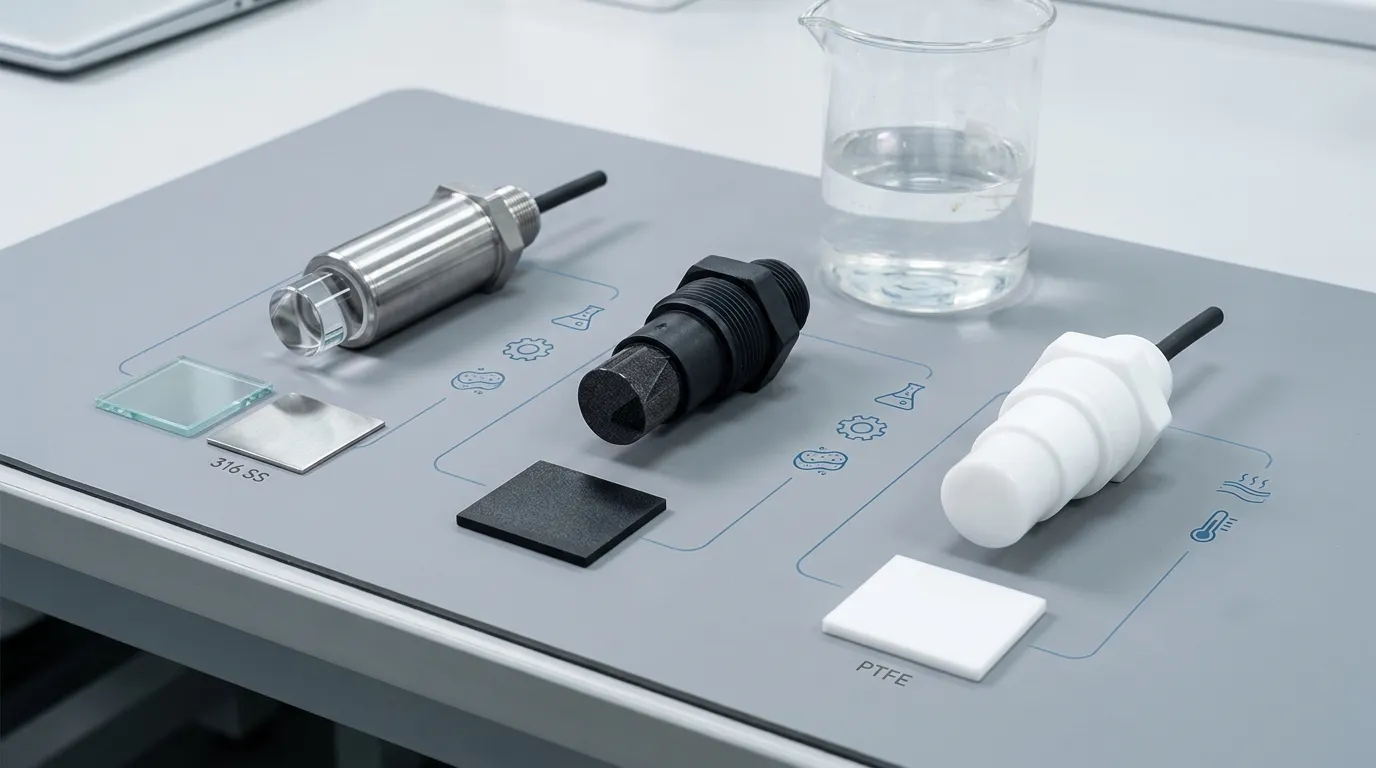
- 316 Acier inoxydable pour la force, Montage fileté, Huiles, Carburants, Liquides industriels, et de nombreux environnements chimiques
- PTFE pour des applications hautement corrosives où la compatibilité avec les fluoropolymères est privilégiée
- Alimentation ou plastique d’ingénierie pour des applications industrielles et électroménagères à moindre coût
- Embout en verre avec corps métallique où la clarté optique et la résistance mécanique sont toutes deux requises
Pour les projets à corps métallique, Examinez notre 316 Capteur optique en inox Options. Pour les milieux corrosifs où toute la structure humide nécessite une protection par fluoropolymères, Comparer avec notre Capteur optique PTFE.
Scellement et rempotage
Le sceau est souvent le point de sélection le plus important. Même lorsque la pointe en verre est compatible, le joint torique, adhésif, Composé de rempotage, Chemise de câble, ou le connecteur peut tomber en panne s’il est exposé à un liquide ou à une mauvaise température. Une bonne RFQ devrait confirmer:
- Que le capteur soit installé de l’intérieur ou de l’extérieur du réservoir
- Que le joint soit continuellement immergé ou uniquement exposé aux éclaboussures
- Que la pression ou le vide soit présent
- Que les produits nettoyants touchent le câble ou seulement la pointe
- Si le matériau du réservoir se dilate lors du chauffage
- Que des vibrations ou des contraintes mécaniques soient présentes
Montage, Production, et Options d’intégration
Les capteurs optiques en verre sont généralement utilisés comme interrupteurs de niveau ponctuel compacts. Ils peuvent être montés à travers un mur de réservoir, Port threadé, Bride, Tableau, ou une caractéristique de réservoir moulé OEM. La position de montage doit permettre au prisme de toucher proprement le liquide sans emprisonner les bulles d’air.
Pour la sortie de contrôle, les acheteurs demandent couramment la commutation NPN ou PNP pour les API, Cartes de contrôle, Pompes, Alarmes, et systèmes de remplissage. La logique de sortie peut souvent être sélectionnée selon que le système a besoin d’un signal lorsque la pointe est humide ou sèche. Pour les projets de niveau continu, La sortie analogique telle que 4–20 mA doit être discutée séparément car elle nécessite une structure de détection différente d’un simple commutateur optique ponctuel.
Avant de commander, Confirmer la tension d’alimentation, Type de sortie, Longueur du câble, Connecteur, fil, Direction de montage, Épaisseur de paroi du réservoir, et si le capteur doit être en sécurité en altitude ou en basse altitude.
Capteurs optiques en verre vs plastique vs PTFE
| Option de matériaux | Meilleur choix | Forces | Limites à vérifier |
|---|---|---|---|
| Embout optique en verre / Prisme | Âpre, chaud, abrasif, ou des liquides fréquemment nettoyés | Bonne clarté optique, Surface dure, Nettoyage plus facile, Meilleure stabilité à haute température que beaucoup de plastiques | Choc thermique, Dégâts d’impact, Compatibilité chimique du verre, Compatibilité des joints |
| Prisme optique en plastique | Eau générale, appareils, Réservoirs compacts, Conceptions OEM à moindre coût | Faible coût, léger, Facile à personnaliser, adapté à de nombreux liquides standards | Résistance chimique et à l’abrasion plus faible, Tolérance à la chaleur plus faible, Décoloration ou gonflement possible |
| Capteur optique PTFE | Produits chimiques corrosifs puissants et exigences exigeantes en matière de matériaux humides | Excellente résistance chimique pour de nombreux milieux agressifs, Faible énergie de surface, Bon comportement anti-adhésif | Coût plus élevé, Limites de conception mécanique, La structure optique et l’étanchéité doivent être confirmées |
| Verre + 316 Corps en inox | Huiles, Carburants, Équipements industriels, Installation filetée haute résistance | Corps fort, Pointe optique propre, Montage industriel robuste | Compatibilité des métaux, Risque galvanique/corrosion, Matériau d’étanchéité, installation torque |
Checklist d’ajustement avant de spécifier le verre
Un capteur optique à prisme de verre est un candidat solide si la plupart de ces points correspondent à votre application:
- Le liquide est chimiquement agressif face aux embouts en plastique courants
- Le capteur doit fonctionner dans un liquide chauffé ou près d’un procédé à haute température
- Le milieu contient des particules, Résidu, Ou des cycles de nettoyage qui peuvent rayer le plastique
- La pointe optique nécessite un essuyage régulier ou un nettoyage chimique
- Le réservoir utilise une installation industrielle filetée ou en inoxydable
- Le liquide est clair, translucide, ou suffisamment prévisible pour la commutation optique
- Écume, bulles, et le revêtement collant peut être géré par la position de montage
- Le choc thermique peut être contrôlé ou conçu autour de cela
- Le sceau, Câble, et le matériau corporel peut être adapté au liquide
- Un échantillon peut être testé dans le liquide réel avant la production de masse
Le verre peut ne pas être la meilleure option si l’application a un fort impact mécanique, Cycles rapides de températures extrêmes, Cristallisation lourde, ou un produit chimique connu pour attaquer le verre. Dans ces cas, PTFE, Inox, ultrasonique, flotter, ou une autre méthode de détection de niveau pourrait être plus sûre.
5-Processus d’approvisionnement en étapes
- Enquête: Envoie le nom du liquide, Dessin de char, Position de montage, Conditions de température, Exigence de production, et planification de la quantité par WhatsApp ou email. Les photos ou dessins aident notre équipe à comprendre la véritable installation.
- Spécifications et personnalisation: Nos ingénieurs examinent le matériau humidifié, Embout en verre, Phoque, Logement, fil, Logique de sortie, Câble, et connecteur. Pour les projets OEM/ODM, On peut discuter de la taille, câblage, Besoins en marque propre, et intégration sur la carte de contrôle.
- Exemple: Un échantillon est recommandé pour les liquides agressifs, Médias à haute température, Liquides de revêtement, ou applications à cycle de nettoyage. Le meilleur test est toujours dans le liquide réel, sous conditions réelles de température et de nettoyage.
- Production et contrôle qualité: HojellyTek fabrique à Shenzhen avec un R interne&Expérience en détection optique D et photoélectrique. La production peut inclure des vérifications de fonction, Contrôles du câblage, Revue du scellement, et inspection visuelle selon la spécification convenue.
- Transport maritime: Nous exportons des capteurs optiques de niveau liquide vers les États-Unis, EU, Inde, et autres marchés. Le mode d’expédition et l’emballage sont confirmés selon la quantité de commande, Urgence de l’exemple, et exigences des acheteurs.
Exigences à confirmer au stade de la RFQ
- Nom liquide, Concentration, viscosité, et comportement des résidus
- Température normale et maximale de fonctionnement
- Que ce soit un chauffage soudain, refroidissement, ou le lavage provoque un choc thermique
- Matériau du réservoir, Épaisseur du mur, et direction de montage
- Fil, Bride, ou une exigence de montage personnalisée
- Matériaux humidifiés: verre, Acier inoxydable, PTFE, Alimentation, Phoque, Câble
- Type de sortie: NPN, PNP, Logique humide/sèche, ou une exigence analogique
- Tension d’alimentation et type de contrôleur
- Longueur du câble, Connecteur, et besoins en propriété intellectuelle/environnement
- Méthode de nettoyage: wipe, rinçage, Lavage chimique, CIP, ou service manuel
- Plan d’échantillonnage avant commande par lots
Pourquoi travailler avec HojellyTek
HojellyTek est un fabricant et exportateur de Shenzhen spécialisé dans les produits de détection optique et liquide. Nous soutenons la sélection standard des capteurs ainsi que le développement OEM/ODM pour les fabricants de chars, Marques d’appareils électroménagers, Constructeurs d’équipements industriels, et intégrateurs de systèmes.
Notre équipe peut vous aider à comparer le verre, PTFE, Acier inoxydable, et des structures de capteurs optiques en plastique au lieu de forcer un seul matériau pour chaque cas. Pour les projets de surveillance des réservoirs connectés, L’intégration Tuya/Smart Life peut également être discutée de la place de la conception du système.
FAQ
À quoi sert un capteur optique de niveau liquide en verre?
Un capteur optique de niveau liquide en verre est utilisé pour la détection ponctuelle en cas de cas agressif, chaud, abrasif, ou des liquides chimiquement exigeants où un prisme optique en plastique peut ne pas offrir une stabilité suffisante du matériau.
Comment un capteur optique de niveau optique en verre détecte-t-il le liquide?
Il utilise une LED infrarouge, Phototransistor, et prisme optique. Dans les airs, La lumière se réfléchit à l’intérieur du prisme. Quand le liquide recouvre la pointe du verre, Les changements du comportement réfractif, et le capteur commute sa sortie.
Le verre est-il meilleur que le plastique pour la détection optique du niveau liquide?
Le verre est souvent meilleur pour les hautes températures, Résistance à l’abrasion, Clarté optique, et nettoyage. Le plastique reste utile pour un coût plus bas, détection générale des liquides où les contraintes chimiques et thermiques sont plus faibles.
Les capteurs optiques en verre peuvent-ils être utilisés avec des produits chimiques?
Oui, Le verre peut fonctionner avec de nombreux milieux chimiques, Mais la compatibilité doit être confirmée. L’acheteur doit vérifier le liquide, Concentration, température, agent nettoyant, et temps d’exposition, En plus du joint et du matériau du boîtier.
Le choc thermique peut-il endommager un capteur optique en verre?
Oui. Le verre peut tolérer une température élevée constante mais peut se fissurer lors d’un changement brusque de température. Rinçage chaud-froid, Remplissage rapide, Ou que les cycles de nettoyage rigoureux doivent être révisés avant l’approbation du capteur.
Comment nettoyer la pointe sensorielle du verre?
Utilisez une méthode de nettoyage compatible avec le liquide, verre, Phoque, et le logement. Évitez les outils durs qui peuvent ébrécher la pointe. Pour les résidus collants, Prévoyez des inspections régulières et testez si l’essuyage ou le rinçage rétablit une commutation stable.
Demandez un devis
Pour spécifier un capteur optique à pointe de verre ou à prisme de verre, Envoyez vos coordonnées liquides, Plage de température, Dessin de char, Exigence de montage, Type de sortie, et procédé de nettoyage. Contactez HojellyTek par WhatsApp ou par e-mail pour demander un devis, Exemple, ou une recommandation de capteur OEM/ODM.


