
Capteur optique de niveau liquide en PTFE
HojellyTek fabrique des capteurs de niveau optique photoélectrique avec des options de corps en PTFE/Téflon, Options en PTFE ou en prisme saphir, et la personnalisation OEM/ODM pour les constructeurs de cuves chimiques, Fabricants d’équipements de dosage, Systèmes de laboratoire, et fournisseurs d’automatisation industrielle.
Capacités des capteurs optiques en PTFE
Un capteur optique à corps en PTFE est un interrupteur compact de niveau ponctuel utilisé pour détecter si un liquide a atteint un niveau fixe à l’intérieur d’un réservoir, Tuyau, Chambre, ou petit réservoir. Il est souvent choisi lorsque les matériaux humides courants ne conviennent pas au contact agressif avec des liquides.
Les capacités typiques incluent:
- Détection de niveau optique photoélectrique sans flotteur, aimant, ou pièce mécanique mobile
- Corps mouillé PTFE/Téflon pour une forte résistance chimique
- Options en PTFE ou en prisme saphir selon le support, Pureté, Performance optique, et exigences mécaniques
- Montage fileté compact pour petits chars, Réservoirs chimiques, et panneaux d’équipement
- Sorties à commutation numérique telles que NPN ou PNP pour les API, Contrôleurs, et circuits d’alarme
- Des options de sortie analogique telles que 4 à 20 mA pour certains designs de surveillance de niveau lorsque nécessaire
- Longueur de câble personnalisée, Connecteur, Logique de câblage, État de sortie, et configuration de montage
- Développement OEM/ODM pour les marques de capteurs, Fabricants d’équipements, et intégrateurs de systèmes industriels
Pour les principes standards de détection de niveau optique et les formats de produits, voir notre Capteur de niveau optique Page.
Pourquoi l’attaque chimique est-elle le principal problème de conception
Dans de nombreuses cuves chimiques, Le capteur de niveau tombe en panne avant que le système de contrôle ne tombe en panne. La raison est simple: Le liquide contacte le capteur tous les jours. Si le corps mouillé, Prisme, Phoque, Chemise de câble, ou le matériau pour rempotage n’est pas adapté, Le capteur peut souffrir d’un gonflement chimique, Fissuration sous contrainte, discoloration, fuite, Dérive du signal, ou une défaillance soudaine de sortie.
Ce problème est particulièrement important dans:
- Réservoirs de stockage d’acide et d’alcali
- Réservoirs d’alimentation en solvants
- Équipement de dosage chimique
- Systèmes de gravure et de nettoyage
- Équipement de manutention des fluides de laboratoire
- Batterie, Placage, et équipements de traitement de surface
- Systèmes d’alimentation chimique à haute pureté
- Machines compactes OEM avec un accès limité à la maintenance
Un corps en PTFE est utile car le PTFE offre une excellente résistance à de nombreux produits chimiques agressifs et est largement utilisé lorsque les métaux ou les plastiques d’ingénierie peuvent être attaqués. Dans un capteur de niveau optique, Le corps entoure la pointe de détection et fournit la structure de montage filetée. Lorsque le prisme est aussi en PTFE ou saphir, La zone de contact liquide est mieux adaptée aux milieux agressifs qu’aux conceptions classiques à corps plastique.
Un prisme saphir peut être choisi lorsqu’un dur, Une fenêtre optique stable est préférée. Un prisme en PTFE peut être choisi lorsque l’adaptation du matériau du corps mouillé est plus importante pour la résistance chimique et une faible interaction de surface. Le bon choix dépend du support exact et des conditions de fonctionnement.
Comment fonctionne la détection optique
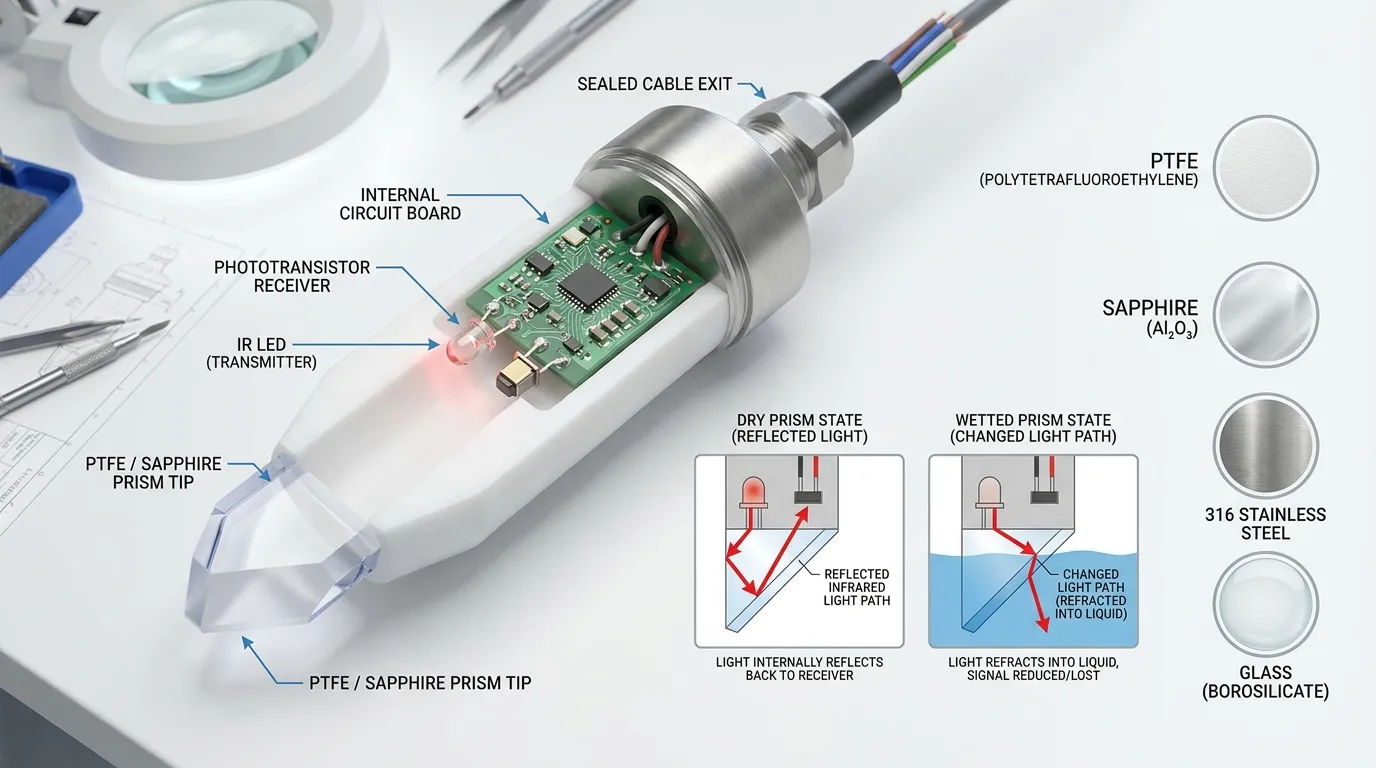
À l’intérieur du capteur, une LED infrarouge envoie la lumière vers la pointe du prisme. Un phototransistor reçoit la lumière réfléchie. À l’état sec, Le prisme réfléchit davantage de lumière à l’intérieur, Ainsi, le récepteur perçoit un signal plus fort. Lorsque le liquide recouvre le prisme, le comportement réfractif change et moins de lumière revient au récepteur. Le circuit convertit ce changement en une sortie de niveau.
Cela rend le capteur utile pour la détection au niveau ponctuel telle que:
- Alarme de faible niveau
- Alarme de haut niveau
- Protection du réservoir vide
- Prévention du débordement
- Détection de recharge chimique
- Protection contre la pompe contre le fonctionnement à sec
- Confirmation du niveau du petit réservoir
Parce qu’il n’y a pas de flotteur, Le capteur évite les problèmes liés au blocage du flotteur, Défaillance de l’aimant, Usure des charnières, ou contamination par pièces mobiles. Cependant, Les capteurs optiques nécessitent encore une bonne révision médiatique. Revêtement épais, Cristallisation, résidu collant, bulles, écume, Ou une accumulation opaque sur le prisme peut affecter la stabilité de la détection.
Guide de compatibilité chimique pour capteurs optiques PTFE/Téflon
Le PTFE est un choix solide pour de nombreux liquides agressifs, Mais aucun capteur ne devrait être vendu comme universellement compatible. La compatibilité dépend du nom chimique, Concentration, température, pression, Temps d’exposition, Procédé de nettoyage, et tous les matériaux humidifiés, y compris le corps, Prisme, Sceaux, Chemise de câble, et rempotage.
| Groupe médiatique | Exemples typiques | Adéquation du corps en PTFE | Option prisme | Avertissement clé |
|---|---|---|---|---|
| Acides forts | Acide sulfurique, Acide chlorhydrique, Applications à l’acide nitrique | Souvent adapté après confirmation | PTFE ou saphir | La concentration et la température doivent être vérifiées |
| Alcalins / Caustiques | Hydroxyde de sodium, Solutions d’hydroxyde de potassium | Souvent adapté après confirmation | PTFE ou saphir | Exposition prolongée et température élevée à examiner |
| Solvants | Alcools, cétones, Solvants de nettoyage, liquides organiques | Souvent adapté à de nombreux systèmes solvants | PTFE ou saphir | La compatibilité entre la gaine et les joints est cruciale |
| Produits chimiques oxydants | Acides oxydants, Produits chimiques à base de peroxyde | Cas par cas | Le saphir peut être préféré dans certains designs | Les oxydants puissants nécessitent une confirmation minutieuse des matériaux |
| Milieu de haute pureté | Produits chimiques semi-conducteurs, Systèmes d’eau DI, Lignes chimiques propres | Possible avec une conception appropriée | PTFE ou saphir | Le faible risque de lixiviation et de contamination doit être examiné |
| Huiles et carburants | Carburant, huile, fluides hydrauliques | Généralement possible, mais le PTFE n’est pas toujours nécessaire | PTFE, verre, ou des options en inox | Confirmer la viscosité, Résidu, et température de fonctionnement |
| Produits chimiques de nettoyage | Fluides CIP, Détergents, Produits chimiques de rinçage | Cas par cas | PTFE ou saphir | Des cycles de nettoyage répétés peuvent affecter les joints et les câbles |
| Techniques mixtes inconnues | Mélanges personnalisés ou déchets de procédé | Doit être examiné | À confirmer | Ne choisissez pas uniquement par le nom chimique |
Note de confirmation des médias: Avant la sélection finale, Notre équipe devrait confirmer le liquide exact, Concentration, température, pression, Méthode de nettoyage, Temps d’immersion, Matériau du réservoir, et la sortie requise. Le PTFE présente une large résistance chimique, mais HojellyTek ne revendique pas une compatibilité universelle pour tous les produits chimiques, Concentration, ou l’état du procédé.
Pureté, Lixiviation, et utilisation des fluides à haute pureté
Pour les milieux de haute pureté, La résistance chimique n’est qu’une partie de la décision. Les acheteurs doivent également prendre en compte la contamination, Extractables, Lixiviation, Propreté des surfaces, et si le corps du capteur ou les matériaux du câble peuvent introduire des particules ou résidus indésirables.
Un capteur optique en PTFE peut convenir à une manipulation chimique de haute pureté lorsque la structure humidifiée est conçue avec soin. Le matériau du corps, Matériau prismatice, Méthode d’étanchéité, Entrée par câble, et le processus de nettoyage doit être examiné ensemble. Pour des applications ultra-propres, Les acheteurs devraient nous dire si le capteur contactera DI Water, acide, solvant, Liquide nettoyant, ou des produits chimiques de qualité semi-conductrice, et si des exigences particulières en matière d’emballage ou de manipulation s’appliquent.
Là où les exigences de contact alimentaire ou sanitaires sont plus importantes que les attaques chimiques, notre capteur optique de qualité alimentaire Page pourrait être une meilleure référence.
Montage, Production, et Options d’intégration
Les capteurs optiques de niveau en PTFE sont généralement montés à travers la paroi du réservoir ou dans un orifice fileté. Le montage latéral est souvent utilisé pour les alarmes de haut ou bas niveau. Le montage en bas peut être utilisé pour la détection à vide, Confirmation du drain, ou la surveillance de petits réservoirs, selon la conception du réservoir.
Les acheteurs doivent confirmer:
- Type de filetage et taille du port
- Côté, Bottom, ou une direction de montage personnalisée
- Épaisseur des parois du réservoir et méthode d’étanchéité
- Longueur mouillée requise
- Direction de sortie du câble
- Turbulence liquide près du point de détection
- Si la pointe peut accumuler des bulles, Résidu, ou cristaux
- Type d’entrée PLC/contrôleur
- NPN, PNP, normalement ouvert, normalement fermé, ou une logique de commutation personnalisée
- Que 4 à 20 mA de sortie soit nécessaire pour une conception continue spécifique ou de type émetteur
Pour les applications où la résistance chimique est moins sévère mais où la résistance mécanique et l’apparence industrielle sont des priorités, Comparer avec un 316 Capteur optique en inox. Pour les parties transparentes ou humidifiées de type laboratoire, Comparer avec un Capteur optique en verre.
5-Processus d’approvisionnement en étapes
- Enquête — Envoie le nom du liquide, Concentration, température, Matériau du réservoir, Méthode de montage, Type de sortie, et commander une estimation de la quantité par WhatsApp ou email.
- Revue des spécifications et de la personnalisation — Notre équipe d’ingénierie examine le matériau mouillé, Option prisme, fil, Câble, Logique de sortie, et interface électrique.
- Exemple de confirmation — Un échantillon peut être préparé pour les essais d’installation, Revue des contacts médias, et la confirmation du signal dans votre réservoir ou équipement réel.
- Production et contrôle qualité — L’usine produit selon des plans confirmés, câblage, matériaux, et exigences d’inspection. La réponse optique et la sortie électrique sont vérifiées avant l’expédition.
- Soutien à l’expédition et à l’exportation — HojellyTek exporte des capteurs optiques de niveau liquide de Shenzhen vers des clients aux États-Unis, EU, Inde, et autres marchés.
Exigences à confirmer avant de commander
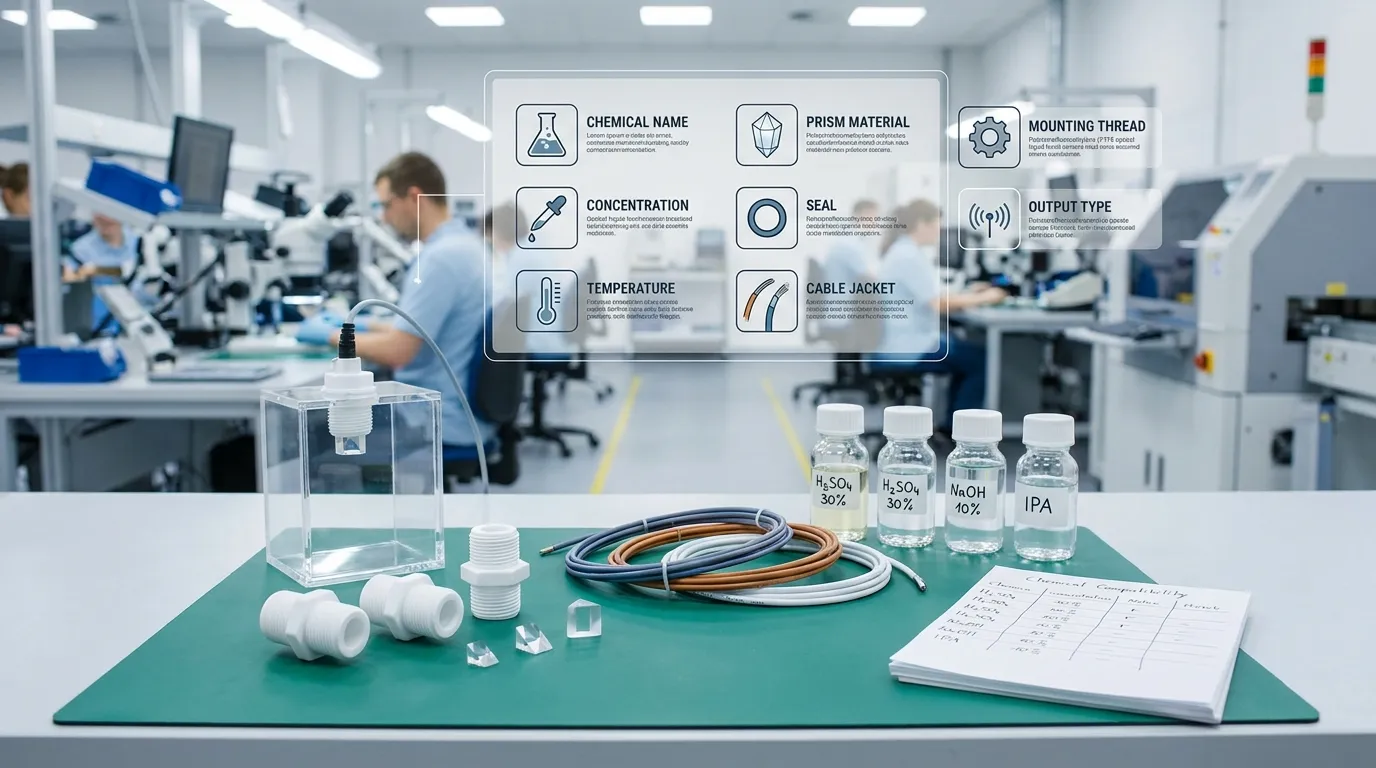
| Exigence | Pourquoi cela compte |
|---|---|
| Nom chimique exact | Les catégories générales ne suffisent pas pour la vérification de la compatibilité |
| Concentration | Une concentration plus forte peut modifier le comportement des matériaux |
| Température | La résistance chimique et la performance des joints dépendent de la chaleur |
| Pression ou état du réservoir | Le filetage et la conception de l’étanchéité doivent correspondre à l’installation |
| Position de montage | Côté, Bottom, et détection d’affect d’installation en angle |
| Condition prismatice | Revêtement, bulles, ou la cristallisation peut affecter la détection optique |
| Type de sortie | Les API et cartes peuvent nécessiter des NPN, PNP, ou signal analogique |
| Câble et connecteur | L’environnement externe peut nécessiter une gaine ou un connecteur différent |
| Exigence de pureté | Les systèmes de haute pureté nécessitent une inspection de contamination et de lixiviation |
PTFE vs autres options de matériaux humides
| Option de matériaux | Utilisation du meilleur ajustement | Force | Limitation |
|---|---|---|---|
| Alimentation / Plastique d’ingénierie | Détection générale de l’eau ou des liquides légers | Économique et compact | Ce n’est pas idéal pour les produits chimiques agressifs |
| PTFE / Téflon | Acides, Solvants, Produits chimiques de haute pureté, Médias corrosifs | Résistance chimique large et faible interaction de surface | Il faut confirmer la conception exacte des supports et mécaniques |
| 316 Acier inoxydable | Huiles, Carburants, Réservoirs industriels, résistance mécanique supérieure | Corps métallique solide et installation robuste | Pas adapté à tous les acides ou produits chimiques corrosifs |
| Verre | Laboratoire, Médias propres, Applications chimiques sélectionnées | Surface humide stable et transparente | Plus fragiles que les conceptions métalliques ou PTFE |
Pourquoi choisir HojellyTek
HojellyTek est un fabricant de capteurs optiques et de niveau liquide de Shenzhen disposant d’un système R interne&D, Expérience en conception de détection photoélectrique, et capacité de production OEM/ODM. Nous supportons les matériaux humides sur mesure, Structures de capteurs compactes, Logique de câblage, Formats de sortie, et exigences de montage pour les fabricants d’équipements.
Notre équipe travaille avec des acheteurs industriels, Distributeurs de capteurs, Constructeurs d’équipements chimiques, et des entreprises d’automatisation qui ont besoin d’une personnalisation directe en usine plutôt que de se contenter de cataloguer les pièces. L’intégration Tuya/Smart Life peut également être discutée lorsque le capteur de niveau fait partie d’un dispositif de surveillance intelligent plutôt qu’un simple circuit de contrôle filaire.
FAQ
Un capteur optique de niveau liquide en PTFE peut-il être utilisé avec de l’acide sulfurique ou de l’acide chlorhydrique ??
Souvent, Le PTFE est un candidat solide pour les applications acides, Mais l’acide exact, Concentration, température, Temps d’exposition, Matériau prismatice, Phoque, et la gaine câblée doit être confirmée avant la sélection. Nous recommandons la confirmation médiatique avant la production de l’échantillon.
Le PTFE est-il meilleur que 316 Acier inoxydable pour les produits chimiques corrosifs?
Pour de nombreux acides agressifs et solutions chimiques, Le PTFE peut être plus adapté que 316 Acier inoxydable. Pour les huiles, Carburants, Équipement mécanique, ou des médias moins corrosifs, L’acier inoxydable reste peut-être un meilleur choix. La décision dépend du support et des conditions d’installation.
Le capteur peut-il fonctionner dans des systèmes chimiques de haute pureté?
Oui, un modèle humidifié en PTFE ou saphir peut être envisagé pour des milieux de haute pureté, Mais les exigences de pureté doivent être examinées avec soin. Les acheteurs doivent respecter les limites de contamination, Procédé de nettoyage, Besoins en matière d’emballage, et si le capteur contacte l’eau DI, solvant, ou produits chimiques de procédé.
Qu’est-ce qui peut causer la défaillance d’un capteur de niveau chimique optique?
Les modes de défaillance courants incluent le gonflement chimique, Fuite d’étanchéité, Attaque de la chemise de câble, Revêtement prismatice, Cristallisation, bulles, Montage incorrect, Câblage de sortie incompatible, et utiliser un matériau corporel inadapté à la concentration chimique ou à la température réelle.
Le matériau du prisme a-t-il de l’importance?
Oui. Le prisme est la surface active de détection en contact avec le liquide. Le PTFE et le saphir offrent des avantages différents en matière de résistance chimique, Dureté, Comportement optique, et la pertinence de pureté. Le bon choix doit être confirmé en fonction du liquide et de l’environnement de fonctionnement.
Comment puis-je demander un capteur optique de niveau liquide en PTFE personnalisé?
Envoyez votre nom chimique, Concentration, température, Dessin de char, Exigence de thread, Direction de montage, Type de sortie, Longueur du câble, et quantité cible. HojellyTek peut examiner la spécification et fournir un devis par WhatsApp ou par e-mail.
Demandez un devis pour capteur optique en PTFE
Besoin d’un capteur de niveau optique à corps en PTFE/Téflon pour les acides, Solvants, Produits chimiques de haute pureté, ou des médias de procédé agressifs? Envoyez vos informations médias, Dessin d’installation, et la diffusion des besoins à notre équipe par WhatsApp ou email. Nous aiderons à confirmer le matériau humidifié, Option prisme, câblage, et montage de la structure avant citation.


