
Spécifications des capteurs de niveau optique & Sélection
Cette ressource de spécification des capteurs de niveau optique aide les acheteurs à comparer les principaux éléments électriques, mécanique, et les détails du matériau humidifié avant de demander une fiche technique, Exemple, ou citation. HojellyTek fabrique des solutions de détection optique photoélectrique de niveau à Shenzhen pour des projets OEM/ODM, Réservoirs industriels, Réservoirs d’appareils, Systèmes pétroliers, Systèmes d’eau, et exporté des ensembles de capteurs pour les États-Unis, EU, et les acheteurs indiens.
Utilisez cette page comme liste de sélection avant de choisir un Capteur de niveau optique pour ton aquarium, Contrôleur, ou conception d’équipements.
Fiche technique du capteur de niveau optique
Un capteur de niveau optique est normalement sélectionné en faisant correspondre d’abord le système de contrôle, puis le réservoir et l’environnement liquide. L’acheteur doit confirmer l’alimentation, Charge de courant, Type de sortie, Logique de commutation, Matériaux humides, température, pression, Filetage de montage, Style à câbles, et protection de la propriété intellectuelle avant commande.
| Élément de spécification | Gamme standard HojellyTek / Statut | Note de sélection des acheteurs |
|---|---|---|
| Principe de détection | Détection optique photoélectrique | IR LED + Phototransistor + Pointe prismatice |
| Tension d’alimentation | 5–24VDC | PCB de correspondance, PLC, Module relais, ou une entrée contrôleur |
| Courant d’alimentation / Consommation actuelle | À suivre | Confirmez lors de la RFQ en fonction du modèle et de la conception du circuit |
| Courant de charge | ≤ 100mA | Vérifiez la limite d’entrée/charge du contrôleur avant de câbler |
| Type de sortie | NPN / PNP | Choisissez selon le type d’entrée de l’API ou du contrôleur |
| Fonction de sortie | NON / NC | Sélectionnez en fonction de l’alarme de haut niveau, Alarme de bas niveau, ou logique de sécurité |
| Réponse de commutation | À suivre | Vérifiez si le niveau de liquide change rapidement ou si le réservoir vibre |
| Matériau de boîtier standard | SUS316 | Adapté à de nombreuses eaux, huile, et applications industrielles par contact liquide |
| Embout de détection standard / Matériau prismatice | Verre | Utilisé pour le changement de réflexion optique entre les états secs et humides |
| Autres choix de matériaux | Alimentation / PTFE / 316 Inox / verre, Confirmer par projet | Utiliser la revue RFQ pour la chimie, température, et exigences de logement OEM |
| Température de fonctionnement | -10~80°C | Confirmez la température du liquide, Température ambiante, et cycle de nettoyage |
| Pression nominale | À suivre | Confirmez pour les réservoirs scellés, Réservoirs sous pression, Pompes, ou systèmes d’alimentation |
| Fil / Options de montage | 1/2« NPT, G1/2, 3/8« NPT | Affrontez le boss tank, Épaisseur du mur, joint, et direction de l’installation |
| Indice IP | IP67 | Adapté aux installations industrielles et d’équipements protégées |
| Voyant | Rouge: pouvoir; Vert: Statut de l’eau | Utile pour les tests de laboratoire et le dépannage sur le terrain |
| Fiche technique / Dessin / câblage | Disponible sur demande | Utilisez un formulaire, WhatsApp, ou envoyer un e-mail pour demander le bon fichier modèle |
Comment fonctionne la spécification de détection optique
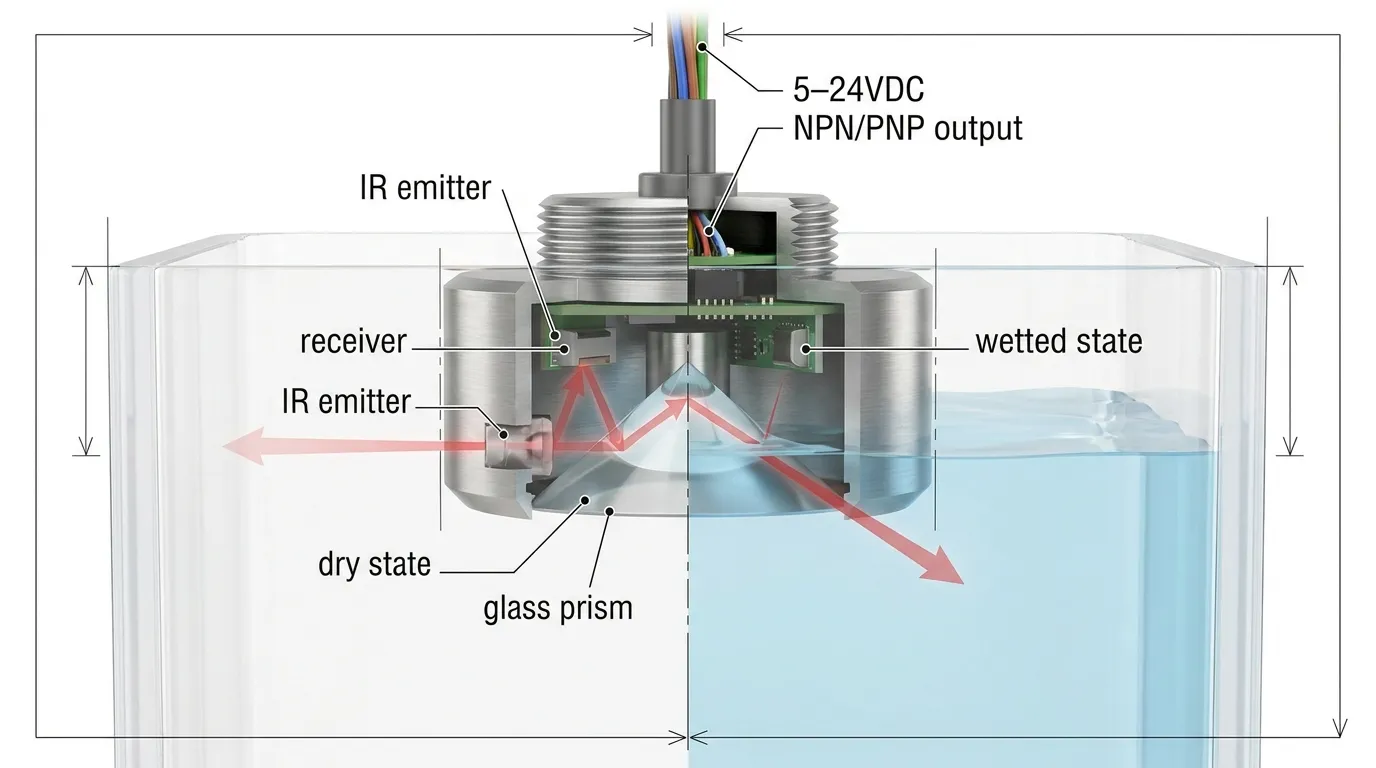
Un capteur optique photoélectrique utilise une LED infrarouge, Un récepteur phototransistor, et une pointe sensorielle en forme de prisme. À l’état sec, Le prisme réfléchit la lumière à l’intérieur vers le récepteur. Lorsque le liquide recouvre le prisme, Le chemin optique change car le liquide présente un comportement réfractif différent de celui de l’air. L’électronique convertit ce changement optique en sortie commutatrice.
Cela rend les capteurs optiques de niveau ponctuel utiles lorsque l’acheteur souhaite une taille compacte, Pas de flotteur en mouvement, Commutation électronique rapide, et un signal propre pour la détection à bas ou haut niveau. Cependant, La spécification doit s’adapter au liquide réel et à l’installation. Écume, bulles, Revêtement épais, Forte contamination, Mauvais angle de montage, Câblage de sortie incorrect, ou des matériaux mouillés incompatibles peuvent tous créer des problèmes de terrain.
Associez les spécifications électriques au contrôleur
La première étape de sélection est l’alimentation et la sortie. La plage de tension d’alimentation standard d’HojellyTek est 5–24VDC, ce qui permet une utilisation sur de nombreuses cartes de contrôle basse tension, Systèmes d’appareils électroménagers, Contrôleurs industriels, et circuits de surveillance des réservoirs OEM.
Pour une détection simple au niveau ponctuel, Les choix de sortie standards sont NPN ou PNP. Le NPN est couramment sélectionné lorsque l’entrée attend un signal de dépression, tandis que PNP est utilisé lorsque l’entrée attend un signal source. Un mauvais type de sortie peut donner l’impression que le capteur est « mort » même lorsque la pointe de détection fonctionne correctement. Pour les détails du câblage, comparer le Sortie NPN/PNP guide avant de confirmer l’ordre.
Certains projets demandent environ 4 à 20 mA car ils sont habitués à des émetteurs de niveau continu. Pour cette page de ressources, La plage standard confirmée est celle de la commutation au niveau de point optique. Si l’application nécessite un signal analogique continu, l’exigence de sortie doit être examinée séparément à l’étape de la RFQ plutôt que supposée.
Le courant de charge est également important. Le courant de charge standard confirmé est ≤ 100mA. Si le capteur commande une entrée PLC, Il s’agit généralement d’une charge au niveau du signal. Si l’acheteur veut piloter un relais, lampe, buzzer, ou un électro directement, Le circuit doit être examiné attentivement car ces charges peuvent dépasser la capacité nominale de sortie du capteur.
Sélectionnez la logique NO ou NC pour la fonction d’alarme
Le même corps de capteur peut être utilisé pour différentes fonctions de contrôle selon la logique de commutation. NON et NC doit être choisi en fonction du comportement de la machine lorsque le point de détection est sec, mouillé, déconnecté, ou en alerte.
Pour un réservoir de protection à faible altitude, L’acheteur peut vouloir que le contrôleur arrête une pompe lorsque du liquide tombe sous le capteur. Pour une alarme de débordement, L’acheteur peut vouloir un signal lorsque le liquide atteint le point supérieur. Dans les conceptions liées à la sécurité, L’ingénieur de contrôle doit décider si l’état normal doit être sous tension ou désalimentation afin d’éviter la rupture du câble, Défaillance du capteur, ou la perte de courant ne crée pas une hypothèse dangereuse.
Matériaux humides et compatibilité liquide
Les parties mouillées décident si le capteur peut survivre au liquide. Les acheteurs comparent souvent Alimentation, PTFE, 316 Acier inoxydable, et verre car chaque matériau se comporte différemment avec l’eau, huile, combustible, Liquide de refroidissement, liquides chimiques, Produits de nettoyage, et cycles de température.
Pour la configuration standard actuelle listée, Le matériau de logement confirmé est SUS316 et la pointe sensorielle est verre. Cette combinaison est utile lorsque la résistance à la corrosion est présente, Durabilité mécanique, et une surface prismatique optique stable sont nécessaires. Le PTFE peut être envisagé pour des environnements chimiques plus agressifs, tandis que les boîtiers de type alimentation peuvent être pertinents pour des applications OEM compactes ou sensibles au coût, mais la disponibilité et l’adéquation du matériel doivent être confirmées lors du RFQ.
Avant de commander, Partagez le nom du liquide, Concentration, température, si le liquide laisse des résidus, si le réservoir est nettoyé avec des produits chimiques, et si la pointe du capteur peut être exposée à un film d’huile, Échelle, écume, ou particules en suspension. Les capteurs optiques fonctionnent mieux lorsque la surface du prisme peut clairement passer de l’air au liquide.
Température, Pression, Classification IP et montage
La plage de température de fonctionnement confirmée est -10~80°C. Cela doit être vérifié à la fois par rapport au liquide et à la température de l’équipement environnant. Un char dans une usine chaude peut encore être à portée, tandis qu’une chaudière, Stérilisation, ou un environnement de nettoyage à haute température peut nécessiter une évaluation séparée du modèle.
La pression nominale est indiquée À suivre Parce que cela dépend de la structure mécanique, Phoque, fil, et configuration finale du modèle. Si le capteur sera utilisé dans un réservoir fermé, Conduite de pompe, Système de carburant, Circuit de refroidissement, ou un récipient à fluctuation de pression, La pression doit être confirmée avant l’approbation de l’échantillon.
La cote IP confirmée est IP67, qui supporte de nombreux équipements et installations industrielles lors de la sortie du câble, Connecteur, et les méthodes d’installation sont correctement protégées. La classification IP ne doit pas être considérée comme une compatibilité chimique ou une autorisation d’immersion illimitée; ce n’est qu’une partie de la sélection environnementale.
Les filetages de montage incluent 1/2« NPT, G1/2, et 3/8" NPT. Choisissez le fil selon la conception du boss tank, Épaisseur du mur, Méthode du joint, Direction du liquide, et l’espace disponible pour le câble. Pour les réservoirs OEM, Vérifiez si le capteur s’installe horizontalement depuis la paroi latérale, verticalement depuis le haut, ou dans une chambre personnalisée.
Table de cartographie des applications
| Application | Spécifications à prioriser | Notes de sélection |
|---|---|---|
| Alarme haute/basse du réservoir d’eau | 5–24VDC, NPN/PNP, NO/NC, IP67 | Confirmez le type d’entrée du contrôleur et la logique d’alarme |
| Réservoir de pétrole ou de carburant | SUS316, Embout en verre, Joint de filetage, pression TBC | Confirmez le film d’huile, vibration, et la température |
| Condensat ou bac de drainage CVC | Montage compact, IP67, NO/NC | Vérifier la contamination, nettoyage, et le passage des câbles |
| Réservoir d’appareil OEM | Tension, Sortie, fil, Taille corporelle | Confirmez l’ajustement de l’échantillon avant que la conception du moule ou du réservoir ne soit finalisée |
| Réservoir industriel de liquide | Matériel, température, pression, Montage | Partagez des données liquides et des plans d’installation |
| Protection contre la pompe contre le fonctionnement à sec | Logique de commutation, réponse à suivre, courant de charge ≤100 mA | Confirmer le comportement de sécurité dans le programme de contrôleur |
Comment spécifier un capteur de niveau optique
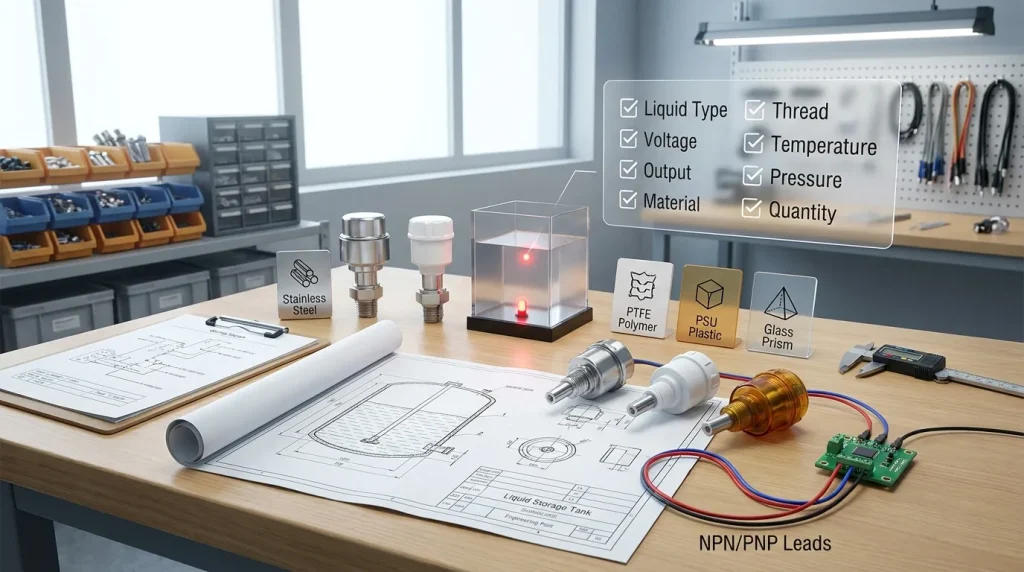
Utilisez cette liste de contrôle avant de demander le Fiche technique des capteurs de niveau optique ou un devis d’usine.
- Confirmez le liquide: eau, huile, combustible, Liquide de refroidissement, Mélange chimique, eaux usées, ou un autre liquide.
- Confirmez la fonction: Alarme de haut niveau, Alarme de bas niveau, Protection contre les essais à sec, Prévention des débordements, ou détection de statut OEM.
- Confirmez l’entrée électrique: 5V, 12V, 24V, Entrée API, Entrée MCU, Module relais, ou carte de contrôle.
- Choisir le type de sortie: NPN ou PNP.
- Choisissez la logique de commutation: NON ou NC.
- Confirmez si le capteur n’envoie qu’un signal ou un autre dispositif.
- Confirmez les besoins en matière: SUS316, verre, PTFE, Alimentation, ou discussion personnalisée.
- Confirmez le montage du réservoir: 1/2« NPT, G1/2, 3/8« NPT, Montage latéral, Montage supérieur, ou structure OEM.
- Confirmez les conditions de température et de pression.
- Tirage au sort, Quantité cible, Préférence câble/connecteur, Besoins d’étiquetage, et destination d’exportation.
Modes de défaillance courants à éviter
La plupart des problèmes de capteurs de niveau optique ne sont pas causés par le principe de détection lui-même. Ils proviennent généralement d’un décalage entre la spécification et l’application.
Un mauvais choix NPN/PNP peut empêcher le contrôleur de lire le signal. Un mauvais choix de NO/NC peut inverser la logique de l’alarme. Un liquide qui recouvre le prisme peut retarder ou bloquer la transition optique. Bulles d’air, écume, ou un liquide turbulent peut créer des commutations instables près du point de détection. Un décalage de filetage peut provoquer des fuites. Une condition de pression non divulguée peut affecter l’étanchéité. Une charge au-dessus ≤ 100mA peut endommager le circuit de sortie.
La méthode la plus sûre est d’approuver la spécification, câblage, Dessin, et test d’échantillon avant la production en lot.
Soutien à la fabrication HojellyTek
HojellyTek est un fabricant et exportateur de Shenzhen spécialisé dans la détection optique photoélectrique, Détection des niveaux liquides, et des projets de capteurs OEM/ODM. Notre R interne&L’équipe D soutient la sélection des modèles, Confirmation du câblage, Revue du matériel, et discussions sur la personnalisation pour les fabricants d’équipements, Distributeurs, et les acheteurs industriels.
Pour des détails plus larges sur le modèle, Examiner le Produit capteur de niveau optique Page, puis envoyez vos exigences de candidature par WhatsApp ou par email pour confirmation.
FAQ
Que doit inclure une spécification de capteur de niveau optique?
Une spécification de capteur de niveau optique doit inclure la tension d’alimentation, Actuel, Type de sortie, Courant de charge, Logique de commutation, Exigence de réponse, Matériaux humides, Température de fonctionnement, Condition de pression, Taille du filetage, Direction de montage, Indice IP, Besoins en câble/connecteur, et le liquide cible.
Le 5–24VDC convient-il à mon contrôleur?
Cela peut convenir si votre carte de contrôle, PLC, ou le module d’entrée fonctionne dans cette plage d’alimentation. Vous devez encore confirmer la sortie NPN/PNP, Logique NO/NC, Courant de charge, et méthode de câblage avant commande.
Un capteur peut-il détecter à la fois l’eau et l’huile ??
Les capteurs optiques peuvent être utilisés dans différents liquides, mais le comportement optique du liquide, Tendance au revêtement, viscosité, température, et la compatibilité chimique doit être examinée. Eau, huile, et les projets de carburant ne devraient pas être traités comme identiques sans test d’échantillon.
Quelle est la différence entre SUS316, PTFE, Alimentation et verre?
Le SUS316 est couramment choisi pour sa résistance à la corrosion et sa résistance mécanique. Le verre est utilisé comme pointe optique du prisme. Le PTFE peut être envisagé pour des substances chimiques agressives. Le matériau de type alimentation peut convenir à certains modèles OEM. Le choix final du matériau doit correspondre au liquide et à l’installation.
Les capteurs de niveau optique mesurent-ils le niveau continu?
Les capteurs optiques standard détectent la présence d’un liquide à un point de détection fixe. Si votre projet nécessite une mesure de niveau continue ou une sortie de 4 à 20 mA, Énoncer cela clairement lors de la RFQ afin que la solution correcte puisse être examinée.
Pourquoi la pression et la réponse de commutation sont-elles marquées TBC?
Ils dépendent du modèle exact, Phoque, Structure mécanique, et conditions du projet. Au lieu d’inventer des figures, Nous confirmons la pression et la réponse à la commutation lors de la revue de la fiche technique, Approbation d’exemple, ou discussion sur les spécifications personnalisées.
Télécharger la fiche technique ou demander un devis
Pour recevoir la bonne fiche technique, Dessin, Guide de câblage, et citation, Envoyez votre type liquide, Tension, Exigence de production, Taille du filetage, Direction de montage, Préférence en matière, température, Condition de pression, et quantité estimée.
Contactez HojellyTek par WhatsApp ou par email pour demander une fiche technique, Exemple de discussion, ou un devis OEM/ODM pour votre projet de capteur de niveau optique.


