
316 Capteur de niveau optique en acier inoxydable
Pour les acheteurs comparant l’alimentation, PTFE, 316/316L en acier inoxydable, et des corps capteurs en verre, cette page se concentre sur les domaines où 316SS est utile, ce qu’il faut vérifier, et quand un autre matériau mouillé est plus sûr.
316/316Capacités des capteurs de niveau optique en acier inoxydable L
Nos capteurs optiques en acier inoxydable sont conçus pour la détection ponctuelle dans les cuves, Réservoirs, Récipients de procédé, petites chambres, et équipements OEM où le liquide est en contact, Cycles de nettoyage, ou la matière de résistance mécanique. Le capteur utilise une détection optique photoélectrique: une LED infrarouge et un phototransistor sont positionnés derrière un prisme optique. Dans les airs, La lumière se reflète à l’intérieur à travers le prisme. Lorsque le liquide recouvre le prisme, Le signal réfléchi change, et l’électronique du capteur convertit ce changement en une sortie à commutation.
Les options typiques de projet peuvent inclure:
- 316 ou une carrosserie humide en acier inoxydable 316L
- Pointe optique adaptée au milieu et aux exigences de température
- Matériau de scellement sélectionné selon le liquide, température, et l’exposition au nettoyage
- NPN, PNP, ou une autre configuration de sortie de la carte de contrôle
- Logique normalement ouverte ou normalement fermée
- Conception de montage fileté ou personnalisée
- Câble, Connecteur, ou des options de faisceau pour l’assemblage OEM
- Détection ponctuelle pour les hauts, faible, déborder, Essai à blanc, ou surveillance des fuites
Pour des choix plus larges de corps de capteurs, voir notre principal Capteur de niveau optique gamme.
Pourquoi les acheteurs choisissent le 316SS plutôt que le plastique pour la détection optique du niveau
Les capteurs optiques en plastique sont rentables pour de nombreuses zones d’eau, basse température, et applications légères. Cependant, Les acheteurs déménagent souvent vers 316 Acier inoxydable lorsque l’application comporte un ou plusieurs de ces risques: Température plus élevée, Contrainte mécanique, Usure du filetage, Exposition à la pression, Contact avec le carburant, Produits chimiques de nettoyage, ou lavage.
316/316L’acier inoxydable L offre une meilleure résistance et résistance à la corrosion que les boîtiers en plastique courants dans de nombreux liquides industriels. Il est souvent envisagé pour le diesel, Mazout, huile lubrifiante, Huile hydraulique, Liquides de procédé à base d’eau, Produits chimiques doux, et des équipements nécessitant un nettoyage répété. Cela donne aussi au capteur un corps fileté plus solide pour les réservoirs métalliques, Machines, et des assemblages industriels compacts.
L’essentiel est que l’acier inoxydable ne rend pas l’ensemble du capteur universellement résistant aux produits chimiques. Le système humide réel inclut le corps en inox, Prisme optique, Sceaux, et toute zone de liaison ou d’interface exposée. Un acheteur doit vérifier l’ensemble de la pile de matériaux humides avant l’approbation.
Construction en pièces humides: Carrosserie, Prisme, Phoque, et Sortie de câble
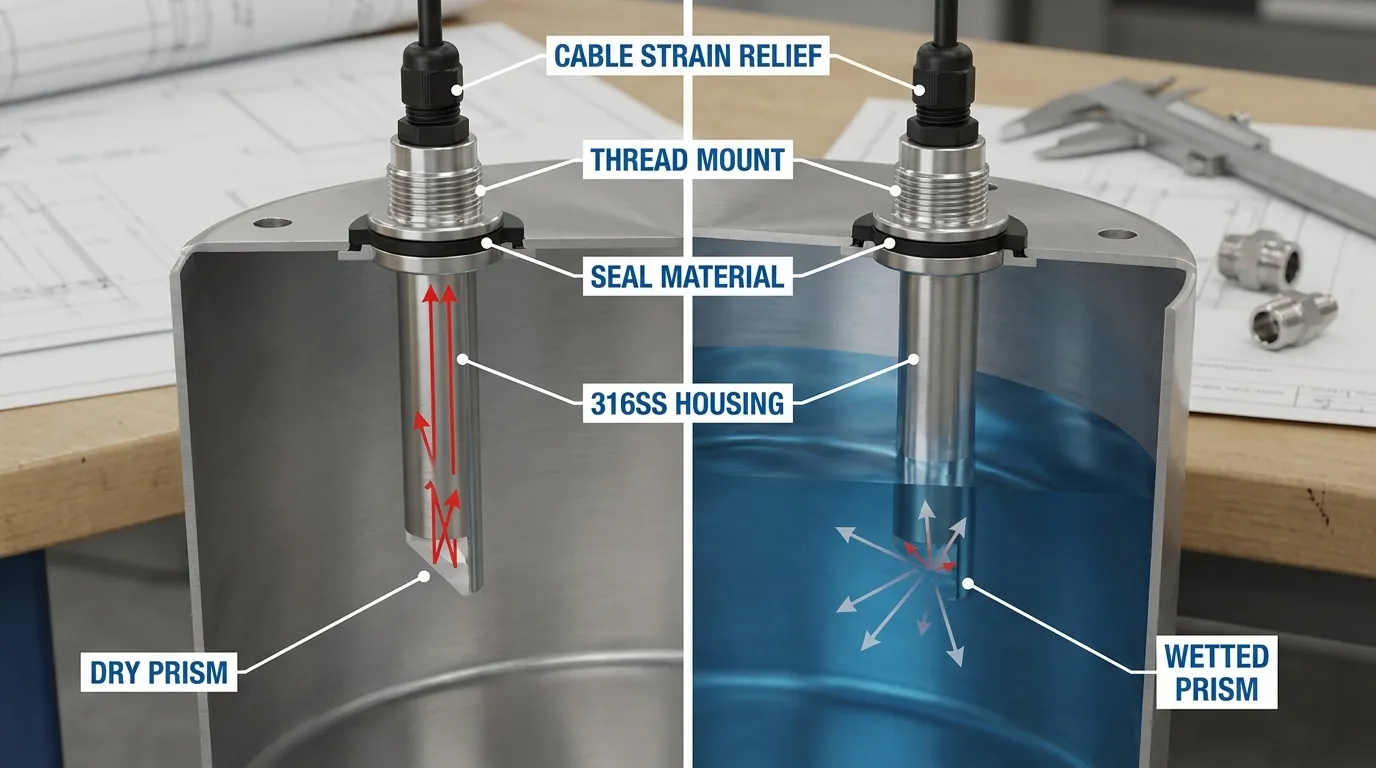
Pour un capteur optique de niveau liquide en inox, « 316SS » fait normalement référence au corps ou au boîtier métallique qui contacte le liquide et fournit le filetage de fixation. Dans certains projets, 316L peut être demandé pour améliorer les performances de corrosion dans des environnements soudés ou sanitaires. La note finale doit être confirmée lors de la RFQ en fonction de la conception du réservoir, Méthode de nettoyage, et exposition aux fluides.
Le prisme optique est la surface de détection. Son matériau doit être compatible avec le fluide, température, et cycle de nettoyage. Dans de nombreux capteurs optiques en acier inoxydable, Un prisme en verre ou de qualité optique est utilisé afin que le signal infrarouge puisse se réfléchir correctement entre les états secs et humides. Le prisme doit rester suffisamment propre pour la transmission de la lumière; Revêtement épais, Cristallisation, boue, Ou un liquide collant peut réduire la fiabilité de la réponse.
Les sceaux sont tout aussi importants. Même si le corps en inox est adapté, le mauvais joint torique ou joint peut gonfler, craquement, Durcir, ou fuite. Carburant, solvant, eau chaude, Détergent, et un liquide de nettoyage alcalin peut nécessiter différents choix d’étanchéités. HojellyTek confirme les options de scellés dès l’étape RFQ au lieu de supposer qu’un seul joint convient à chaque liquide.
La sortie du câble ou la zone du connecteur doit également être vérifiée. Pour le matériel de lavage, L’acheteur doit discuter de la direction du câble, Soulagement de la déformation, Protection de l’enclos, et si le capteur sera éclaboussé, submergé, exposée à la vapeur, ou nettoyé avec un spray sous pression.
Guide de compatibilité des matériaux pour capteurs de niveau optique 316SS
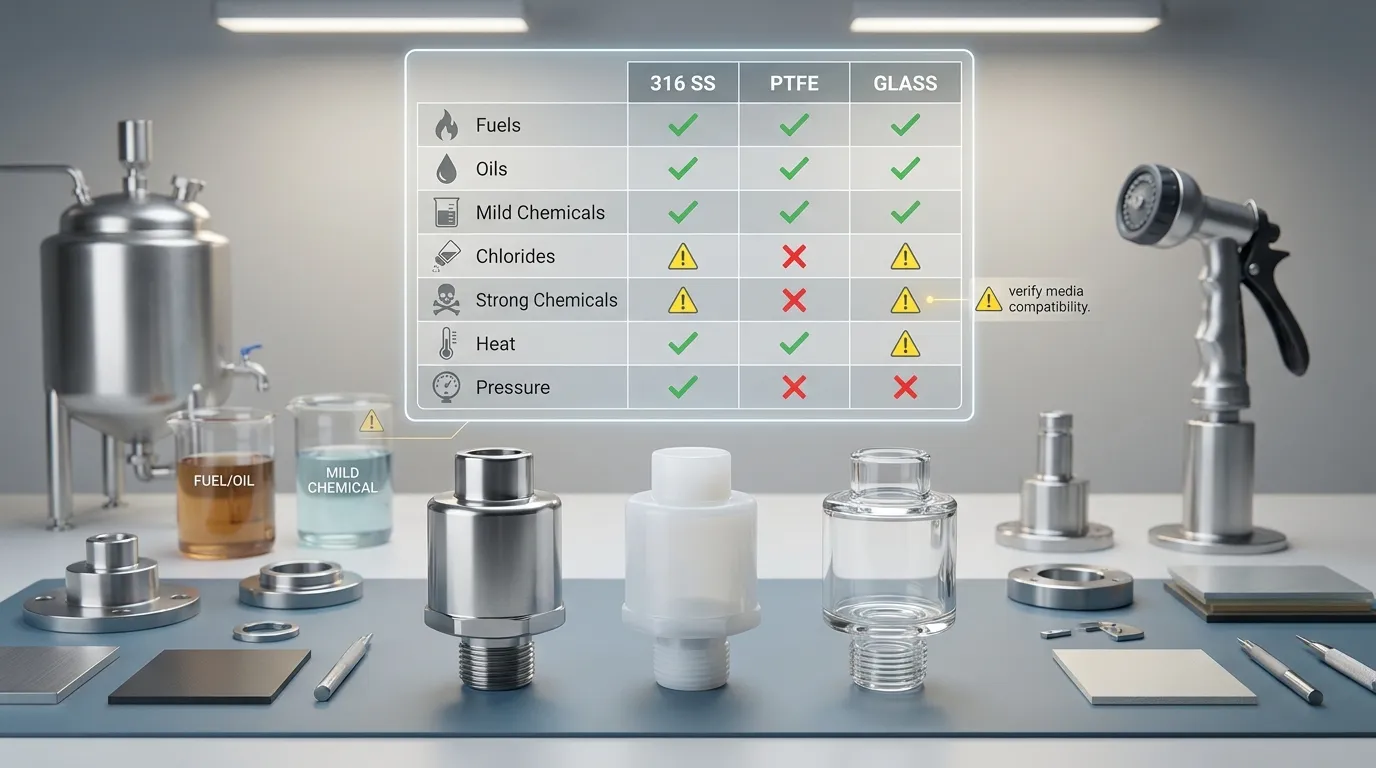
Le tableau ci-dessous est un guide de sélection, Pas une garantie de compatibilité finale. Vérifiez toujours le nom du média, Concentration, température, pression, et le processus de nettoyage avant commande.
| Média ou état | 316/316L Adéquation de l’acier inoxydable | Que vérifier avant de commander | Alternative à considérer |
|---|---|---|---|
| Diesel, Mazout, huile lubrifiante | C’est souvent une raison forte de choisir l’inox plutôt que le plastique | Matériau du joint, Encrassement prismatical, température, vibrations du réservoir | Inox avec scellé vérifié |
| Huile hydraulique et huile de machine | Adapté à de nombreux projets de surveillance au niveau des équipements | Additifs à huile, Impulsion de pression, Type de filetage, Protection des câbles | Inox ou verre selon la chaleur |
| Eau et liquides doux à base d’eau | Généralement adapté, Surtout lorsque la résistance ou le wash-down comptent | Niveau de chlorure, Produits chimiques de nettoyage, température | Plastique pour une utilisation d’eau à faible coût |
| Produits chimiques doux | Possible, mais il faut vérifier | Nom chimique, Concentration, Temps d’exposition, Gonflement des joints | PTFE ou verre si agressif |
| Cycle de nettoyage ou de lavage CIP | Utile pour une construction de corps et de filetage plus solides | Agent nettoyant, température, Pulvérisation sous pression, Matériau du joint | PTFE/verre pour des liquides nettoyants plus agressifs |
| Des milieux chauds ou pressurisés | Souvent mieux que des boîtiers en plastique | Limites de température et de pression requises, Cycle thermique | Version haute température |
| Liquides riches en chlorure ou exposition au sel | Nécessite de la prudence | Risque de piqûres/corrosion, Concentration, température | PTFE ou verre |
| Acides forts, Alcalis puissants, solvants agressifs | Ne supposez pas la compatibilité | Revue complète de la compatibilité chimique | Capteur optique PTFE |
| Haute pureté, haute température, ou un service chimique spécial | L’inox n’est peut-être pas la meilleure surface humide | Pureté, Choc thermique, Attaque chimique, Méthode de nettoyage | Capteur optique en verre |
Température et pression: Que confirmer
316 L’acier inoxydable peut supporter des conditions mécaniques et thermiques plus exigeantes que de nombreux corps de capteurs en plastique, Mais la capacité totale du capteur dépend de plus que la coque métallique. Les limites de température et de pression sont affectées par le prisme, Électronique interne, Structure d’étanchéité, Câble, Matériau de rempotage, et conception de montage.
Pour le liquide chaud, Les acheteurs doivent confirmer la température continue, Température de nettoyage courte, Exposition à la vapeur ou à l’eau chaude, Cycle thermique, et si l’électronique est proche de la chaleur du procédé. Pour la pression, Confirmez la pression de travail normale, Pics de pression, Conditions de vide, Méthode de scellement du filetage, et couple d’installation.
Si l’application concerne principalement une température de procédé élevée, un dévoué capteur optique haute température peut être plus adapté qu’un modèle standard en inox.
Où 316 L’acier inoxydable reste à la hauteur
316Le SS est un matériau industriel solide, Mais ce n’est pas la solution la plus sûre pour tous les liquides. Elle peut tout de même courir un risque de corrosion dans des milieux riches en chlorure, quelques acides, quelques alcalis, Produits chimiques oxydants, et une exposition chimique à haute température. Dans certaines applications, Le corps en acier inoxydable peut survivre mais le joint ou le prisme peut céder en premier.
Les modes de défaillance réels incluent:
- Corrosion ou piqûres sur le corps mouillé
- Gonflement du joint, craquelement, ou perte de compression
- Revêtement prismatical à partir de boue pétrolière, écume, Échelle, ou des médias collants
- Fausses commutations à partir des bulles, Dépôts, ou un angle de montage incorrect
- Fuite causée par une mauvaise étanchéité du filetage ou un matériau de joint incompatible
- Dégâts du câble lors du lavage ou vibrations
- Désaccord de sortie avec un API, Relais, ou carte de contrôle
Pour les produits chimiques agressifs, Le PTFE est souvent un meilleur choix pour le corps humide. Pour les hautes températures, Pureté, ou des exigences optiques particulières, Le verre pourrait être meilleur. La méthode la plus sûre consiste à envoyer les détails réels du fluide avant de sélectionner le corps du capteur.
5-Processus de projet en étapes
- Enquête
Partagez le liquide, Dessin de char, Position de montage, Production attendue, quantité, et marché cible. - Revue des spécifications et de la personnalisation
Notre équipe d’ingénierie vérifie les matériaux humides, Conception du prisme, Choix du sceau, câblage, fil, Câble, Connecteur, et logique de contrôle. - Exemple de confirmation
Les échantillons peuvent être préparés pour l’ajustement, Logique de commutation, installation, et tests en support avant production. - Production et contrôle qualité
L’assemblage des vérifications en usine, Sortie électrique, Apparence, et la réponse fonctionnelle selon la spécification d’ordre confirmée. - Soutien au transport
HojellyTek exporte des capteurs pour des clients aux États-Unis, EU, Inde, et autres marchés, avec un support via WhatsApp ou email pour la coordination des commandes.
Exigences et spécifications de la RFQ à préparer
Avant de demander un devis, Préparez les informations suivantes:
- Nom liquide, Concentration, Additifs, et produits chimiques de nettoyage
- Température normale et maximale du liquide
- Conditions de pression normale et maximale
- Matériau du réservoir et épaisseur des parois
- Position de montage: Côté, Retour au début, Bottom, horizontal, ou verticale
- Taille du filetage ou dessin de montage personnalisé
- Sortie requise: NPN, PNP, Interface de relais, Signal analogique, ou signal de la carte de contrôle
- Exigence de tension d’alimentation
- Logique normalement ouverte ou normalement fermée
- Longueur du câble, Connecteur, ou demande de harnais
- Exposition au prisme: liquide propre, écume, Revêtement, bulles, boue, ou des médias collants
- Quantité d’échantillon et quantité de production attendue
- Toute exigence d’intégration Tuya/Smart Life ou smart monitoring, s’il est utilisé dans un dispositif connecté au niveau du réservoir
Comparaison de la sélection des matériaux
| Matériau du corps du capteur | Applications de meilleure adéquation | Forces | Limitations |
|---|---|---|---|
| Alimentation / plastique | Réservoirs d’eau, Appareils électroménagers à faible coût, Équipements OEM légers | Économique, compact, Facile à intégrer | Limité pour la chaleur, pression, combustible, et quelques produits chimiques |
| 316/316L en acier inoxydable | Carburants, Huiles, Produits chimiques doux, Supports chauds ou pressurisés, Matériel de lavage | Corps fort, Filetage durable, Meilleure résistance industrielle que le plastique | Pas une résistance chimique universelle; Les joints et prismes doivent être vérifiés |
| PTFE | Liquides chimiques agressifs et environnements corrosifs | Excellente résistance chimique dans de nombreux fluides agressifs | La conception mécanique et les limites de température doivent encore être examinées par le projet |
| Verre | Haute température, haute pureté, ou des applications chimiques spéciales | Fortes performances optiques et chimiques dans certaines conditions | Plus fragile que le métal; Des questions de protection montante |
Pourquoi travailler avec HojellyTek
HojellyTek est un fabricant et exportateur de Shenzhen spécialisé dans la détection optique photoélectrique pour la détection des niveaux liquides. Nous soutenons les projets OEM/ODM où les acheteurs ont besoin de plus qu’une simple pièce de catalogue: Revue du matériel, Adaptation de montage, Configuration du câblage, et support des tests d’échantillons.
Notre R interne&L’équipe D peut aider à comparer l’acier inoxydable, PTFE, plastique, et des options de verre basées sur le fluide et l’installation. Au lieu de survendre 316SS comme solution universelle, Nous aidons les acheteurs à vérifier les matériaux humidifiés avant la production.
FAQ
Qu’est-ce qu’un 316 Capteur de niveau optique en acier inoxydable utilisé pour?
A 316 Le capteur de niveau optique en acier inoxydable est utilisé pour la détection ponctuelle dans des réservoirs ou équipements où le plastique peut ne pas convenir, comme les réservoirs de carburant, Réservoirs de pétrole, Contenants chimiques doux, Systèmes liquides chauds, Vases pressurisés, ou du matériel de lavage.
316L est-il mieux que 316 pour les capteurs optiques de niveau liquide?
316L a une teneur en carbone plus faible et peut être préféré pour certains produits soudés, hygiéniste, ou des constructions sensibles à la corrosion. Le meilleur choix dépend du liquide, Méthode de nettoyage, température, et conception de chars. Confirmez la qualité du matériau lors de la RFQ.
Les capteurs optiques 316SS peuvent-ils être utilisés avec du carburant ou de l’huile?
Oui, Les capteurs optiques en inox sont couramment choisis pour les carburants et les huiles, Mais le sceau, Prisme, Sortie du câble, température, et les additifs doivent encore être vérifiés. La boue ou le revêtement d’huile peut également affecter le prisme si le liquide laisse des dépôts.
Is 316 Acier inoxydable adapté aux produits chimiques puissants?
Pas toujours. 316Le SS présente une bonne résistance dans de nombreux environnements doux, mais des acides forts, Alcalis, Chlorures, et les solvants agressifs peuvent nécessiter du PTFE ou du verre à la place. Fournissez toujours le nom exact du produit chimique et la concentration avant de commander.
Quels types de sortie sont disponibles?
Selon le projet, le capteur peut être configuré pour des systèmes de contrôle industriels ou OEM courants tels que NPN, PNP, Logique de commutation, ou d’autres exigences d’interface. La sortie doit être adaptée à votre API, Relais, PCB, ou contrôleur.
Comment puis-je demander le bon capteur optique en inox?
Envoyez vos informations liquides, température, pression, Filetage de montage, Dessin de char, Type de sortie, Tension, Demande de câble ou de connecteur, et quantité d’échantillon. Notre équipe examinera la construction humide et recommandera une configuration adaptée.
Demandez un devis
Besoin d’un capteur optique de niveau en inox 316/316L pour le carburant, huile, Produits chimiques doux, Liquide chaud, ou du matériel de lavage? Envoyez vos coordonnées de candidature par WhatsApp ou par e-mail pour demander un devis, Discussion sur la fiche technique, ou un exemple de critique.


