
12Capteur optique de niveau liquide V
Au lieu de choisir un capteur général et d’adapter le circuit plus tard, Cette page aide les acheteurs à vérifier d’abord la correspondance électrique: 12Alimentation en V, Logique de sortie, Charge de courant, Protection du câblage, Exigences en câble, et l’environnement réel des chars.
12Capacités du capteur de niveau optique V
HojellyTek fabrique des capteurs optiques photoélectriques de niveau liquide pour les acheteurs qui ont besoin d’un signal numérique ou analogique propre provenant d’un capteur compact monté sur un réservoir. Pour les projets en 12V CC, l’exigence clé n’est pas seulement « peut-il s’allumer à 12 V,« mais si la configuration électrique complète s’adapte au système de contrôle.
Une configuration 12V peut être adaptée pour:
- 12Cartes de contrôle en V DC, Modules relais, Contrôleurs de pompe, et les entrées du MCU
- Faible consommation de courant pour les équipements alimentés par batterie ou solaires
- Protection contre la polarité inverse contre les erreurs de câblage de terrain
- NPN, PNP, ou une autre logique de sortie selon le circuit récepteur
- Longueur du câble, Style de connecteur, et exigences en matière de couleur de fil
- Plastique, PTFE, 316 Acier inoxydable, ou des sections humidifiées par verre
- Fileté, Bride, Mur latéral, ou montage sur cuve sur mesure
- Eau, Liquide de refroidissement, huile, combustible, Liquide nettoyant, ou fluides industriels compatibles
Pour une vue d’ensemble plus large de la famille de capteurs, voir notre Capteur de niveau optique Page.
Faites correspondre l’alimentation 12V avant de choisir le capteur
Un capteur optique de niveau liquide 12V est souvent utilisé dans des systèmes où l’alimentation n’est pas parfaitement stable. Automobile, VR, Solaire, et les équipements de batterie peuvent être appelés « 12V »,« mais la tension de fonctionnement réelle peut bouger à cause de la charge, Décharge de batterie, Comportement de l’alternateur, Longues lignes de câbles, ou la commutation de charge.
C’est pourquoi la première étape de sélection consiste à confirmer la plage de tension acceptable du capteur avec la source d’alimentation réelle. Un acheteur ne doit pas seulement dire « 12V ». La RFQ doit expliquer si l’alimentation provient d’un adaptateur DC régulé, Batterie de véhicule, Bande de batteries pour camping-cars, Contrôleur de charge solaire, Pack batterie lithium, ou rail d’alimentation du circuit imprimé.
Pour les projets 12V, Notre équipe vérifie:
- Que le capteur soit connecté à une alimentation 12V régulée ou à batterie
- Si la sortie du capteur doit être normalement élevée, normalement bas, Humide-actif, ou à sec-actif
- Que le dispositif récepteur soit un relais 12V, Entrée API, Entrée MCU, Tableau d’alarme, ou contrôleur de pompe
- Si une protection contre la polarité inverse est requise pour le câblage de terrain
- Que le tracé du câble soit court à l’intérieur d’un dispositif ou long à travers un système de cuves
- Que le capteur ait besoin d’un connecteur intégré ou de câbles volants
Cela est important car une sortie capteur qui fonctionne bien avec une petite entrée MCU peut ne pas convenir directement à la commutation d’une bobine de relais, sauf si le courant de sortie et la conception du circuit ne sont pas confirmés. Pour le contrôle du relais, Le capteur peut avoir besoin d’alimenter un circuit intermédiaire, Étage à transistor, Module relais, ou une entrée contrôleur selon la charge.
Types de sortie pour relais 12V, MCU, et Panneaux de contrôle
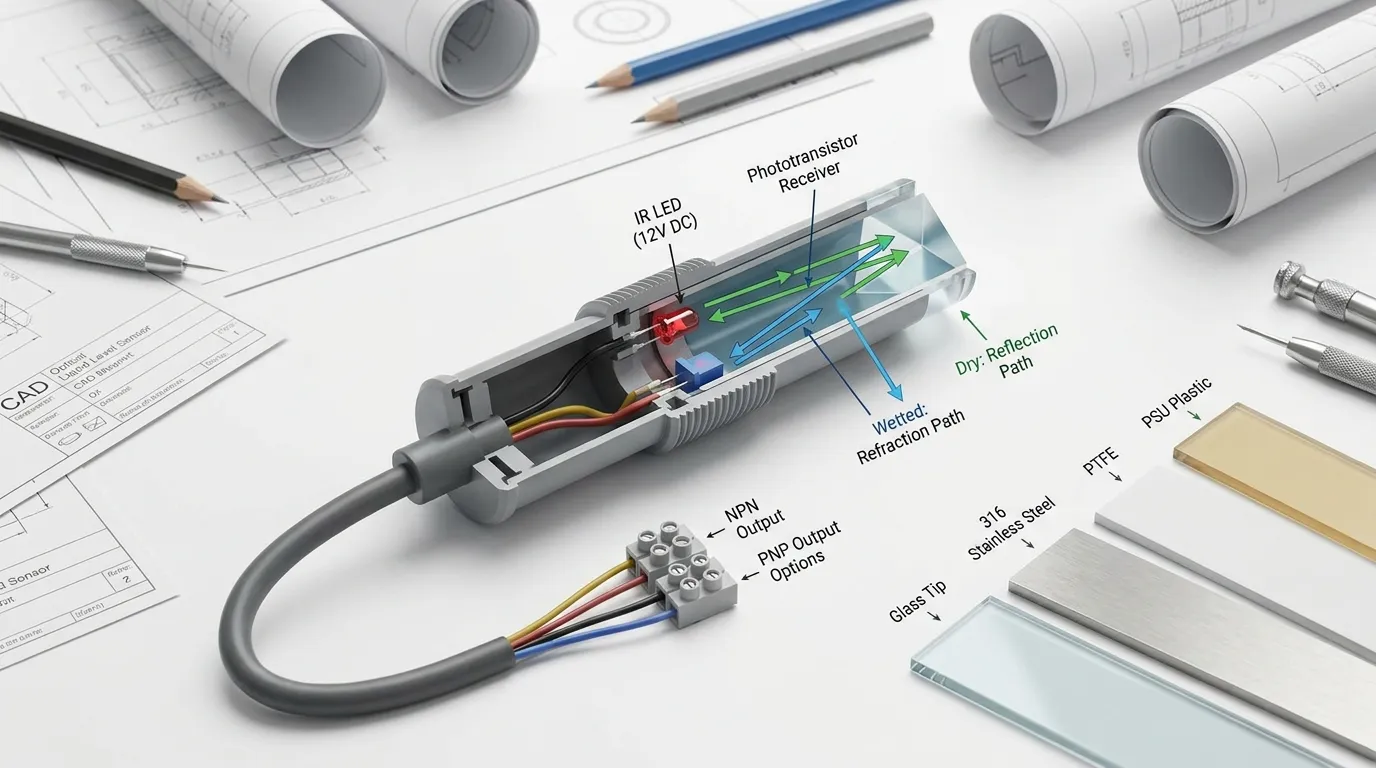
Le type de sortie est le choix de configuration le plus important après la tension. Un capteur 12V peut être physiquement correct mais électriquement incorrect si la sortie ne correspond pas au circuit récepteur.
Sortie NPN
La sortie NPN est couramment sélectionnée lorsque l’entrée de contrôle attend un signal de déploiement. En termes simples, La sortie du capteur attire la ligne de signal vers la terre lorsqu’elle est activée. Cela peut être utile pour de nombreuses cartes de contrôle DC, Entrées de type API, ou circuits d’interface.
Avant de commander une version NPN, Confirmez la méthode de traction d’entrée, Tension d’entrée, Logique humide/sèche, et si la sortie du capteur sera connectée uniquement à une entrée de signal ou si elle devrait changer une charge.
Sortie PNP
La sortie PNP est utilisée lorsque le circuit récepteur attend un signal source. Dans cette configuration, La sortie fournit une tension positive à l’entrée lorsqu’elle est activée. C’est courant dans de nombreux modèles industriels d’entrée en courant continu et certains modules de contrôle.
Pour un système 12V, vérifier si la borne d’entrée attend un signal positif de 12V et si le contrôleur partage la même référence de masse que l’alimentation du capteur.
MCU ou entrée logique
Pour les produits basés sur le MCU, le capteur peut ne pas se connecter directement à une broche logique 12V. De nombreux microcontrôleurs utilisent des tensions logiques plus faibles, donc le circuit d’interface doit être vérifié. Le capteur peut être configuré pour communiquer avec la carte de contrôle, Mais le concepteur de la carte doit confirmer les limites de tension d’entrée, Conception à traction vers le haut/tirage vers le bas, et conditionnement du signal.
4–20 mA de sortie
Certains acheteurs demandent 4 à 20 mA lorsqu’ils ont besoin d’un signal analogique robuste pour un contrôleur ou un système de surveillance. Cela est d’autant plus pertinent lorsque le système nécessite une transmission à niveau sur distance ou une intégration dans une boucle de contrôle industrielle. Pour un commutateur ponctuel dans un produit compact 12V, La sortie numérique est souvent plus simple, mais le type de signal requis doit être défini à l’étape RFQ.
Comment fonctionne la pointe optique dans un système 12V
Un capteur optique 12V utilise toujours le même principe compact de détection photoélectrique: une LED IR émet de la lumière dans une pointe prismatice, et un phototransistor ou un récepteur détecte le motif de lumière réfléchie. Quand le prisme est sec, La lumière se réfléchit différemment que lorsque la pointe est humidifiée par un liquide. Le circuit interne convertit cette condition sèche/humide en une sortie électrique.
Pour les acheteurs, Le point important n’est pas la théorie elle-même, mais l’impact de la sélection:
- La pointe du prisme doit toucher le liquide au bon point de commutation.
- Écume, bulles, Revêtement, ou que les résidus puissent affecter la fiabilité de la détection.
- Sombre, collant, Ou bien les liquides cristallisants peuvent nécessiter un entretien des matériaux et une révision de l’installation.
- Le capteur doit être monté de manière à ce que la pointe de détection ne soit pas bloquée par les parois du réservoir, Étanché, ou pièces mécaniques.
- La logique de sortie doit correspondre à la question de savoir si la machine doit se déclencher lorsque le réservoir est plein, vide, faible, ou débordait.
C’est pourquoi HojellyTek examine à la fois le circuit électrique et l’environnement liquide avant de recommander une configuration 12V.
12Tableau des spécifications électriques V
| Élément de spécification | 12Guidage de configuration V |
|---|---|
| Type d’alimentation | 12Système V DC, confirmé par rapport à la source d’énergie réelle |
| Tolérance de tension | Confirmez à l’étape RFQ basée sur l’adaptateur régulé, Batterie de véhicule, Batterie pour camping-cars, Batterie solaire, ou alimentation pour carte de contrôle |
| Tableau actuel | Configuration à faible courant pour les équipements alimentés par courant continu et batteries |
| Options de sortie | NPN, PNP, Signal MCU/tableau de contrôle, ou 4 à 20 mA lorsque nécessaire |
| Connexion relais | Confirmez le courant de la bobine du relais et le circuit d’interface avant la commutation directe |
| Connexion avec le MCU | Confirmer la tension logique, Référence au sol, et protection des entrées |
| Protection | La protection contre la polarité inverse peut être spécifiée pour le câblage de terrain |
| Câble | Longueur de câble personnalisée, Veste, Couleur du fil, et connecteur disponible par projet |
| Montage | Fileté, Mur latéral, Bride, ou un montage personnalisé selon la conception du réservoir |
| Matériaux humidifiés | Alimentation, PTFE, 316 Acier inoxydable, verre, ou la sélection de matériaux spécifiques au projet |
| Liquides typiques | Eau, Liquide de refroidissement, huile, combustible, ou des liquides de procédé compatibles après examen |
| Domaines d’application | Automobile, VR, Solaire, Systèmes de batteries, petits réservoirs, Modules d’alarme, Contrôle de la pompe |
Liste de contrôle du câblage pour l’installation en 12V CC
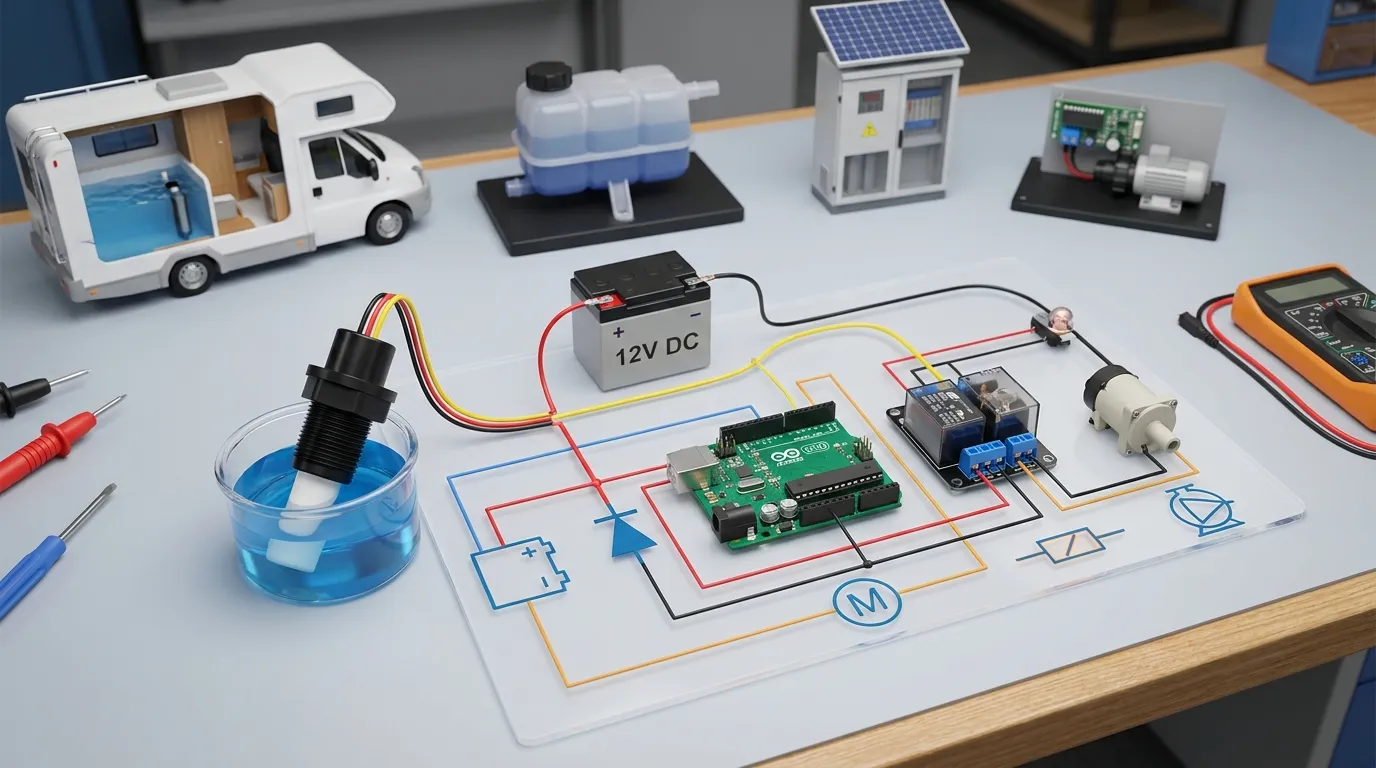
Utilisez cette liste de contrôle avant de confirmer votre commande ou vos unités d’échantillonnage de câblage.
- Confirmez la source d’alimentation
Dites-nous si le capteur est alimenté par un adaptateur DC 12V régulé, Batterie de véhicule, Batterie pour camping-cars, Banque de batteries solaires, Système de batteries lithium, ou PCB de contrôle. - Confirmer le terrain d’entente
Pour la plupart des circuits de commande en courant continu, Le capteur et le contrôleur récepteur doivent partager la bonne référence de masse. Si l’entrée du contrôleur est isolée, Le plan de câblage doit être examiné. - Sélectionnez la sortie NPN ou PNP
Ne choisissez pas le type de sortie par habitude. Associez-le à l’entrée de contrôle. Le NPN est généralement en train de sombrer; PNP est généralement le fournisseur. - Vérifiez la charge du relais avant la connexion directe
Une bobine de relais 12V peut consommer plus de courant qu’une sortie de petit capteur ne devrait commuter directement. Si le capteur contrôle un relais, vérifiez s’il est connecté à une entrée de module relais, Pilote de transistor, ou bobine de relais. - Définir la logique humide/sec
Décidez ce que doit faire la sortie lorsque la pointe du prisme est sèche et ce qu’elle doit faire lorsqu’elle est humide. Cela affecte la protection de la pompe, Alarme de débordement, et le comportement d’arrêt de bas niveau. - Protéger contre le câblage inverse
La protection contre la polarité inverse est recommandée pour les équipements installés par les techniciens de terrain, Utilisateurs de camping-cars, Ateliers automobiles, ou équipes de service distribuées. - Confirmez le tracé et la longueur du câble
Longs câbles, Pièces mobiles de véhicules, Câblage à haute intensité, et le rouage extérieur peut influencer le choix de la veste, Besoins de blindage, Style de connecteur, et soulagement de la contrainte. - Test avec le vrai liquide
Eau, Liquide de refroidissement, huile, combustible, et les fluides mélangés se comportent différemment à la pointe du prisme. Un test avec le liquide cible est recommandé avant l’approbation de la production.
Matériaux et options de montage pour les réservoirs 12V
Le corps mouillé et la zone prismatice doivent être sélectionnés selon la compatibilité liquide, température, Contrainte mécanique, et conditions de nettoyage.
Alimentation ou plastique d’ingénierie est souvent utilisé pour l’eau compacte, Appareil, et des applications générales dans les réservoirs où la résistance à la corrosion et la légèreté sont importantes.
PTFE est sélectionné pour une résistance chimique plus forte ou des liquides plus exigeants là où les plastiques standards peuvent ne pas convenir.
316 Acier inoxydable convient aux chars industriels robustes, Systèmes de refroidissement, Applications liées au pétrole, et des ensembles de réservoirs métalliques où la résistance mécanique est importante.
Conseils pour détecter le verre peut être utilisé lorsque la clarté optique est, Compatibilité chimique, ou une performance mouillée de qualité supérieure est requise.
Le montage peut être configuré par la conception des parois du réservoir. Le montage fileté est courant pour les réservoirs compacts et les panneaux d’équipement. Une installation latérale peut placer la pointe du prisme exactement au point bas ou haut. Des brides ou des boîtiers personnalisés peuvent être envisagés pour les équipements OEM lorsque la structure du réservoir est déjà fixe.
Pour les acheteurs comparant les familles de tensions, notre 5Capteur d’eau V IR Page est utile pour les cartes de contrôle basse tension, tandis que notre Capteur optique à tension alternatif Page prend en charge les projets nécessitant des configurations alimentées en courant alternatif au lieu de 12V CC.
Applications typiques du 12V
Réservoirs de liquide de refroidissement et de lavage automobiles
12Les systèmes V DC sont courants dans les véhicules, Ainsi, les capteurs optiques sont souvent utilisés pour les réservoirs de liquide de refroidissement, Réservoirs de liquide de lave-laveur, Détection de débordement, ou des points d’alarme de faible niveau. Les principales préoccupations concernent les vibrations, température, Compatibilité liquide, Acheminement des câbles, et protection contre les erreurs de câblage. Pour un exemple de véhicule dédié, voir notre Capteur de réservoir de liquide de refroidissement Page.
Systèmes d’eau douce et d’eaux usées pour RV
Les systèmes RV fonctionnent généralement autour d’une alimentation de batterie 12V. Un capteur optique compact peut supporter des basses altitudes, Réservoir plein, ou indication d’alarme lorsque les flotteurs mécaniques peuvent être affectés par un mouvement ou un espace limité. Les acheteurs doivent confirmer si le liquide est de l’eau propre, Eaux grises, ou un autre médium pour char.
Systèmes solaires et de secours par batterie
Les équipements solaires et les armoires à batteries nécessitent souvent des capteurs à faible courant pour le stockage de l’eau, Circulation du liquide de refroidissement, Détection de fuite, ou la surveillance des réservoirs auxiliaires. La consommation de courant compte car le système peut fonctionner à partir d’énergie stockée pendant de longues périodes.
Protection de la pompe et coupure de basse altitude
Un capteur optique 12V peut servir de point de signal pour la protection contre le fonctionnement à sec, Coupure de faible niveau, ou contrôle de recharge. Le capteur doit généralement alimenter un module de contrôle ou de relais plutôt que d’être traité comme un composant de commutation à haute puissance sans vérifier la charge.
Petits réservoirs OEM et appareils DC
Pour les produits OEM compacts, Les facteurs clés sont la taille du capteur, Sortie du câble, Connecteur, Filetage de montage, Logique humide/sèche, et qualité de production reproductible. La personnalisation OEM/ODM est disponible pour la géométrie de réservoir non standard ou les ensembles d’équipements de marque.
5-Processus de projet en étapes
1. Enquête
Envoyez la candidature, Type liquide, Matériau du réservoir, Point de commutation, 12Source d’alimentation en V, Exigence de production, Position de montage, Longueur du câble, et l’utilisation prévue par ordre. Les photos ou dessins aident notre équipe à mieux comprendre la disposition de l’aquarium.
2. Revue des spécifications et de la personnalisation
Nous confirmons la correspondance électrique, Type de sortie, matériel, fil, Câble, Connecteur, et comportement logique. Pour les projets OEM/ODM, HojellyTek peut examiner la taille des logements, Style prisme, Couleurs des fils, Labels, et besoins en emballage.
3. Exemple
Une configuration d’échantillon peut être préparée pour des tests électriques et liquides. L’acheteur doit tester le capteur avec le liquide réel, Entrée réelle du contrôleur, et un itinéraire de câble réel lorsque possible.
4. Production et contrôle qualité
Après approbation, La production suit la configuration confirmée. La QC se concentre sur l’apparence, câblage, Comportement de sortie, Correspondance électrique, et des exigences du projet convenues.
5. Transport maritime
En tant que fabricant et exportateur de Shenzhen, nous soutenons les acheteurs étrangers aux États-Unis, EU, Inde, et autres marchés. Les détails de l’expédition sont confirmés selon la taille de la commande, Destination, et préférence client.
Exigences à confirmer avant de commander
Préparez ces détails lors de la demande de devis:
- 12Type de source d’alimentation en V: Adaptateur régulé, Batterie, Contrôleur solaire, Système de véhicules, ou rail de circuit imprimé
- Type de sortie: NPN, PNP, Entrée MCU, Entrée du module relais, ou 4–20 mA
- Exigence logique de sortie humide/sèche
- Informations sur le relais ou la charge d’entrée
- Cibler le liquide et savoir s’il laisse des résidus, écume, bulles, ou revêtement
- Matériau du réservoir, Épaisseur du mur, et direction de montage
- Préférence pour les matériaux de logement: plastique, PTFE, 316 Acier inoxydable, ou verre
- Filetage ou exigences de montage
- Longueur du câble, Connecteur, et la couleur des fils
- Intérieur, Extérieur, Véhicule, ou environnement système de batterie
- Quantité d’échantillon prévue et utilisation de production
12Comparaison de la configuration des capteurs V
| Choix de configuration | Meilleur choix | L’acheteur devrait vérifier |
|---|---|---|
| 12Sortie numérique V NPN | Cartes de contrôle qui s’attendent à une sortie en dégradation | Traction d’entrée, Logique humide/sèche, Courant de charge |
| 12Sortie numérique V PNP | Des entrées qui attendent un signal de source positif | Terrain partagé, Tension d’entrée, Câblage du contrôleur |
| 12Signal du module relais V | Pompe, alarme, Remplir, ou contrôle de coupure | Courant d’entrée du module relais et logique de déclenchement |
| 12Interface MCU V | PCB personnalisé ou produit embarqué | Tension logique et circuit de protection du MCU |
| 4Option –20 mA | Surveillance à longue distance ou entrée de contrôle analogique | Compatibilité des récepteurs et conception des boucles |
| Conception à inox ou verre humide | Liquide de refroidissement, huile, combustible, ou des liquides exigeants | Compatibilité liquide et contrainte d’installation |
| Conception humide en plastique ou PTFE | Eau, chimique, ou des systèmes OEM compacts | Résistance chimique et structure de montage |
Pourquoi choisir HojellyTek
HojellyTek est un fabricant de capteurs optiques et de niveau liquide de Shenzhen disposant d’un système R interne&D, Expérience de détection optique photoélectrique, et prise en charge OEM/ODM pour les configurations de capteurs personnalisées. Nous travaillons avec des acheteurs qui ont besoin de plus qu’une pièce de catalogue: Correspondance de tension, Logique de sortie, Matériau de logement, Câble, Connecteur, et le montage doit s’adapter à l’équipement final.
Notre usine supporte des capteurs optiques de niveau liquide, Commutateurs de niveau optique, Modules capteurs infrarouges de niveau d’eau, Options de détection continue de niveau, et solutions intelligentes de surveillance des cuves. Pour les projets de surveillance des réservoirs connectés, L’intégration des applications Tuya ou Smart Life peut également être discutée lorsque c’est pertinent.
Les acheteurs nous choisissent lorsqu’ils ont besoin d’une communication directe à l’usine, Soutien à l’exportation, et flexibilité de configuration pour l’industrie, Automobile, VR, Appareil, Solaire, et systèmes alimentés par batterie.
FAQ concernant les capteurs optiques de niveau liquide 12V
Un capteur optique de niveau liquide 12V peut-il fonctionner avec un relais 12V ??
Oui, Mais la charge du relais doit être vérifiée. De nombreux capteurs sont conçus pour fournir une sortie de signal, ne pas alimenter directement une bobine de relais. Pour le contrôle du relais, Vérifiez si le capteur est connecté à une entrée de module relais, Circuit de conduite, ou contrôleur.
Dois-je choisir la sortie NPN ou PNP pour un système 12V ??
Choisissez NPN si votre entrée attend un signal de décrochage, et choisir PNP s’il attend un signal de sourcing. Le bon choix dépend de votre manette, Module relais, Conception du câblage, et l’exigence de logique humide/sèche.
Une protection contre la polarité inverse est-elle nécessaire?
Il est fortement recommandé pour les systèmes 12V installés sur le terrain, Notamment dans l’automobile, VR, Solaire, et équipements de batterie. Le câblage inverse peut se faire pendant l’entretien ou l’installation, Ainsi, la protection améliore la fiabilité pratique.
Le capteur peut-il être utilisé dans les réservoirs de liquide de refroidissement automobiles?
Oui, Les capteurs optiques peuvent être configurés pour la détection du niveau des réservoirs de refroidissement, Mais matériel, température, vibration, Acheminement des câbles, et la compatibilité liquide doit être examinée avant la production.
Puis-je personnaliser la longueur du câble et le connecteur?
Oui. Longueur du câble, Couleur du fil, Type de connecteur, Exigences en matière de vestes, et l’étiquetage peut être personnalisé selon le projet. Les longues pistes de câbles doivent être discutées lors de l’étape de RFQ.
Est-ce que 12V est mieux que 5V pour la détection optique du niveau liquide?
Aucune des deux options n’est automatiquement meilleure. Un capteur 5V convient souvent aux appareils électroniques basse tension et aux cartes compactes, tandis que le 12V est courant dans l’automobile, VR, Solaire, Batterie, Relais, et systèmes de contrôle en courant continu. Choisissez la tension qui correspond à l’architecture d’alimentation de l’équipement.
Demandez un devis pour capteur optique 12V
Envoyez votre type d’alimentation 12V, Exigence de production, Liquide cible, Dessin de montage, Longueur du câble, et les détails de la demande à HojellyTek pour examen. Notre équipe peut vous aider à confirmer la configuration correcte du capteur optique de niveau liquide 12V pour votre relais, MCU, Contrôleur de pompe, Tableau de bord pour camping-cars, Système solaire, ou réservoir automobile.
Demandez un devis via WhatsApp ou email avec votre dessin, Type liquide, et exigences de câblage.


