
SST POS / Alternative au capteur optique de niveau d’huile
Le sst pos 187 413 Capteur optique de niveau d’huile est généralement recherché par des acheteurs qui ont besoin d’un capteur optique compact au niveau ponctuel pour la détection du niveau d’huile, Alarmes de bas niveau, Contrôle des dépassements, ou intégration d’équipements OEM. HojellyTek propose une alternative d’usine à capteurs optiques de niveau d’huile/carburant pour les acheteurs souhaitant des performances de détection compatibles, Options de sortie flexibles, Montage personnalisé, et un meilleur contrôle des coûts sans copier les données des pièces SST.
Nous ne sommes pas un distributeur SST et cette page ne revendique pas un remplacement sans rendez-vous approuvé. C’est une page alternative équitable pour les ingénieurs, Équipes d’achat, et les acheteurs OEM qui ont besoin d’un capteur optique compatible huile construit autour de leur liquide réel, câblage, Tension, Espace d’installation, et exigences de production.
Capacités alternatives du capteur optique de niveau d’huile
HojellyTek conçoit et fabrique des capteurs photoélectriques de niveau liquide à Shenzhen pour des projets OEM/ODM, Équipements industriels, Systèmes carburant/huile, Réservoirs intelligents, et exporté des ensembles de capteurs pour les États-Unis, EU, et marchés indiens. Pour les acheteurs comparant un capteur SST série POS, Notre équipe peut aider à évaluer une solution optique équivalente au niveau ponctuel basée sur:
- Détection optique compacte des liquides pour le pétrole, combustible, Liquide de refroidissement, Huile hydraulique, et liquides compatibles
- IR LED, Phototransistor, et la structure de détection à pointe prismatique
- Commutation de signal sec/humide pour la détection à bas ou haut niveau
- NPN, PNP, normalement ouvert, normalement fermé, et la logique de sortie personnalisée
- Tension d’alimentation adaptée à la carte de contrôle ou à l’entrée PLC du client
- Fileté, Panel, Mur de char, et des conceptions de montage personnalisées
- Longueur du câble, Connecteur, Couleur du fil, et personnalisation du logement
- Matériaux humidifiés tels que les PSU, PTFE, 316 Acier inoxydable, ou verre selon les besoins en liquide et en température
Pour les conceptions générales de détection optique des liquides, voir notre Capteur de niveau optique Page. Pour les acheteurs qui ont besoin d’un fabricant direct plutôt qu’un fournisseur commercial, notre Fabricant de capteurs optiques La page explique davantage le support OEM et la capacité de production.
Comment fonctionne la détection optique du niveau d’huile
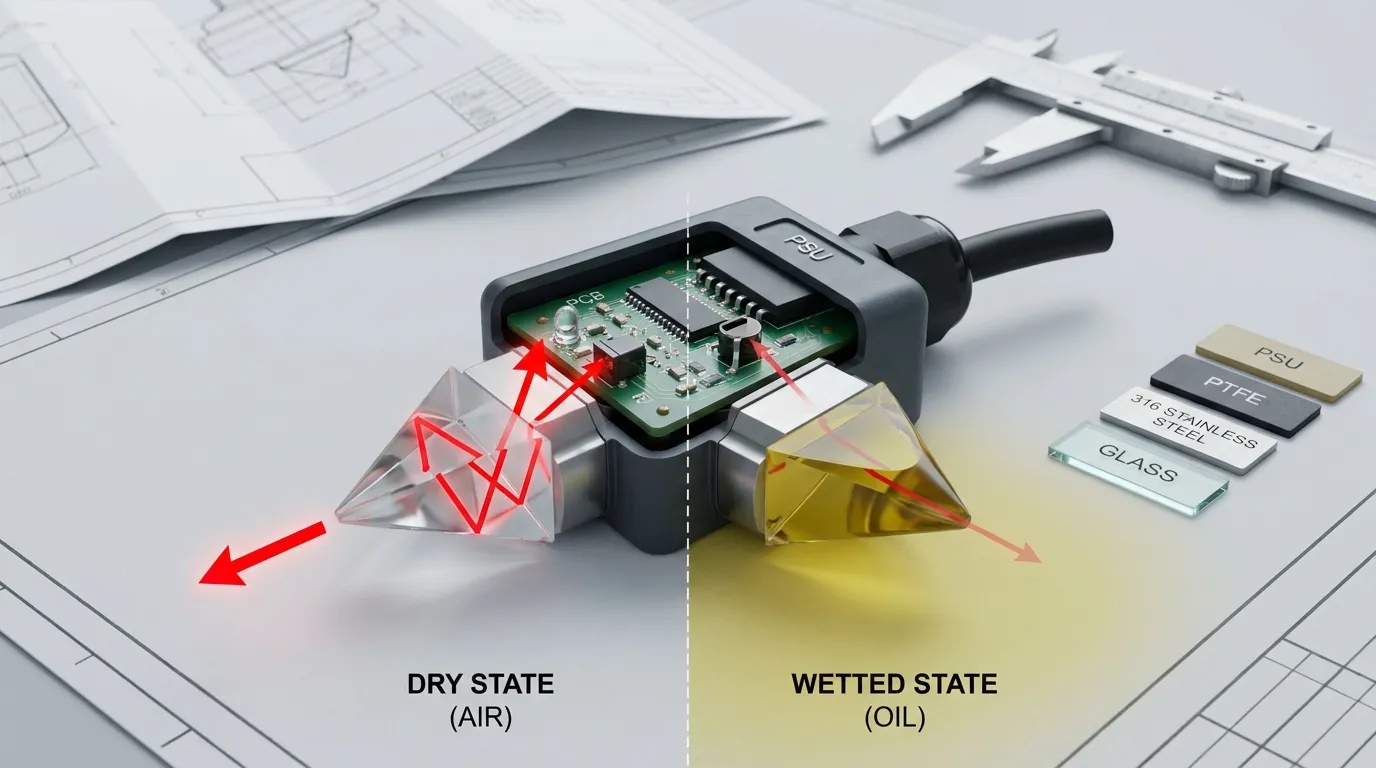
Un capteur optique de niveau d’huile utilise un principe de détection basé sur la lumière au lieu d’un flotteur, Interrupteur à anches, ou pièce mécanique mobile. À l’intérieur du corps du capteur, une LED infrarouge envoie la lumière vers une pointe de détection de prisme. Un phototransistor reçoit la lumière réfléchie.
Quand la pointe du prisme est dans l’air, La lumière infrarouge se réfléchit à l’intérieur et revient fortement au récepteur. Lorsque l’huile ou un autre liquide recouvre le prisme, Modifications de l’indice de réfraction. Moins de lumière revient au récepteur, et l’électronique commute l’état de sortie. Cette transition du sec vers l’humide permet au capteur de détecter un point de niveau liquide fixe.
Pour les applications pétrolières et carburantières, Ce design est utile car il est compact, presque, et non affecté par le flotteur qui s’accroche dans les espaces étroits. Il peut être utilisé pour les alarmes de faible qualité d’huile, Surveillance de petits réservoirs, Systèmes de lubrification, Réservoirs générateurs, Détection du niveau de liquide de refroidissement, et des équipements compacts où un commutateur à flotteur est trop grand.
Cependant, Le service d’huile nécessite un examen attentif des matériaux et optique. Carburant léger, diesel, huile lubrifiante, Huile hydraulique, et l’huile usagée foncée ne se comporte pas de la même manière. Viscosité, Film à l’huile, écume, bulles d’air, Particules métalliques, et la boue peut affecter la réponse optique. C’est pourquoi un capteur alternatif sérieux ne devrait pas être choisi uniquement en correspondant à une photo ou au nom d’une pièce. L’échantillon liquide, Position du char, câblage, et la logique de contrôle doit être vérifiée avant de confirmer la production.
Alternative HojellyTek pour les acheteurs de la série SST POS
La série SST POS est connue pour sa détection optique compacte au niveau du point, Et beaucoup d’acheteurs le recherchent parce qu’ils ont déjà une conception machine, Besoin d’entretien, ou référence à la lettre de commerce. Notre approche est différente de simplement dire « même pièce ». Nous aidons les acheteurs à construire une alternative compatible autour de l’application réelle.
Pour des projets liés au pétrole et au carburant, HojellyTek peut fournir un Capteur de niveau carburant/huile Configuration avec le bon boîtier, Câble, Sortie, et disposition de montage. Si le liquide est chimiquement agressif, contient des produits chimiques de nettoyage, ou nécessite une protection plus forte contre les matériaux humides, a Capteur optique résistant aux produits chimiques peut-être plus adapté.
Le plus grand avantage est la personnalisation. Si votre capteur actuel est cher, difficile à trouver, ou pas assez flexible pour votre projet OEM, Notre équipe peut ajuster le corps du capteur, Sortie du câble, fil, Connecteur, Logique de sortie, et sélection des matériaux. C’est particulièrement utile pour les fabricants d’équipements qui ont besoin d’un approvisionnement stable, Design de marque propre, ou un capteur conçu pour un nouveau produit au lieu d’acheter seulement un remplacement standard.
Vérifications clés avant de remplacer un capteur SST série POS
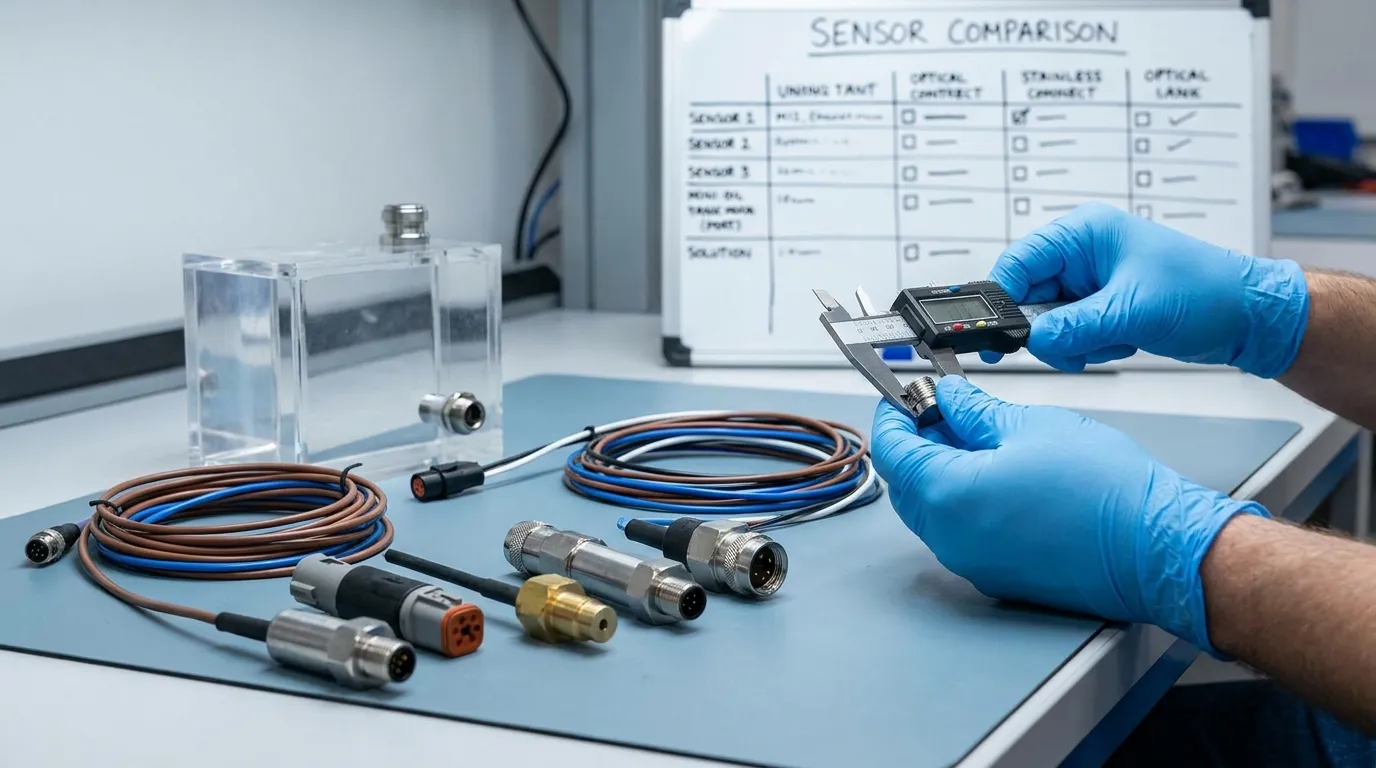
Avant de choisir une alternative, Les acheteurs devraient confirmer les exigences réelles d’ingénierie au lieu de se fier uniquement à la phrase « SST POS 187 413 capteur optique de niveau d’huile. »
Compatibilité huile et carburant
Confirmez le liquide exact: Huile moteur, huile lubrifiante, diesel, Mélange de carburant, Huile hydraulique, Liquide de refroidissement, ou fluide mixte. L’huile claire propre est plus facile à détecter que l’huile usagée foncée avec des particules. Si l’huile laisse un film épais sur le prisme, Le capteur peut rester dans un état fausse humide après la baisse du niveau. Pour cette raison, La forme de la pointe de détection, installation angle, et les attentes en matière de nettoyage doivent être examinées.
Sortie et tension
La plupart des capteurs optiques au niveau ponctuel sont sélectionnés par type de sortie. L’acheteur doit confirmer si le contrôleur nécessite NPN ou PNP, comportement normalement ouvert ou normalement fermé, Logique de suppression ou de sourcing, et la direction du signal à l’état humide. La tension d’alimentation doit être adaptée à la carte d’équipement, PLC, Module relais, ou circuit d’alarme à l’étage RFQ. Pour les projets nécessitant un niveau de réservoir proportionnel plutôt qu’un signal à point unique, une solution de niveau 4 à 20 mA peut être discutée séparément.
Montage et étanchéité
Le capteur alternatif doit s’adapter physiquement au réservoir ou à la machine. Les acheteurs devraient vérifier le type de fil, Profondeur d’insertion, Épaisseur du mur, Direction du câble, Jeu de jeu pour clés, Matériau du joint torique ou du joint, et si le capteur est installé de l’intérieur ou de l’extérieur du réservoir. Un capteur qui fonctionne électriquement peut toujours tomber en panne en remplacement si le filetage, Phoque, Ou la position du prisme est incorrecte.
Sélection des matériaux humides
L’alimentation est couramment envisagée pour des corps de capteurs optiques compacts où l’exposition chimique est modérée. Le PTFE est préféré lorsqu’une résistance chimique plus forte ou un démantèlement plus nettoyant des liquides collants est nécessaire. 316 L’acier inoxydable est utile pour la résistance mécanique robuste et les réservoirs industriels. Le verre peut être sélectionné selon des conditions optiques et chimiques spécifiques. Le choix du matériau doit être basé sur le liquide réel, Procédé de nettoyage, et environnement opérationnel.
Modes de défaillance réels pour prévenir
Les problèmes courants incluent des faux déclenchements dus aux résidus d’huile, logique humide/sèche incorrecte, Sortie instable due au bruit électrique, plastique fissuré à cause d’un liquide incompatible, fuites dues à un mauvais choix d’étanchéité, Mauvais soulagement de la tension des câbles, et un signal illisible dû à un liquide sombre ou contaminé. Une sélection alternative appropriée doit résoudre ces risques avant l’approbation de l’échantillon.
5-Processus de capteur personnalisé par étapes
- Enquête
Envoyez votre référence de capteur actuelle, application photos, Type liquide, Matériau du réservoir, Exigence de câblage, et estimation annuelle de la demande. - Revue des spécifications et de la personnalisation
Nos ingénieurs examinent le type de sortie, Tension, Montage, Matériau humide, Câble, Connecteur, et si le capteur est utilisé pour la détection de haut ou de bas niveau. - Exemple de confirmation
Une configuration d’échantillon peut être préparée pour l’ajustement, câblage, et les essais liquides avant la production de masse. - Production et contrôle qualité
L’usine vérifie la réponse optique, câblage, Scellement, Logement, et l’apparence selon les exigences confirmées du projet. - Transport maritime et support
Les capteurs finis peuvent être exportés pour la production OEM, Matériel d’entretien, ou alimentation par distributeur, avec un support via WhatsApp ou email.
Exigences pour demander une demande de propositions
Pour citer avec précision, Préparez-vous, s’il vous pl:
- Nom du liquide et s’il est propre, sombre, mousse, visqueux, ou contaminé
- Fonction du capteur: Alarme de bas niveau, Alarme de haut niveau, déborder, Protection contre les essais à sec, ou détection de présence de chars
- Sortie requise: NPN, PNP, NON, NC, Compatible relais, ou une exigence analogique
- Tension d’alimentation utilisée par votre contrôleur
- Taille du filetage ou du trou du réservoir de montage
- Préférence pour les matériaux de logement: Alimentation, PTFE, 316 Acier inoxydable, verre, ou coutumier
- Longueur du câble, Type de connecteur, et définition du fil
- Photos ou dessins de l’installation actuelle
- Quantité d’échantillon et utilisation prévue de la production
Série SST POS vs Alternative HojellyTek
| Point de comparaison | Capteur optique SST série POS | Alternative au capteur optique de niveau d’huile HojellyTek |
|---|---|---|
| Rôle principal | Détection optique compacte au niveau ponctuel pour la présence de liquides | Détection optique de niveau de point de carburant compatible adaptée au projet |
| Position de la marque | Option de capteur de marque établie | Alternative directe à l’usine pour les acheteurs OEM et les équipes d’approvisionnement |
| Utilisation du pétrole | L’acheteur doit vérifier l’adéquation exacte du modèle à partir de la fiche technique originale | Huile, combustible, Liquide de refroidissement, et la compatibilité de l’huile hydraulique examinée avant le devis |
| Sortie et tension | Doit correspondre à la pièce d’origine et à l’entrée système | NPN, PNP, NO/NC, Tension, et la logique de câblage peut être personnalisée |
| Montage | L’installation existante doit suivre la conception mécanique d’origine | Fil, Sortie du câble, Matériau de la carrosserie, et le connecteur peut être ajusté |
| Position des coûts | Fort lorsque l’acheteur a besoin de la marque originale exacte | Fort lorsque l’acheteur veut contrôler les prix, personnalisation, et soutien en usine |
| Meilleur choix acheteur | Équipes de maintenance nécessitant la continuité initiale de la MAU | OEM, Distributeurs, et les constructeurs d’équipements ayant besoin d’une alternative flexible |
| Risque à vérifier | Disponibilité, Prix, et la dépendance exacte aux parties | Nécessite un test d’échantillon avant de revendiquer l’adéquation du remplacement |
Où la SST pourrait encore être le meilleur choix
SST peut toujours être la meilleure option lorsque votre projet nécessite exactement la marque d’origine, Un dessin préalablement approuvé, Dossiers de certification existants, Continuité de la BOM héritée, Ou un capteur de remplacement déjà validé par votre client. Si le manuel de votre machine ne spécifie que la pièce SST d’origine et que votre équipe d’achat ne peut pas approuver les alternatives, Rester avec le capteur d’origine peut réduire le travail de documentation.
Notre alternative est mieux adaptée lorsque vous pouvez approuver un capteur compatible par révision technique, Essais par échantillon, et la qualification des fournisseurs. C’est aussi un choix pratique en termes de prix, Flexibilité MOQ, Personnalisation des câbles, Sélection des matériaux, ou la fourniture à long terme de l’OEM compte plus que l’achat de la pièce de marque exacte.
Pourquoi travailler avec HojellyTek
HojellyTek est un fabricant de capteurs optiques et de niveau liquide de Shenzhen disposant d’un système R interne&Support de production D et OEM/ODM. Nous nous concentrons sur la détection optique photoélectrique, Conceptions compactes à pointe prismaticale, Câblage personnalisé, et la compatibilité liquide spécifique à l’application. Pour les projets IoT au niveau réservoir, L’intégration de Tuya et Smart Life peut également être discutée de la place de l’architecture du produit.
Les acheteurs travaillent avec nous lorsqu’ils ont besoin de plus qu’une simple pièce de catalogue: Ils ont besoin d’un capteur adapté à l’aquarium, Correspond à la manette, survit au liquide, et peuvent être fournies de façon constante pour la production.
FAQ
HojellyTek peut-il remplacer un point de sortie SST 187 413 Capteur optique de niveau d’huile?
Oui, nous pouvons évaluer une alternative compatible pour le sst pos 187 413 Capteur optique de niveau d’huile, mais nous ne prétendons pas qu’il s’agisse d’une pièce SST approuvée. Le remplacement correct dépend du type de liquide, Sortie, Tension, Montage, Câble, et tests d’échantillons.
Le capteur alternatif est-il adapté pour l’huile et le carburant?
Il peut être configuré pour l’huile, combustible, Huile hydraulique, Liquide de refroidissement, et liquides apparentés, Mais la compatibilité doit être vérifiée avec le liquide lui-même. Huile foncée, Film d’huile collante, boue, et les bulles peuvent nécessiter des matériaux ou des choix d’installation différents.
Puis-je choisir la sortie NPN ou PNP?
Oui. NPN, PNP, normalement ouvert, normalement fermé, et une logique de sortie humide/sèche personnalisée peut être examinée lors de l’étape RFQ. L’objectif est d’aligner votre API, Carte contrôleur, Entrée relais, ou circuit d’alarme.
Le support peut-il être personnalisé ??
Oui. Style de filetage, Longueur de carrosserie, Direction du câble, Connecteur, Matériau de logement, et la structure d’étanchéité peut être personnalisée selon le réservoir et l’application. Les photos ou dessins de l’installation existante aident à accélérer la révision.
Est-ce un remplacement garanti en admission directe?
Non. Il doit être considéré comme une alternative compatible, Pas un remplacement garanti sans rendez-vous. Le capteur doit être vérifié pour la logique électrique, Tension, fil, Phoque, Profondeur d’insertion, et la réponse liquide avant l’approbation de la production.
Quelles informations sont nécessaires pour un devis?
Envoyez le type liquide, Référence actuelle du capteur, installation photos, Tension, Type de sortie, Détails de montage, Demande de câble ou de connecteur, et la quantité attendue. Notre équipe pourra alors recommander une configuration adaptée à un capteur optique de niveau d’huile.
Demandez un devis
Besoin d’une alternative à un capteur optique de niveau d’huile SST série POS pour une huile, combustible, Liquide de refroidissement, ou projet de réservoir hydraulique? Envoyez vos photos de candidature, Exigence de câblage, Détails de montage, et des informations liquides à HojellyTek via WhatsApp ou email. Notre équipe vous aidera à comparer la fonction requise, Confirmez le chemin de personnalisation, et cite une alternative pratique à l’usine directe.


